Reaktor work graph
The work graph is an engine for projects carried out by people, agents and experts. Its paper is general: it covers research teams, weddings, buildings and software, and it names Reaktor and Manna only as products that will carry the engine. This page is the Reaktor side. It gives the software release that led to the design, what Hangar and Manna already keep, how Reaktor builds the engine first on Reaktor V1 and later moves it onto a typed graph of the system, the order of the work, the hypotheses with their baselines, and the market for work that Manna can host.
Hangar's plans and Manna's records exist and run today. Everything else on this page is a design, and each section says which parts exist.
Overview#
The engine keeps one small typed graph that every actor in a project shares. Four kinds of element and six families of assertion record outcomes, commitments, evidence and decisions, so that what the group is trying to achieve, who owes what to whom, what evidence changed the plan and who can decide next are queries (the graph). Its unit is the commitment: a debtor promises a creditor that a proposition will hold by a deadline, and the creditor decides when it holds (commitments). Every change is admitted against the commitments it touches, and a refusal names the commitment and its holder (admission). Rules for deadlines, heartbeats, recorded waiting, computed dependencies, status by query and acceptance by the creditor answer the costs of coordination (liveness).
In Reaktor the engine has one store and two surfaces. Hangar is where agents do most of the work, and Manna is where people organise their projects and their learning. Both will read and write the same commitments, so a person in Manna and an agent in Hangar see the same answer to each of the four questions. The engine refers to the things the work is about through a subject space: first the repositories, builds, code graph and application graph of Reaktor V1, and later a typed graph of the whole system.
What one release measured#
Between 8 and 10 November 2026, Reaktor's agents and its owner prepared the BestBuds app and submitted it to two app stores. Several agents worked in parallel lanes, each holding a seat on a shared plan in Hangar's agent plane, and one person decided what only a person could decide. Writing the code took less of the release's time than coordinating it. The table lists each measurement, what it shows, and the mechanism of the engine that addresses it. Two rows come from earlier work in October and carry their own dates.
| Measurement | What it shows | Mechanism of the engine |
|---|---|---|
| 1,685 sleeps inside turns, about 53 hours; 87% of that time ended in a read or write of the plan | waiting was polling, and nobody could see it | waiting is recorded and woken by a watch |
| a queued order waited 5.9 hours on average; 13 of 225 turns held 69% of the busy time | work was dispatched by hand, in long turns | dispatch when antecedents hold; one ranked queue of attention |
| 63 collisions of request identifiers | clients minted identities | identities issued by the store |
| 55% of completed items closed within a minute of creation | the plan was used as a log | records kept apart from commitments |
| 26 of 1,631 items declared a dependency | dependencies were rarely stated | dependencies computed from regions |
| 20 leases held for 14 to 50 hours | leases outlived their work | leases held by active commitments and renewed only by reports |
| 11 of the owner's 42 messages asked for status | status had to be asked for | status is a query |
| build machines busy about 4% of the time | idle capacity was invisible | resources with capacities |
| between 16 and 27 October, 431 of 1,443 applies were refused because any active run blocked every apply; since 27 October only overlapping writers are refused | a run's region was the whole workspace | admission against computed regions, with witnesses |
| an audit on 31 October of one request with 56 asks found 14 built as asked; 14 plan items marked done were reopened, and two had been closed without the owner's acceptance | debtors closed their own work | acceptance belongs to the creditor |
The last two rows come from the weeks before the release. Between 16 and 27 October, 469 of Codex's 1,443 attempts to apply a planned change failed, 431 of them because any active run in the workspace blocked every apply. An audit on 31 October of 56 requests for changes to Hangar found 14 built as asked and 33 built in part. It reopened 14 items that had been marked done, and it found two items that needed the owner's acceptance closed without it.
Taken together, the owner was the sequencer, waiting was invisible, regions were as coarse as a whole workspace, and the plan mixed promises with a record of events. The paper's evidence finds the same costs in research, construction and knowledge work at large, and that is why the engine is written for every discipline.
How the design came about#
The design went through four steps. Later decisions depend on them, so they are recorded here.
- A draft protocol. While the design was discussed, a draft took the commitment as the basic unit of group work and proposed two loops, six modes of collaboration and six verbs: propose, commit, delegate, report, decide and amend. The work graph keeps all of them.
- The release. The measurements above added four verbs that let a commitment end or move in the open (decline, release, cancel and escalate), and the rules for deadlines, heartbeats, recorded waiting, identities issued by the store and acceptance by the creditor.
- A design of its own. The work graph began inside a larger design for a typed graph of the whole system. On 11 November 2026 it was split out, because it is useful long before such a graph exists and gains precision from one, so each can be built, used and replaced on its own. The same day, Reaktor decided to build it first on Reaktor V1 and to migrate it later.
- A general engine. The engine was then written for projects in any discipline and of any size, from one person directing agents to several organisations, with people, agents, contractors and certified experts as actors. The paper now stands alone, and the Reaktor material moved to this page.
What Hangar and Manna hold today#
Hangar's work plane keeps plans of items (messaging and coordination primitives). An item has a kind
(component, task, check or decision), a status (to do, in progress, done or won't do), prerequisites, references into
Reaktor's graphs written as strings such as graph:DesktopAgentNode, a seat with a profile, a lease that lapses ten
minutes after the last activity, and a completion report. Plan patches carry a base revision and a request identifier,
and refusals carry a reason. Agents exchange typed messages: questions, answers, handoffs, findings, decision requests
and resource conflicts. On 1 November 2026 seven agents worked on two plans at once, and the release ran on the work
plane. Hangar shows the plans to people.
Manna keeps outcomes, missions whose acceptance items cite evidence, assignments, decisions and proposals. Durable
background work, such as a release step that must survive a restart, runs on reaktor-work, one
workflow engine with a journal that runs on six targets.
Both hold most of the work graph's state under other names. The table maps each construct onto the engine, and it is the starting point of steps W1 and W3 of the build order.
| Today | In the work graph |
|---|---|
| Hangar's work plane | |
| plan item of kind task | commitment; its title and detail state the consequent |
| plan item of kind component | declared region of the commitments under it |
| plan item of kind check | acceptance query |
| plan item of kind decision | a request for a decision from a named actor, answered by a decision |
| status to do, in progress, done, won't do | proposed, active, discharged, cancelled |
prerequisites (after) | antecedent |
references such as graph:DesktopAgentNode | declared region, by identity in the subject space |
| seat with a profile | the debtor, an actor with a profile |
| lease, lapsing ten minutes after the last activity | a lease held by an active commitment and renewed only by reports |
| completion report with files | a record attached as evidence |
| work logs | records |
| plan patch with base revision and request identifier | a proposed change with base revision and read set; identities issued by the store |
| refusal with a reason | refusal with the failed clause of admission and a witness |
| messages: question, answer, handoff, finding, decision request, resource conflict | propose; decide or report; delegate; report; escalate for a decision; a refusal's witness or escalate |
| Manna | |
| outcomes | propositions adopted as aims by decisions |
| missions with acceptance items that cite evidence | commitments with acceptance queries; evidence attached to propositions |
| assignments | commit and delegate |
| decisions | decisions |
| proposals, including proposals of relations | propose |
| records of work evidence | records attached as evidence |
The first subject space: Reaktor V1#
Reaktor V1 is the framework that runs today: the graph runtime, the code graph, the build tree, Hangar's work plane, Manna and the kernel's operation catalogue. It supplies everything the engine needs to start.
- A store. The work graph's elements live in the store that keeps Hangar's plans, which issues their identities.
- A door. The ten verbs are operations of the kernel's catalogue, so agents reach them through the same door they use for everything else (agents).
- Timers. Deadlines, heartbeats and recorded waits run as durable timers in
reaktor-work, which survives restarts on every target. - Regions. A region is declared over paths, over queries to the code graph, and over the components and steps of the application graph, which plan items already name.
- Evidence. Records name files, test runs, build receipts and spans, and a span joins its node by a definition identifier where the runtime carries one.
- Surfaces. Hangar and Manna can draw the work graph with the painter they already share.
V1 has three limits that a typed graph of the system removes. Its graphs share no identity, so a region that spans the code graph, the application graph and the telemetry joins them by names. Nothing records what an arbitrary check or script reads, so read sets outside code are declared. And evidence does not know when its subject changed.
Four rules keep the later move a change of subject space.
- Every reference into the subject space goes through one adapter that implements the paper's definition of a subject space.
- Identities are issued by the work graph's store and never derived from V1's names.
- The verbs keep their names and shapes as operations of the catalogue, so surfaces and agents call the same operations before and after the move.
- Every admission records whether each predicate in its read set was declared or computed, so the move knows which regions to recompute.
What a typed graph of the system adds#
Reaktor is moving to one typed graph of the whole system, its system graph: the application across phones, browsers, edge isolates, servers and databases, with its design, what runs and what was observed. The graph has the meta-model that the paper defines for work and for structure together, in its section on one graph model. Its elements are typed and placed in levels, and its store is the paper's store, which keeps immutable revisions changed by patches and records what every traversal reads. Two reference engines of that store exist and neither is mounted in Reaktor, so everything in this section waits on building it. Reaktor goes from V1 directly to the system graph. The Reaktor Graph paper of October 2026 explored an earlier form of this graph. It is a design study and will not be built as written. The paper's section on subject spaces with structure gives the general case; this section gives it for Reaktor.
Exact regions. In a repository the finest predicate is usually a file. Two agents who change different operations in one file conflict, which is a false refusal. An agent whose change in one file breaks what another commitment's acceptance reads through a different file is admitted, because nothing declared that read, which is a missed conflict. V1's code graph removes false refusals of the first kind for code, since a predicate over it can select one declaration. In the system graph a predicate can select one operation, one step of a workflow, one field of a contract or one store, so regions follow the structure of the system.
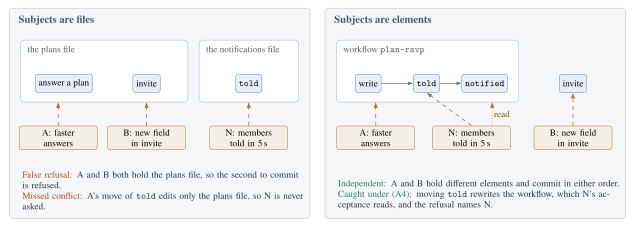
Recorded read sets. Over the system graph, acceptance queries, antecedents and checks are traversals, and the store records what each traversal read. The read sets are then sufficient by construction, and the paper's proposition that independent admitted changes commute holds without trusting anyone's declarations. Code inside a component stays opaque to the graph, which knows its declared effects and its contract, and a query about the running system reads the observations the store imported, so it is as fresh as the last import.
Evidence joined by identity. A test result attests to the component it tested at the revision it tested, a span names the element that emitted it, and a build receipt names its inputs. The system graph makes the status of a claim a function of its evidence and of the dependency closure of that evidence, so evidence about a subject goes stale when the subject changes.
Preconditions held as standing commitments. A field can be dropped from a contract if no client in use reads it, and a step can leave the request path if no client depends on it finishing first. Over a typed graph that also records what runs and what is observed, such a condition is a query. The actor who applies the change holds it as the acceptance query of a standing commitment, and a later change that would break it is refused with a witness that names the earlier change and its holder.
One regression around the loop#
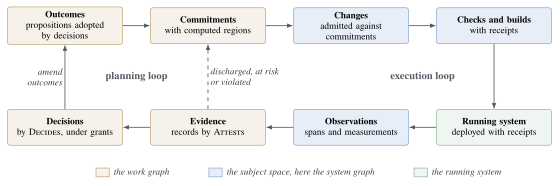
The operation by which a member answers a plan in the BestBuds app shows how the work graph and a typed graph of the system work together. The run below is illustrative and describes no incident that happened.
The owner of the plans service holds a standing commitment that answering a plan takes at most 300 ms at the 95th
percentile, and its acceptance query reads the observed spans of the workflow plan-rsvp over the last day. A release
makes the operation slower. The spans carry the workflow's definition identifier, the telemetry importer records them
as observations joined to the workflow's element, and the acceptance query becomes false. The standing commitment is
violated, which proposes new work: a commitment to restore the condition by a deadline, offered to the owner of the
plans service, who accepts it and delegates the investigation to an agent. A query from the slow spans leads the agent
to the running activation, the workflow, the operation, the requirement, the commitment and its owner, and spans for
each step show that told, which sends a plans event to the plan's members inside the request, regressed.
The agent records hypotheses as propositions with evidence from queries over the observations, and it proposes to move
told and notified out of the request into a durable run that starts after the answer is written. The change writes
into the region of the notifications owner's standing commitment, whose acceptance query reads told, so admission
asks that owner. The notifications owner allows it on the condition that members still hear of an answer within five
seconds, which becomes an amendment of that owner's commitment. The change is built and deployed with receipts, new
spans arrive, the acceptance query holds again, the delegated commitment is discharged, and the standing commitment
holds again. At every step the four questions have answers by query.
On Reaktor V1 the same run works where spans carry the workflow's definition identifier, with the notifications
owner's region declared as the step told of the application graph. The record of what the acceptance query read, and
the staleness of its evidence, wait on the move to a typed graph.
Migration from Reaktor V1#
The move from V1's subject space onto a typed graph of the system follows the five parts in the paper's section on changing the subject space: identities adopted, references resolved, regions recomputed, evidence joined, and a shadow period. In Reaktor they take these forms.
- The kernel adopts the identities that the work graph's store issued on V1, so every commitment, record and decision keeps its identity and history.
- Every reference such as
graph:DesktopAgentNoderesolves to one element of the typed graph. A reference that resolves to no element or to several is listed for the holder of the commitment that uses it. - During the shadow period every change and every status is judged under both subject spaces, and the store acts on V1's verdict. Each disagreement is a false refusal or a missed conflict of one of the two spaces, which is the measure of the precision test below.
The kinds, families, verbs, catalogue operations and surfaces do not change, and the no-rewrite test below checks that they did not.
Build order#
Steps W0 to W4 run on Reaktor V1 and need no new store. W5, the migration, waits on the store of the system graph, which is not built into Reaktor yet. No step passes through the Reaktor Graph design study of October 2026: Reaktor goes from V1 directly to the system graph, and no migration has started. Every step has an acceptance test. "Tests" names the hypotheses of the next section.
| Step | What is built | Acceptance test | After | Tests |
|---|---|---|---|---|
| W0 | On Hangar's plans: deadlines and heartbeats; leases renewed only by reports; recorded waits that wake the waiting lane; status as a query; request identities issued by the server | the next release-sized run meets the targets of the liveness test | — | liveness |
| W1 | Commitments as elements of the plan store, with the ten verbs as operations of the catalogue; regions declared over paths, the code graph and the application graph; records kept apart from commitments | every closed item is a discharged commitment or a record; every refusal names a commitment and its holder | W0 | liveness, weight |
| W2 | Admission against commitments over V1's subject space: read sets computed by the code graph where it answers and declared elsewhere; merge laws for reports | no apply is blocked by a run whose region it does not touch; false refusals and missed conflicts counted, with the share of admissions that rested on declared read sets | W1 | precision |
| W3 | Manna's outcomes, missions, assignments, decisions and proposals as elements of the same graph; acceptance by the creditor | an audit like that of 31 October finds no item that needed a creditor's acceptance closed without it | W1 | acceptance |
| W4 | Every mode as a configuration; one outside party exchanging signed commitments and decision records | an automated production run, an open-ended investigation and a project with an outside party whose terms change midway | W2, W3 | generality |
| W5 | Migration onto a typed graph of the system, with a shadow period under both subject spaces | no kind, verb or operation changes; every disagreement of the shadow period reviewed; the regression above on staging | W4, the kernel | precision, no rewrite |
W0 is reversible and touches only Hangar's plans. The market for work in Manna, described below, starts after W3. From W1 on, the paper's Kotlin engine and its tests are the reference for the verbs, the admission clauses and liveness.
Hypotheses and baselines#
Each hypothesis has a baseline from the release and a result that would reject it. The column "Paper" names the general hypothesis of the paper that each one tests in Reaktor.
| Test | Hypothesis | Measurement and baseline | Rejected if | Paper |
|---|---|---|---|---|
| Liveness | The rules for liveness and attention remove the coordination costs the release measured. | On the next release-sized run: time asleep in turns (53 hours), mean wait of a queued order (5.9 hours), status questions from the owner (11 of 42), collisions of request identifiers (63), dependencies declared or computed (26). | two or more of: sleep above 10 hours, wait above one hour, more than two status questions, any collision, fewer than half of the strict dependencies known | H1, H5 |
| Generality | Four kinds and six families serve every mode of collaboration. | An automated production run, an open-ended investigation, and a project with an outside party whose terms change midway. | any case needs a new kind, family or verb, or one of the four questions cannot be answered by query | H2 |
| Precision | A typed graph of the system makes admission more precise than V1's subject space. | Every change of the shadow period of W5, judged under both subject spaces; false refusals and missed conflicts counted under each. | the typed graph does not halve at least one of the two counts, or it raises the other | H3 |
| Weight | Commitments stay light enough that people and agents use them. | Dependencies found only after the fact; commitments released or cancelled because they went stale; time that actors spend on verbs. | more than a fifth of dependencies are found only after the fact, or more than a fifth of commitments go stale | H4 |
| Acceptance | Acceptance by the creditor stops work from being closed without the creditor. | An audit of the same design as that of 31 October on a comparable batch (56 asks, of which 14 were built as asked; 14 plan items reopened; two closed without the owner's acceptance). | any item that needs the creditor's acceptance is discharged without it, or more than 5% of discharged items are reopened | H1 |
| No rewrite | Building on Reaktor V1 first costs no rewrite: the migration changes the subject space and nothing else. | The migration of W5: changes it needs to kinds, families, verbs, catalogue operations and surfaces; references from V1 that resolve to exactly one element. | any kind, family, verb or operation changes, a surface changes beyond its subject-space adapter, or more than 5% of references from V1 resolve to no element or to several | — |
Manna and a market for work#
Manna is a web application in which people and teams organise their projects and their learning, with shared workspaces, research projects, roadmaps and skill trees. With the engine underneath, it is where Reaktor's work reaches projects outside software, and where a market for work can form, as the paper's section on markets describes. Nothing in this section is built yet. The plan has four steps.
- Teams. Teams that already work in Manna's workspaces make commitments with deadlines, heartbeats and acceptance by the creditor, and read status by query. This is step W3 of the build order.
- Open commitments. A team posts a commitment whose debtor is open, with its acceptance query, its deadline and the credentials it requires. People outside the team propose to take it, with their terms and their evidence, and the team decides.
- Payment on acceptance. The client's commitment to pay has the worker's discharged commitment as its antecedent, and the money is held as a resource that the commitment uses, so it cannot be spent twice. Milestones are smaller commitments that contribute to the whole.
- Reputation from evidence. An actor's reputation is a query over its commitments, their evidence and their creditors' acceptances, together with what the actor learned in Manna, and it travels with the actor from one project to the next.
Agents in Hangar can take open commitments too, under the grant and budget of the person they act for, and that person answers for them. The protections in the paper's section on risks apply from the first open commitment: routing rules are recorded decisions the parties can read, both sides hold the records, a person decides any end to an actor's participation, disputes go to an arbiter whom both sides granted the right to decide, and the market follows the law where it runs.
Sources#
Counts over agent transcripts and plan records were taken by scripts that count and never print content, because transcripts can carry credentials. The retrospective and the audit are internal documents of the project.
| Measurement | Date | Source |
|---|---|---|
| Sleeps inside turns, busy time per turn, waits of queued orders, collisions of request identifiers, items closed within a minute, declared dependencies, lease durations, status questions, use of build machines | 8–10 Nov 2026 | the retrospective of the release, 10 November 2026, and its counting scripts over the plan, the lanes' transcripts and the owner's messages |
| Attempts to apply planned changes and their failures | 16–27 Oct 2026 | agent transcripts, counted by script |
| Seven agents on two plans | 1 Nov 2026 | Hangar's plan records |
| Audit of 56 requests for changes to Hangar | 31 Oct 2026 | the audit of 31 October 2026 |
| Item kinds, statuses, leases, seats and message types of the work plane | Nov 2026 | Hangar's documentation (agents) and source |
| Manna's outcomes, missions, assignments, decisions and proposals | Nov 2026 | the Manna source |