1. Introduction
Consider a social application in production on Reaktor’s current runtime. It is not one program. Its screens run on Android and iOS; its web client runs in browsers; its API runs as Kotlin/JS on Cloudflare Workers and Durable Objects; graph and batch work runs on JVM services; and its state lives in Postgres, an object store and a graph database, joined by Pub/Sub, queues and WebSockets. Each runtime has its own deployment unit, scheduler, failure behaviour and debugger. The system (which screen invokes which operation, through which binding, under which authority, against which data, placed where, observed how) exists in no single place. People reconstruct it from code and dashboards, and AI agents increasingly reconstruct it from text. When an agent proposes a change, it emits a textual diff whose effect on that system has to be reconstructed once more. The gap widens every year: agents multiply the code each person can produce, and each system spans more runtimes, while the attention of the people responsible for it does not grow. We argue in Section 18 that keeping pace requires raising the unit of programming from text to the typed system, and state the claim as a falsifiable hypothesis.
Kubernetes showed that a typed object store with reconciling controllers can act as an operating system over a fleet of machines [47, 347]. Its objects are infrastructure, its relations are labels and selectors, and its semantics stop at the container boundary. We ask what the corresponding substrate is for applications that span many runtimes. Its objects are screens, routes, operations, topics, workflows, tables, places, activations and claims. Its relations are typed and often multi-party. Its controllers include the deployer, and also the dependency injector, the router, the renderer, the lifecycle manager, the code-push planner and the verifier.
Thesis#
A multi-runtime system is a typed, layered port hypergraph. Every platform service is a traversal of that graph or a patch to it, and the behaviour of the system is the composition, along the graph, of the behaviours of its parts.
Six systems shaped this thesis. We state what each contributes and what we decline to copy.
React [242] expresses all of UI with one primitive and keyed reconciliation. RG makes reconciliation the meaning of its runtime layer: the tree of activations is the reconciled image of the definitions, keyed by stable identity (Section 8.4).
Actors [7, 20, 169] give isolation, mailboxes, supervision and, in Orleans, virtual activation [34]. RG keeps each of these as a facet or a hyperedge family, not as a second runtime (Section 6).
Unreal Blueprints [110] expose durable C++ primitives to visual composition through typed pins and separate execution pins from data pins. Shipped in 2014, before language models could write code, they showed that typed graphs over a native core let mixed teams build software that is both complex and fast, and we treat them as the gold standard (Section 4). RG separates the Transition family from Bind and Channel in the same way, and compiles graph-owned behaviour regions to Kotlin.
Transformers [344] replaced bespoke architectures with one general, parallel primitive: attention, a form of message passing over a set [346]. RG makes the analogous bet for platform services. Typed message passing over incidences is the one computational primitive the kernel provides over the graph, and solvers are called from it (Section 8). Agents act on systems through typed queries and patches rather than text.
TLA [212, 214] describes systems as state machines, composition as conjunction and implementation as refinement. RG derives specifications from hyperedge families and stores claims and evidence as graph elements (Section 7 and Section 15).
Kubernetes contributes the open, typed schema (custom resources) and controllers that compute plans from desired and observed state. RG has an open signature and executors that apply plans computed by pure traversals.
From the current runtime to RG#
Reaktor’s current graph runtime already composes a production application: nested graphs, typed provider and consumer ports, routes with typed payloads, actors, service clients and Compose rendering (Section 2). It is, however, a binary port graph of mutable objects. It has one relation type in code, random identities, lifecycle and coroutine scopes fixed inside classes, a hard dependency on platform libraries, and no model of change. Publish/subscribe, queues, workflows, FFI, data, capabilities and evidence sit outside it or are attached to it by convention. The 2026 design corpus contains a hypergraph definition IR and a catalogue of 40 node kinds, 24 port profiles and 36 hyperedge kinds [291, 292]. Nothing executes that IR. Its role vocabularies conflict, and the catalogue has no formal semantics. This paper turns those ingredients into one model. Reaktor, as released, consists of RG and RGL, the modules and tools that are fragments of its signature (Section 14), and a reference realization in Kotlin on Cloudflare, Google Cloud and Postgres (Section 13).
Contributions#
A model (Section 5). RG is a typed port hypergraph with a containment forest, formalised as attributed C-sets [280] typed over a signature and fibred over six layers: source, definition, deployment, runtime, observation and assurance. Layer projections are restriction functors, so every restriction view commutes with every patch.
A minimal type system (Section 6). Fourteen base node kinds composed from facets; ports typed by family, role, contract, ownership and quality of service; four connection families (Bind, Session, Channel, Transition) and ten assertion families. Protocol is separated from realization, which is why “rpc” and “ffi” are bindings rather than port kinds. Information-flow labels, tenancy and an effect lattice are facets and rules, not new kinds.
A compositional semantics (Section 7). Well-formed subgraphs with boundaries are morphisms of a free hypergraph category [35, 136]. Behaviour is a hypergraph functor into spans of transition systems [193]. As a result a self-contained subgraph mounts at any compatible boundary, and replacing it is sound under trace refinement.
One traversal primitive (Section 8). Typed message passing over incidences, with determinism, incremental maintenance [46] and coordination-freedom [16] results. Dependency resolution, navigation, rendering, lifecycle planning, capability resolution, effect and flow analysis and code-push closure are instances, and the same algebra compiles into data stores.
A change model (Section 9). Double-pushout patches in an adhesive category [102, 210] as transactions, commuting independent patches, refs and proposals, graph diffs as the unit of review, and code push as a region release with a closure computation and epoch-fenced activation.
A language, a kernel, a protocol and a reference realization (Section 10 and Section 11 and Section 12 and Section 13). RGL’s four sublanguages and phases; an integration with the Kotlin compiler in which the graph supplies the facts that thirteen optimisations need, with the conditions under which each is sound; a data-oriented kernel with stated complexity; a wire protocol in which reads are traversals, watches are streams of Z-set deltas with cursors, changes are sessions with effect identity, and authorities federate through signed views filtered by labels; the capability profile a host must meet; a realization in Kotlin, with compiler plugins and coroutines, on Cloudflare, Google Cloud and Postgres, worked through end to end, on paper, for one feature; and four further stacks: the reference stack at large scale, a Chinese cloud stack, an alternate public cloud stack and a corporate stack hosted internally.
Precedents, problems, scope and programming model (Section 4 and Section 16 and Section 17 and Section 18 and Section 19). Lessons from game engines, with Unreal Blueprints as the gold standard, and from Kubernetes, actors, TLA, statecharts and React; twenty recurring problems of multi-runtime systems, each mapped to the mechanisms that address it; eleven classes of systems mapped onto the model, from chat to scientific simulation and neurosymbolic AI; and a division of labour between people and agents, with compilers, test and analysis tools and agents working on one graph, and the scale hypothesis stated so that it can be rejected.
Evidence and a plan (Section 14 and Section 20 and Section 22). A mapping of Reaktor’s forty modules and tools onto RG, and of what they gain when connected; a mechanical study of the 140 published design graphs; a survey of 283 features of Reaktor and five systems built on it; two bounded protocol models and five TLA templates checked with TLC; fifteen hypotheses with rejection criteria; and a twelve-month plan built on them.
Organisation#
Section 2 describes the current runtime, Section 3 the background the paper uses, and Section 4 the precedents, game engines first. Section 5 and Section 6 and Section 7 and Section 8 and Section 9 define the model, its types, its semantics, its traversals and its change model. Section 10 and Section 11 and Section 12 and Section 13 present the language and its compiler, the kernel, the graph protocol and the reference realization, and Section 14 maps Reaktor’s modules onto the graph. Section 15 covers assurance, Section 16 the recurring problems of multi-runtime systems, and Section 17 the classes of systems in scope. Section 18 and Section 19 turn to programming at scale and to tools, agents and teams. Section 20 and Section 21 and Section 22 give the evaluation, related work and the plan.
Figure 1 shows one chat feature across the six layers; the rest of the paper defines each element of that figure. Figure 2 draws a whole platform the same way: two phones and a browser, the edge network, a cloud region, a managed database and external services, with the region that can be pushed as code highlighted.
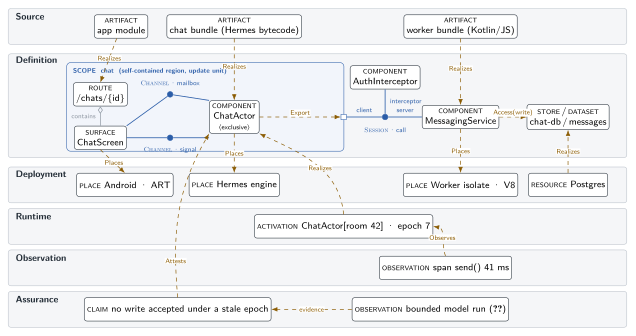
Figure 1. One chat feature in the six layers of RG. Blue lines are connections, the incidences of an executable hyperedge (filled dot). Brown dashed arrows are assertions, which relate elements and often cross layers. Grey diamonds mark containment. The Scope chat is self-contained: its only outward incidence passes through a boundary port. The whole region can therefore be mounted elsewhere or shipped to a Hermes engine as one bundle. The layers are fibres of one typed graph, not separate stores.