Appendix G. Roadmaps for learning and building
This appendix turns the paper into two roadmaps: one for learning what the design draws on, and one for building it. Both are drawn with Reaktor Graph itself (Figure 32), and both are tabulated in (Table 39 and Table 40). Learning is always on the left page and building on the right. The roadmaps carry no dates; the dated plan is Table 30. Here each step is a concept or a task, with what to read or deliver and what to practise or accept, and progress is measured by evidence rather than by the calendar.
The roadmaps as a graph#
Each step is a Scope with an identifier.
A learning step holds two Artifacts, what to read first and what to add, and a Claim: what the learner should be able to show.
A building step holds the Artifact it delivers, the Observation that serves as evidence, and the Claim that the evidence must attest.
Transitions give the suggested order of the steps within a track.
Seven tracks face each other across the fold. Structure faces the kernel; computation, the traversals; behaviour, the assurance work; machines and data, the persistence layer; distributed systems, the families and their realizations; languages and compilers, RGL and its compiler; and engines, tools and agents, the tools and agents.
A gate at the fold is one Transition whose join waits for its learning steps before its building steps begin. Gates show the needs within a track. Needs across tracks are listed in Table 40.
Why a graph rather than a list#
The roadmap is a graph-owned scope like any other (Section 9), so the operations of the paper apply to it.
What can be started now? The steps whose Transitions are enabled, because the claims of their predecessors are fresh. This is a traversal over the status of claims.
What blocks R3? Reverse reachability from R3 over Transitions and gates, stopping at fresh claims.
What needs review? The claims whose evidence has aged. A claim of mastery goes stale like any other claim (Section 15), so spaced review is the invalidation traversal applied to what a learner can show.
Who may sign off? Practice that needs a reviewer is attested by a second principal. Rule A5 therefore applies to learning too: no one certifies their own mastery.
Changing the roadmap, for example to add a resource or to split a step, is a patch, reviewed as a graph diff.
Resources#
Books and courses come from a curated catalogue of learning resources that the authors maintain. The catalogue links each resource to its chapters and to related resources, and the tables cite chapters and lectures from it. Papers are references of this paper. Where the catalogue has no resource, as for session types and for Lean, a step relies on papers and on an online book. Listing 29 shows how two learning steps, one building step and the gate between them are written in RGL.
val Learning = scope("learning", owner = Graph) {
    step("S1", "sets, relations, graphs") {
        read(book("Halmos", chapters = 6..10), book("Bondy and Murty", chapter = 1))
        practise(claim("a port graph as sets and functions"), fresh = 180.days)
    }
    step("S3", "categories, C-sets", after = "S2") {
        read(book("Fong and Spivak", chapter = 3), course("Applied Category Theory"))
        practise(claim("the C-set schema and one instance"), fresh = 180.days)
    }
}
val Building = scope("building", owner = Graph) {
    val tables = step("K1", "identity, C-set tables") {
        deliver(artifact("kernel v0 tables"))
        accept(claim("identifiers stable across runs"), evidence = observation("projection round trips"))
    }
    gate(join = All, from = Learning["S1", "S3"], to = tables)
}
Listing 29.
Part of the roadmaps of Figure 32 in RGL (proposed API).
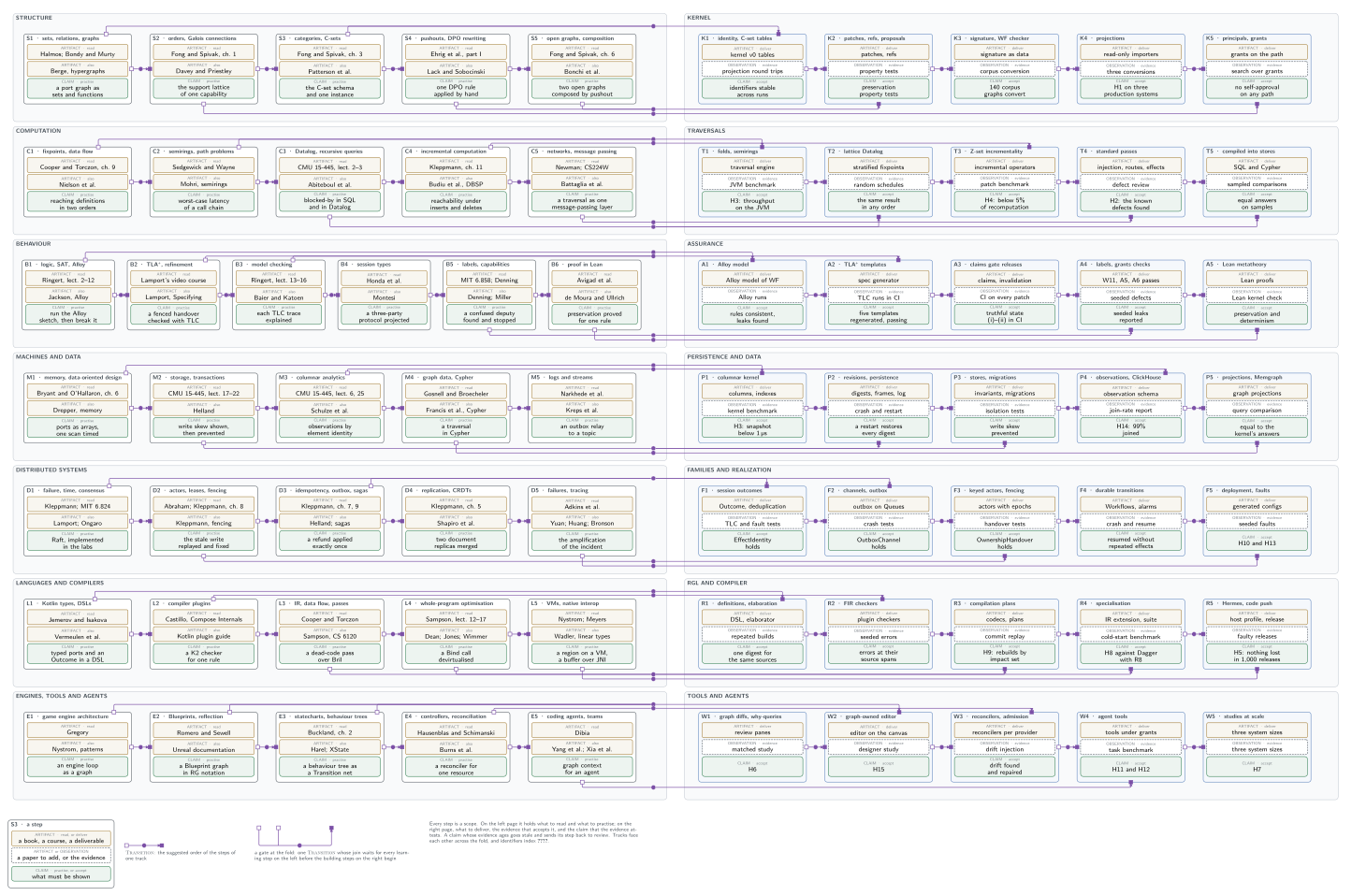
Figure 32. Roadmaps for learning (left page) and building (right page), drawn as one graph in RG notation. Seven tracks face each other across the fold. Within a track, Transitions give the suggested order; gates at the fold join the learning steps that a building step needs. Learning steps draw on a curated catalogue of books and courses and on the references of this paper; building steps end in the hypotheses of Section 20.4. There are no dates: progress is the evidence that attests each claim.
| Step | Read | Practise | Unlocks |
|---|---|---|---|
| S1 sets, relations, graphs | Halmos, sections 6–10 [160]; Bondy and Murty, ch. 1 [37]; also [30] | Write the chat scope of Figure 1 as sets of elements, ports and incidences with their maps; draw one session in the three forms of Figure 3. | K1 |
| S2 orders, Galois connections | Fong and Spivak, ch. 1 [137]; also [82] | Derive the support lattice of one capability and the Galois connection between requirements and offers (Section 6.6). | K5, A4 |
| S3 categories, C-sets | Fong and Spivak, ch. 3 [137]; their lectures [316]; also [221, 280] | Write the schema of Figure 6 as a category, one instance as a functor, and one morphism between two instances. | K1, K3 |
| S4 pushouts, DPO rewriting | Ehrig et al., part I [102]; also [210] | Apply a patch to the chat scope by hand as a DPO rule, and show why deleting a node that still owns ports is refused. | K2 |
| S5 open graphs, composition | Fong and Spivak, ch. 6 [137]; also [35, 136] | Compose two scopes along a boundary as cospans and list the ports that become internal (Corollary 4). | K2 |
| C1 fixpoints, data flow | Cooper and Torczon, ch. 9 [73]; Sampson’s lectures on data flow [304]; also [75, 266] | Solve reaching definitions on a small program by chaotic iteration in two orders and check that the results agree (Theorem 6). | T1 |
| C2 semirings, path problems | Sedgewick and Wayne, shortest paths [309]; also [194, 250] | Compute the max-plus latency and the max-times retry amplification of the incident of Section 16.5. | T1 |
| C3 Datalog, recursive queries | Pavlo, lectures 2–3 [281]; also [4, 232] | Write the query of Listing 2 as recursive SQL and as Datalog, and explain why it terminates on cycles. | T2, T5 |
| C4 incremental computation | Kleppmann, ch. 11 [200]; also [46, 236] | Maintain reachability over Z-sets under insertions and deletions, and explain why deletion is the hard case. | T3 |
| C5 networks, message passing | Newman [265]; Leskovec’s lectures [222]; also [29, 145] | Write Equation 2 as one message-passing layer, and rank the elements of Figure 2 by betweenness. | T4 |
| B1 logic, SAT, Alloy | Ringert, lectures 2–12 [300]; also [178] | Run Listing 17; find an instance, then a counterexample to a proposed change of the signature. | A1 |
| B2 TLA, refinement | Lamport’s video course [216]; also [1, 214] | Write the handover of Listing 26 from scratch and run TLC on its safe and unfenced configurations. | A2 |
| B3 model checking | Ringert, lectures 13–16 [300]; also [24] | Explain each violated configuration of Table 34 from its trace. | A2, A3 |
| B4 session types | also [173, 253] | Write a three-party checkout as a global type and project it onto each role. | F1 |
| B5 labels, capabilities | Zeldovich et al. [363]; also [91, 162, 246, 259] | Find the confused deputy and the label leak that the graph of Figure 25d prevents, and the rules that catch them. | A4 |
| B6 proof in Lean | Avigad et al. [22]; also [85] | State Listing 18 and prove it for the operation that adds an element. | A5 |
| M1 memory, data-oriented design | Bryant and O’Hallaron, ch. 6 [44]; Fabian, on tables and existence-based processing [130]; also [100] | Lay out the port table of Figure 18 as arrays and as objects, and time a scan of each. | P1 |
| M2 storage, transactions | Pavlo, lectures 4–5 and 17–22 [281]; also [166] | Break a balance invariant by write skew under snapshot isolation, then prevent it with serializable isolation or one writer. | P2, P3 |
| M3 columnar analytics | Pavlo, lectures 6 and 25 [281]; also [308, 322] | Load spans that carry element identifiers into a columnar store and answer a why-query by element. | P4 |
| M4 graph data, Cypher | Gosnell and Broecheler [154]; also [17, 139] | Compile the traversal of Listing 2 into Cypher and compare its answer with the SQL one. | P5 |
| M5 logs and streams | Narkhede et al. [261]; Kleppmann, ch. 11 [200]; also [198, 208] | Build an outbox relay to a topic and show that a crash between commit and publish loses nothing. | F2 |
| D1 failure, time, consensus | Kleppmann’s lectures [201]; MIT 6.824, lectures 1–7 [257]; also [211, 272] | Implement Raft in the 6.824 labs, and explain why a timeout cannot tell a slow peer from a dead one. | F1 |
| D2 actors, leases, fencing | Abraham, the opening chapters on actors [228]; Kleppmann, ch. 8 [200]; also [34, 199] | Reproduce the stale write of Figure 4 and fix it with an epoch that the store checks. | F3 |
| D3 idempotency, outbox, sagas | Kleppmann, ch. 7 and 9 [200]; also [131, 140, 166] | Make a refund call exactly once with an effect identity bound to the digest of its request. | F1, F2 |
| D4 replication, CRDTs | Kleppmann, ch. 5 [200]; also [202, 310] | Merge two replicas of the shared document of Figure 25a and state its conflict law. | – |
| D5 failures, tracing | Adkins et al. [6]; Parker et al., on instrumentation [278]; also [39, 174, 362] | Compute the retry amplification of Section 16.5 and decide which single layer retries. | F5 |
| L1 Kotlin types, DSLs | Jemerov and Isakova, ch. 6, 9 and 11 [179]; Vermeulen et al., ch. 4 and 13 [348]; also [105] | Write the builder of Listing 7 with ports typed by family, role and contract, and an Outcome with four cases. | R1 |
| L2 compiler plugins | Castillo, on the Compose compiler and runtime [54]; also [149, 181] | Write a K2 checker that reports W10 at the call site of an operation above its ceiling. | R2 |
| L3 IR, data flow, passes | Cooper and Torczon, on intermediate representations and on optimisation [73]; Sampson, lectures 2–9 [304] | Write dead-code elimination and local value numbering over Bril. | R3 |
| L4 whole-program optimisation | Sampson, lectures 12–17 [304]; also [88, 188, 352, 355] | Devirtualise a Bind call among the elements admitted together on one host, and state what would make it unsound. | R3, R4 |
| L5 VMs, native interop | Nystrom, part III [269]; Meyers, on smart pointers and move semantics [243]; also [349] | Run a region’s code on a bytecode VM, and pass a borrowed buffer across JNI without a copy or an escape. | R5 |
| E1 game engine architecture | Gregory, ch. 8 and 15–16 [157]; Nystrom, on game loops, components and data locality [268] | Draw an engine’s loop and its systems in RG notation, marking what is native and what is composed. | W2 |
| E2 Blueprints, reflection | Romero and Sewell, on the editor, functions, events and Blueprint communication [302]; also [113, 124] | Rebuild Figure 5a and translate it as in Figure 5b. | W2 |
| E3 statecharts, behaviour trees | Buckland, ch. 2 [45]; Romero and Sewell, on behaviour trees [302]; also [163, 320] | Turn a behaviour tree into a Transition net with joins and guards. | W2 |
| E4 controllers, reconciliation | Hausenblas and Schimanski [164]; also [47, 336] | Write a level-triggered reconciler for one custom resource and make it idempotent. | W3 |
| E5 coding agents, teams | Dibia [95]; Fried and Neubig’s lectures on agents [263]; also [227, 356, 359] | Give an agent a traversal with coverage instead of files, and count its round trips. | W4 |
| Step | Needs | Deliver | Accept |
|---|---|---|---|
| K1 identity, C-set tables | S1, S3 | C-set tables, stable identifiers and digests (Section 11) | projections round-trip with identifiers stable across runs |
| K2 patches, refs, proposals | S4, S5, K1 | patches as DPO rules, refs and proposals (Section 9) | property tests of Proposition 9 |
| K3 signature, WF checker | S3, K2 | as data with labels, tenancy and the effect lattice; | all 140 corpus graphs convert (Section 20.1) |
| K4 projections | K3 | read-only projections of the current runtime’s graphs, documents and deployment inventory | H1 |
| K5 principals, grants | S2, K3 | principals, grants and the effect lattice on the change path | no path lets a requester approve its own plan (A5) |
| T1 folds, semirings | C1, C2, K1 | folds and semiring path problems over incidences (Equation 2) | H3: at least incidences per second on the JVM |
| T2 lattice Datalog | C3, T1 | lattice Datalog with strata | Theorem 6 under randomized schedules |
| T3 Z-set incrementality | C4, T2, K2 | DBSP operators over revisions (Proposition 7) | H4 |
| T4 standard passes | C5, T3 | injection, routes, lifecycle, effects and flows, capability, closure and lints (Table 8) | H2 |
| T5 compiled into stores | C3, T2 | compilation into Postgres, Cypher and ClickHouse SQL (Listing 3) | answers equal to the kernel’s on sampled graphs |
| A1 Alloy model | B1, K3 | the schema and rules in Alloy (Listing 17) | an instance exists, and seeded inconsistencies are found |
| A2 TLA templates | B2, B3, K3 | templates instantiated per family and region (Equation 1) | the modules of Table 34 regenerate and pass TLC |
| A3 claims gate releases | B3, A2, T3 | claims, evidence and invalidation (Section 15) | conditions (i)–(ii) of Definition 10 in CI |
| A4 labels, grants checks | S2, B5, K5 | traversals for label flow, tenancy and authority | seeded label leaks, tenant leaks and self-approvals are reported |
| A5 Lean metatheory | B6, K2 | proofs of Proposition 9 and Theorem 6 | the proofs check in Lean 4 |
| P1 columnar kernel | M1, K1 | columns, CSR indexes, pre-order intervals and chunks (Section 11) | H3: snapshot below 1 μs and injection plan below 1 ms |
| P2 revisions, persistence | M2, P1 | Merkle digests, the change log and FlexBuffers frames | a restart reproduces every digest |
| P3 stores, migrations | M2, K3 | dataset invariants at commit, and migrations | seeded write skew is prevented |
| P4 observations, ClickHouse | M3, P2 | observations joined by element identity in ClickHouse | H14 |
| P5 projections, Memgraph | M4, T5 | projections of the system and data graphs in Memgraph | Cypher answers equal the kernel’s |
| F1 session outcomes | B4, D1, D3, K3 | Outcome with UNKNOWN, effect identity and deduplication | the EffectIdentity template holds for the realization |
| F2 channels, outbox | D3, M5, F1 | atomic(store) with an outbox on Cloudflare Queues |
OutboxChannel holds, and crash tests lose nothing |
| F3 keyed actors, fencing | D2, F1 | keyed actors on Durable Objects and JVM shards, with epochs | OwnershipHandover holds |
| F4 durable transitions | F2 | durable transitions on Workflows and Durable Object alarms; schedules | runs resume after crashes without repeating effects |
| F5 deployment, faults | D5, F4 | the deployment layer for Cloudflare, Google Cloud and Postgres; fault plans | H10 and H13 |
| R1 definitions, elaboration | L1, K2 | definitions and their elaboration into patches (Section 10) | the same sources give the same digest |
| R2 FIR checkers | L2, R1 | checkers for W5 and W9–W11 | seeded errors are reported at their spans |
| R3 compilation plans | L3, L4, T4, R2 | codecs and compilation plans (Listing 10) | H9 |
| R4 specialisation | L4, R3 | the IR extension and the conformance suite | H8 |
| R5 Hermes, code push | L5, R4, F5 | the Hermes host profile and region release (Section 9.5) | H5 |
| W1 graph diffs, why-queries | K2, T4 | graph diffs ranked by risk, with why-queries | H6 |
| W2 graph-owned editor | E1, E2, E3, W1 | editing graph-owned scopes on the canvas, as patches | H15 |
| W3 reconcilers, admission | E4, F5 | reconcilers and admission per host | condition (iii) of Definition 10 |
| W4 agent tools | E5, K5, A4 | query, propose, check, plan and observe as tools under grants | H11 and H12 |
| W5 studies at scale | W1, W4 | studies at , and elements | H7 |