14. Reaktor: modules and tools around the graph
Reaktor, as released, consists of four parts:
RG and RGL;
the modules that give each kind and family a working implementation;
the tools through which people and agents read and change the graph;
the cloud realization of Section 13.
Reaktor today has about forty modules. Table 20 groups them and maps every module and tool to a fragment of plus traversals and executors. In this mapping none needs a new base kind or a kernel change; H1 (Section 20.4) tests that claim on real graphs. The status column is honest: several modules are partial, some exist only as designs, and their mapping is what the plan in Section 22 implements. Section 14.1 then takes the groups one at a time and states how each module is built on the graph, and Section 14.2 shows what a builder gains when all of them share it.
| Modules | Status | Elements of | Traversals and executors |
|---|---|---|---|
core: process-wide slots, capabilities, fact provenance |
implemented | slots become capability ports offered by places; fact origins become evidence origins | support resolution (Section 6.6) |
graph-port, graph-runtime: ports, definition IR, wiring, navigation, actors, shapes |
implemented | the kernel’s tables; Bind, Session, Transition; Route; exclusive Component | injection, navigation and lifecycle traversals |
compiler, flexbuffer: generated codecs, FlexBuffers |
partial | Contracts and fingerprints; rgp/1 frames |
codecs; compilation plans (Section 10.7) |
ffi: trunks to C++ and Hermes |
prototype | a Place per runtime; native Components; ownership modes | trunk plans; fingerprint gate |
dependeasy: build plugins |
implemented | Artifacts related to sources by Derives | the build graph as a projection |
graph renderers, ui, surface, surface-compose |
partial | Surface, Route; signal Channels; behaviours as Transition nets | render fold; reconciler; route table |
web: embedded web runtime |
partial | a nested Place with capability ports; bundles as Artifacts | bridge plans; content policy as Grants |
blueprint, compose-flow: graph canvases |
partial | — | views (Proposition 2); edits as patches |
service, io: operations, routes, transports |
implemented | Session contracts; Routes; realizations over HTTP and WebSockets | binding plans; contract compatibility |
db: object, SQL, GraphQL and graph stores |
partial | Store, Dataset; Access, References, Derives | query plans; migrations as [314]; traversals compiled into stores |
work: durable work |
partial | durable Components and Transitions; receipts as Observations; schedules | run plans; recovery from committed outcomes |
Actors, in graph-runtime |
partial | exclusive Component; mailbox Channel; keyed Realizes; partitioned Places | virtual activation; fencing |
notification, google: push, Pub/Sub, connectors |
partial | Channels to devices and topics; external Components | delivery plans; consent as Grants |
| Bus and Mesh | design | Resource; topic and queue Channels; multiparty Session | lints: dead letters, idempotency, ordering keys |
auth, auth-core: principals, tenants, tokens, secured ports |
implemented | Principal; Grant, Access; tenancy (A6) | authority and flow analysis; reference monitor |
security, crypto, secrets: end-to-end encryption, primitives, secret stores |
partial | labels and declassifiers; native Components; Resources with a secret label | label flow (W11); rotation plans |
media, location, sensors, health, tactile |
partial | capability Contracts offered by device Places; personal labels | support resolution with fallback; permission requests as plans |
telemetry, performance, devtools |
implemented | Observations; Observes, Derives; budgets as Claims | instrumentation and fault plans; trace joins by identity |
| Capture and replay | design | check Component, Claim; Attests; facets marking where a capture cuts a connection | capture regions; replay plans |
tooling, code, idb, cli |
implemented | tools as Sessions with effect classes | queries, plans and receipts behind every face |
mcp: tool protocol |
partial | tools that read by default; effects under grants | the change pipeline (Figure 15) |
conductor: agents working together |
implemented | agent Principals; workflows as durable Transition nets with gates; evidence as Claims | proposal, check, plan, receipt |
| Workbench | partial | — | each pane is a view (Proposition 2) |
cloud: control plane |
partial | Place, Resource, Artifact; Realizes, Places | reconcilers; plans with approvals |
cloudflare: Workers runtime |
implemented | isolates and Durable Objects as Places; realizations of sessions, channels and stores | the generated deployment layer |
Evidence of fragmentation#
The survey behind this paper (Section 20.2) found the same model reimplemented many times across systems built on the current runtime.
A hidden signature. A knowledge-and-work system keeps about fourteen graph representations. Its registry of 67 typed record collections, composed from 26 domain modules with owners, references, transition rules, authority and a privacy lattice, is a kind signature in all but name.
A hand-built change pipeline. The same system’s write path is the change pipeline built by hand: commands with expected revisions, receipts, checks, one gateway transaction, a monotone change log, client outboxes and propose-only agents.
Seven models of one system. The developer workbench holds seven models of the system it inspects, joined by names.
Seven topology sources. A product declares its deployment topology in seven hand-kept places that disagree.
RG removes the reason for each copy. The signature is data, the pipeline is the kernel’s, and routes, documents and infrastructure are one graph with projections.
14.1 Each module on the graph#
Kernel and language#
Today core keeps a process-wide registry of slots, one per platform service: permissions, databases, files, the theme, authentication, secrets, haptics, health data, steps, location, eight media services, notifications, telemetry, Pub/Sub and work. These are the 31 process-global service slots of Table 28. graph-runtime wires consumers to providers by type and key and falls back to a dependency-injection container. On the graph each slot becomes a capability port that a place offers, resolved with its fallbacks by the support traversal (Section 6.6), and the wiring becomes the lattice traversal of Table 8, which reports a missing or ambiguous provider with a witness instead of failing at run time. graph-port’s definition IR already has nested regions, typed ports with contracts and polarity, and hyperedges with ordered, role-labelled incidences; it becomes the kernel’s tables almost unchanged. core also records the provenance of facts as live, source, inferred, fixture, stale, failed or unknown, which maps onto the origin and freshness dimensions of claim status (Section 15). The codec generator becomes the first stage of the compilation pipeline (Section 10.7), ffi’s registry of invokable functions becomes a trunk whose imports are capability ports, and the outputs of the build plugins become artefacts that derive from their sources.
Interface#
The renderers draw route and container nodes with Compose on Android, iOS and the desktop, and with React on the web. surface expresses menus, tabs, tables, toggles and other widgets as reducer state machines that depend on no toolkit, and surface-compose renders them. On the graph a widget’s behaviour is a small Transition net inside a Surface, a statechart in the sense of Section 4; rendering is the fold of Section 8.3; and each renderer is a reconciler of render plans. ui lets authors give interface elements identities so that tools can find them, and on the graph those identities are stable element identifiers. The embedded web runtime already hosts pages in a session with local bundles, a content policy and a typed bridge. On the graph the web view is a place nested in the app, its bundle is an artefact with a digest, its bridge is a trunk whose host imports are capability ports, and its content policy is a set of grants. Finally, blueprint already draws a running application’s graph as cards with typed pins, connected by wires and grouped in frames, on the canvas that compose-flow provides. It is read-only today. With RG the same canvas becomes an editor for graph-owned scopes, because an edit is a patch that the kernel checks, which is the Blueprint editor of Section 4 extended to the whole system.
Services, data and work#
service describes operations with typed requests and responses, chains of interceptors and operation descriptors whose port type the runtime already uses. On the graph each operation is a Session with a contract fingerprint, each interceptor is an interceptor incidence, and the HTTP and WebSocket transports of io are realizations. db covers object stores with cache and retention policies, a SQL language, SQLite in the browser, a GraphQL client and a graph-database client whose Cypher queries are checked for tenant safety. On the graph these are stores and datasets, retention is an attribute of a dataset, the tenant check is rule A6 compiled into each query, and traversals over data compile into SQL or Cypher (Section 8.3). The data graph that the current runtime approximates with heuristics is declared: definitions declare stores and datasets, and the compiler derives each operation’s Access footprint from its typed queries. Existing databases are imported by introspection adapters that record provenance, so a schema found in Postgres is observed until a definition claims it. A schema change is a patch to datasets and References, and the matching data migration is induced by a functor between schemas [314], executed at the owning store. work, which is being rebuilt around intents, claims, checkpoints and receipts, is the durable profile: its steps are durable transitions, its receipts are observations, and recovery replays committed outcomes. Actors are exclusive components with mailbox channels. notification and google provide channels to devices and to Pub/Sub topics, and connectors to external services; a connector’s consent is a grant.
Security#
auth is already graph-native. On the server it is a graph of about fourteen nodes for tokens, sessions, personal access tokens, service accounts and delegated exchange, and its secured ports check an authorization requirement before a call proceeds. On the graph its principals, memberships and tenants are Principals and attributes, a secured port is one whose Session requires a Grant, and the authority traversal finds every effect reachable without one. security encrypts conversations end to end with MLS, implemented in C++ behind a C interface that Kotlin/Native, JNI, WebAssembly and JSI reach. On the graph it is a native component behind trunks, and the boundary of plaintext is a boundary of labels: only components on members’ devices read plaintext, and moderation sees only what a member reports (Section 17.1). Secrets are resources with a secret label, and crypto’s primitives are pure components.
Device capabilities#
Camera, gallery, audio, speech, location, step counting, health records and haptics are adapters behind slots today, each with its own check of availability and its own permission request. On the graph each is a capability contract offered by device places, with availability as part of the offer. A feature that needs a capability states the requirement, and support resolution chooses a provider, or a declared fallback, before the feature activates (Section 6.6). A permission request is a step of a plan whose outcome is a grant from the person who owns the device. Health and location data carry personal labels, so their flows are checked by W11 like those of any other personal data.
Observation, tools and agents#
telemetry already walks the port graph with a visitor and installs tracing interceptors on ports; on the graph that visitor is the telemetry traversal of Table 8, and its result is a patch. performance defines budgets and measurement requirements for every target and fails a gate when a required metric was never recorded. On the graph a budget is a claim, a measurement is evidence, and a missing measurement is a gap in coverage. devtools streams the graph’s shape, port calls, traffic, logs and crashes to the workbench, and injects faults through port interceptors. On the graph its taps are observation plans, its faults are the fault plans of Section 19, and its streams are observations joined by identity. tooling, cli, code and idb provide discovery, task plans, runs, approvals and receipts, supervised processes, code intelligence and device automation, and mcp exposes tools that read by default and need an authenticated host and an explicit effect to write. On the graph each tool is a Session with an effect class, under grants, and agents read the graph through the same typed queries as tools and people, exposed as tools of the Model Context Protocol [18]. conductor runs coding agents from several vendors over one checkpointed thread, composes them in workflows of agent, check and gate stages, and keeps evidence that links tasks, candidates, findings and checks. On the graph its workflows are durable transition nets with human gates, its agents are principals that propose, and its evidence is claims and attestations. Agents act only by proposing patches, which are checked, planned and admitted like any other change, under a Grant that never includes approving one’s own plan (Figure 15). What an agent knows about a system is then what the graph and its coverage claims say, not what it scraped from files.
Cloud#
cloud reads the Worker inventory from the Wrangler configs and places processes and endpoints on the map. cloudflare runs Kotlin/JS on Workers with routing, D1, R2, KV, Durable Objects, service bindings and AI bindings, has clients for Postgres, ClickHouse and Memgraph, and mounts the graph’s service nodes into its router. On the graph, places and resources are elements, the configuration of each provider is generated from the deployment layer (Listing 19), and the operations of the control plane are plans with approvals, executed and reconciled like any other.
14.2 When everything is connected#
A module on its own answers questions about itself. Connected through one graph, the modules answer questions that span them, and those are the questions builders actually ask. With about forty modules there are 780 pairs, and every pair that shares identities can answer questions that neither answers alone. Today each such pair is joined by integration code, if it is joined at all: the survey found up to seven models of one system inside one tool, joined by names, and four observation paths whose identities do not match (Table 28). In RG the join needs no pairwise integration code, because identity is shared by construction. Its cost moves elsewhere: to declaring elements, footprints, labels and grants, and to carrying identity through every runtime. Figure 23 contrasts the two arrangements, and Table 21 lists ten questions that span modules, each answered by traversals of the connected graph.
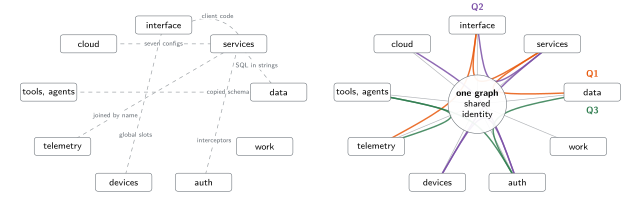
Figure 23a. Today: modules are joined pair by pair, by integration code, names and copies, where they are joined at all.
Figure 23b. With RG: every module joins through shared identity, and a question that spans modules is one traversal. Q1–Q3 follow the first three questions of Table 21; modules not drawn are omitted.
Figure 23. The modules of Reaktor, joined in pairs today and through one graph with RG.
| Question | Modules it spans | Traversal |
|---|---|---|
| Which screens, routes and dashboards break if this column is dropped? | data, services, interface, telemetry | reverse reachability over Access, Session and Derives |
| Can this feature be pushed to phones today, and to which ones? | interface, services, device capabilities, auth, cloud, FFI, assurance | closure, support resolution, admission |
| Which personal data can reach the LLM provider, and through which components? | data, auth, agents, tools, telemetry | label flow (W11) over Derives, Session and Channel |
| Why did checkout take three seconds for this user? | telemetry, devtools, services, data, cloud | critical path (max-plus) over observations joined by identity; provenance |
| What does this agent’s proposal touch, and who may approve it? | agents, auth, work, and every module the patch touches | impact; authority; A5 |
| Which notification goes out when an order is refunded, to which device, under whose consent? | work, notification, auth, device capabilities | paths over Transition, Channel and Grant |
| What breaks if this secret is rotated, and in which order must its users change? | secrets, auth, cloud, services | reverse reachability; an ordered plan (fold) |
| Which tests must run for this patch, and on which devices? | tools, device capabilities, services, interface | impact; support resolution to select devices |
| What degrades if the analytical store is down? | data, services, telemetry, tools | reverse reachability over Derives and Access, by failure domain |
| Does this feature work on this device, and what does it fall back to? | device capabilities, interface, FFI | support resolution with fallback |
The builder’s power#
Connecting the modules changes three things for the person or agent building on Reaktor.
Questions become queries. Each question in Table 21 is a traversal with a coverage claim. Today each is an investigation across repositories, dashboards and people.
Changes become one patch. Renaming a field touches a dataset, a contract, a screen, a dashboard, an analytical table and a graph projection. On the graph it is one patch, reviewed once as a graph diff, with its impact computed and its migration generated, rather than six coordinated changes in six tools.
New modules join without adapters. A new module adds derived kinds and traversals, and once it declares its elements and footprints it takes part in every existing query. A payments module, for example, receives authority analysis, label flow, telemetry, code push, deletion closure and test selection without writing an adapter for any of them.
The value of each module therefore grows with the number of modules it connects to, as in a network. This is also why the graph matters more for agents than for people: an agent can answer a question that spans forty modules with one query, instead of reading the code of forty modules.
14.3 Truthful state#
R17 asks for code and its ecosystem as a database with transactional edits. That helps only if code, processes and the graph never disagree, and “never disagree” needs a definition that can be checked.
Definition 10 (Truthful system). A system is truthful at a revision vector , which gives one revision per consistency domain, if it satisfies four conditions:
every source-owned scope’s definition region has the digest of the elaboration of its source at ;
every observed activation has a Realizes assertion to an element of an admitted revision, under an epoch issued by its authority;
every managed resource realizes a definition element, and every unmanaged one is imported with provenance and marked observed, never desired;
every claim’s status is a function of its evidence and of the dependency closure of that evidence at .
Condition (i) is checked in CI by digest equality. Condition (ii) holds by construction on hosts that admit only releases whose digests are in ; anywhere else, an activation without a realization is reported as of unknown provenance, not inferred. Conditions (iii) and (iv) are reconciler and invalidation traversals. Heuristic recovery of structure, such as regular expressions over SQL or matching spans to nodes by label, becomes unnecessary for managed parts and explicitly labelled for imported ones. Human and agent changes take the same path, each step an element of the graph. A snapshot and query yield a proposal (a patch artefact). The proposal is checked and planned, and the plan gets a fingerprint. A Grant approves it, and no principal may approve its own proposal. An executor applies the plan. A reconciler compares the result, and the receipt is recorded as an Observation.