17. Systems in scope
Multi-runtime systems differ along eight axes:
who owns state, and how it is partitioned;
the consistency each datum needs;
the latency regime;
what an effect is, and when it becomes final;
how much people and agents take part;
how tightly the system is coupled to the physical world;
how many tenants share it;
how its computation is produced and trusted: written, simulated or learned, and how its results are reproduced.
Table 23 selects eleven classes that together span these axes. For each it gives the difficulty that defines the class, the tools that address part of it today, and the RG mechanisms that address it as a whole. Section 17.1 then takes the classes one at a time.
| Class (examples) | Defining difficulty | Strongest tools today | RG mechanisms |
|---|---|---|---|
| Real-time communication and collaboration (messaging, presence, calls, shared documents) | Per-conversation order and fan-out under churn; offline replay; moderation versus end-to-end encryption | Socket servers, push services, CRDT libraries [202, 310] | Keyed exclusive rooms; signal and mailbox channels with sequence numbers; Replicates with conflict laws; guards that order effects; labels that keep plaintext from moderation sinks |
| Social and content platforms (feeds, follow graphs, ranking, notifications) | Graph-shaped reads; projections across stores; privacy that must follow derived data; deletion everywhere | Graph databases, caches, search indexes, pipelines | Derives with lineage; labels propagated to derived data; deletion as invalidation across stores; traversals compiled into stores |
| Transactional commerce and finance (orders, payments, ledgers, inventory) | Correctness under partial failure and external providers; invariants; reconciliation; separation of duties | Workflow engines [329], sagas [140], idempotency keys [219] | atomic(store) with outbox; outcomes with UNKNOWN; dataset invariants at commit; transition nets with compensation; grants without self-approval; receipts bound to payloads |
| Agentic and AI-native systems (tool-using agents, multi-agent work, human-in-the-loop operations) | Non-deterministic, long-running steps; authority for tool calls; prompt injection and exfiltration; evidence of what was done | Agent loops [361], tool protocols [18], control–data separation [74, 89] | Agents as principals that propose; tools as Sessions with effect classes and grants; label flow as a structural defence against injection; durable runs; receipts and claims; context as traversals with coverage |
| Workflow and process automation (back office, compliance, B2B integration) | Long waits on people and external systems; flaky integrations; audit evidence; deadlines | Workflow engines, robotic process automation, cron | Durable transitions with human sessions as gates; schedules; Attests with digests; completion only with receipts |
| Interactive simulation and multiplayer games (matches, persistent worlds, live operations) | Latency; authoritative state and interest management; matchmaking; updates without downtime | Dedicated game servers with latency compensation [31] | Keyed rooms placed near players; signal channels with declared QoS; match lifecycles as transition nets; region release with drain-and-swap at match boundaries |
| Robotics, IoT and fleets (robot fleets, connected devices, vehicles) | Heterogeneous capabilities; intermittent links; safe control handover; over-the-air updates; safety evidence | ROS 2 on the robot [231]; fleet and update services | Devices as places with capability offers; task allocation as a solver; handover with epoch fencing (Table 34); commands with effect identity; safety claims that go stale with firmware; coordination-free traversals |
| Data and ML pipelines (streaming ETL, materialized views, features, lineage) | Incremental computation; schema evolution; backfills; reproducibility; retention | Logs and stream processors [51, 208]; incremental engines [46, 236] | stream components on Channels, maintained over Z-sets; Derives for lineage; migrations as functors; labels; retention as a dataset attribute |
| Multi-tenant platforms and control planes (SaaS, bring-your-own-cloud, developer platforms) | Tenant isolation; placement across customer clouds; fleet upgrades; quotas | Kubernetes operators [47], intercloud brokers [360] | Tenancy rule (A6); capability-qualified placement; releases admitted per cell; quotas as grant attributes; observations per tenant and element |
| Scientific simulation (brain simulators, multiscale models, digital twins) | Models composed across scales and simulators; GPUs and MPI ranks; runs of days that must checkpoint; parameter sweeps; provenance and validation of every result | Simulators [142, 171, 321], model languages [81, 84, 146], co-simulation [97], workflow managers [252] | Populations and projections as elements and hyperedges; simulators as places with capability offers; co-simulation channels with declared delays; durable runs; sweeps as scope factories; provenance as Derives; validation as claims; labels on human recordings |
| Neurosymbolic AI (learned proposers with symbolic checkers, differentiable logic, program search) | Two representations and runtimes, tensors and terms, joined by glue; trust in learned steps; training signal from checks | Neurosymbolic languages [224, 234], search with evaluators [301, 340] | One typed graph for both halves; message passing that is either a traversal or a neural layer; semiring traversals that compute proofs, probabilities or gradients; proposals checked by rules, solvers and TLC; checks as labelled data |
What the classes share#
Every class needs the same five things across its whole system:
one model of what exists;
identity that survives restarts and runtimes;
effects that are neither lost nor misreported;
actions attributed to principals under grants, with data flowing only where its labels allow;
placement chosen from capabilities.
Today each is solved inside one tool: order inside a log, durability inside a workflow engine, isolation inside an actor runtime, permissions inside an API gateway. Each is lost at the boundaries between tools. RG states them once, as types, rules and traversals over the whole system, and keeps the specialized tools as realizations. This is the sense in which RG is designed to serve these classes better than any single existing system. It is not deeper along any one axis; each cited tool is. It aims to be consistent across the axes at once, where present systems are joined by convention. Whether it succeeds is what the hypotheses of Section 20.4 test.
17.1 The classes one by one#
Figure 25 and Figure 26 and Figure 27 draw a representative graph for each class, in the notation of Figure 2. Each graph is small, but each shows the structure that makes its class hard and the mechanism that addresses it, in orange. Table 24 names, for each class, one defect that the rules of Section 6.5 catch before activation and that today’s tools let through.
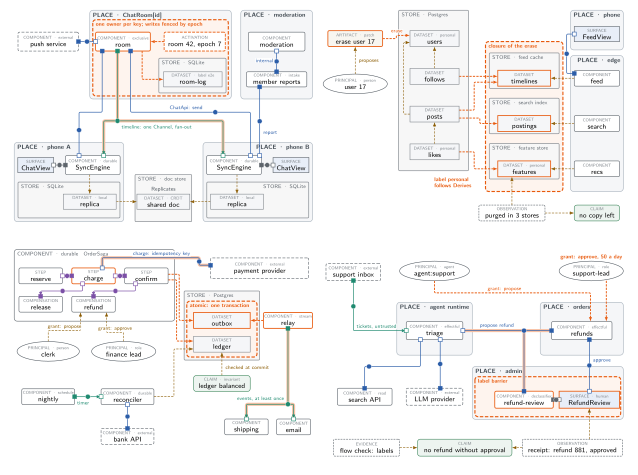
Figure 25a. Real-time communication and collaboration. The keyed room owns the order of one conversation, and its activation fences writes by epoch; one timeline Channel fans out to both phones. Moderation never reads end-to-end content on the server: it receives only what a member reports from a phone.
Figure 25b. Social and content platforms. Feeds, search and recommendation features are projections, each a Derives from the base datasets. Erasing a user is a data plan whose targets are the closure over Derives, with a receipt from every store, and the label personal follows the same edges.
Figure 25c. Transactional commerce and finance. The saga’s charge carries an idempotency key, and confirm writes the ledger and the outbox in one transaction, so a relay can publish at least once without a dual write. Grants separate who proposes a refund from who approves it.
Figure 25d. Agentic and AI-native systems. Tickets arrive untrusted; the agent’s tools are Sessions. The agent holds a grant to propose a refund, not to approve one, and the ticket’s text reaches the refund only through the review declassifier, an interceptor on the proposing Session.
Figure 25. Representative graphs of the classes of Section 17 (1 of 3). Notation as in Figure 2: places and stores are containers, connections end in ports and meet at hubs, dashed arrows are assertions, and orange marks the mechanism that defines the class.
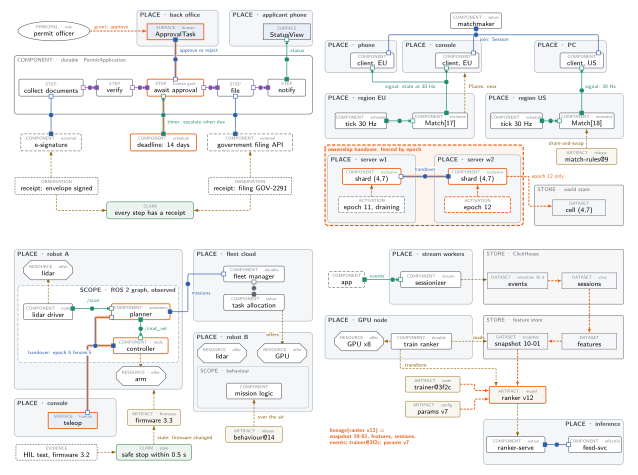
Figure 26e. Workflow and process automation. A durable workflow waits on a person through a Session to a human surface, a gate like any other call, and on a deadline timer fed by a schedule. External systems are Sessions, and their receipts attest the compliance claim.
Figure 26f. Interactive simulation and multiplayer games. A solver assigns players to keyed match rooms placed near them; each room ticks and sends state on a signal Channel at a declared rate. A world shard moves between servers by an ownership handover that the store fences by epoch, and new match rules ship by drain-and-swap at a match boundary.
Figure 26g. Robotics, IoT and fleets. Robots are places that offer capabilities; the on-robot ROS 2 graph is an observed scope. Control passes between teleoperator and autonomy by an ownership handover in which the controller fences the old epoch. Behaviour ships over the air, and the safety claim goes stale with new firmware.
Figure 26h. Data and ML pipelines. A stream processor maintains a view, features and a snapshot derive from it, and the model derives from the snapshot, the training code and its parameters. The orange Derives chain is what a lineage query returns; retention is an attribute of the raw events.
Figure 26. Representative graphs of the classes of Section 17 (2 of 3). Notation as in Figure 2 and Figure 25.
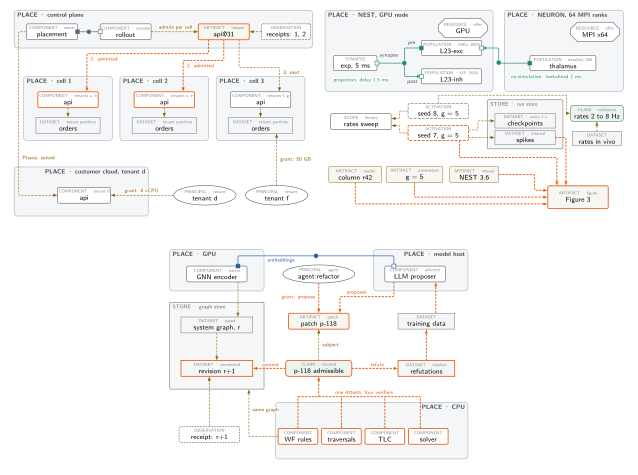
Figure 27i. Multi-tenant platforms and control planes. Cells are places, and every workload and dataset carries a tenant facet. A release is admitted cell by cell, each admission a Realizes of its own; quotas are attributes of grants, and a solver places one tenant’s workload in the customer’s own cloud.
Figure 27j. Scientific simulation. Populations are elements; a projection is a hyperedge with roles pre, post and synapse. The projection between the two simulators is a co-simulation Channel whose minimum delay is the lookahead. The figure Derives from the model revision, parameters, seed, simulator release and spikes, and goes stale when any of them changes.
Figure 27k. Neurosymbolic AI. A GNN encodes the typed system graph and an LLM, acting for an agent principal, proposes a patch. Rules, traversals, TLC and a solver read the same graph and attest a claim about the patch: if it holds, the patch commits as revision with a receipt; if not, the refutation becomes a labelled example that Derives the proposer’s training data.
Figure 27. Representative graphs of the classes of Section 17 (3 of 3). Notation as in Figure 2 and Figure 25.
| Class | A defect caught before activation | Rule |
|---|---|---|
| Communication | A room’s state written by a realization that does not fence by epoch | A2: the binding is not qualified |
| Social platforms | A deletion that misses a derived store | the deletion patch’s closure over Derives |
| Commerce and finance | A charge sent without an idempotency key bound to its request | A2: the binding misses the call’s QoS |
| Agentic systems | Ticket text from a customer reaching a refund’s arguments | W11: flow without a declassifier |
| Workflow automation | A human approval step with no deadline or escalation | the human profile’s laws (Table 4) |
| Simulation and games | Match state shared with a component in another place | A1: a Bind that leaves its process |
| Robotics and fleets | A motion command whose timeout is read as “not done” | W5: the outcome type lacks UNKNOWN |
| Data and ML pipelines | A feature table that drops the personal label of its source | W11 on a Derives path |
| Multi-tenant platforms | A query that does not carry the tenant | A6 |
| Scientific simulation | A projection between two simulators with no declared delay | W8: a cycle of value dependencies needs a delay |
| Neurosymbolic AI | A learned proposer granted the right to approve its own patches | A5: no self-approval |
Real-time communication and collaboration#
This class covers messaging, presence, voice and video calls, and shared documents and whiteboards. It is the running example of Figure 1 and Figure 2, and Figure 25a reduces it to its core. Such systems hold millions of small conversations, most of them idle at any moment and some of them suddenly very busy.
What makes it hard. Messages of one conversation must keep their order while devices connect and disconnect and servers fail over. A device that has been away for a week must catch up without gaps or duplicates. Fan-out reaches phones, browsers and push services, while typing indicators and read receipts may be lost without harm. End-to-end encryption conflicts with moderation and server-side search. Shared documents accept concurrent edits that must converge.
Today. Socket servers, push services and CRDT libraries [202, 310] each solve one of these. Order is the socket server’s private business, replay is code in each client, encryption is a library, and moderation is a separate service that has to be told what it may see.
With RG. Each room is an exclusive component keyed by room, realized by a Durable Object, and its epoch fences writes at the store when it fails over (Table 34). The timeline Channel fans each room’s events out to its devices and declares its order and delivery, and a binding that cannot provide them fails A2. A device that has been away does not depend on the channel’s memory: it calls the room’s Session with its last sequence number and receives what it missed from the room’s message dataset. Presence and typing indicators travel on a signal channel declared best effort, so nobody builds a guarantee on them. Shared documents declare their conflict laws on Replicates. Encryption is a native component behind trunks, and plaintext carries a label that confines it to members’ devices. Moderation therefore never reads end-to-end content on a server: it sees only messages that a member reports, released on that member’s device under the member’s own grant. Server-side moderation, as in the worked example of Section 13.6, applies to rooms without end-to-end encryption. Push to an offline device is a Channel to a component on the device, realized through the platform’s push service.
Outside RG. Media codecs, call quality and the convergence algorithms of the CRDTs themselves stay inside opaque components.
Social and content platforms#
This class covers feeds, follow graphs, likes and comments, search, recommendations, notifications, moderation and tools for creators. Reads outnumber writes by orders of magnitude, popularity is highly skewed, and most of the data is derived (Figure 25b).
What makes it hard. Many reads are graph-shaped: followers of followers, mutual connections, the audience of a post. The same facts are copied into feed caches, counters, a search index, an analytical store, a graph store and the features of recommendation models, and every copy must be kept current. Privacy must follow the copies: a post restricted to friends must not leak through a cache, an index or a feature, and a block must reach all of them. Deleting an account must reach every copy. Skewed accounts force a choice between writing to every follower’s feed and reading at request time.
Today. Graph databases, caches, search indexes and data pipelines each hold part of the picture, and deletion is a script that someone must keep up to date with every new copy (P10 in Section 16).
With RG. Each copy is a dataset related to its source by Derives, with lineage. Rows are not part of the graph, so deleting a user’s data is a data plan whose targets are the closure over Derives; it runs as a saga with a receipt from every store. Labels propagate along Derives, so a feature computed from personal data is personal, and its consumers need the corresponding grants. Traversals compile into the stores that hold the data: follow-graph queries into Cypher for Memgraph, engagement analytics into SQL for ClickHouse, and feeds into recursive SQL for Postgres (Listing 3). Writing to feeds or reading at request time is a choice in the plan, made per account from observed fan-out, not a decision buried in code. Moderation decisions are claims with evidence, so an appeal can see what the decision rested on.
Outside RG. The quality of ranking and of recommendation models.
Transactional commerce and finance#
This class covers carts, orders, payments, refunds, inventory, ledgers, invoices and payouts. Its systems depend on external providers, such as payment processors, banks, tax and shipping services, that are the sources of truth for money and goods and that can time out after acting (Figure 25c).
What makes it hard. An effect may have happened even when its call failed (P1), and retries can repeat it (P2). Invariants must hold: balances never negative, stock never oversold, every ledger transaction summing to zero. The system must be reconciled against providers that keep their own records. Duties must be separated, so that the person who requests a refund is not the one who approves it, and every step must leave evidence for audit.
Today. Workflow engines [329], sagas [140] and idempotency keys [219] address the calls; nightly scripts reconcile; approvals live in a separate tool; and audit logs are written by convention.
With RG. The checkout of Figure 2 is a saga: a Transition net with compensations. Its charge carries an effect identity bound to the digest of the request, and a timeout yields UNKNOWN, never “not applied”. Effects leave through an outbox written in the same transaction (Listing 27). The ledger’s balance and the zero sum of each transaction are dataset invariants checked at commit, under serializable isolation or with one writer per account, because snapshot isolation allows write skew to break them. A scheduled reconciler compares the ledger with the bank and resolves outcomes that were left unknown. Separation of duties is a grant rule: no principal approves its own proposal (A5), and a refund above a threshold needs a grant whose budget is an attribute. Receipts are bound to payloads, and TLC checks the call and the outbox templates; their evidence gates every release of the payment region.
Outside RG. Fraud models, pricing and the accounting rules themselves, although the rules, once stated, become invariants.
Agentic and AI-native systems#
This class covers support agents, coding agents, research agents, operations agents and teams of agents, together with the people who supervise them. Agents call tools, many of them through MCP [18], run for minutes or days, and act on systems that matter (Figure 25d).
What makes it hard. Steps are non-deterministic and long-running, so they must survive restarts and be resumable. Every tool call needs authority. Content returned by one tool can carry instructions that steer another tool’s effect, which is prompt injection, and it can carry data out, which is exfiltration. Each run must leave evidence of what was done. Cost and rate limits must be enforced, and the quality of an agent’s work must be evaluated.
Today. Agent loops interleave reasoning and tool calls [361], tool protocols type the calls [18], and graph runtimes make agent workflows durable and interruptible [217]. Frameworks type tool calls but rarely type authority or data flow. Recent designs separate the control path from untrusted data for that reason [74, 89].
In RG three structural facts limit the damage:
an agent is a principal that proposes;
each tool is a session with an effect class;
untrusted content carries a label that privileged sinks reject.
The defence does not depend on the model resisting the injection. It bounds what an injected instruction can cause, although a declassifier or an approver who is deceived can still let content through (Section 23). The same graph gives the agent its context as a traversal with a coverage claim, and records what it did as receipts and claims. Listing 23 shows the shape. An instruction injected into a ticket can make the agent propose a refund but not execute one. Only a person holds the grant to approve, and the ticket’s text can reach the refund’s arguments only through a review declassifier that the same person holds. Runs are durable components whose steps persist their outcomes, so a run interrupted by a deployment resumes rather than repeats its tool calls. Spending and rate limits are budgets on grants. An evaluation of an agent’s work is a claim attested by checks and by reviewers, and the accumulated verdicts are the data from which the agent’s grants are widened or narrowed (Section 19).
val Support = scope("support") {
    val agent = principal("agent:support", kind = Agent)
    val lead = role("support-lead")
    val tickets = channel<Ticket>("tickets", Mailbox, label = Untrusted)
    val refunds = require(Session.call<RefundApi>(), effect = ReversibleProductionWrite)
    component("triage", ::Triage, profile = Effectful) { consumes(tickets); proposes(refunds) }
    grant(to = agent, on = refunds, actions = setOf(Propose))
    grant(to = lead, on = refunds, actions = setOf(Approve), budget = perDay(50))
    declassifier("refund-review", from = Untrusted, to = Internal, holder = lead)
}
Listing 23.
An agent’s tool under grants and labels (proposed API).
Workflow and process automation#
This class covers onboarding, permits, insurance claims, procurement, compliance checks, integrations between businesses and the back office in general (Figure 26e).
What makes it hard. Processes wait for days or weeks on people and on external systems. They have deadlines, escalations and service-level agreements. Integrations with external interfaces and file exchanges are flaky. Regulators ask for evidence of every step. And a process definition changes while thousands of instances are still running.
Today. Workflow engines, process notations such as BPMN, robotic process automation and scheduled jobs each cover part of this; versioning of running instances is usually left to the engine’s conventions.
With RG. Steps are durable transitions. A person’s decision is a Session with a human surface, so it is a gate like any other call, with a deadline and an escalation that the human profile’s laws require (Table 4). Deadlines are timers, and recurring work is a schedule with a misfire policy. External systems are Sessions whose outcomes include UNKNOWN. A process completes only with receipts, which is the audit evidence regulators ask for, kept as Attests with digests. A change to the process is a patch: running instances stay bound to the revision they started on, and moving them to the new one is an explicit plan, released with draining like any region.
Outside RG. Whether the business rules are the right ones.
Interactive simulation and multiplayer games#
This class covers competitive matches, persistent worlds, casual multiplayer, live operations with events and stores, and simulations for training (Figure 26f). Section 4 discussed the engines; here the subject is the system around them.
What makes it hard. Latency budgets are tens of milliseconds. Each match needs one authoritative state and must decide which player sees what. Matchmaking balances skill, latency and capacity across regions. A persistent world is partitioned across servers, and players cross the partitions. Updates must ship during live events, without downtime. Around the game runs a backend of accounts, inventories, stores, leaderboards, anti-cheat and analytics, with every problem of Section 16.
Today. An engine, dedicated game servers with latency compensation [31] and a separate backend stack, joined by convention.
With RG. A match is a keyed room placed near its players. Its tick loop is an exclusive component driven by a fixed-rate timer, and its state updates travel on signal channels at a declared rate. Fast-paced games need unreliable datagrams, which the reference stack does not offer (Section 13), so their rooms run on game-server places. Matchmaking is a solver traversal over players and capacity. A persistent world partitions space into keyed regions, and a player crossing a boundary is an ownership handover with fencing. Updates happen at match boundaries in drain-and-swap mode. The backend is in the same graph: a kill recorded on a leaderboard is a Session with effect identity (Figure 5b), and anti-cheat signals are observations joined to the match that produced them.
Outside RG. Netcode, client prediction, physics and rendering stay inside the engine.
Robotics, IoT and fleets#
This class covers warehouse robots, drones, fleets of vehicles, industrial equipment, smart buildings and medical devices (Figure 26g). These are multi-runtime systems with unreliable links and safety-critical change.
What makes it hard. Devices differ in sensors, actuators and compute. Links drop for minutes. Control passes between an autonomy stack, a teleoperator and a failover controller, and must never be held by two at once. A command acts on the physical world, so its outcome may be unknown. Software updates go over the air and must roll back safely, and regulators ask for safety cases that stay true as the software changes.
Today. ROS 2 runs on the robot [231]; fleet managers, update services and safety documents are separate systems.
Three results of this paper apply directly:
a control handover between an autonomy stack, a teleoperator and a failover controller is the ownership handover of Table 9 and Table 34, where a check by the sender is not enough and the receiver must fence;
a command to a machine is an effect whose timeout means UNKNOWN;
a behaviour update is a region release with admission and rollback (Listing 6).
The on-robot computation graph is itself a typed port graph of topics, services and actions with quality-of-service profiles [231]. It can be imported as an observed scope, so the fleet and the robot are one graph. Devices are places that offer capabilities, so task allocation is a solver over capability offers. Fleet state that only grows, such as observation logs and sets of visited areas, is merged by monotone traversals that need no coordination while links are down (Proposition 8). A safety claim depends on firmware and parameters, so it goes stale when either changes. Hard real-time control loops and perception models stay inside opaque components.
Data and ML pipelines#
This class covers streaming ETL, change data capture, materialized views, feature stores, training pipelines, model registries, analytics and backfills (Figure 26h).
What makes it hard. Computation must be incremental, and data arrives late and out of order, which forces trade-offs between correctness, latency and cost [9]. Schemas evolve while producers and consumers run. Backfills reprocess history. Results must be reproducible: which data trained this model? Retention, deletion and consent apply to every copy. And the features computed for training must equal those computed for serving.
Today. Logs and stream processors [51, 208], incremental engines [46, 236], schedulers and lineage tools, each with its own model of the pipeline.
With RG. The stages of a pipeline are stream components joined by Channels, and each stage maintains its output incrementally with Z-set operators, as in DBSP [46]. Derives records the lineage between the datasets that the stages read and write; like every assertion, it does not execute. Windows and triggers are attributes of the channels between stages. A schema change is a migration patch, and a backfill is a traversal over history that produces a plan. Every model artefact derives from a data snapshot, code and parameters, so the question “which data trained this model” is a query. Retention is an attribute of the dataset, and deletion propagates as in social platforms. Training and serving features are two realizations of one definition, and a claim compares them on samples.
Outside RG. Statistics and the accuracy of the models.
Multi-tenant platforms and control planes#
This class covers SaaS products, deployments into customers’ own clouds, developer platforms and internal platforms, operated as fleets of cells (Figure 27i).
What makes it hard. Tenants must be isolated in data, compute and noisy neighbours. Placement spans customer clouds and regions, under data-residency rules. Fleet upgrades need canaries and per-tenant compatibility. Quotas and billing must be exact. Support engineers sometimes need access to a tenant, and that access must be bounded and recorded.
Today. Kubernetes operators [47], intercloud brokers [360], feature flags and per-tenant configuration files.
With RG. Tenancy rule A6 makes the isolation of data a checked property of the graph; isolation of compute is a placement constraint together with quotas. Cells are places, and data residency is a constraint on the region attribute of places. Bring-your-own-cloud placement is a constrained assignment of components to the places a customer offers, solved over capability offers and certified for constraint satisfaction (Section 23). A fleet upgrade is a sequence of region releases admitted cell by cell, each gated by claims. Quotas are attributes of grants, observations are kept per tenant and element, and access for support is a grant with a time limit whose use leaves receipts.
Outside RG. Pricing and commercial decisions.
Scientific simulation#
This class covers brain simulators, climate and earth-system models, multiscale physics and digital twins. Computational neuroscience is our example (Figure 27j). Its studies run on laptops, clusters and supercomputers, often with GPUs, and the software around them is usually scripts that each group writes again. A study often composes models from several groups and scales:
detailed cells in NEURON [171];
whole-brain models in The Virtual Brain [306];
several of these in one run, through co-simulation [97].
Model languages such as NeuroML, PyNN and SONATA already separate a model from the simulator that runs it [81, 84, 146]. The science follows computational neuroscience [103]; RG does not choose models or numerics. What it helps with is the software around the science, which is still built by hand for each study:
Composition. A population is an element and a projection is a hyperedge among a source population, a target population and a synapse model, with roles and a delay. A domain module provides these as derived kinds, without a new base kind (Listing 24).
Placement. Simulators are places that offer capabilities: GPUs, MPI ranks, time steps, supported neuron models. A model that no available simulator can run is a finding before the run, not a crash after an hour.
Co-simulation. Simulators exchange spikes on channels with a declared minimum delay. The smallest delay across a cut is the lookahead that lets each side advance without waiting, and a traversal computes it.
Long runs. A run is a durable component that checkpoints; a parameter sweep is a scope factory whose instances are activations with seeds.
Provenance. Every result Derives from a model revision, parameters, seeds, a simulator release and input data, in the spirit of W3C PROV [254] but checked: a figure goes stale when any input changes, like the claims of Figure 24. Workflow managers [94, 252] order the steps; the graph also knows what they mean.
Validation and data. “The model reproduces this firing-rate distribution within this tolerance” is a claim attested by a run and a dataset. Recordings from people carry labels and reach only analyses granted for that purpose.
val Column = scope("cortical-column") {
    val exc = population("L23-exc", model = AdEx, size = 8_000)
    val inh = population("L23-inh", model = Lif, size = 2_000)
    val drive = population("thalamus", model = Poisson(rate = 8.hz), size = 500)
    projection(exc to inh, synapse = Exponential(tau = 5.ms), connect = FixedProbability(0.1), delay = 1.5.ms)
    projection(inh to exc, synapse = Exponential(tau = 10.ms), connect = FixedProbability(0.2), delay = 1.ms)
    projection(drive to exc, synapse = Static(weight = 0.5), connect = FixedInDegree(50), delay = 2.ms)
    val study = sweep("rates", seeds = 1..20, parameters = grid("g", 4.0, 5.0, 6.0, 7.0, 8.0)) {
        simulation(duration = 10.s, dt = 0.1.ms, checkpointEvery = 1.s, on = capability(Gpu, Nest))
    }
    record(study, exc, Spikes, into = dataset("spikes", label = Internal))
    claim("rates in range", about = exc) { meanRate(between = 2.hz..8.hz) }
}
Listing 24.
A network study in a proposed neuroscience module of RGL.
Neurosymbolic AI#
Neurosymbolic systems pair learned models with symbolic reasoning, search or verification [58, 83]. A language model proposes programs that an evaluator scores [301]; a symbolic engine and a language model take turns on a geometry proof [340]; a logic program trains a perception network through its rules [224, 234]. They are hard to build (Figure 27k) because the two halves live in different runtimes and representations, tensors on accelerators and terms on CPUs, joined by glue that no one checks. The Reaktor graph addresses four obstacles, shown in Figure 28:
One representation. The graph is typed, so a graph neural network can embed it: each layer is a message pass over the same incidences as Equation 2 [29, 145], as programs are embedded from their graphs [10]. The same graph is the domain of Datalog-style traversals and model checking. Learned and proven facts about a system sit side by side, distinguished by their evidence: a Derives from a model, or an Attests from a check.
Semirings as the bridge. Traversals already compute over semirings (Section 8.2). With the Boolean semiring a rule computes a proof; with a probabilistic one, a confidence; with a differentiable one, a gradient [156, 224]. One rule then serves the symbolic and the learned half.
Checked loops. A neural proposer, such as a language model writing patches or a policy proposing placements, is a principal that proposes. Rules, solvers and TLC templates accept the proposal or refute it with a witness, on the change path of Figure 15, under grants and effect ceilings.
Data with ground truth. Every patch, finding, counterexample and receipt is a labelled example. A running installation accumulates a dataset of system changes with verdicts, which is the training signal these loops lack today.
Three systems we intend to build follow this pattern: a placement policy learned from receipts whose output a solver certifies; a network that predicts a patch’s impact, checked against the exact traversal; and agents that propose refactorings that must pass and TLC. In each, the graph does not make the model more accurate. It makes the system around the model feasible to build and safe to run.
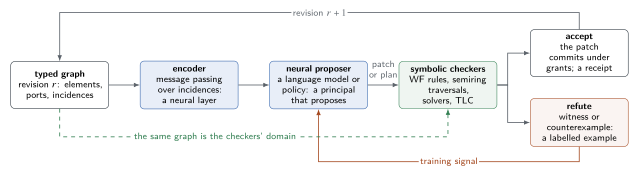
Figure 28. A neurosymbolic loop over the Reaktor graph. Learned components encode the graph and propose changes; symbolic components check them on the same graph, over Boolean, probabilistic or differentiable semirings. Accepted proposals become revisions, and refutations become training data.
What RG does not solve#
Several difficulties stay inside opaque components and specialized hosts, where RG places and observes them but does not improve them:
game netcode and client prediction;
hard real-time control loops;
numerical methods inside simulators, and the scientific validity of a model;
the accuracy of a learned model;
cryptographic protocols;
ranking.