Appendix D. Study plan
The paper draws on more fields than any one reader is likely to know. This appendix offers five reading paths, a map of the concepts, a table of what to read for each, and readings tied to the milestones of Table 30.
D.1 Reading paths#
Practitioners and founders: Section 1 and Section 2 and Section 13 and Section 17 and Section 18, then Section 22.
Theorists: Section 3 and Section 5 and Section 6 and Section 7 and Section 8 and Section 9 and Appendix A.
Implementers: Section 6 and Section 8 and Section 9 and Section 10 and Section 11 and Section 13, Appendix C and Appendix E.5.
Reviewers of the evidence: Section 20, Appendix B and Appendix C, and the scripts in
anc/.Builders of tools and agents: Section 4 and Section 10.7 and Section 16 and Section 19, then Section 20.4.
D.2 A map of the concepts#
Figure 31 groups the background into four strands. Arrows point from a concept to the ones that build on it, and each strand ends in the sections it unlocks.
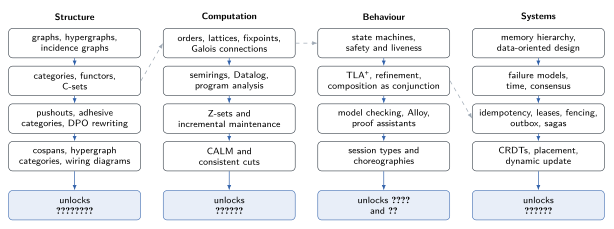
Figure 31. Four strands of background and the sections each one unlocks. Dashed arrows mark the main links between strands: an order is a category with at most one arrow between two objects; the reachable states of a state machine form a least fixpoint, which is what a model checker computes; and refinement states what idempotency and fencing must preserve.
D.3 What to read, and how to check yourself#
Table 35 lists, for each concept, where the paper uses it, a first source, a deeper source and a question to check understanding. Appendix E covers each concept briefly.
| Concept | Used in | Start with | Go deeper | Check yourself |
|---|---|---|---|---|
| Hypergraphs, incidence graphs | Section 5 | [30], Appendix E.1 | [37] | Why does a five-party session cost five incidences, and what does its clique of ten edges lose? |
| Network measures, multilayer networks | Section 21 | [265] | [26, 197] | Which elements of Figure 1 would betweenness centrality flag as blast-radius risks? |
| Categories, C-sets | Section 5 | [137], Appendix E.2 | [221, 280] | Write the schema of directed graphs, one instance, and a morphism between two instances. |
| Pushouts, adhesivity, DPO | Section 9 | [102] | [159, 210] | Why can a DPO rule not delete a node that still owns ports? |
| Cospans, hypergraph categories | Section 7 | [137] | [35, 136, 193] | Compose two cospans by pushout; which ports become internal? |
| Lattices, fixpoints | Section 8 | [82], Appendix E.3 | [75, 266] | Model dependency resolution as a lattice. What do and mean? |
| Semirings, Datalog | Section 8 | [4] | [156, 232, 250] | Which semiring gives the worst-case latency of a call chain? |
| Z-sets, incrementality | Section 8 and Section 11 | [46] | [236, 251] | Why is deletion harder than insertion for incremental reachability? |
| CALM, consistent cuts | Section 8 | [167] | [16, 56] | Why must “no provider exists” be evaluated on a consistent cut? |
| State machines, TLA, refinement | Section 7 and Section 15 | [214], Appendix E.4 | [1, 2, 12] | Write the Next action of a lease handover with fencing. |
| Model checking, Alloy, proofs | Section 15 | [24] | [85, 178] | What does a bounded check prove, and what does it not? |
| Session types, choreographies | Section 6 | [173] | [50, 253] | Project a three-party protocol onto each of its roles. |
| Memory hierarchy, data-oriented design | Section 11 | [100, 130], Appendix E.5 | [5, 168] | How many cache lines does one scan of a column of ports touch? |
| Failure models, consensus, leases | Section 7 and Section 9.5 | [48], Appendix E.6 | [134, 230, 272] | Why can a client not tell a slow server from a crashed one? |
| Idempotency, outbox, sagas | Section 9 and Section 13 | [166] | [140, 200, 219] | Where must the deduplication record live for effects to happen exactly once? |
| CRDTs, local-first, placement | Section 17 | [310] | [202, 360] | Which state can converge without coordination? |
| Dynamic software update | Section 9.5 | [170] | [129, 207, 262] | What makes a code-push region closed? |
| Brain simulation, co-simulation | Section 17.1 | [103] | [97, 146, 254] | Why does the smallest delay across a cut let two simulators advance independently? |
| Neurosymbolic programming | Section 17.1 | [58] | [29, 224, 234] | Which semiring turns a proof rule into a probability, and which into a gradient? |
| Game engines, visual scripting | Section 4 | [114, 124] | [113, 119, 125] | Which Blueprint nodes have no execution pins, and when do they run? |
| Dataflow and placement | Section 10.7 | [191] | [3, 55, 220] | Why must an edge that crosses devices become a send and a receive? |
| Whole-program optimisation | Section 10.7 | [88] | [186, 188, 352, 355] | Which optimisation becomes unsound if the other side of a boundary can be released on its own? |
| Failures in production | Section 16 | [362] | [39, 174, 327] | How can retries at three layers keep a system down after its trigger is gone? |
| Coding agents | Section 19 | [359] | [25, 227, 356] | What context does localisation need, and how would a traversal with coverage supply it? |
D.4 Readings by milestone#
Table 36 pairs the quarters of the plan with the primary sources each needs. Each row ends in an artefact the milestone needs, so the reading is never separate from the build.
| Quarter | Theory | Primary sources | Artefact |
|---|---|---|---|
| Q4 2026 | C-sets, typed graphs, adhesive categories, DPO; information-flow lattices; failure models and fencing | [42, 91, 102, 199, 210, 280] | kernel v0; Alloy model of ; principals and grants on the change path |
| Q1 2027 | Attribute grammars, data-flow and semiring analysis, Datalog, incrementality, message passing; idempotency and outboxes; studies of production failures | [39, 46, 76, 166, 205, 232, 250, 362] | traversal engine; standard passes; channels with outbox; fault plans |
| Q2 2027 | State machines, refinement, failure models, sessions, update; durable execution; whole-program and incremental compilation | [1, 53, 88, 170, 173, 186, 214, 253, 352] | RGL on four hosts; TLA templates checked by TLC; Hermes profile; compilation plans |
| Q3 2027 | Supervision, virtual actors, durable work, hypergraph categories, mechanised proof; placement; coding agents; visual composition | [20, 34, 35, 85, 114, 136, 193, 359, 360] | keyed actors; placement solver; Lean proofs; agent tools; graph-owned editor |