Reaktor Product Atlas — Original Source Review — Fable 5
:::info Merged into the canonical guide This exhaustive source review has been combined, corrected, and rewritten for implementation use in Reaktor Product Atlas — Canonical Review and Revamp — 5.6 Ultra. Read the canonical guide first. This page remains public so its measurements, full board inventories, and original reasoning can be audited. :::
Date: 2026-08-27
Subject: /Users/ovd/dev/bestbuds/modules/reaktor.pen — 104 boards, 1,457 component instances, 96 reusable components
Author: Claude (Fable 5), with nine parallel analysts
Companions: Verified Foundations · Stable Foundations 5.6 Ultra · Reaktor Essays
Evidence basis
Every board was exported from the live .pen file and read in full as text — 191,505 characters across 104 boards. Nine analysts each took a section cluster and answered the same six questions per board: what is actually on it, which part of the Reaktor vision it embodies, where it sits in a real development workflow, what an AI agent does with it, how it maps to Unreal's Blueprint toolchain, and what existing tools it replaces or absorbs. Each then proposed concrete improvements and a verdict.
The source audit reports measurements from the .pen file. Its counts and conclusions belong to that dated source snapshot. The measurement basis excludes the stale pen-truth.json. Where an automated pass produced a false positive, that is recorded with its scope.
Judgements are made against two fixed references: the Reaktor essays for what the framework is trying to be, and the foundation audit for what the code actually does today. A board depicting a subsystem the audit found to be a skeleton is judged on that basis.
The atlas in one page
The file is a product atlas for Reaktor System Studio: a workbench in which a developer maps a whole system, traces any consequence through it, validates claims about it, and acts on it through governed plans. Its entry board states a constitution — the Symphony Contract — promising that workspace, revision, environment, selection, time, principal, and evidence all survive every movement, and that human and agent changes share one path from patch to plan to receipt.
Structurally it is organised twice over. The stated organising principle is a matrix of four movements (Map, Trace, Validate, Act) against eight instruments (Interface, Source, State, Identity, Intelligence, Runtime, Delivery, Product). The actual organising principle is thirteen numbered sections running from North Star through Create, Govern, Graph Substrate, Interface System, Inner Loop, Ship, Agent Operations, State and Trust, Observe, Learn, AI Engineering, and Runtime and Extensibility. Twenty further boards depict states of two flows — a five-step Composer wizard with five provisioning outcomes, and five deployment states — plus five shell breakpoints.
The craft is real. Eighty-four of eighty-nine product boards carry a complete identity chain — workspace, revision, environment, principal — and the V2 band grammar has genuinely landed file-wide. This is a more coherent design system than most shipped products have.
The diagnosis
Nine findings, in order of severity. Each is measured, and each is developed in the section-by-section review that follows.
1. The fixture data contradicts itself, which disproves the atlas's own thesis
Reaktor's central claim is that the diagram of the system and the system are the same object, so the diagram cannot lie. This atlas is a diagram that lies, and it can be proven from the boards alone without reference to any code:
- The rollback dialog offers a known-bad release as the healthy restore point.
STATE · Deploy · Rollback Confirmationproposes restoringrc-810asverified · healthy · 100% traffic. Five other boards —07.04and four deploy states — record that same release, same sha4f81dc0, asrolled back · 1d ago. This is the most irreversible screen in the product. - One release candidate has three test denominators.
rc-812showsMaestro · 14/14on three boards,Maestro · 12/14on another, andMaestro flows 21/22on07.02; unit tests are1,284on four boards and142on07.02. There is no continuous integration behind any of them. - The same figure is both a daily and a monthly cost.
11.04labels$118.00asBY RESOURCE · JUL MTD;12.02labels the same$118ascost / dayand11.05asAI cost/day. That is a thirty-fold discrepancy, and11.05prints "numbers always match" directly beneath its copy. - One trace has two durations. Trace
abc4f1e2appears on both06.04and10.01with different totals. - One subsystem is routed four ways on one revision. Moderation runs on
llama-3.3-70b,llama-guard-3-8b,haiku, andworkers-aidepending on which board you open — all under revision8f41c2. - Retention data is provably authored.
11.02's W1 column reads 68, 70, 71, 72, 74, 75, 77 — strictly monotone with zero reversals across seven cohorts. Real retention never looks like this, and the board's own AI answer then claims a cohort is an outlier against a table in which no outlier is possible.
A design file is allowed to use sample data. It is not allowed to use sample data that contradicts itself, because the moment a reader notices one contradiction, every number in the atlas becomes unreliable. For a product whose thesis is that the picture cannot lie, this is not a cosmetic problem — it is the thesis failing on its own artefact.
2. The evidence block is a constant
The evidence grammar is not underused so much as un-bound. Where it appears, it appears as copy-pasted chrome carrying identical values about unrelated subjects.
| String | Boards carrying it verbatim |
|---|---|
EVIDENCE · 94% | 20 |
12 findings · 3 blocking | 17 |
14 tests · 3 deploy targets | 17 |
Runtime observation is not wired | 17 |
Observed — runtime · 3s | 17 |
Confidence — 1.0 / exact | 17 |
Seventeen boards — a design system, an AI trace viewer, a knowledge atlas, a visitor lab, a primitive catalogue, an FFI switchboard — each claim exactly twelve findings of which three block, exactly fourteen tests across three deploy targets, and confidence of exactly 1.0.
Every one of those seventeen contradicts itself. All state Runtime observation is not wired in the findings block, and eighteen lines below, Observed — runtime · 3s with Confidence — 1.0 / exact. On 03.04 the words Truth UNKNOWN · not wired sit nine lines above Confidence 1.0 / exact on the same card.
This includes 13.03 · FFI Switchboard, otherwise the best board in the file. Its structure is the correct template; its values are the same constant as everywhere else. The template is right and nothing has ever been filled in.
3. The evidence discipline reaches the periphery and stops at the core
Across all ten boards of Section 04 — the graph substrate, the most important cluster in the atlas and the one closest to Reaktor's central claim — the fields Effect, Permission, Origin, Confidence, and Revision appear zero times, and Truth appears once as a plain row label. Across the other eighty product boards, Permission and Truth appear on thirty each, Revision on twenty-eight, Owner on twenty, and Effect, Origin, and Confidence on seventeen each.
Meanwhile 04.01 alone carries 54 unit-bearing numeric assertions with no provenance — roughly one in twelve of the entire atlas's total — including throughput figures for a Google Pub/Sub island on a plane the audit found has no queues at all.
4. Time is the invariant that broke
Of the seven things the Symphony Contract promises survive every movement, six hold up well and one does not.
| Element | Coverage |
|---|---|
| Environment | 97.8% |
| Evidence (as a label) | 96.6% |
| Workspace, revision, selection, command palette | 95.5% |
| Principal, four movements | 94.4% |
| Time and freshness | 23.6% |
Three quarters of the atlas shows data with no as-of, no TTL, and no staleness, in a product built to answer whether what you are looking at is still true.
5. The atlas depicts Reaktor's structure and not its semantics
Counted across all 104 boards: ports and wires appear on 54, actors on 36, scopes on 31, capabilities on 19, adapters on 14. Against that — visitors on 4, one of the four pillars of the vision; graph code push on 4; backpressure and credits on 3; conformance on 3; FlexBuffers on 2, the data plane the entire polyglot claim rests on; invariants on 2; idempotency on 1. Choreography, saga, and session types: zero. Eigenvector, spanning, and redundancy — the framework's own stated principle for choosing primitives: zero.
A developer could learn the shape of a Reaktor system from this atlas and would learn nothing about what makes one correct.
6. There is no assurance section
lincheck, property test, model check, fuzz, differential, defect, and counterexample each appear zero times across all 104 boards. invariant appears twice. fingerprint appears twice — for the keystone primitive of the entire verification programme, and neither instance refers to it.
Thirteen sections for activities, none for correctness. This is simultaneously the atlas's largest content gap and the most defensible thing Reaktor could show anyone.
7. Governance forks into four mechanisms where the contract promises one
The Symphony Contract states that human and agent changes share one path from patch to plan to receipt. In practice:
07.04governs a bundle —Bundle #1042 · 7 commandsunderPlanApproved · plan_8dd4 · actor alice · approver bob · independent · expires 9m · sha256:…· one use. This is the contract drawn correctly, once.- Section 08 governs a command —
approved cmd #14,BLOCKED cmd #11,12 commands proposed · 0 applied. 12.05invents a third path,PromoteChain, gated by continuous integration that does not exist.12.02,12.04, and12.06use a fourth — bare buttons acting directly on production, including anaskcell draftingSetProperty(matching.threshold, 0.68).
Approving twelve commands individually has different atomicity and different rollback behaviour than approving one sealed plan. These are two transaction models sharing a word. Not one board in Section 08 or 12 shows a plan id, a receipt, a hash, or an approver distinct from the requester — and the receipt chain that 07.04 establishes vanishes on the four deploy states that follow it, none of which say which receipt authorised the act they are performing.
8. Provenance is mis-encoded rather than missing — and this is the cheap fix
Thirty-five boards do mark provenance, in strings like session adapter not connected, FIXTURE · no geo adapter, masked by policy, DESIGN FIXTURE, and adapter not wired. These marks are legible to a human and invisible to a query, because they live in V2 band labels as text rather than in the TruthMark component.
That means the atlas is not 2.5% honest and 97.5% silent. It is roughly 40% honest in a form nothing can enforce. Making the V2 band label a slot that renders a TruthMark component would move all thirty-five boards into the queryable, gate-able set without redesigning any of them — the single highest-leverage change available.
9. Substantial redundancy above healthy chrome
Shared chrome is 27.6% of all text, which is the shell doing its job correctly. Above that: 04.06 and its two states overlap at 0.84–0.87; 02.01 is a string-for-string duplicate of Composer · 3 of 5, making eleven Composer boards where there is one; the five provisioning states share a byte-identical five-row ledger, so Complete claims 5 / 5 verified above three rows still marked blocked. In total 191 board pairs share more than 30% of their unique content, and sixteen boards are chrome with a label — including 05.03 · Command Palette, the single most important surface humans and agents share, at 48 unique lines.
One apparent case of redundancy is not one, and the correction is worth stating because it shows the limit of text-only measurement. The three Expanded-1600 shell states are textually identical, which a text comparison flags as triplication. Reading their fills shows they are honest theme forks — dark on #9EABC1 and #6F8FFF, light on #526078, #315BFF and #087A4A, high contrast on #FFFFFF, #00FFFF and #00FF88. They are three legitimate boards maintained by hand. The real defect there is different: the light and high-contrast token values appear nowhere in the design system.
10. The design system has drifted out from under the atlas
The Machine Signal board is a legend for a system nobody draws in any more.
- The documented palette is not the painted palette. All eighteen colour tokens on
05.00appear between two and eleven times in the entire 18MB export — essentially only inside their own swatch chips. The colours actually painting the atlas are a different set:#9EABC1with 7,178 uses,#F4F7FBwith 3,977,#263349with 2,842,#6F8FFFwith 2,057. Node-kind colours survived a migration; surfaces, text, accent, status and wire colours did not. - The truth marks collide at the pixel level.
#F5B84B1Frenders Stale, Partial, Remote Reversible and Approval Required simultaneously.#8DA7FF1Frenders Source, Read Only and Local Write. A component that writes and a component that cannot write are the same pill — which breaks the Symphony Contract's own clause that truth, effect and permission stay independent, not by omission but by rendering. - The shell is 86 hand-copies and has provably drifted. There are 86 layers named
Command Bar, 86Context Spine, 84Status, 82Workspace Bar. Eighty-two boards carry a layer namedStatus / policy loaded · v19; only four still display that string, while seventy-five displaypolicy required. Layer names and rendered text have come apart. - The agent's contract changes with screen width. At 1600 the agent affordance reads
Ask · Propose; at 768 and 390 it readsAsk. The same shell also silently drops128 Sourcefrom its truth mix at 768, so one system reports 149 entities on a laptop and 21 on a tablet.
Every truth-vocabulary instance in the atlas — all nineteen by exact component name — lives on 05.00. So does the only instance of each data-bearing component. Ninety-six other layers have "Metric" in their name and are hand-drawn.
What follows
Part 3 gives the evidence template — the reusable specification reverse-engineered from 13.03, which is the mechanism that fixes findings 1 through 4 and 8 at once. Parts 4 to 12 review every board, section by section. Part 13 collects the new panes the atlas needs. Part 14 proposes the taxonomy after revamp. Part 15 is the seamlessness programme, and Part 16 sequences the work.
Part 3 · The evidence template
13.03 · Extend · FFI Switchboard is not a better-looking board than the other 103. It is the one board with a grammar, and the grammar is what should be lifted. What follows is that grammar written as a specification a designer can apply to any board tomorrow. It is the mechanism that fixes diagnoses 1 through 4 and 8 at once.
13.03 · Extend · FFI Switchboard is not a better-looking board than the other 103. It is a board that has a grammar, and the grammar is what should be lifted. What follows is that grammar written as a specification a designer can apply to any board tomorrow.
The template exists to satisfy one promise the atlas already makes on 00 · START HERE: "Map the whole system, trace any consequence, validate every claim, and act through governed plans — without losing workspace, revision, environment, selection, time, principal, or evidence." Those seven carriers are the template's reason to exist. Every region below either carries one of them or renders the object under study. Nothing else is allowed in.
The regions
R1 — Identity strip (mandatory). The top line carries five of the seven carriers at once: workspace and product path (bestbuds / extend-ffi-switchboard), revision (8f41c2), environment (LOCAL), principal (ovd), and two entry points — the command palette (⌘K, labelled Search · Navigate · Run · Change · Ask) and the agent (Ask · Explain · Propose). This strip must be byte-identical across all 104 boards. Its job is to prove that moving between boards did not silently change who you are, which revision you are reading, or which environment you would write to.
R2 — Movement and instrument selector (mandatory). Map ⌘1 · Trace ⌘2 · Validate ⌘3 · Act ⌘4 and the eight instruments Interface · Source · State · Identity · Intelligence · Runtime · Delivery · Product. Every board is one (movement × instrument) cell and must show which cell it is by selection state, not by its title. A board whose content does not match its declared movement is a defect the selector makes visible — this is exactly how 13.02 fails, below.
R3 — Scope rail (mandatory for any board whose subject is a set; optional for a single-object board). Three stacked parts. A free filter (Filter entities, findings…), a SYSTEM group of structural scopes (Everything · Product islands · Runtime fabric · External boundaries), and a SAVED group of stored queries (Blast radius · Security findings · Changed since main · Unknown evidence). The rail closes with R4.
R4 — Coverage declaration (mandatory, one per board, no exceptions). One sentence, two halves, separated by a middle dot: what is real, then what is not. Kotlin source · foreign targets designed. Desktop source · MCP parity proof pending. This is the single most valuable component on the model board and the one most obviously missing from 13.01 and 13.02.
The rule that makes it honest: it is a bound component, not a text field. The first half must resolve to a module path plus a revision. The second half must resolve to a document anchor. A board that cannot fill both halves from real references may not render the component — it must instead render COVERAGE · UNDECLARED, which is a visible defect, not a blank.
R5 — Board thesis (mandatory). Two lines. A title that names the object in the system's own vocabulary (FFI Switchboard — explicit contracts across runtime boundaries) and a dimension line (ABI · schemas · ownership · cancellation · streaming · conformance). The dimension line is a contract with the reader: every dimension named must resolve to a region on the board or to an explicit gap marker. 13.03 names six dimensions and delivers on roughly one and a half, which is the board's central failure.
R6 — Mode strip (mandatory). SOURCE · MAP · TRACE · VALIDATE · ACT · EXPLORE · EDIT · DEBUG · COMPARE. Nine modes, exactly one active. The rule: a mode must either produce a materially different rendering of the same selection, or render disabled with a one-line reason. Nine always-enabled modes that all show the same plane is worse than three modes that work.
R7 — Query bar (mandatory). Query · kind: owner: truth: path: with / as the focus key. The four typed facets are what turn the truth vocabulary from decoration into an index. truth:unknown must be a runnable query — that single capability is what would let a reviewer find the atlas's own 49 unmarked boards. Facets are extensible per section; kind, owner, truth, path are the floor.
R8 — Revision and layer strip (mandatory). main@8f41c2 (base), Δ5 · DRAFT (uncommitted delta count and draft state), L2 · FEATURE (semantic level), then layer toggles BASE · STRUCTURE / + RUNTIME / + CHANGE / TESTS / +3. Two things are separated here and must stay separated: semantic level (how much of the graph you resolve, L0 to L4) and overlay layers (which evidence planes are composited on top). Boards routinely conflate them.
R9 — Plane header (mandatory). Three bound values: the dual-plane declaration (DESIRED + OBSERVED), liveness (LIVE · 2s), and evidence coverage (EVIDENCE · 94%). All three are computed. The dual-plane declaration is a state, not a label: legal values are DESIRED ONLY, OBSERVED ONLY, DESIRED + OBSERVED, and DESIRED + OBSERVED · CONFLICT. If a board renders DESIRED + OBSERVED while its findings ledger says Runtime observation is not wired, the header must fall back to DESIRED ONLY automatically. 13.03 violates this today.
R10 — The plane (mandatory). Named for what it renders and how it was derived: BOUNDARY PLANE · SOURCE-DERIVED, PROJECTION PLANE · IDENTICAL SNAPSHOT HASH. Immediately below sits the density control, L2 · SCOPE · STANDARD DENSITY, which is three independent settings — level, grouping, density — and should read as three controls, not one string.
The plane holds entity cards. Every card carries exactly four things: a name in system vocabulary (TYPESCRIPT GUEST), a role line naming its concerns (Workers · events · promises · streams), a truth stamp (SOURCE · main, OBSERVED · 3s, UNKNOWN), and an Inspect ↗ affordance that navigates without losing selection. A card with no truth stamp is invalid.
R11 — Findings ledger (mandatory). A counter (12 findings · 3 blocking) and a typed list. 13.03 shows four classes; the full set should be six: Conflict (two claims disagree), Unknown (a claim cannot be made because something is not wired), Stale (an observation exists but is older than its freshness horizon), Impact (what a change here would touch — 14 tests · 3 deploy targets), Policy (what governs a mutation — Approval required before mutation), and Defect (a known D-* or S-* finding scoped to this object). The atlas has no Defect class today, which is why the twelve security findings and the port-identity defect appear nowhere.
Two binding rules. A Conflict must name both operands — Desired and observed claims disagree is a class label masquerading as a finding; the real finding reads desired: TS guest present in HELLO capability table · observed: no HELLO ever exchanged. And the counter must be the length of the list; if the list is truncated, the truncation is shown.
R12 — Selected path (mandatory). The causal chain this board exists to let you walk: Contract → generated boundary → runtime call → trace → conformance receipt. Each hop is a navigation target, and each hop carries its own truth stamp, so a chain that goes dark halfway is visible as such. This is the region that makes selection survival concrete rather than promised.
R13 — Selection inspector (mandatory). Four stacked parts.
- Subject line, typed:
Boundary / chat.realtime. Kind first, then identity. - Qualifier line, one sentence of honest nuance:
Source contract · native parity not yet proven. - The three independent axes, each in its own slot and never merged into a single badge: Truth (
UNKNOWN · not wired), Effect (READ ONLY), Permission (APPROVAL REQUIRED). The Symphony Contract names a fourth — Lifecycle — which13.03omits and which the template must add, because a boundary that isDraft,Active,DeprecatedorRemovedbehaves differently under every other axis. - The evidence block, R14.
R14 — Evidence block (mandatory, five fields on the model board, seven in the template). Origin (source:main), Observed (runtime · 3s), Confidence (1.0 / exact), Revision (spec@8f41c2), Owner (platform). Two fields must be added.
Method — how the observation was made: read, sampled, replayed, computed, asserted. Without it, Confidence 1.0 / exact is unfalsifiable. And Horizon — the age at which this observation becomes Stale, which is what converts Observed · 3s from a timestamp into a judgement.
Field-level rule: Observed and Confidence render as — when Truth is UNKNOWN. It is not possible to have observed something at exact confidence three seconds ago that is simultaneously not wired. This one rule would have caught the model board's own contradiction.
R15 — Commit affordance (mandatory when Effect is not READ ONLY; hidden otherwise). One button, Commit, and it must be the only write path on the board. Every mutation on every board therefore travels the same patch → plan → receipt route the Symphony Contract promises.
R16 — Footer status ledger (mandatory). Five self-reports: working-tree state (main · clean), projection provenance (source projection · designed), selection state (selection synced), governance state (policy required), and measurement state (performance · unmeasured). The last one is the atlas's best habit and should never be dropped: a board that has not measured itself says so in its own footer.
Mandatory versus optional
Mandatory on every board: R1, R2, R4, R5, R6, R7, R8, R9, R10, R11, R13, R14, R16. That is thirteen of sixteen regions.
Conditional: R3 (scope rail) only when the subject is a set; R12 (selected path) only when the board has a causal chain to offer, which for a Map-movement board it may not; R15 (commit) only when effect is not read-only.
Optional and section-specific: extra planes below R10 — 13.01's operations catalog and run ledger, 13.02's inventory table. These are free-form but inherit the card rules from R10: name, role, truth stamp, inspect.
The four validity rules
V1 — Independence. Truth, Effect, Permission and Lifecycle occupy four separate slots and never collapse into one status chip. This is a direct restatement of the Symphony Contract's second clause and it is the rule the atlas breaks most often, because a single coloured badge is easier to draw.
V2 — No orphan numerals. No numeral may render without a truth stamp inside the same component. 12 findings, 94%, 14 tests, 3 deploy targets, Δ5 are all currently orphans. The honest alternatives are a stamped number, or the number's absence with a stated reason. Section 1 of the brief already gives the doctrine: "NotWiredYet that states what is missing is a better answer than an invented number."
V3 — Conflicts name operands. See R11.
V4 — Coverage bounds the plane. No card may claim a truth class stronger than the board's coverage line permits. If coverage says Kotlin source · foreign targets designed, then the C++ GUEST card cannot read SOURCE · main; the strongest legal stamp for it is DESIGNED. This one rule, mechanically enforced, would remove most of the atlas's dishonesty in a single pass.
How a board declares its coverage honestly
Four steps, in order.
- Name the artefact that makes the real half true — a module path, a test name, a run id. If you cannot name one, the real half is empty and the coverage line reads
NOTHING WIRED · <subject> designed. - Name the anchor that makes the designed half true — a spec section, a roadmap phase.
13.03's designed half should readforeign targets designed · spec §8 trunk matrix · P2–P4. - Set the plane header (R9) from the coverage line, not by hand. Designed-only coverage forces
DESIRED ONLY. - Push the coverage class down to every card via V4, and let the cards that fall back to
DESIGNEDbe visibly different from the ones that do not. A board where three of four cards readDESIGNEDis not an embarrassing board; it is an accurate one, and it tells a planner exactly where the work is.
Applying the template to a new board tomorrow
Take the target board. Write its coverage line first, before drawing anything — it decides the ceiling for everything else. Write the thesis dimension line second, and treat it as a checklist of regions you now owe. Draw R1, R2, R6, R7, R8, R16 as fixed chrome copied verbatim. Choose the plane's derivation label and put every entity on a card with the four required parts. Enumerate findings by class and let the counter compute itself. Write the selected path as the chain a reader actually needs to walk, and mark the hop where it currently goes dark. Then fill one selection inspector for the most interesting entity, with all four axes and all seven evidence fields, and delete any field you cannot source rather than inventing it.
The finished board is correct when a stranger can answer three questions from it without asking: what part of this is real, what would happen if I changed it, and who has to say yes.
Part 4 · Section 00–01 — Entry and North Star
Boards covered: 20 (00 START HERE, 01.01–01.05, the REFERENCE LIBRARY board, and the thirteen SECTION banners as one grouped entry).
00 · START HERE — Reaktor Product Atlas

On the board. This is a poster, not a surface. It carries a masthead ("REAKTOR · SYSTEM STUDIO / One system. / Four movements. / Every instrument."), a one-sentence thesis promising to "Map the whole system, trace any consequence, validate every claim, and act through governed plans—without losing workspace, revision, environment, selection, time, principal, or evidence", a four-line THE SYMPHONY CONTRACT block, an EIGHT INSTRUMENTS list (Interface, Source, State, Identity, Intelligence, Runtime, Delivery, Product), a single truth chip reading "SOURCE / Design contract · implementation proof varies by surface", and four movement cards. Each movement card has the identical internal anatomy: a title and subtitle, a "COMPOSE WITH ANY INSTRUMENT" list of four entries, a "CORE MOVEMENT" list of three verbs, and a one-line "OUTPUT". Map outputs "GraphLink · findings · draft patch"; Trace outputs "Causal path · evidence bundle · explanation"; Validate outputs "Findings · gate verdict · approval prerequisites"; Act outputs "Sealed plan · run events · immutable receipt".
The movements, judged as a taxonomy. The four movements are the strongest single idea in the atlas and they should survive any revamp untouched. Map, Trace, Validate, Act is an epistemic loop — what is the system, why did it do that, is the claim true, change it — and it is precisely the loop that only a live runtime graph can close. In a system where the graph is compiled away, Trace is a stack of log lines and Validate is a CI badge; in Reaktor's thesis they are queries against a resident object. The movements are also correctly typed by their outputs: every movement ends in an artifact that the next movement can consume, and "Act" ends in an "immutable receipt" rather than a deploy. That is a genuine design commitment and the boards downstream mostly honour it.
Two problems. First, the movements are declared as a partition but function as an ordering, and the atlas never says whether a board may sit in two movements at once — yet eleven boards name two (04.08 · Act + Source, 06.05 · Validate + Delivery, 09.04 · Map + State). If a movement is a phase, a board cannot be in two; if it is a facet, the four cards should not read as a sequence. The board never decides.
Second and much more serious: Validate is hollow. Its four composable entries are "Tests & Gates", "Identity Policy", "AI Evals", "Accessibility & Performance". Not one of those is a correctness proof. Three of the four are policy checks — did a rule pass, did a person approve — and the fourth is a benchmark. The core-movement verbs confirm it: "Generate impacted verification sets", "Expose stale / partial / unknown truth", "Block unsafe effects before approval". Those describe an approval workflow, not an assurance program. Against §2, where the credibility of the entire product rests on the L0–L5 ladder and the one-fingerprint keystone, this is the atlas's defining gap. The word "invariant" appears twice in 104 boards; "lincheck", "property test", "model check", "differential", "counterexample" appear zero times. The movement that is supposed to make "the diagram cannot lie" true has been staffed with a release checklist. And "Tests & Gates" is itself unbacked, because §2 establishes that no CI exists — the only framework workflow file is fully commented out.
The instruments, judged as a taxonomy. The eight instruments are not an eigenbasis, and this is why the matrix does not work. They mix three incompatible kinds of thing. Interface, Source, State, Runtime and Delivery are layers or lifecycle stages of a system. Identity is a cross-cutting concern that applies to all five of them — it is, in §1's own language, a visitor: "auth wraps a boundary". Intelligence is a technology class, not a peer of State. Product is an audience view — outcomes, retention, cost — that sits above all the others rather than beside them. A matrix column axis must be a partition; this one is not. That failure is measurable in two ways.
The first measurement is cell coverage. Of the 4 × 8 = 32 cells, exactly 10 are populated: Map × State (09.04), Map × Intelligence (12.03), Map × Runtime (13.01), Trace × Interface (06.01), Trace × Runtime (10.01 and 13.02), Trace × Product (11.01), Validate × Delivery (06.05), Validate × Identity (09.01), Act × Source (04.08), Act × Delivery (07.04). Twenty-two cells are empty. The Validate row has six of eight columns empty; Act has six of eight empty. There is no Validate × Runtime board (deterministic simulation, chaos, the L5 tier), no Validate × Source board (property tests, lincheck, differential conformance, the L2 tier), and no Validate × State board (data invariants). The three empty cells that matter most are exactly the three tiers of §2's verification program.
The second measurement is adoption. §3 records the constitution's claim that "Every board is a (movement × instrument) cell". Only 15 of the 69 numbered boards name a movement at all, and only 11 name an instrument alongside it. The other 54 use a parallel vocabulary of legacy verbs — Graph, Interface, Inner Loop, Ship, Trust, Observe, Learn, Optimize, AI, Create, Govern, Extend, Scale, North Star. The atlas has two taxonomies stacked on one another and has never reconciled them. That is the deepest structural fact about this document, and it is visible from the entry board alone.
Where the instruments under-serve §1. Four of the vision's load-bearing ideas have no instrument to live in. Adapter and capability — the central platform abstraction of a KMP framework, where "product code branches on capability, never on platform" — has no axis; capability tiers surface only as a wizard step (STATE · Composer · 3 of 5 · Targets & Capabilities) and a node badge on 01.01 ("MediaUploader / CAPABILITY"). Polyglot on one data plane has no axis; the FFI, which the audit calls a skeleton whose Transport is four TODO()s, is smuggled into "Runtime" and parked in section 13. Visitors have no axis, which is ironic because Identity — an instrument — is a visitor, and treating it as a column is what breaks orthogonality. Graph code push has no axis and, as far as the manifest shows, no board anywhere in the atlas.
Where the instruments over-serve. Intelligence gets two whole sections (08 Agent Operations, 5 boards; 12 AI Engineering, 7 boards) for twelve boards total, which is 17% of the numbered atlas devoted to one instrument, while Delivery gets four and the entire assurance program gets zero. Product likewise gets a five-board section (11) built on retention, experiments and cost — legitimate, but it is the instrument furthest from anything the audit says exists.
Vision tie. This board embodies the thesis of §1 but not its mechanics. "Selection survives every movement" and "Truth · effect · permission · lifecycle stay independent" are precise, testable, framework-shaped commitments and they are the right constitution. But nothing here mentions typed ports, nesting graphs, eigenvector primitives, adapters, or the live-at-runtime choice that is the product's actual bet. A reader who saw only this board would think Reaktor was an IDE shell, not a runtime graph substrate. The single most load-bearing sentence in §1 — "the diagram of the system and the system are the same object, so the diagram cannot lie" — does not appear.
Workflow tie. Nobody opens this board in a working week. It is a first-day orientation poster and a pitch slide. That is a legitimate job, but it means the constitution lives on a surface no engineer ever returns to, so its rules are never enforced at the moment of use.
Agentic tie. An agent reads a taxonomy here and nothing else. There is no machine-readable statement of which cells exist, which boards implement them, what a GraphLink is, or what a "sealed plan" contains. An agent cannot use this board to navigate the atlas because the board does not enumerate the atlas. This is the board most in need of being a node rather than a picture.
Blueprint tie. This is the Unreal documentation landing page, not any editor. The closer analogy is the Unreal Editor's mode switcher — Select / Landscape / Foliage / Modeling — which is a real, always-present control, whereas Map/Trace/Validate/Act appear here as poster cards and only become real on 01.01 as "⌘1 ⌘2 ⌘3 ⌘4".
Replaces / augments. As a document it displaces the architecture-decision README and the onboarding Notion page. As a promise it stakes claims on Datadog (Trace), Sentry (Trace), LaunchDarkly and Spinnaker (Act), Backstage (Map), and — on paper only — the assurance tools it never names.
Improvements.
- Add a Cell Coverage pane to the board: a 4 × 8 grid where each cell shows the board ID that implements it or the string
NotWiredYet. Twenty-two cells would readNotWiredYettoday, which is the honest state and immediately makes the missing Validate row visible. - Replace the lone "SOURCE / Design contract · implementation proof varies by surface" chip with a Wiring Ledger strip carrying three counts and a
FreshnessStamp: surfaces designed, surfaces wired, surfaces proven. Per §2 that reads "69 designed · 30 wired · 0 proven", and it converts the atlas's biggest liability into its most credible statement. - Rewrite Validate's "COMPOSE WITH ANY INSTRUMENT" list from "Tests & Gates / Identity Policy / AI Evals / Accessibility & Performance" to the assurance ladder: "L0 Hygiene & CI / L1 Invariants & Defects / L2 Property, Lincheck & Differential / L3 Model Checking / L4 Proofs / L5 Deterministic Simulation", each entry linking to a board in the new Assurance section.
- Give the board the shell every other board has — the ⌘K bar, the breadcrumb, the revision chip, and the ⌘J evidence drawer. The constitution board is currently the one board that does not obey the contract it declares, which undercuts the contract more than any missing feature.
- Add a Fingerprint entry to the instrument rail or a dedicated strip. §2 names one fingerprint system unifying port type identity, codec layout identity and FFI method identity as the keystone primitive; the word appears twice in 104 boards. If it is the keystone it belongs on the constitution.
- Add a fifth contract line stating the movement composition rule explicitly: whether a board may occupy two cells, and if so what the pair means. Eleven boards already do this and the rule is unwritten.
Verdict. Rebuild. The four movements survive; the eight instruments and the "every board is a cell" claim do not.
01.01 · North Star · Mission Control
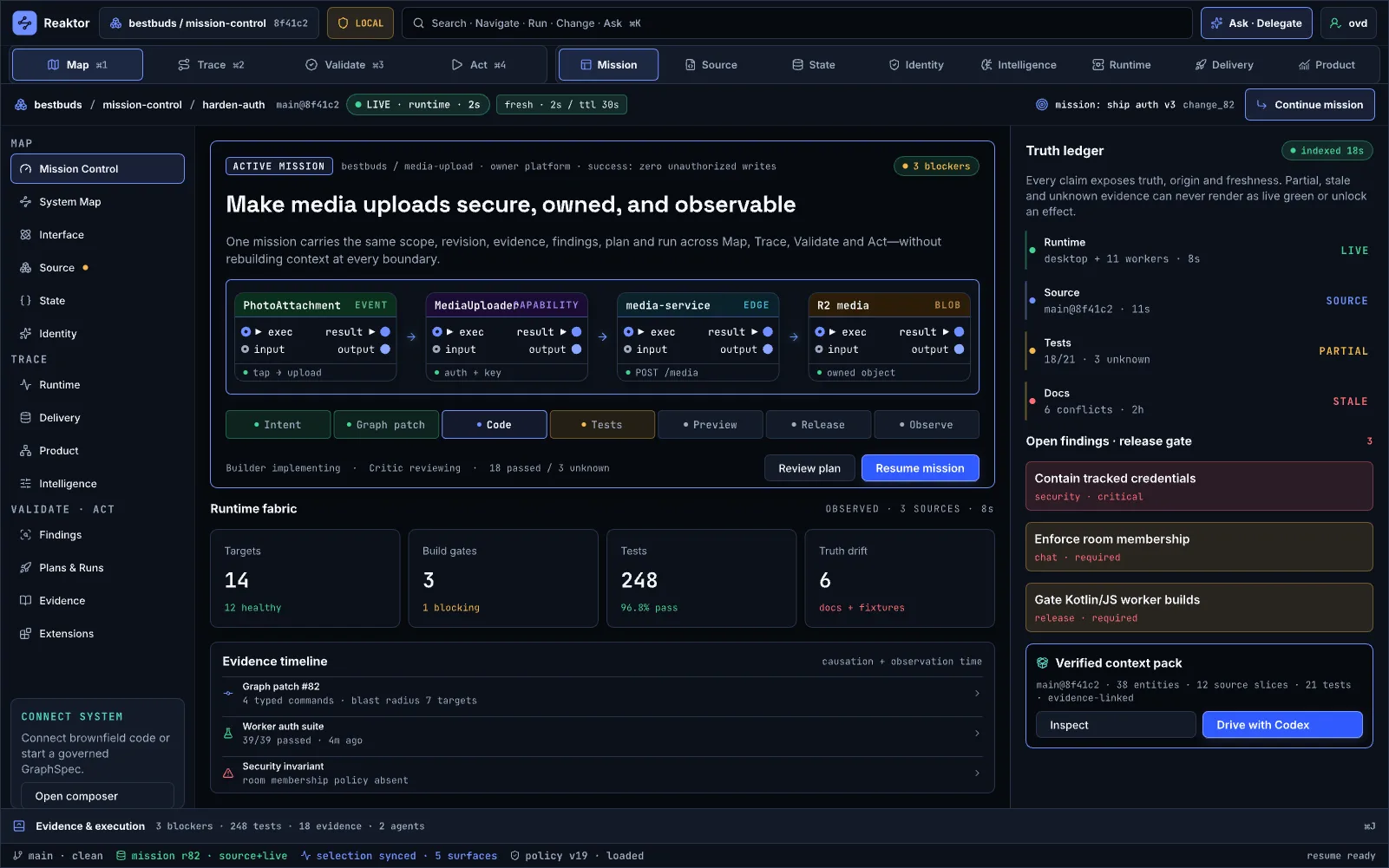
On the board. This is the atlas's densest board and its most complete shell. The top chrome carries the product mark, a breadcrumb "bestbuds / mission-control / harden-auth", a revision chip "8f41c2", an environment chip "LOCAL", a ⌘K command bar labelled "Search · Navigate · Run · Change · Ask", an "Ask · Delegate" affordance, and a principal chip "ovd". Below sit the four movement tabs with "⌘1"–"⌘4" and an instrument rail. The left rail groups navigation under MAP (Mission Control, System Map, Interface, Source, State, Identity), TRACE (Runtime, Delivery, Product, Intelligence) and "VALIDATE · ACT" (Findings, Plans & Runs, Evidence, Extensions), then a CONNECT SYSTEM card ("Connect brownfield code or start a governed GraphSpec. / Open composer"). The body carries an ACTIVE MISSION card ("bestbuds / media-upload · owner platform · success: zero unauthorized writes / 3 blockers"), a four-node port-graph strip (PhotoAttachment EVENT → MediaUploader CAPABILITY → media-service EDGE → R2 media BLOB, each with "▶ exec / result ▶ / input / output" and edge labels "tap → upload", "auth + key", "POST /media", "owned object"), a lifecycle ribbon ("Intent / Graph patch / Code / Tests / Preview / Release / Observe" with "Builder implementing · Critic reviewing · 18 passed / 3 unknown"), a "Runtime fabric / OBSERVED · 3 SOURCES · 8s" metric block (Targets 14, Build gates 3, Tests 248 at 96.8% pass, Truth drift 6), an evidence timeline, a truth ledger with four rows (Runtime LIVE, Source SOURCE, Tests PARTIAL, Docs STALE), an "Open findings · release gate" list of three, a "Verified context pack" card ("main@8f41c2 · 38 entities · 12 source slices · 21 tests · evidence-linked") with "Inspect" and "Drive with Codex", and a ⌘J evidence drawer. The status bar reads "main · clean / mission r82 · source+live / selection synced · 5 surfaces / policy v19 · loaded / resume ready".
Vision tie. This is the best single expression of §1 in the atlas. The mission strip is a typed port graph with real port kinds (EVENT, CAPABILITY, EDGE, BLOB) rather than boxes-and-arrows, so the eigenvector-primitive idea is visible as a first-class visual grammar. The "Truth ledger" and its rule — "Every claim exposes truth, origin and freshness. Partial, stale and unknown evidence can never render as live green or unlock an effect" — is the evidence discipline of §1 stated as a UI invariant, which is the correct place to state it. Agents-as-operators is present through "Builder implementing · Critic reviewing" and "Drive with Codex". What is absent is nesting: the mission graph is four flat nodes with no subgraph, so the "a feature is a subgraph of an app, an app is a node in a product" claim is asserted nowhere on the home board.
Workflow tie. This is the tab an engineer leaves open all day and the screen a lead opens at standup. The mission framing — one named objective carrying "the same scope, revision, evidence, findings, plan and run across Map, Trace, Validate and Act" — replaces the daily reconstruction of context across Linear, GitHub, Datadog and Slack. Today the same person opens five tabs and rebuilds the mental link between a ticket, a branch, a dashboard and an incident by hand.
Agentic tie. An agent reads a mission with an explicit success criterion ("zero unauthorized writes"), a blocker count, a typed graph patch ("Graph patch #82 / 4 typed commands · blast radius 7 targets"), and a pre-assembled context pack with entity, slice and test counts. That is unusually good agent input: blast radius is exactly the number an agent needs to decide whether to propose or escalate. Governance is present through the critic and "policy v19 · loaded". The weakness is that "Drive with Codex" and "Ask · Delegate" imply an agent may act, while the sibling boards 01.02–01.05 all say "Ask · Propose" and gate every effect behind "APPROVAL REQUIRED". The atlas has two different agent-authority models one board apart and never explains the difference.
Blueprint tie. This is not a Blueprint surface at all — it is the Unreal Project Launcher plus the Session Frontend, the place you pick what you are working on and see health. The port-graph strip is a Blueprint fragment embedded in a dashboard. The analogy breaks in a way that flatters Reaktor: Unreal has no notion of a mission carrying evidence across tools.
Replaces / augments. Linear or Jira (mission, blockers, owner), Backstage (service catalog and ownership), Datadog and Grafana (the runtime fabric tile), Sentry (open findings), GitHub's PR page (graph patch and review), and the Copilot Workspace / Codex task pane.
Improvements.
- Reconcile the three test counts. The board says "Tests 248 / 96.8% pass", "Tests 18/21 · 3 unknown", and "Worker auth suite 39/39 passed · 4m ago" with no relationship between them. Make the tile a single Test Ledger with columns for scope, run reference, passed, unknown and freshness, and give the 96.8% a
RunRefor delete it. - Attach a
TruthMarkandSourceRefto every number in the fabric tile individually rather than the one shared "OBSERVED · 3 SOURCES · 8s" header. Four counters currently inherit one provenance chip, which is the exact pattern §3 flags across 49 boards. - Add a Blocker row type to the ACTIVE MISSION card that names each of the "3 blockers" with its finding ID, owner and the effect it blocks. The count is on the board; the items are not, so the primary call to action ("Continue mission") has no target.
- Fix the instrument rail: it reads "Mission / Source / State / Identity / Intelligence / Runtime / Delivery / Product", silently substituting Mission for Interface. Either the constitution's eight instruments are wrong or this rail is. Restore Interface and move Mission to the breadcrumb where it belongs.
- Make the port-graph strip expandable in place. Add a disclosure control on MediaUploader that reveals its subgraph, so the home board demonstrates nesting — the one §1 idea it currently omits.
- Add a Capability tier chip to the MediaUploader node showing which tier is available on the current target. The node is already labelled CAPABILITY; showing the tier is what makes "branch on capability, never on platform" legible.
Verdict. Strengthen. This is the atlas's anchor board and it earns its density; the fixes are provenance and one taxonomy error, not structure.
01.02 · North Star · Auth System Slice
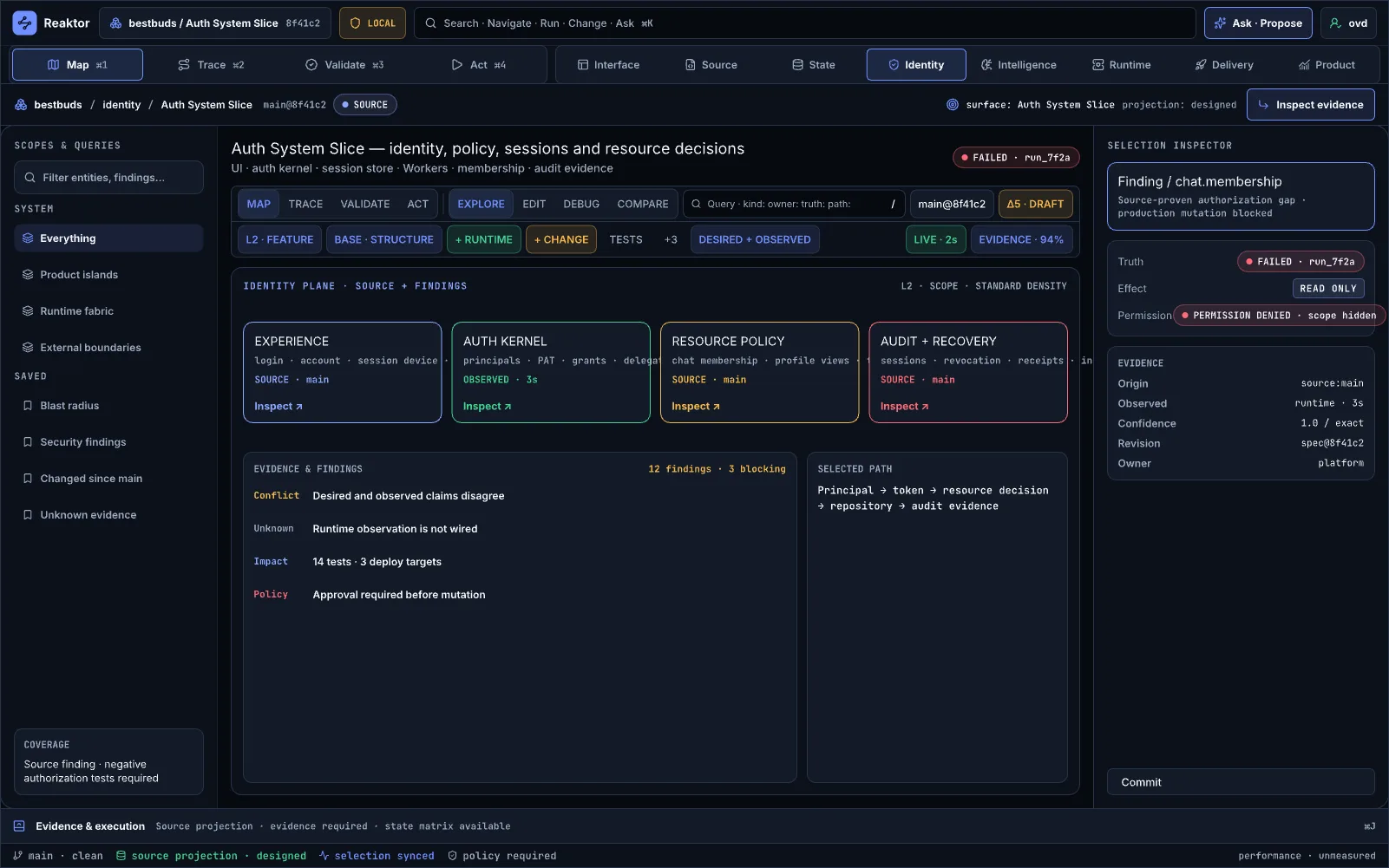
On the board. A four-quadrant slice of the identity plane inside the full System Studio shell. The header adds "surface: Auth System Slice / projection: designed / Inspect evidence". A SCOPES & QUERIES rail offers SYSTEM scopes ("Everything / Product islands / Runtime fabric / External boundaries") and SAVED queries ("Blast radius / Security findings / Changed since main / Unknown evidence") plus a COVERAGE line, here "Source finding · negative authorization tests required". The canvas header reads "Auth System Slice — identity, policy, sessions and resource decisions / UI · auth kernel · session store · Workers · membership · audit evidence" with a truth chip "FAILED · run_7f2a", and a control strip carrying MAP/TRACE/VALIDATE/ACT, EXPLORE/EDIT/DEBUG/COMPARE, a typed query field ("kind: owner: truth: path:"), "Δ5 · DRAFT", "L2 · FEATURE", layer toggles "BASE · STRUCTURE / + RUNTIME / + CHANGE / TESTS / +3", "DESIRED + OBSERVED", "LIVE · 2s" and "EVIDENCE · 94%". The four quadrants are EXPERIENCE ("login · account · session device · step-up", SOURCE · main), AUTH KERNEL ("principals · PAT · grants · delegation · authorization", OBSERVED · 3s), RESOURCE POLICY ("chat membership · profile views · tenant boundaries", SOURCE · main) and AUDIT + RECOVERY ("sessions · revocation · receipts · incident evidence", SOURCE · main). Right rail: EVIDENCE & FINDINGS ("12 findings · 3 blocking", Conflict / Unknown / Impact / Policy rows), SELECTED PATH ("Principal → token → resource decision → repository → audit evidence"), and a SELECTION INSPECTOR on "Finding / chat.membership — Source-proven authorization gap · production mutation blocked" with Truth "FAILED · run_7f2a", Effect "READ ONLY", Permission "PERMISSION DENIED · scope hidden", and an evidence block (Origin source
, Observed runtime · 3s, Confidence 1.0 / exact, Revision spec@8f41c2, Owner platform, Commit).Vision tie. Two ideas land well. The typed query grammar "kind: owner: truth: path:" is the visitor idea made into a control — a saved query named "Blast radius" is a traversal, not a search box, and "Unknown evidence" as a saved query is exactly the §1 claim that unreachable or unproven things are found by query rather than by reading files. The truth/effect/permission triple in the inspector, kept independent as the Symphony Contract requires, is the cleanest instance of that rule outside 13.03. Nesting is again absent: "L2 · FEATURE" implies levels L0–L4 but nothing on the board lets you descend.
Workflow tie. A platform engineer opens this the morning after a security review, or a reviewer opens it when a PR touches auth. Today that person reads the RBAC middleware, greps for the policy check, opens the Supabase policy list, and forms a private opinion with no artifact at the end. Here the artifact is a finding with an owner and a blocked effect.
Agentic tie. This is the most agent-legible board in my cluster. An agent reads a named finding (chat.membership), a truth class, a permission denial with a stated reason ("scope hidden"), a blast radius, and a selected path it can walk. It can propose a patch against "negative authorization tests required" and cannot execute one, because Effect is READ ONLY and Permission is denied. The governance model is visible in the data rather than described in prose, which is the right shape.
Blueprint tie. This is the Unreal asset validator combined with the reference viewer: a scoped subgraph with rule violations attached to specific nodes. It is not the debugger, because nothing here is stepping through execution.
Replaces / augments. Auth0 and Okta dashboards, AWS IAM Access Analyzer, Supabase RLS policy editor, Snyk and Semgrep findings triage, and the security-review spreadsheet.
Improvements.
- Split the "12 findings · 3 blocking" summary into a real finding list with severity, owner, first-seen and blocked-effect columns. Twelve findings behind one number is the atlas's most repeated compression, and this board is the right place to break the habit because it has a named finding already.
- Add a negative-test coverage column to the quadrants. The COVERAGE line asks for "negative authorization tests required" and no quadrant shows whether one exists. Per §2 the real answer for chat membership is zero, and showing that zero is more valuable than the finding.
- Make "EVIDENCE · 94%" clickable to a denominator. Ninety-four percent of what, measured when, over which entities — as written it is the exact kind of unmarked assertion the truth ledger on 01.01 forbids.
- Add the audit's own security findings as a saved query. The rail already has "Security findings"; wire it to
S-1…S-12so the board shows twelve real defects instead of twelve invented ones. - Replace "Confidence 1.0 / exact" with a confidence that can vary. A constant 1.0 across every North Star board makes the field decorative.
Verdict. Strengthen. This is the template the other three slices should have been differentiated from, and its headline finding is one of the few in the atlas that matches the audit.
01.03 · North Star · System Fabric
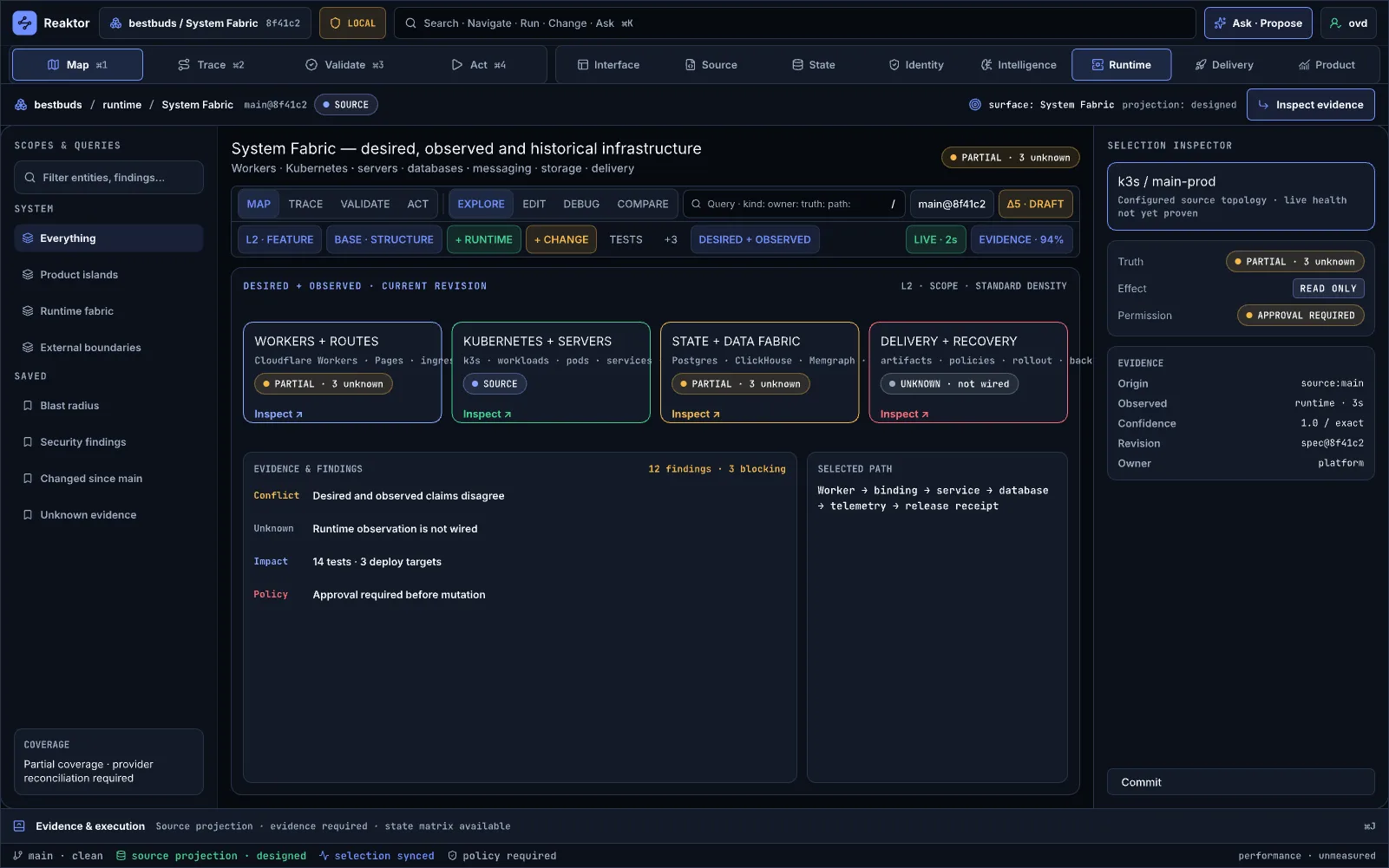
On the board. Structurally identical to 01.02 — a byte-for-byte match on 106 of its 134 lines. The differences are the breadcrumb ("bestbuds / runtime / System Fabric"), the COVERAGE line ("Partial coverage · provider reconciliation required"), the canvas title ("System Fabric — desired, observed and historical infrastructure / Workers · Kubernetes · servers · databases · messaging · storage · delivery"), a canvas truth chip "PARTIAL · 3 unknown", the plane label "DESIRED + OBSERVED · CURRENT REVISION", four quadrants — WORKERS + ROUTES ("Cloudflare Workers · Pages · ingress · bindings", PARTIAL · 3 unknown), KUBERNETES + SERVERS ("k3s · workloads · pods · services · hosts · processes", SOURCE), STATE + DATA FABRIC ("Postgres · ClickHouse · Memgraph · D1 · DO · ObjectDatabase", PARTIAL · 3 unknown), DELIVERY + RECOVERY ("artifacts · policies · rollout · backup · restore evidence", UNKNOWN · not wired) — a SELECTED PATH ("Worker → binding → service → database → telemetry → release receipt"), and an inspector on "k3s / main-prod — Configured source topology · live health not yet proven" with Truth "PARTIAL · 3 unknown" and Permission "APPROVAL REQUIRED".
Vision tie. This is the opinionated-stack idea, and it is the only board in my cluster that varies its truth chips per quadrant rather than inheriting them from a template. "DELIVERY + RECOVERY / UNKNOWN · not wired" is a real NotWiredYet in §1's sense — it states what is missing instead of inventing a number — and "Configured source topology · live health not yet proven" is an honest sentence. The board is a desired-versus-observed reconciliation surface, which is the correct shape for infrastructure and matches the DESIRED + OBSERVED dual plane that §3 identifies as the model pattern on 13.03.
Workflow tie. The platform on-call opens this at the start of a shift or during an incident to answer "what is actually running". Today that is the Cloudflare dashboard in one tab, kubectl get pods in a terminal, and the Postgres console in a third, with the desired state living in Pulumi files nobody diffs against reality.
Agentic tie. Good input, weak governance detail. An agent can read that three things are unknown and that delivery is unwired, which is enough to refuse a confident answer. But there is no per-quadrant reconciler identity — nothing says which provider API produced the observed side, so an agent cannot tell whether "3 unknown" means the API failed, the resource is absent, or nobody has wired the collector. Add that and this becomes a strong agent surface.
Blueprint tie. The Unreal level outliner for infrastructure, with a device-profile overlay: a hierarchical inventory of what exists in the world, annotated by what each target supports. It is not the profiler; no timing appears here.
Replaces / augments. Cloudflare dashboard, Lens or k9s, Pulumi and Terraform state inspection, Backstage's resource catalog, and AWS Config style drift detection.
Improvements.
- Add a Reconciler column per quadrant naming the source of the observed side and its last successful poll, so "PARTIAL · 3 unknown" resolves into which collector is missing.
- Add an explicit Drift row that lists desired-versus-observed disagreements as items rather than as the generic "Conflict / Desired and observed claims disagree" chip repeated on all four North Star boards.
- Fix the internal contradiction: the footer says "source projection · designed" and the inspector says "Observed runtime · 3s". A designed projection cannot carry a three-second-old observation. Either suppress the Observed field when the projection is designed, or show it as
NotWiredYet. - Add a queue entity to STATE + DATA FABRIC and mark it
UNKNOWN · not wired. Per §2 the distributed plane has no queues at all and every pipeline iswaitUntilfire-and-forget; a fabric board that does not show the absence of queues is hiding the platform's largest structural risk. - Give DELIVERY + RECOVERY a restore-drill timestamp field, permanently empty until one runs. Backup without a proven restore is the quadrant's whole point.
Verdict. Strengthen. Structurally the most honest of the four slices; it needs reconciler provenance and one contradiction removed.
01.04 · North Star · Agent OS
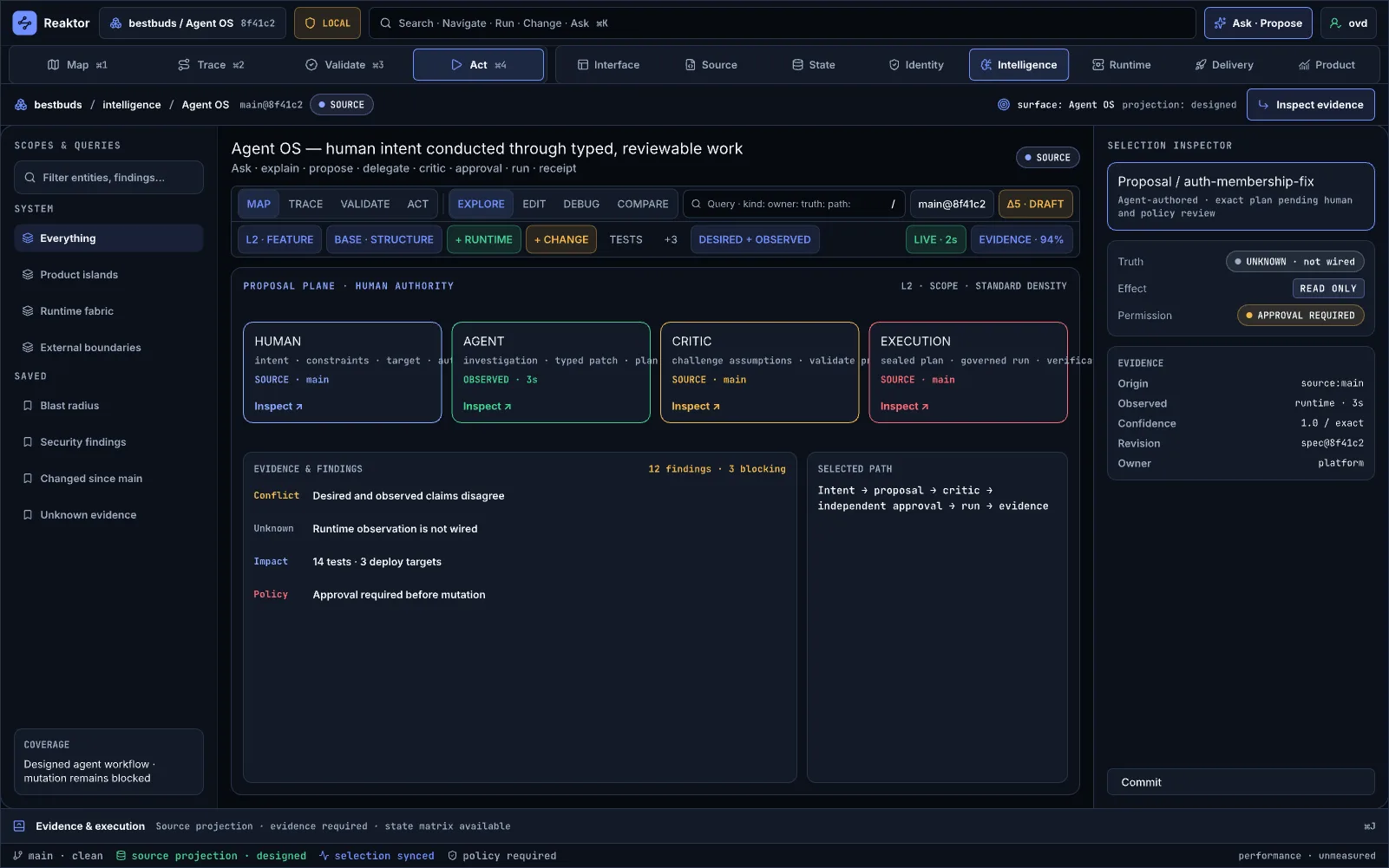
On the board. The same shell and the same 106 shared lines again. The breadcrumb is "bestbuds / intelligence / Agent OS", the COVERAGE line is "Designed agent workflow · mutation remains blocked", the canvas reads "Agent OS — human intent conducted through typed, reviewable work / Ask · explain · propose · delegate · critic · approval · run · receipt" under a bare "SOURCE" chip, and the plane is labelled "PROPOSAL PLANE · HUMAN AUTHORITY". The four quadrants are HUMAN ("intent · constraints · target · authority · approval"), AGENT ("investigation · typed patch · plan · evidence collection"), CRITIC ("challenge assumptions · validate proof · never self-approve") and EXECUTION ("sealed plan · governed run · verification · receipt"). SELECTED PATH is "Intent → proposal → critic → independent approval → run → evidence". The inspector shows "Proposal / auth-membership-fix — Agent-authored · exact plan pending human and policy review" with Truth "UNKNOWN · not wired", Effect "READ ONLY", Permission "APPROVAL REQUIRED", and the shared evidence block including "Confidence 1.0 / exact".
Vision tie. This is §1's agents-as-first-class-operators idea and it is the clearest statement of it anywhere in the atlas. "never self-approve" is a governance invariant expressed in four words, and the separation of HUMAN, AGENT, CRITIC and EXECUTION into distinct planes with a one-way path through independent approval is a real architectural position, not a diagram. What the board does not show is the §1 differentiator — that the agent reads the floor plan, a typed introspectable graph, rather than a tool list. Nothing here distinguishes Reaktor's agent from an MCP client.
Workflow tie. An engineering lead opens this when deciding how much autonomy to grant, and a reviewer opens it when an agent-authored patch arrives. Today the equivalent is a CODEOWNERS file plus a private convention about which bot PRs may auto-merge.
Agentic tie. The board is about agents but is not itself agent-legible: the quadrants are prose lists of nouns, not typed structures. An agent reading this cannot determine what a "sealed plan" contains, what a critic's rejection looks like as data, or which scopes an approval grants. This is the board where a schema matters most and there is none.
Blueprint tie. The Unreal build and cook pipeline with a submit gate: a proposal is compiled, validated, and only then permitted to produce artifacts. The analogy breaks because Unreal has no critic and no notion of an author whose authority differs from the approver's.
Improvements.
- Add a Proposal schema pane showing the actual fields of a sealed plan — typed commands, blast radius, expiry, principal, revision, required approvals — so an agent can construct one. 01.01 already asserts "4 typed commands · blast radius 7 targets"; put the type behind it here.
- Add a Critic verdict state set with real states (accepted, challenged with counterexample, insufficient evidence, out of scope) and show what each blocks. "validate proof" is currently an aspiration with no artifact.
- Add an Authority matrix sub-pane mapping principal to permitted effects, and reconcile "Ask · Propose" here with "Ask · Delegate" on 01.01. Two agent-authority models one board apart is a governance defect, not a copy inconsistency.
- Delete "Confidence 1.0 / exact" from this board or set it to unknown. A board whose own Truth chip reads "UNKNOWN · not wired" cannot carry exact confidence in the same inspector, and this contradiction is on-screen twice.
- Add a Receipt exemplar showing one immutable receipt's fields. Act's output on the constitution board is "immutable receipt" and no board in the atlas shows one.
Verdict. Strengthen, and give it the schema it is missing. The governance model is right; the board is currently prose.
01.05 · North Star · Knowledge Atlas
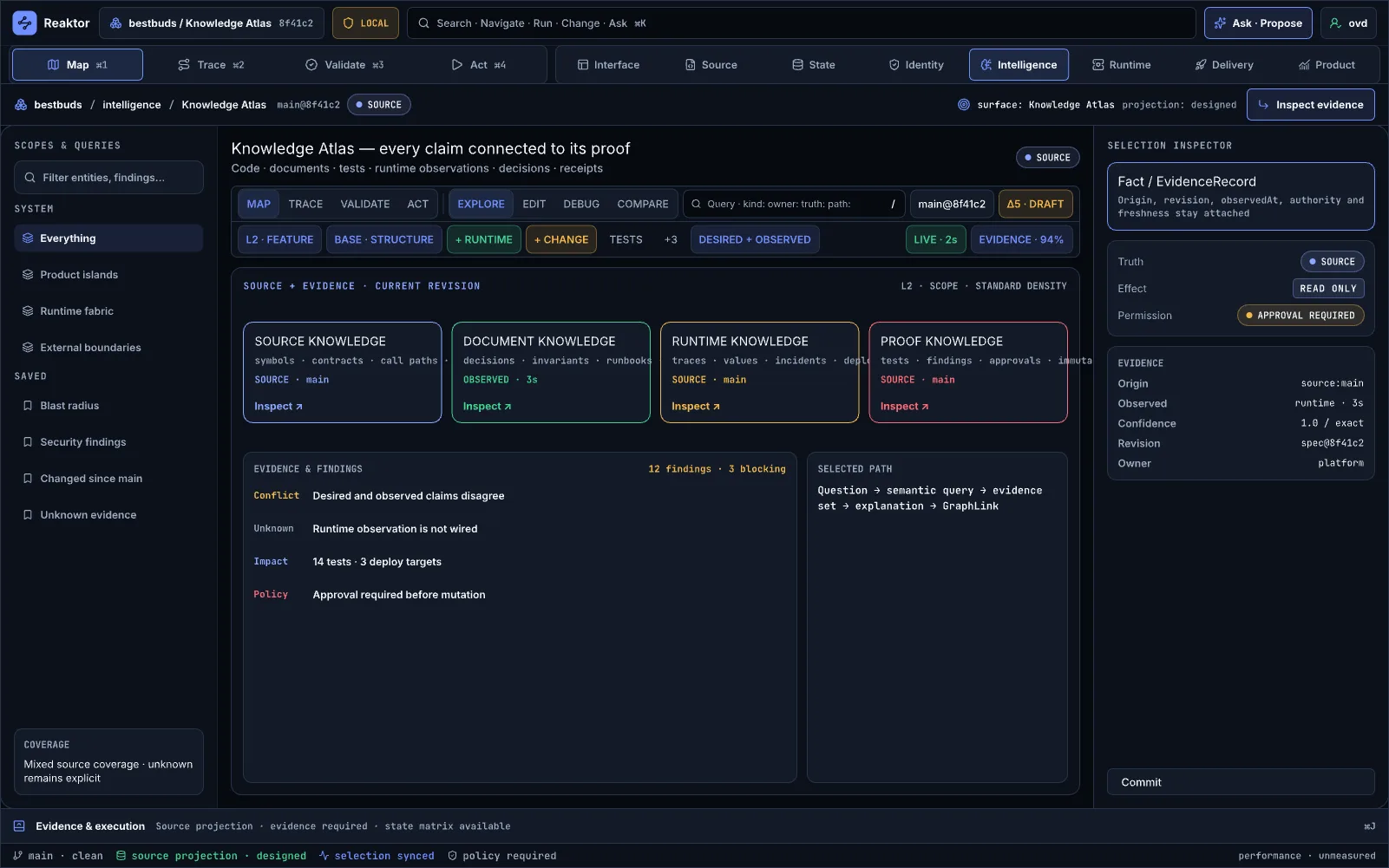
On the board. The same template a fourth time, differing from 01.04 in twenty lines. Breadcrumb "bestbuds / intelligence / Knowledge Atlas", COVERAGE "Mixed source coverage · unknown remains explicit", canvas "Knowledge Atlas — every claim connected to its proof / Code · documents · tests · runtime observations · decisions · receipts", plane "SOURCE + EVIDENCE · CURRENT REVISION". Quadrants: SOURCE KNOWLEDGE ("symbols · contracts · call paths · ownership"), DOCUMENT KNOWLEDGE ("decisions · invariants · runbooks · architecture"), RUNTIME KNOWLEDGE ("traces · values · incidents · deployment evidence"), PROOF KNOWLEDGE ("tests · findings · approvals · immutable receipts"). SELECTED PATH is "Question → semantic query → evidence set → explanation → GraphLink". The inspector is on "Fact / EvidenceRecord — Origin, revision, observedAt, authority and freshness stay attached" with Truth "SOURCE".
Vision tie. This is §1's evidence idea and it names the actual type — Fact / EvidenceRecord with "Origin, revision, observedAt, authority and freshness" — which is more concrete than any other North Star board manages. It is also the only board in my cluster that names "invariants" (inside DOCUMENT KNOWLEDGE), which is a thin thread to the verification program but a real one. The board is the atlas's answer to "how does the diagram avoid lying", and it is placed correctly as a North Star rather than a feature.
Workflow tie. Anyone answering "why do we believe this" opens this — a new joiner tracing a decision, an engineer writing a postmortem, an auditor asking for the evidence behind a compliance claim. Today that means grep, a stale ADR folder, a Confluence page, and asking whoever has been here longest.
Agentic tie. Potentially the highest-value board in the atlas for an agent, because "Question → semantic query → evidence set → explanation → GraphLink" is a retrieval contract with a citable output. But it is unusable today: there is no query pane, no result list, no evidence set rendered, and no GraphLink shown. The board describes a capability rather than demonstrating one, which for the board whose subject is proof is a self-defeating choice.
Blueprint tie. The Unreal content browser plus reference viewer — an indexed store of every asset with backward and forward references. The analogy is unusually good, and the gap is that Unreal's reference viewer actually shows edges while this shows four labelled boxes.
Replaces / augments. Backstage TechDocs, Confluence and Notion architecture pages, Sourcegraph, ADR repositories, and the evidence-collection step of a SOC 2 audit.
Improvements.
- Add a working Question pane with one worked example: a question, the semantic query it compiled to, the evidence set returned with per-item truth marks, and the GraphLink produced. One end-to-end example is worth all four quadrants.
- Make the quadrant truth chips vary. All four inherit the template's positional pattern — SOURCE, OBSERVED · 3s, SOURCE, SOURCE — so DOCUMENT KNOWLEDGE claims a three-second-old runtime observation of a documentation corpus. Truth marks that are template artifacts are worse than no truth marks.
- Add a Conflict class to PROOF KNOWLEDGE for claims where document and runtime disagree, and wire it to 01.01's "Truth drift 6 / docs + fixtures". Two boards already gesture at the same phenomenon with different names.
- Add an Invariant entity type as a first-class row under DOCUMENT KNOWLEDGE, listing
INV-*identifiers with their proof status. §2's L1 tier is written invariants; this is the one board where they already almost live. - Add a Staleness control that lets the reader filter the whole atlas to claims older than a chosen TTL, mirroring 01.01's "fresh · 2s / ttl 30s".
Verdict. Strengthen. Right subject, right placement, but it must demonstrate one query rather than describe four categories.
SECTION 01–13 banners (thirteen boards, grouped)
On the board. Thirteen near-identical dividers. Each carries a "+" glyph, a two-digit number, a title, a one-line description, a surface count, and a "READ →" control. The descriptions are the only real content: 01 "Begin with the product thesis and its complete system model", 02 "Turn intent, primitives, and product capabilities into features", 03 "Operate safely across languages, legacy systems, and placement constraints", 04 "Zoom from the whole distributed system into ports, wires, and edits", 05 "The UI grammar, command surface, drawers, and visual verification", 06 "Preview, storyboard, record, trace, and test without losing causality", 07 "Validate targets, execute pipelines, release, and pass deployment gates", 08 "Move from a bounded session through orchestration, context, and audit", 09 "Identity, policy, data shape, migrations, and durable history", 10 "Trace, measure, profile, classify, and route signals into action", 11 "Connect product outcomes to experiments, cost, and decisions", 12 "Compose models, retrieval, prompts, evaluation, notebooks, and traces", 13 "Inspect cloud cells and project the graph across languages and tools". Section 05 uniquely reads "LIBRARY ↗ + 4 SURFACES" rather than a plain count.
Is the taxonomy right? No, in four specific ways.
The counts are wrong. Section 04 declares "6 SURFACES" and contains ten boards (04.01, 04.02, 04.03, 04.04, 04.05, 04.06, 04.06A, 04.06B, 04.07, 04.08) — eight even if the A/B variants are excluded. Twelve of the thirteen counts are correct and one is stale, which is exactly the failure mode the atlas exists to prevent: a hand-maintained number that drifted from the thing it counts. This is a one-line, undeniable proof that the atlas needs the truth vocabulary applied to itself.
Twenty boards belong to no section. The atlas has 104 boards: thirteen banners, START HERE, the reference library board, and 69 numbered surfaces — leaving 20 STATE boards (ten Composer states, five Deploy states, five System Studio Shell states) with no section number and no banner. That is 19% of the atlas outside the taxonomy entirely. They are not junk; the Composer set is a complete five-step wizard with five provisioning outcomes including Failed, Retry and Rollback, which is more state coverage than most sections have. They are simply unfiled.
The sections use a different vocabulary from the constitution. Section titles are legacy verbs and domains — Ship, Observe, Learn, Trust, AI Engineering — while the constitution declares Map, Trace, Validate and Act. Section 10 OBSERVE is Trace. Sections 07 and 08 are Act. Section 04 is Map. No banner names a movement. A reader who internalises the constitution cannot use the sections, and a reader who navigates by section never encounters the constitution again.
Three sections are miscategorised. Section 03 GOVERN / EXTEND / SCALE is a grab-bag whose title needs three slashes and whose four boards belong in three different places: Visitor Lab is graph substrate, Polyglot Boundary Studio belongs with the FFI Switchboard, Brownfield Atlas belongs with the Composer, and Constraint Optimizer belongs with placement and deployment. Section 05 INTERFACE SYSTEM is the atlas's own design-system reference library — its banner admits this with "LIBRARY ↗" — and does not belong in the numbered product spine. Sections 08 and 12 split one instrument across two sections, with overlapping content (08.04 MCP & Memory against 12.04 RAG; 12.07 AI Traces against 10.01 Spans).
Vision tie. The banners embody nothing from §1. They are navigational furniture. The one place they could have carried the vision — a per-section statement of which load-bearing idea it serves — is unused.
Workflow tie. Nobody opens a banner deliberately; they are scroll landmarks in a canvas. That is fine, but it means the surface counts are read only in passing, which is how one of them drifted.
Agentic tie. These are the atlas's only index structure and they are hostile to an agent: a count with no list, a title with no ID range, a "READ →" with no target. An agent cannot enumerate the atlas from them.
Blueprint tie. Content-browser folders. Nothing more.
Improvements.
- Replace the hand-typed surface count with a computed count plus a
FreshnessStamp, and show the wiring split beside it — for example "10 surfaces · 4 wired · 6 designed". Section 04's wrong "6" is the proof this is needed. - List the board IDs on each banner. A section divider that names its members is an index; one that names a number is decoration.
- Add a movement badge to each banner mapping the section onto Map, Trace, Validate or Act, which forces the two taxonomies into one place and makes the missing Validate section visible.
- Dock the twenty orphan STATE boards under their parent surface with an explicit "states" strip on the parent's banner, so 02.01 shows "10 states" and 07.04 shows "5 states".
- Add a per-section owner field. Every North Star inspector carries "Owner / platform"; sections carry none.
Verdict. Rebuild. Keep the banner as an object; replace the taxonomy it expresses.
REFERENCE LIBRARY · MACHINE SIGNAL

On the board. The smallest board in the atlas at 172 characters. It carries a "+", the title "MACHINE SIGNAL LIBRARY", the line "Tokens · primitives · shell · graph chrome · system states", and the reference "05.00 · REFERENCE". It is a pointer to the 14,507-character 05.00 · Interface System — Machine Signal Design System board.
Vision tie. Indirectly, the eigenvector-primitive idea applied to the UI rather than the system: one token set and one component grammar spanning every surface. The five categories named — tokens, primitives, shell, graph chrome, system states — are a reasonable decomposition, and "graph chrome" as a distinct category is the right recognition that a graph editor needs its own visual vocabulary.
Workflow tie. A designer opens 05.00 when adding a surface; nobody opens this stub, which exists only so the canvas has a labelled entrance to the library.
Agentic tie. As a pointer it is inert. Its useful form would be a token manifest an agent can read to generate a compliant surface, which is exactly what the desktop implementation needs given §2's finding that roughly 30 of 74 panes are genuinely wired.
Blueprint tie. The Unreal engine content folder — the shared material and widget library every project draws from.
Replaces / augments. A Figma library page, Storybook's docs index, a design-tokens repository.
Improvements.
- Give it a coverage counter: how many of the atlas's 1,457 component instances come from the library versus are one-off. That single number tells the designer whether the design system is real.
- Add a truth-vocabulary usage row. §3 establishes that the truth components are used 36 times atlas-wide, 20 of them on the catalog board, with four components at zero uses. The library entrance is where that fact should be visible to the person who can fix it.
- Merge this stub into the section 05 banner. Two navigational objects pointing at the same board is redundant chrome, and the section 05 banner already says "LIBRARY ↗".
Verdict. Merge into SECTION 05 banner.
Cluster findings
Missing panes.
- 01.06 · North Star · Assurance. There is no North Star for correctness. Four of five North Stars are about knowing the system and one is about agents; none is about proving anything. §2's L0–L5 ladder and the one-fingerprint keystone are the product's entire credibility argument and have no entry point in the atlas.
- Section 07 · Assurance (a whole missing section). Boards for L0 CI & Hygiene, L1 Invariants & Defect Burn-down (
INV-*,D-*), L2 Property, Lincheck & Differential Conformance, L3 Model Checking (TLA+/Quint), L4 Proofs (Lean 4), and L5 Deterministic Simulation. Justified by §2: the verification program is agreed and the atlas depicts none of it. - Fingerprint Registry. One board showing the single fingerprint unifying port type identity, codec layout identity and FFI method identity, with the
D-6unsoundness rendered as a live defect —Typebeing(String, KClass?)where the string path connects mismatched classes. §2 names this the keystone primitive; it appears twice in 104 boards. - Defect Board (
D-*) and Security Findings Board (S-1…S-12). 01.02 shows one invented finding while twelve real ones exist, including "any authenticated user can join any chat room" and moderation failing open. The atlas has a saved query named "Security findings" pointing at nothing real. - Graph Code Push. §1 lists marked subgraphs updating and rewiring at runtime, delivered as Kotlin/JS through Hermes with typed boundaries, as a load-bearing idea. No board in the 104 depicts it.
- Capability & Adapter Matrix. Targets down one axis, capability tiers across, with designed degradation per cell. §1's "product code branches on capability, never on platform" currently exists as one wizard step and one node badge.
- Saga / Choreography. Cross-system flows as saga graphs executed by visitors, with session-typed wires. §1 names it; sections 08 and 12 cover agent task DAGs instead, which is a different thing.
- Queue & Backpressure. §2 says the distributed plane has no queues at all and every pipeline is
waitUntilfire-and-forget, with no idempotency in notifications. This is the largest single runtime risk in the audit and no board shows it, not even as absent. - Atlas Self-Map. A board that indexes the atlas — every surface with its section, movement, instrument, wiring state and freshness. The section-04 count being wrong proves the index is currently maintained by hand.
Seams.
- Two taxonomies, never reconciled. The constitution declares movements and instruments; the thirteen sections use legacy domain verbs. Only 15 of 69 numbered boards name a movement, and only 11 name an instrument. The claim that every board is a cell is false by the atlas's own naming.
- Twenty unfiled boards. The Composer, Deploy and Shell state sets have no section, no banner and no parent link, so 19% of the atlas is reachable only by scrolling.
- The instrument rail disagrees with the constitution. 01.01 lists "Mission" where the constitution lists "Interface". The first board a reader opens after the constitution contradicts it.
- Two agent-authority models. 01.01 offers "Ask · Delegate"; 01.02–01.05 offer "Ask · Propose" and gate everything behind "APPROVAL REQUIRED". The difference is never explained and is a governance question, not a label.
- The constitution is outside the system it governs. START HERE has no shell, no ⌘K, no breadcrumb, no revision chip, no ⌘J drawer and no selection. It cannot demonstrate "selection survives every movement" because it has no selection.
- Template inheritance masquerading as evidence. 01.02, 01.04 and 01.05 carry the identical positional truth pattern — SOURCE · main, OBSERVED · 3s, SOURCE · main, SOURCE · main — across entirely different subject matter. Only 01.03 varied its chips. The one vocabulary the atlas says can never be faked is being inherited from a layout.
- Selection does not visibly survive. All four slice boards say "selection synced" in the footer, but no two boards share a selectable entity, so the promise is asserted five times and demonstrated zero times.
- Section 05 has two entrances. The section banner and the REFERENCE LIBRARY stub both point at 05.00.
Honesty audit.
01.01 Mission Control is the worst offender in the cluster, with roughly 61 numeric tokens and one shared provenance chip. "Tests 248 / 96.8% pass" is invented — §2 establishes that no CI exists, that 12 of 30 framework modules have zero tests, and that a green build proves three modules' JVM tests plus about fifteen source-text conventions. The board also asserts "18/21 · 3 unknown" and "39/39 passed · 4m ago" for the same subject without reconciliation, and "policy v19 · loaded" implies a versioned policy engine the audit does not support. The honest version keeps the layout and shows "Tests · 3 modules covered · 18 of 30 modules untested · no CI run · NotWiredYet", with the build-gate tile reading "Gates · 0 automated · 1 manual dispatch".
01.02 Auth System Slice tells a true story with an invented citation. The finding "chat.membership — Source-proven authorization gap" matches §2's real defect that any authenticated user can join any chat room, which is to the board's credit. But "FAILED · run_7f2a" cites a run that cannot exist, "EVIDENCE · 94%" has no denominator, and "Confidence 1.0 / exact" is asserted for a claim with no run behind it. The honest version replaces the run reference with SourceRef to the policy file and the missing negative test, and sets confidence to reflect a source-only claim.
01.03 System Fabric is the most honest board in the cluster and still contradicts itself: the footer declares "source projection · designed" while the inspector reports "Observed / runtime · 3s". Its "PARTIAL · 3 unknown" and "UNKNOWN · not wired" chips are good practice. The honest version drops the Observed field wherever the projection is designed, and adds a queue entity marked absent.
01.04 Agent OS carries the sharpest single contradiction in the cluster: Truth reads "UNKNOWN · not wired" and, six lines later in the same inspector, Confidence reads "1.0 / exact". Exact confidence in an unwired claim is the precise failure the truth ledger on 01.01 forbids. The honest version sets confidence to unknown and marks EXECUTION as NotWiredYet, since no sealed-plan schema, critic verdict type or receipt exists in code.
01.05 Knowledge Atlas asserts "OBSERVED · 3s" over DOCUMENT KNOWLEDGE, claiming a three-second-old runtime observation of a documentation corpus, purely because that is the second quadrant's inherited chip. The honest version marks documents STALE with a real age, matching 01.01's own "Docs / 6 conflicts · 2h".
00 START HERE asserts little numerically — seven numeric tokens, the lowest in the cluster — but its one disclosure, "implementation proof varies by surface", is the atlas's entire credibility problem compressed into six unquantified words. The honest version is a counter: 69 surfaces designed, roughly 30 wired, 0 proven.
The section banners assert thirteen surface counts, one of which is wrong: section 04 claims six and holds ten.
Atlas taxonomy verdict
Should the atlas keep 13 sections? No. The right answer is eleven numbered sections plus two lettered appendices — but the count is a side effect, not the point. The count changes because three of the thirteen sections are miscategorised, one section that must exist is missing, and twenty boards belong to no section at all.
The four reasons to change are all evidenced above. Section 03 is a grab-bag whose title needs three slashes and whose four boards belong in three other sections. Section 05 is the atlas's own design-system library sitting in the numbered product spine, which its own banner admits with "LIBRARY ↗". Sections 08 and 12 split one instrument across two sections with duplicated content. And there is no section for assurance, which per §2 is the product's entire credibility argument — the L0–L5 ladder and the one-fingerprint keystone appear nowhere in 104 boards, while the words "lincheck", "property test", "model check", "differential" and "counterexample" appear zero times each.
The section list after a revamp:
| # | Section | Movement | Composition |
|---|---|---|---|
| 00 | START HERE — The Contract | — | Rebuilt: adds the 4 × 8 cell-coverage grid, the wiring ledger, and the Validate ladder |
| 01 | North Star | all | 01.01–01.05 plus a new 01.06 Assurance North Star |
| 02 | Compose | Act | 02.01 Composer, 02.02 Design System Graph, 02.03 Primitive Atlas, 02.04 BestBuds Feature Graph, plus 03.03 Brownfield Atlas; the ten Composer STATE boards docked beneath 02.01 |
| 03 | Graph Substrate | Map | All of old 04 including the A/B connection variants, plus 03.01 Visitor Lab and 13.04 Graph Projections |
| 04 | Inner Loop | Map + Trace | Old 06 in full, plus 05.02 Responsive & Visual Tests |
| 05 | Assurance | Validate | New. L0 CI & Hygiene, L1 Invariants & Defects, L2 Property/Lincheck/Differential, L3 Model Checking, L4 Proofs, L5 Deterministic Simulation, Fingerprint Registry |
| 06 | State & Data | Map + Act | 09.04 Data Studio, 09.05 Query Plan & Governed Migrations, 09.06 Data Evidence & History |
| 07 | Identity & Trust | Validate | 09.01 Policy/RBAC, 09.02 Auth Sessions, 09.03 Security Simulator, plus a new Security Findings board carrying S-1…S-12 |
| 08 | Ship & Operate | Act + Trace | Old 07 and old 10 merged, plus 03.04 Constraint Optimizer; the five Deploy STATE boards docked beneath the deployment board |
| 09 | Intelligence | all | Old 08 and old 12 merged and de-duplicated, with 12.07 AI Traces folded into the tracing board and 08.04 MCP & Memory reconciled with 12.04 RAG |
| 10 | Product & Economics | Trace | Old 11 unchanged |
| 11 | Boundary & Extensibility | Map + Act | 13.01, 13.02, 13.03 FFI Switchboard, plus 03.02 Polyglot Boundary Studio and a new Graph Code Push board |
| L | Machine Signal Library (appendix) | — | 05.00, 05.01 Atomic Catalog, 05.03 Command Palette, 05.04 Drawer States, plus the five Shell STATE boards; absorbs the REFERENCE LIBRARY stub |
| S | State Matrix (appendix) | — | An index of every state set with its parent surface, so no board is unfiled |
Justification against the vision and the audit. Section 05 Assurance is non-negotiable: §1's thesis is that "the diagram cannot lie", and a diagram with no proof apparatus is a diagram that merely has not been caught lying yet. §2 makes the stakes concrete — port type identity is unsound, lifecycle fires effects on rejected transitions, actors can double-start, FlexBuffers has no bounds checks on the read path — and every one of those is a board in section 05 today rendered as a live defect with an owner. Section 11 Boundary & Extensibility gathers the polyglot data plane into one place because §1 treats it as a single idea and §3 identifies 13.03 as the atlas's model board; splitting its neighbours across sections 03 and 13 wastes the best pattern in the document. Merging 08 and 12 removes the atlas's largest duplication and stops one instrument consuming 17% of the numbered spine. Demoting the design system to an appendix is a statement about what the atlas is for: it is a product atlas, and its own UI kit is a tool, not a product surface.
Finally, whatever section count survives, the banners must stop hand-typing their counts. One of the thirteen is already wrong.
Part 5 · Section 02–03 — Create, Govern, Extend, Scale
Eight boards: 02.01, 02.02, 02.03, 02.04, 03.01, 03.02, 03.03, 03.04. Extended treatment for 02.03 Primitive Atlas and 03.01 Visitor Lab. Explicit ruling on 03.02 versus 13.03.
A structural fact governs everything below, so it is stated once here rather than repeated eight times. Seven of my eight boards — every board except 02.01 — are the same artboard with roughly twelve lines changed. They share, verbatim, the scope rail (Everything, Product islands, Runtime fabric, External boundaries, Blast radius, Security findings, Changed since main, Unknown evidence), the lens strip (Δ5 · DRAFT, L2 · FEATURE, DESIRED + OBSERVED, LIVE · 2s, EVIDENCE · 94%), the entire EVIDENCE & FINDINGS block (12 findings · 3 blocking, Conflict — Desired and observed claims disagree, Unknown — Runtime observation is not wired, Impact — 14 tests · 3 deploy targets, Policy — Approval required before mutation), the evidence stamp (Origin source:main, Observed runtime · 3s, Confidence 1.0 / exact, Revision spec@8f41c2, Owner platform), and the footer (policy required, performance · unmeasured). What actually varies per board is the coverage line, the title and subtitle, one plane label, four card headings with a subtitle each, one SELECTED PATH string, and one two-line SELECTION INSPECTOR. Across the atlas, 12 findings · 3 blocking appears on 17 boards, EVIDENCE · 94% on 20, and Runtime observation is not wired and 1.0 / exact on 17 each. This is not a stylistic observation. It means the finding count, the evidence percentage and the confidence rating are chrome rather than data, and it is the root cause of most of the honesty problems recorded at the end.
02.01 · Create · New System Composer
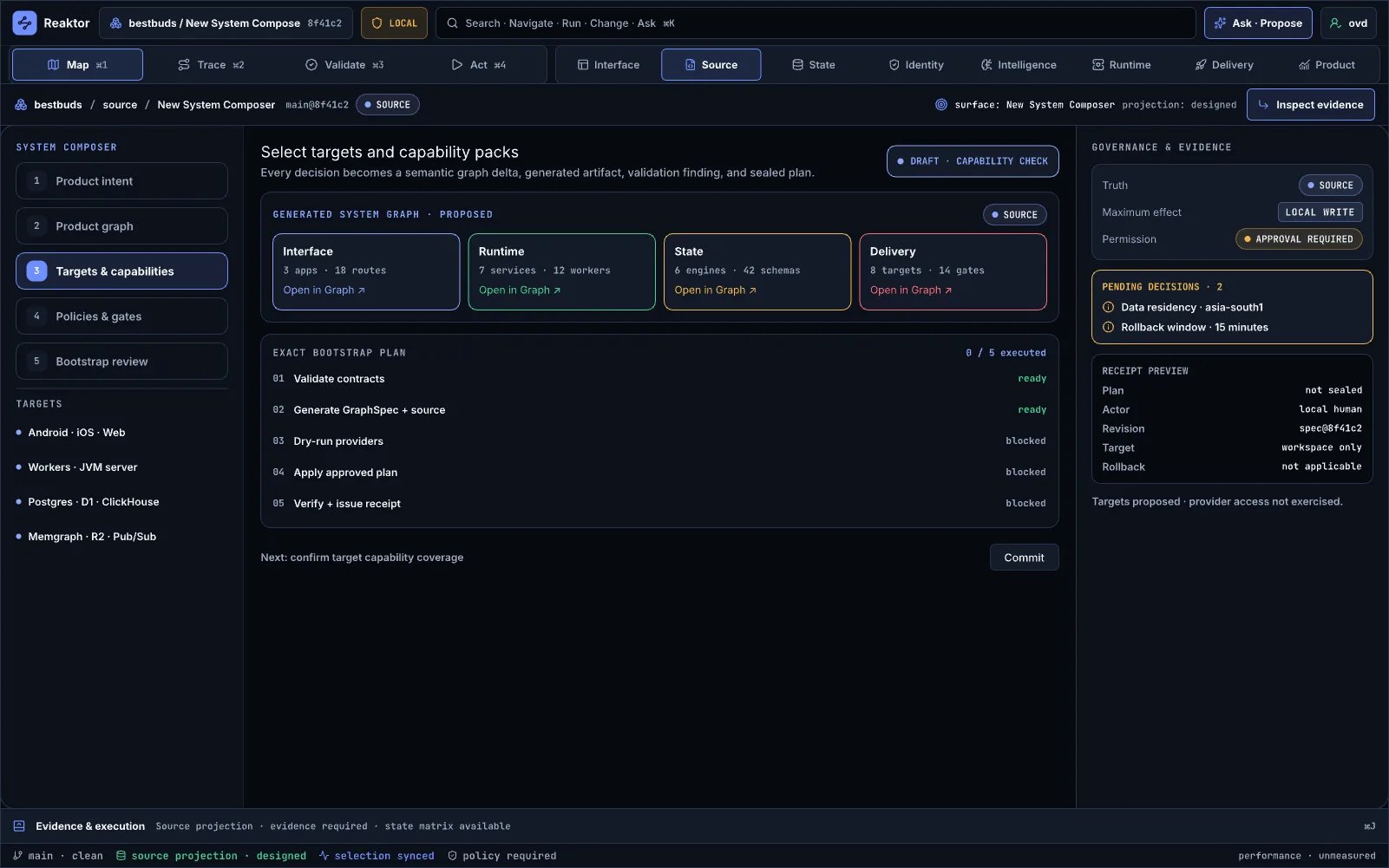
On the board. This is the one board in my set with its own layout. A left rail titled SYSTEM COMPOSER lists five steps — 1 Product intent, 2 Product graph, 3 Targets & capabilities, 4 Policies & gates, 5 Bootstrap review — above a TARGETS list of Android · iOS · Web, Workers · JVM server, Postgres · D1 · ClickHouse, Memgraph · R2 · Pub/Sub. The centre holds GENERATED SYSTEM GRAPH · PROPOSED as four quadrants each with an Open in Graph ↗ affordance (Interface — 3 apps · 18 routes, Runtime — 7 services · 12 workers, State — 6 engines · 42 schemas, Delivery — 8 targets · 14 gates) and below it EXACT BOOTSTRAP PLAN — 0 / 5 executed with five numbered rows (01 Validate contracts · ready, 02 Generate GraphSpec + source · ready, 03 Dry-run providers · blocked, 04 Apply approved plan · blocked, 05 Verify + issue receipt · blocked). The right column is GOVERNANCE & EVIDENCE with Truth SOURCE, Maximum effect LOCAL WRITE, Permission APPROVAL REQUIRED, then PENDING DECISIONS · 2 (Data residency · asia-south1, Rollback window · 15 minutes) and a RECEIPT PREVIEW reading Plan not sealed, Actor local human, Revision spec@8f41c2, Target workspace only, Rollback not applicable. Ten companion STATE boards exist for the same surface: steps 1, 2, 3, 4 and 5, plus Provisioning · Running, Complete, Failed, Retry and Rollback.
Vision tie. This is the composition thesis made operable: "Every decision becomes a semantic graph delta, generated artifact, validation finding, and sealed plan." Building a system by choosing targets and capability packs rather than by writing scaffolding is exactly the eigenvector-primitive claim applied at product scale, and the opinionated stack from §1 is present by name in the TARGETS list. It is the strongest embodiment in my cluster.
Workflow tie. Opened once at the start of a new product or a new major surface, by a tech lead or a founding engineer, in the hour where today they run create-next-app or a Spring Initializr, hand-write a Terraform root module, copy a wrangler.toml from the last project, and then spend two weeks discovering which capability the chosen targets do not have. The composer replaces that fortnight with a reviewable plan.
Agentic tie. Excellent shape for an agent. The five steps are a state machine, the plan is five discrete typed operations, and the receipt preview binds actor and revision, so an agent can propose a full bootstrap and a human approves one sealed artifact. The governing controls are already right: Maximum effect LOCAL WRITE, APPROVAL REQUIRED, and the honest closing line Targets proposed · provider access not exercised. What is missing for agents is a machine-readable diff of what step 3 would change if a target were added or removed.
Blueprint tie. Not the Blueprint graph editor. This is the project-creation wizard plus the project settings and the cook/package target list — the screen where you choose which platforms you are shipping to and the engine tells you what each platform costs you. The analogy holds well, with one Reaktor advantage: Unreal's target settings never produce a plan you approve.
Replaces / augments. Terraform and Pulumi plan/apply, Crossplane, AWS CDK diff, Backstage software templates and the scaffolder, Spring Initializr, create-next-app, and the "new service" checklist that lives in a Confluence page at most companies.
Improvements.
- Fix the bootstrap plan state machine. Across all ten
STATEboards the five step rows never change:Provisioning · Completesays5 / 5 verifiedin the header while rows 03, 04 and 05 still readblocked. Each row needs its own state (ready,running,verified,failed,skipped,rolled back) driven by the board state, with a timestamp and a run id per row. - Make
RECEIPT PREVIEWreact. It readsPlan not sealed/Target workspace only/Rollback not applicableeven on the board captionedVERIFIED · RECEIPT ISSUEDwhose own footer saysreceipt_0182 · verified · rollback window 15m, and on the board captionedROLLING BACK · VERIFIED STEPS. Bind the five preview fields to the run. - Add a
CAPABILITY GAPSpane to step 3. TheSTATEcopy of this board already carries the string8 targets · 4 capability gapsin its footer and the product board threw it away. Promote it to a real pane listing each gap, the target that lacks it, and the designed degradation. - Escalate the environment chip with the effect chip.
Provisioning · RunningclaimsAPPLYING · NON-PROD WRITEandMaximum effect REMOTE REVERSIBLEwhile the top-bar environment still readsLOCAL; onlyRollbackflips toPROD. The environment chip must move when the effect does, or the effect ladder is decorative. - Label the four quadrant numbers as proposed.
3 apps · 18 routesand42 schemasdescribe a system that does not exist yet; prefix the block withPROPOSED —or attach the sameTruthMarkthe governance column uses. - Give step 3 a
Diff targetscontrol that shows, before commit, which of the five plan steps change if a target is added or dropped.
Verdict. Keep. It is the best board in the cluster and the only one whose companion states exist at all. Its defects are wiring defects, not conception defects.
02.02 · Create · Design System Graph
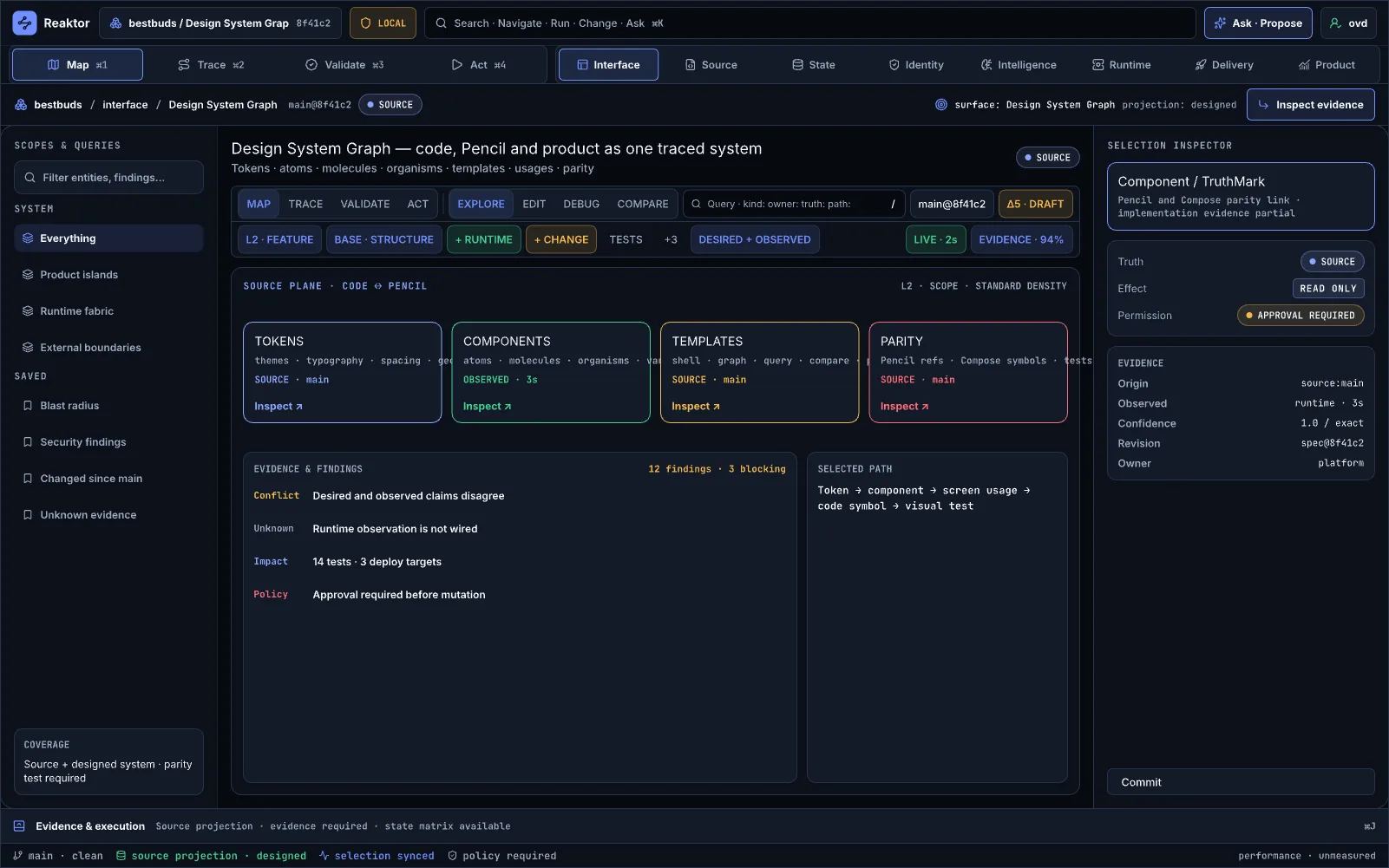
On the board. Template board. Its four cards are TOKENS — themes · typography · spacing · geometry · motion, COMPONENTS — atoms · molecules · organisms · variants · semantics, TEMPLATES — shell · graph · query · compare · plan · responsive and PARITY — Pencil refs · Compose symbols · tests · usage evidence, under the plane label SOURCE PLANE · CODE ↔ PENCIL. Coverage reads Source + designed system · parity test required, the selected path is Token → component → screen usage → code symbol → visual test, and the inspector shows Component / TruthMark — Pencil and Compose parity link · implementation evidence partial.
Vision tie. It gestures at "the diagram of the system and the system are the same object" in the narrowest place it is actually true today — the design file and the Compose code — but it embodies the idea only as a caption. The one genuinely Reaktor-specific claim here is the PARITY card, and it is four words.
Workflow tie. A design-systems engineer opens this on the Monday after a token change, to find out which screens moved. Today that is a Figma library-update dialog, a git grep for the token name, and a Chromatic run.
Agentic tie. The selected path Token → component → screen usage → code symbol → visual test is a genuinely good agent query — it is a five-hop join an agent could execute and act on. Nothing on the board exposes it as a query; it is printed as a sentence.
Blueprint tie. The content browser filtered to materials and material instances. The analogy breaks because Unreal's content browser shows you the actual asset thumbnails and their reference counts; this board shows category names.
Replaces / augments. Storybook, Chromatic, Figma library analytics, Supernova, Zeroheight, Style Dictionary.
Improvements.
- Merge the content of
05.01 Interface · Atomic Cataloginto this board or delete this board in its favour. 05.01 already shows real tokens with real values and usage counts (color.accent.brand · #4B7BFF · 14 uses · ⚠ drift,space.16 · 16dp · 54 uses), real variant rows with pass andFAILstates, real renderer parity rows (Tactile · physics skins — designed · not built) and three named accessibility findings. This board shows the same six categories as nouns. - If it survives, make
PARITYthe entire board and the only board. The unique asset is the Pencil-to-Compose link; give it a two-column ledger with one row per component, the Pencil node id, the Compose symbol, the last parity run, and adriftstate. 05.01 has the drift concept but not the link. - Add an
UNUSEDand anUNDECLAREDbucket. A design-system graph earns its name by answering which tokens nothing consumes and which hard-coded values have no token — neither appears. - Turn the selected path into a runnable query in the
Query · kind: owner: truth: path:field and show the result count. - Replace
12 findings · 3 blockingwith the design-system's own findings; 05.01 already has three real ones (tap target 38×38 < 44dp,contrast 3.1:1 · needs 4.5:1,missing semantic label).
Verdict. Merge into 05.01 Interface · Atomic Catalog, keeping only the Pencil-to-Compose parity ledger as a new sub-pane there.
02.03 · Create · Primitive Atlas
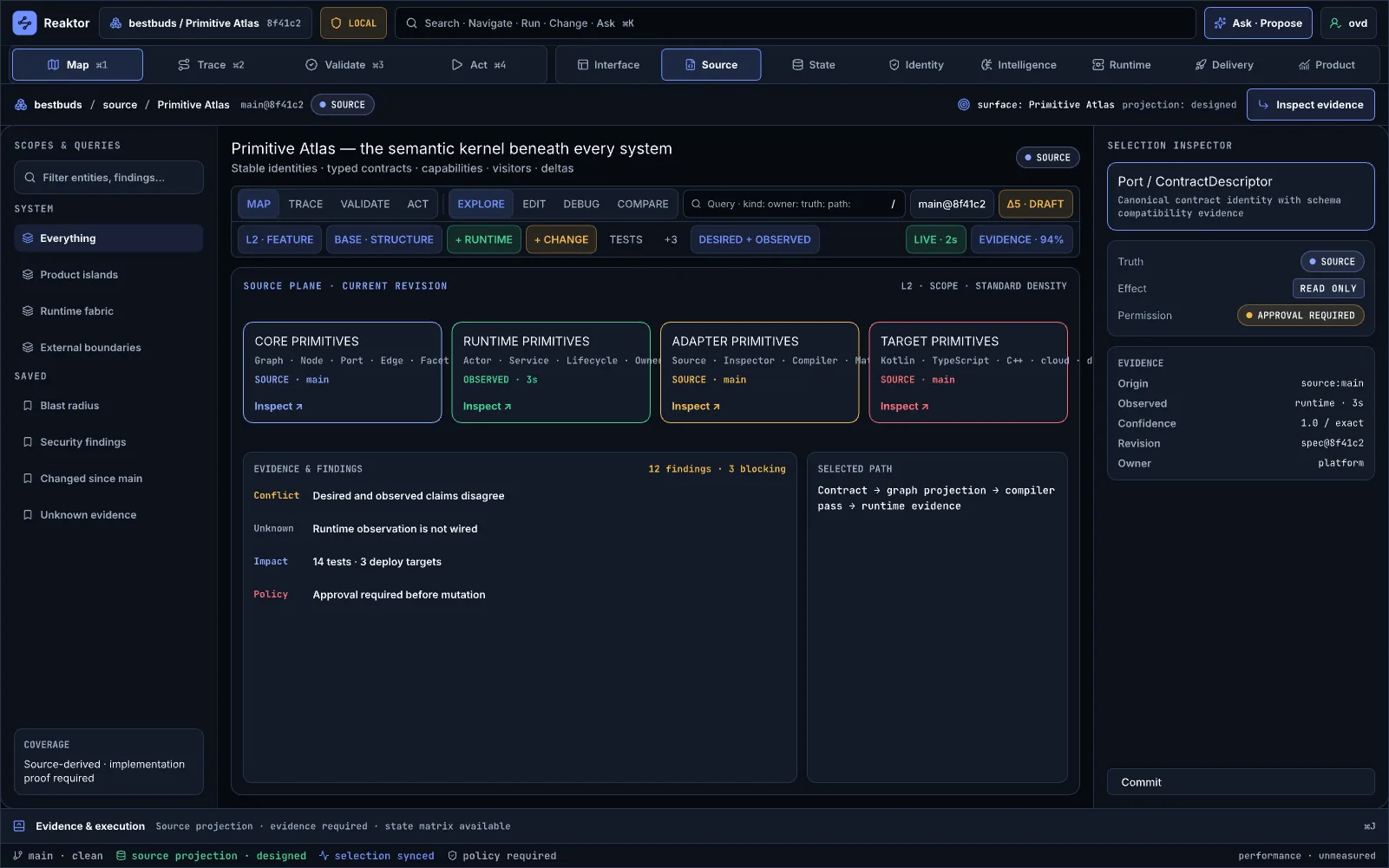
This is where the eigenvector-primitive claim must live or die, so it gets the hard reading.
On the board. Template board. Four cards under the plane SOURCE PLANE · CURRENT REVISION: CORE PRIMITIVES — Graph · Node · Port · Edge · Facet · Capability, RUNTIME PRIMITIVES — Actor · Service · Lifecycle · Ownership · Events, ADAPTER PRIMITIVES — Source · Inspector · Compiler · Materializer · Observer, and TARGET PRIMITIVES — Kotlin · TypeScript · C++ · cloud · devices. The subtitle is the semantic kernel beneath every system over Stable identities · typed contracts · capabilities · visitors · deltas. Coverage reads Source-derived · implementation proof required. The selected path is Contract → graph projection → compiler pass → runtime evidence and the inspector reads Port / ContractDescriptor — Canonical contract identity with schema compatibility evidence with Confidence 1.0 / exact.
Vision tie. It names the idea and does not demonstrate it. The board's entire content is twenty-one nouns arranged in four boxes. That is a taxonomy poster, not an atlas, and it fails the claim in four specific ways.
First, there is no basis test anywhere. A minimal non-redundant basis is a claim with two halves — that the primitives span the space, and that none is derivable from the others — and the board tests neither. The word eigen appears zero times in all 104 boards, and redundan appears zero times. The most important assertion in the framework is made nowhere in the artifact that exists to make it.
Second, the fourth card is a category error that a redundancy analysis would have caught immediately. Kotlin, TypeScript, C++, cloud and devices are not primitives of the same kind as Port and Edge. They are values along a target dimension, and a target is something a Capability already ranges over. Listing them as a fourth peer class of primitive is precisely the kind of category invention the vision says wiring primitives is supposed to replace. In the same vein, Service sits beside Actor, Lifecycle and Events in the runtime card without the board ever saying whether a Service is a primitive or an Actor with a lifecycle and typed ports — which is the exact question a basis has to answer.
Third, the board asserts exactness at the one point the audit says the code is unsound. The inspector selects Port / ContractDescriptor and describes it as Canonical contract identity with schema compatibility evidence, stamped Confidence 1.0 / exact. Audit finding D-6 says port type identity is (String, KClass?), that every string-built port — meaning every ServiceNode endpoint and every JS caller — carries null, that same-named ports on different paths refuse to connect, and that different classes on the string path connect happily. Canonical contract identity is the single thing this primitive does not have. The board is at its most confident exactly where the framework is at its most broken.
Fourth, and most costly, there is no negative space. The most valuable pane in a genuine primitive atlas is the one that says what cannot yet be expressed. Nothing here shows an unrepresentable system, a primitive under consideration, or a workaround that indicates a missing primitive.
What a genuine primitive atlas would show, concretely: a spanning matrix with primitives down one axis and system kinds across the other (mobile screen, edge worker, durable object, batch job, native library, agent tool) where each cell is filled, partial or empty, and the empty cells are the product's roadmap; a derivation graph showing which primitives are expressible in terms of others, with an explicit rule that anything derivable is demoted out of the basis; a usage census counting how many real nodes in the BestBuds and framework codebases instantiate each primitive, which immediately exposes primitives nothing uses; an expressivity gap ledger naming systems the current basis cannot describe (credit-based backpressure has no primitive here, and neither does a queue, which is notable given audit §2's finding that the distributed plane has no queues at all); a fingerprint column per primitive, since §2 names one unified fingerprint system as the keystone; and a proposed primitive queue with the burden of proof for admitting a twenty-second noun.
Workflow tie. Nobody opens this in a normal week, which is itself the problem. It should be opened at exactly two moments: when an engineer cannot express something and needs to know whether that is their failure or the basis's, and when someone proposes adding a concept to the framework and must show it is not derivable. Neither moment is served by a list of nouns.
Agentic tie. This is the board an agent most needs and can least use. An agent planning a change needs to know the legal vocabulary and the composition rules; it gets twenty-one strings with no arity, no port signature, no legal-neighbour relation, no fingerprint. Meanwhile 04.02 Map · Semantic Graph Editor & Compiler already carries the real thing under PORT & RELATIONSHIP TAXONOMY — CONTRACT + LABEL + SHAPE + COLOR, listing exec — control flow · triangle + arrow · explicit order, Session / domain types — domain contract · named schema + compatibility, Flow<T> / streams — Flow<T> stream · pulse pattern + rate + label, navigation, and containment — dashed boundary + scope identity. The board whose job is the primitive basis is outranked on its own subject by a board about the editor, and does not link to it.
Blueprint tie. The node palette and the content browser combined. The comparison is brutal: Unreal's palette is generated from reflection, every entry is draggable onto a canvas, each shows its exact pin signature, and right-clicking a pin filters the palette to what can legally connect. This board is text you cannot drag, with no pins. 04.02's right-click canvas — palette from registered contracts · type + capability filtered describes the Unreal behaviour correctly, on a different board.
Replaces / augments. The framework reference documentation site, ArchUnit and dependency-rule linters, the "concepts" chapter every framework ships and nobody reads, and — if the spanning matrix were built — Structure101 and architecture-decision-record repositories.
Improvements.
- Add a
COVERAGE MATRIXpane: primitives as rows, system kinds as columns, each cellfull,partialorabsent, sorted so the absent cells cluster. This is the pane that turns the poster into an atlas. - Add a
REDUNDANCYpane with a derivation column per primitive —derivable fromandadmitted because. Start by resolvingServiceagainstActor + Lifecycle + portsandFacetagainstCapabilityin public. - Delete the
TARGET PRIMITIVEScard and re-expressKotlin · TypeScript · C++ · cloud · devicesas the column headers of the coverage matrix, where they belong. - Add a
CANNOT EXPRESS YETpane with named entries. Seed it from audit §2: no queue primitive, no credit or backpressure primitive, no idempotency-key primitive. - Replace
Confidence 1.0 / exacton thePort / ContractDescriptorselection with aConflictfinding citingD-6, and split the inspector into two rows,reified port · class carriedandstring-built port · class null, showing the count of each in the real codebase. - Give every primitive a
fingerprintfield, and link that column to the fingerprint registry that §2 calls the keystone.
Verdict. Rebuild. The subject is the framework's central claim and the board currently makes no argument for it. The rebuilt board is a matrix and two ledgers, not four cards.
02.04 · Create · BestBuds Feature Graph
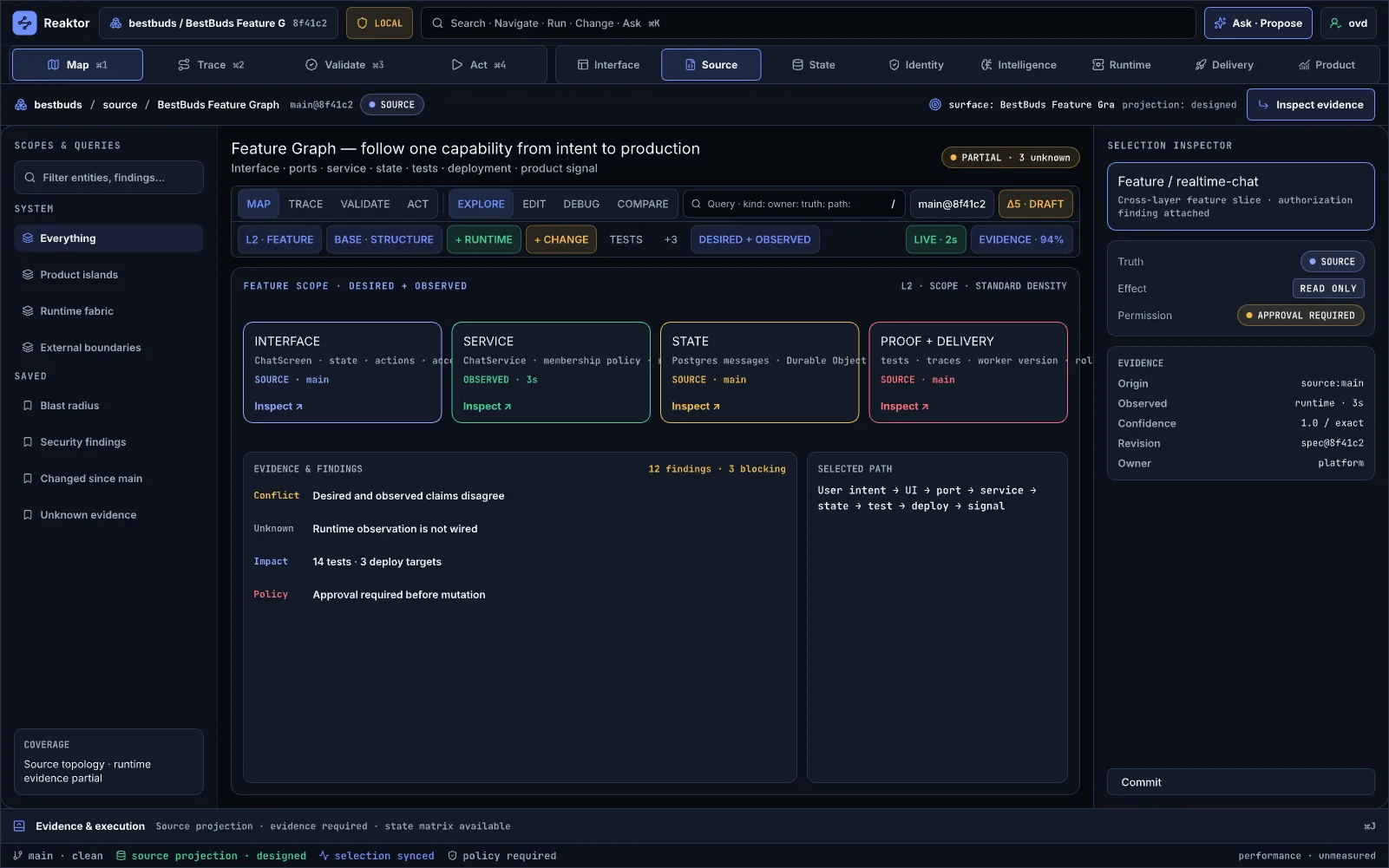
On the board. Template board, but with the most concrete card content in the cluster: INTERFACE — ChatScreen · state · actions · accessibility semantics, SERVICE — ChatService · membership policy · realtime contract, STATE — Postgres messages · Durable Object room · Pub/Sub events, and PROOF + DELIVERY — tests · traces · worker version · rollout · product impact, under the plane FEATURE SCOPE · DESIRED + OBSERVED. Uniquely in the Create section it carries the coverage badge PARTIAL · 3 unknown rather than a flat SOURCE, and its coverage line is Source topology · runtime evidence partial. The path is User intent → UI → port → service → state → test → deploy → signal and the inspector reads Feature / realtime-chat — Cross-layer feature slice · authorization finding attached.
Vision tie. This is the vertical-slice proof of the nesting claim from §1 — a feature is a subgraph of an app, an app is a node in a product — and it is the only board in the Create section that names real artifacts from a real product rather than categories. PARTIAL · 3 unknown is also the correct posture given §2.
Workflow tie. Opened during a bug triage or an incident, by whoever owns chat, at the moment the question is "where does this actually break". Today that means five tabs — the repo, the Cloudflare dashboard, Supabase, Sentry and a Grafana board — and a person who has held the mapping in their head for six months.
Agentic tie. Strong. A slice with named endpoints on both ends is a scope an agent can be bounded to, and authorization finding attached is exactly the hook an agent should read before proposing a change. The finding is referenced but never displayed, so the agent gets a flag with no payload.
Blueprint tie. The level. This is an assembled thing with real actors placed in it, as opposed to the palette (02.03) and the content browser (02.02). The analogy holds cleanly.
Replaces / augments. Backstage service catalog entries, Datadog service map, Sentry issue-to-release linking, the hand-drawn architecture diagram in the feature's design doc.
Improvements.
- Show the authorization finding. The inspector says one is attached; audit
S-2says any authenticated user can join any chat room. Render it inline with its severity, the node it attaches to, and the test that would catch it. This is the highest-value single change in the cluster because it converts a claim into evidence. - Name the three unknowns.
PARTIAL · 3 unknownis the most honest badge on any of my boards and it is unexplained; each unknown needs anEmptyReason— which layer, and what would resolve it. - Make the eight-hop path a spine, not a sentence. Render
User intent → UI → port → service → state → test → deploy → signalas eight nodes with per-hop status, so the reader can see which hop is thePARTIAL. - Add a second feature selector. A feature graph with exactly one feature (
realtime-chat) cannot show what the projection does under variation; addonboardingandnotificationsas switchable slices, since both exist in the audit findings. - Attach the delivery card to real values.
worker versionandrolloutare the two fields where 04.01 System Graph already has concrete data (cf.workers/auth — 88ms · 8.4k · v4.2.1), and there is no link between the boards.
Verdict. Strengthen. This is the template board most worth keeping and the one closest to being genuinely useful.
03.01 · Govern · Visitor Lab
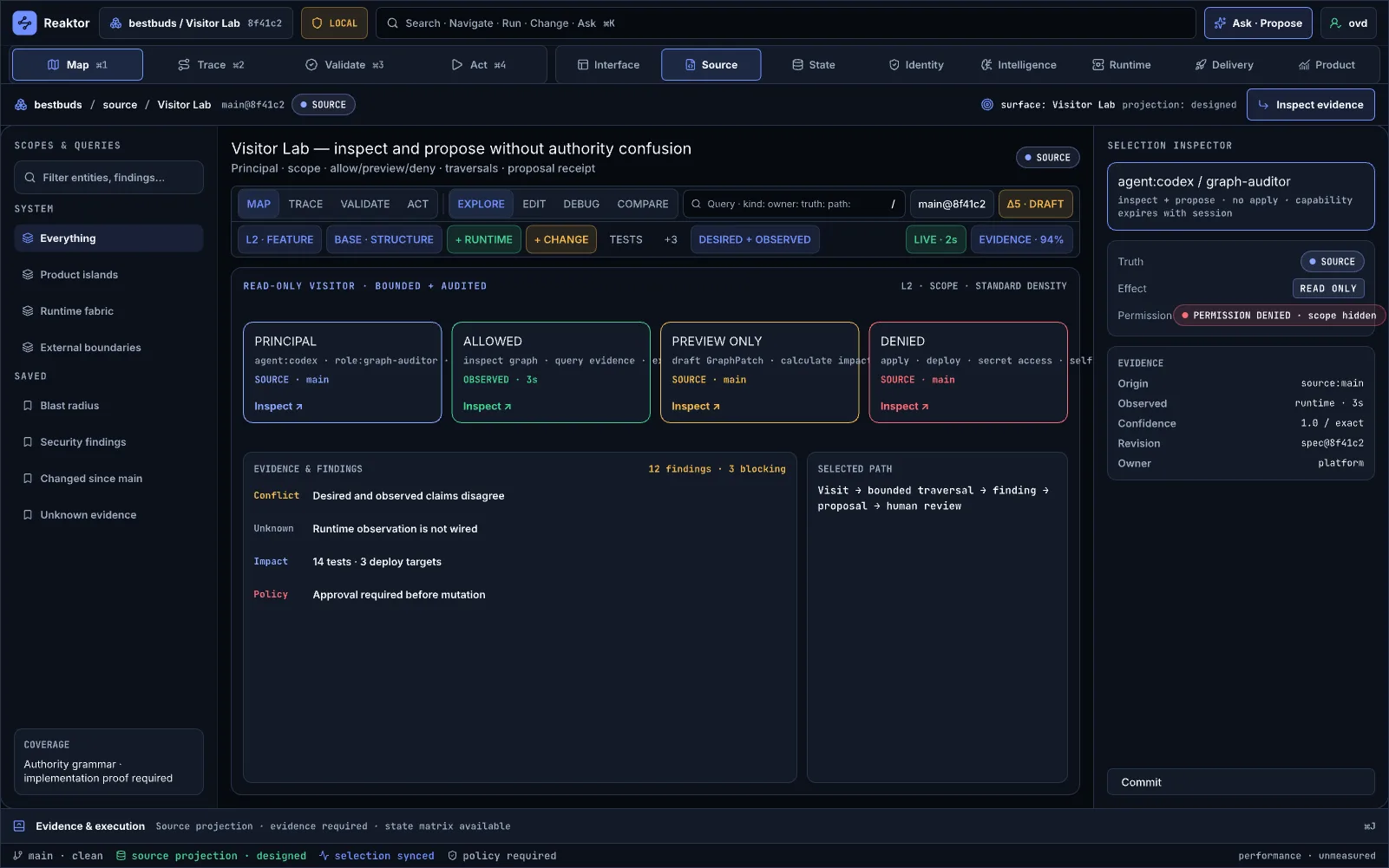
This is where the visitor pattern must become a product surface, so it gets the hard reading too.
On the board. Template board. Four cards under the plane READ-ONLY VISITOR · BOUNDED + AUDITED: PRINCIPAL — agent:codex · role:graph-auditor · session scoped, ALLOWED — inspect graph · query evidence · explain findings, PREVIEW ONLY — draft GraphPatch · calculate impact · request review, and DENIED — apply · deploy · secret access · self-approval. Coverage reads Authority grammar · implementation proof required, the subtitle is inspect and propose without authority confusion, the path is Visit → bounded traversal → finding → proposal → human review, and the inspector reads agent:codex / graph-auditor — inspect + propose · no apply · capability expires with session. This is the only board in my eight whose permission chip reads PERMISSION DENIED · scope hidden rather than APPROVAL REQUIRED.
Vision tie. The board is misnamed, and the mismatch is the finding. §1 defines a visitor as a traversal that carries cross-cutting behaviour: telemetry instruments a subtree, auth wraps a boundary, unreachable routes are found by query. None of those three appears anywhere on this board. What is actually depicted is an access-control card for one agent principal — an ACL rendered as four boxes. Authoring a visitor, running a visitor, and reading a visitor's results are all absent. The word visitor appears in the title and in the phrase READ-ONLY VISITOR, and in both cases it means "an agent with read permission", not "a traversal".
That substitution matters because the ACL half is already done better elsewhere. 08.04 Agents · MCP & Memory shows the same governance with real content: reaktor-graph — graph.query · graph.command · lineage — 42 calls/h — ⛨ every mutation = typed command w/ review gate, reaktor-db — ⛨ writes DENIED · read-only role, github — ⛨ merge blocked · human approves, pencil-design — ⛨ active-editor only · filePath ignored. That is the allow/preview/deny grid with named subjects, live call rates and per-row reasons. And 04.02 Map · Semantic Graph Editor & Compiler states the authority model in one line the Visitor Lab never manages — agents are visitors, Authenticated read plane → snapshot/query/evidence · mutation broker → proposal/plan, and agent/Critic may propose and review, never self-approve or apply. Two other boards own this board's stated content, more concretely, and it links to neither.
There is also a self-inflicted irony worth naming. The one board whose purpose is to explain authority has PERMISSION DENIED · scope hidden in its own selection inspector. The governance surface refuses to explain its own scope.
What a visitor debugger would actually need. Since the board does not depict authoring or running visitors, here is the surface it should be. A visitor registry listing each visitor by name, kind (instrument, guard, query, migration), author, version and fingerprint, with standing visitors separated from one-shot runs. A traversal source pane showing the actual predicate — which node kinds it matches, how deep it descends, whether it crosses subgraph boundaries. A scope preview that runs the match without side effects and reports matched N of M nodes with the unmatched ones grouped by reason, so the author sees the blast radius before running. A dry-run diff listing nodes visited, nodes skipped and why, and every effect that would fire, each carrying an EffectMark — this is the pane that makes "auth wraps a boundary" checkable rather than asserted. A step-through with the traversal frontier visible on the graph and a breakpoint on node match, which 04.02 already half-describes with F9 on node — sandbox breakpoint · capability-gated · never production by default. An overhead readout, because §1's entire wager is that keeping the graph resident costs "a small measured overhead"; the visitor is where that overhead is spent, so per-run cost in wall time and allocations is the measurement that proves or kills the thesis, and today the board's own footer says performance · unmeasured. A conflict view for when two visitors match the same node, showing ordering and whether the pair is commutative. And a findings output, since the path promises finding → proposal → human review but the board shows no findings and no proposals; 08.05 Agents · Runbooks & Audit already shows what one looks like (@claude · critic — BLOCKED — cmd #11 · DropIndex ix_msg_room — still used by chat.query p95 path).
Workflow tie. Two distinct moments, currently conflated. A platform engineer opens the authoring surface on the day they want telemetry on every service node without touching forty files, or want to prove no route is unreachable — today that is an OpenTelemetry auto-instrumentation config, a custom ESLint or Semgrep rule, or a CodeQL query. A security or platform lead opens the ACL surface when onboarding an agent — today that is an OPA policy file and a code review.
Agentic tie. The board describes agent governance correctly and provides an agent nothing to act on. There is no visitor an agent could author, no run it could request, no result it could read. The single most agent-legible thing in the whole cluster would be a visitor an agent writes, dry-runs, and submits as a proposal, and this board is the one that should host it.
Blueprint tie. Named for the Blueprint debugger, functioning as the project's permissions page. The closest true Unreal analogue is the asset validator and the commandlet runner — you author a check, run it across all content, and get a result list. The analogy breaks precisely at the result list: Unreal's validator produces one, this board produces nothing.
Replaces / augments. OPA and the Rego playground, CodeQL, Semgrep and ESLint custom rules, ArchUnit, OpenTelemetry auto-instrumentation configuration, Backstage tech-insights checks, Danger, and the review checklist that enforces cross-cutting rules by human attention.
Improvements.
- Add a
VISITORSlist pane as the primary left-hand content, with columns for name, kind, scope predicate, last run, nodes matched, and standing-or-one-shot. Without this the board has no subject. - Add a
DRY RUNpane producingvisited / skipped / would-affectcounts and an effect list marked withEffectMark, reachable before any apply. - Add a
SCOPE PREVIEWcontrol on the predicate that reportsmatched N of Mwith the unmatched grouped by reason, and highlights the matched set in the graph. - Add a per-run
OVERHEADreadout in milliseconds and allocations, and removeperformance · unmeasuredfrom this board specifically once it exists. This is the board that owes the framework its central performance claim. - Move the
PRINCIPAL / ALLOWED / PREVIEW ONLY / DENIEDgrid into08.04 MCP & Memoryas a per-principal row, rather than maintaining a second, thinner copy of it here. - Replace
PERMISSION DENIED · scope hiddenin the inspector with the actual grant and its expiry. A governance board that hides its own scope teaches the reader the wrong lesson. - Seed three named visitors matching §1 exactly:
telemetry.instrument(subtree),auth.wrap(boundary),routes.unreachable(). These are the three examples the vision uses and none is on any board.
Verdict. Split into two boards. A new 03.01 Visitor Author & Run carrying the registry, source, scope preview, dry-run diff and overhead — the capability that is currently missing from the entire atlas — and the ACL half folded into 08.04, where the better version already lives.
03.02 · Extend · Polyglot Boundary Studio
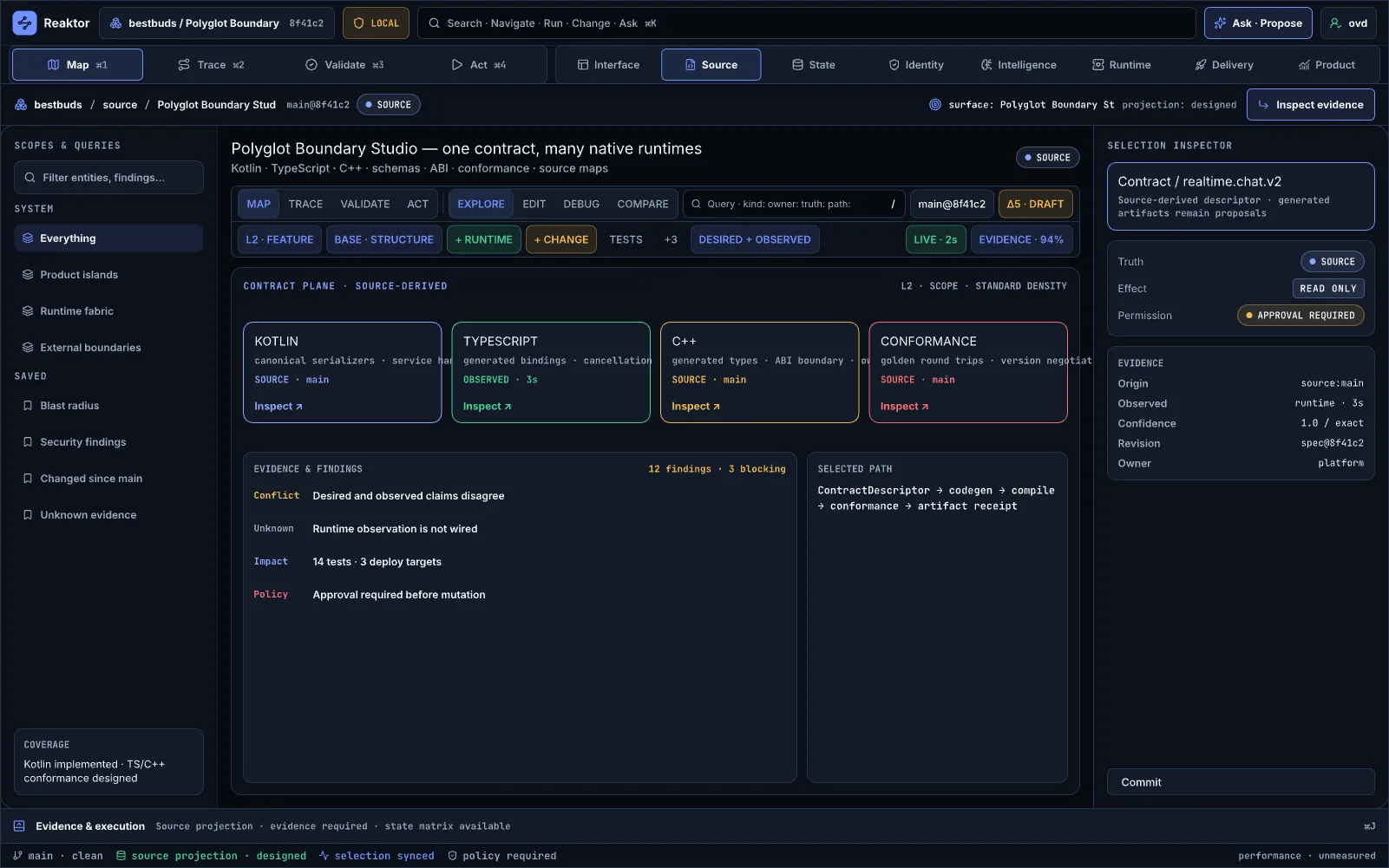
On the board. Template board. Four cards under CONTRACT PLANE · SOURCE-DERIVED: KOTLIN — canonical serializers · service handlers · descriptors, TYPESCRIPT — generated bindings · cancellation · streaming · errors, C++ — generated types · ABI boundary · ownership · backpressure, and CONFORMANCE — golden round trips · version negotiation · trace parity. Coverage reads Kotlin implemented · TS/C++ conformance designed, the subtitle is one contract, many native runtimes, the path is ContractDescriptor → codegen → compile → conformance → artifact receipt, and the inspector reads Contract / realtime.chat.v2 — Source-derived descriptor · generated artifacts remain proposals with Truth SOURCE.
Relationship to 13.03 FFI Switchboard — the explicit ruling. These are a split that should be merged, and merged toward 13.03. Side by side, 13.03's four cards are KOTLIN HOST — service kernel · serializers · lifecycle, TYPESCRIPT GUEST — Workers · events · promises · streams, C++ GUEST — native memory · threads · error algebra, CONFORMANCE — ABI digest · round trips · cancellation · backpressure; its coverage is Kotlin source · foreign targets designed; its path is Contract → generated boundary → runtime call → trace → conformance receipt. Same template, same four-column shape, same three languages in the same order, same fourth conformance column, same repeated numbers.
There is a defensible distinction buried in the two paths. 03.02 is design-time — descriptor, codegen, compile, artifact receipt. 13.03 is run-time — generated boundary, runtime call, trace, conformance receipt. That is a real axis. But it is invisible on the boards, because the split was executed as two near-identical four-column layouts rather than as two different surfaces, and a reader landing on either one cannot tell which they are on.
Worse, the two boards disagree about the truth status of the same subsystem, and the disagreement points the wrong way. 13.03 marks Truth UNKNOWN · not wired. 03.02 marks Truth SOURCE and claims Kotlin implemented · TS/C++ conformance designed. Audit §2 says reaktor-ffi is a skeleton: the spec pins a seven-slot frame, nine verbs, a six-function C ABI, credits and an ownership table, and the code has none of it, with Transport being four TODO()s. The board making the stronger claim is the board whose subject — TypeScript and C++ code generation — has the least behind it. Of the two, the one designated atlas-wide as the model of honesty is the one that got its own truth marking right; this one did not.
If the split is kept rather than merged, it must be re-cut on the time axis and labelled: 03.02 becomes Contract & Codegen owning descriptors, generated artifacts, version diffs and compile status, and 13.03 stays Boundary Runtime owning frames, credits, ownership transfer and live calls. Neither board may then show a CONFORMANCE card, because conformance spans both and belongs on its own surface.
Vision tie. Polyglot on one data plane, from §1, and it names the right three languages. It omits the mechanism entirely: FlexBuffers read in place, Kotlin Flow ported as the async model, credit-based backpressure, and frames over JSI, a C ABI, gRPC or browser bridges. The word backpressure appears once as a bare card subtitle; credit appears nowhere in the atlas outside the cost board, where it means dollars.
Workflow tie. Opened by whoever owns the boundary on the day a contract changes and three runtimes must agree — today a .proto or schema file, three code generators, three build systems, and a conformance test suite someone maintains by hand.
Agentic tie. ContractDescriptor is a good agent anchor, and generated artifacts remain proposals is exactly the right governance posture. But there is no artifact list, no version, no diff, so an agent has nothing to propose against.
Blueprint tie. The build and cook pipeline — the machinery that turns one authored asset into per-platform binaries. The analogy is apt and unflattering: Unreal's cook reports per-platform success, failure and size, and this board reports category names.
Replaces / augments. Protobuf and gRPC codegen, Cap'n Proto, FlatBuffers, wasm-bindgen, JNI and cbindgen toolchains, OpenAPI generators, Kotlin/Native cinterop, and the hand-maintained cross-language conformance suite.
Improvements.
- Adopt 13.03's
Truth UNKNOWN · not wiredmarking, and change the coverage line fromKotlin implemented · TS/C++ conformance designedto something that survives §2 — the generators do not exist. - Replace the
CONFORMANCEcard with a run table: one row per golden case, the three runtimes as columns, and cells that arepass,failornever run. Today all cells would readnever run, which is the honest and useful state. - Show the protocol the spec actually pins — the seven-slot frame, the nine verbs, the six-function C ABI, the credit window and the ownership table — as a
PROTOCOLpane with an implemented-versus-specified column. This is the board's real subject and none of it is present. - Add an
ARTIFACTSpane listing each generated binding with its version, its source descriptor revision, and whether it compiles.generated artifacts remain proposalsneeds a list of proposals. - Surface the one piece of genuine evidence the framework has. §2 records that FlexBuffers is the best-tested module with a differential C++ oracle, an adversarial suite and device runs. That is the exact cross-language conformance evidence this board claims to be about, it exists, and it is on no board in the atlas.
- Name the flow-control mechanism. Change the C++ card's
backpressureto credit-based flow control and give it a pane, since it is the mechanism that makes the polyglot data plane work.
Verdict. Merge into 13.03 Extend · FFI Switchboard. If the merge is refused, re-cut both on the design-time versus run-time axis and move conformance to its own board.
03.03 · Scale · Brownfield Atlas
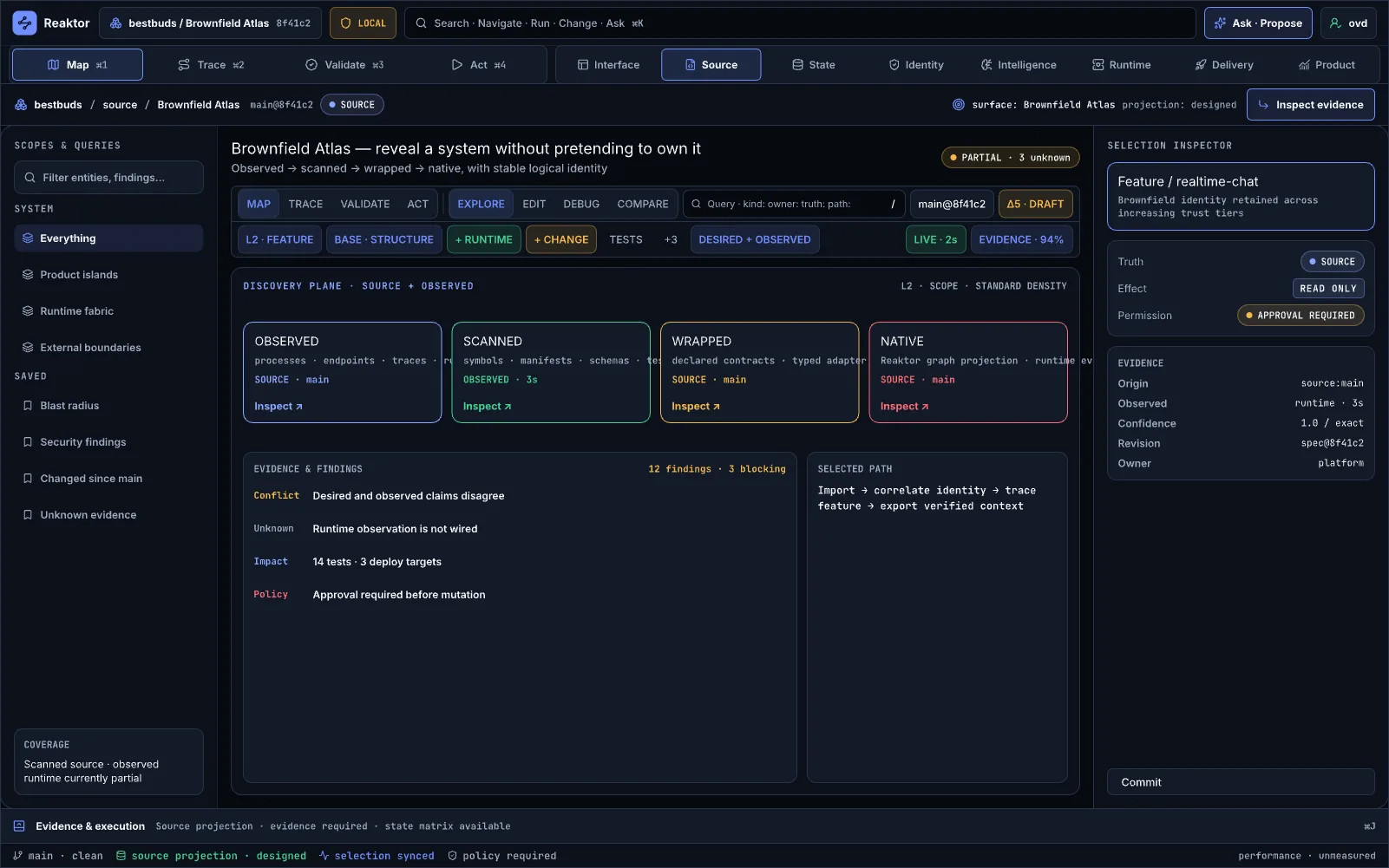
On the board. Template board. Four cards under DISCOVERY PLANE · SOURCE + OBSERVED: OBSERVED — processes · endpoints · traces · runtime topology, SCANNED — symbols · manifests · schemas · tests · dependencies, WRAPPED — declared contracts · typed adapter · governed operations, and NATIVE — Reaktor graph projection · runtime events · full evidence. Coverage reads Scanned source · observed runtime currently partial, the badge is PARTIAL · 3 unknown, the subtitle is reveal a system without pretending to own it over Observed → scanned → wrapped → native, with stable logical identity, the path is Import → correlate identity → trace feature → export verified context, and the inspector reads Feature / realtime-chat — Brownfield identity retained across increasing trust tiers.
Vision tie. Conceptually the strongest board in my cluster and the most commercially important one in the section, because it is the adoption path. A framework whose thesis is that the graph is the system has an obvious objection — nobody rewrites a working system to adopt it — and this board is the answer: four ascending trust tiers with logical identity preserved across them, so a team can start at OBSERVED and climb. The subtitle reveal a system without pretending to own it is the best single line of copy in my eight boards. It also embodies the adapter idea from §1 concretely, since WRAPPED — declared contracts · typed adapter · governed operations is exactly what an adapter is for.
Workflow tie. Opened in week one of adopting Reaktor into an existing codebase, and again every time a legacy service is promoted a tier. Today this is a Backstage catalog someone fills in by hand, a Datadog service map, an afternoon with grep and a whiteboard, and an architecture diagram that is wrong within a month.
Agentic tie. Very high potential and unrealised. Discovery and correlation are exactly what an agent is good at — read the manifests, read the traces, propose the identity mapping — and Import → correlate identity is a task an agent should own end to end, with the human approving the correlation rather than authoring it. Nothing on the board is a work item an agent can pick up, because there are no discovered entities, only category names.
Blueprint tie. Asset import and the migration or conversion tool — bringing foreign content into the engine and progressively making it native. A good fit, and Unreal's version has the thing this board lacks: a per-asset import log with warnings.
Replaces / augments. Backstage catalog and service discovery, Datadog service map, Dynatrace Smartscape, AWS Application Discovery Service, Structure101 and NDepend, and the architecture spreadsheet.
Improvements.
- Replace the four sibling cards with a
TIER LEDGER— one row per discovered entity, columns for logical identity, current tier, evidence backing that tier, and owner. The four tiers are a progression with a per-entity position, and rendering them as four equal boxes destroys the only structure that matters. - Add a
PROMOTEcontrol per row showing what it costs to move one tier up: which contracts must be declared to go from scanned to wrapped, which operations must be governed to go from wrapped to native. This is the board's product. - Fix the internal contradiction. The
OBSERVEDcard claimsprocesses · endpoints · traces · runtime topologyand is itself stampedSOURCE · main, on a board whose findings block saysUnknown — Runtime observation is not wired. The observation card is not observed. Either wire it or mark itNotWiredYet. - Add a
CONFLICTSpane for identity correlation. The hard part of brownfield import is that the same logical service appears under three names across traces, manifests and code; the board promisescorrelate identityand shows no correlation. - Name the three unknowns behind
PARTIAL · 3 unknown. - Add a coverage number that means something — entities discovered versus entities estimated, with the estimate's basis — instead of the inherited
EVIDENCE · 94%.
Verdict. Strengthen. Highest leverage board in the cluster to make concrete, because it is the one that answers the adoption objection.
03.04 · Scale · Constraint Optimizer
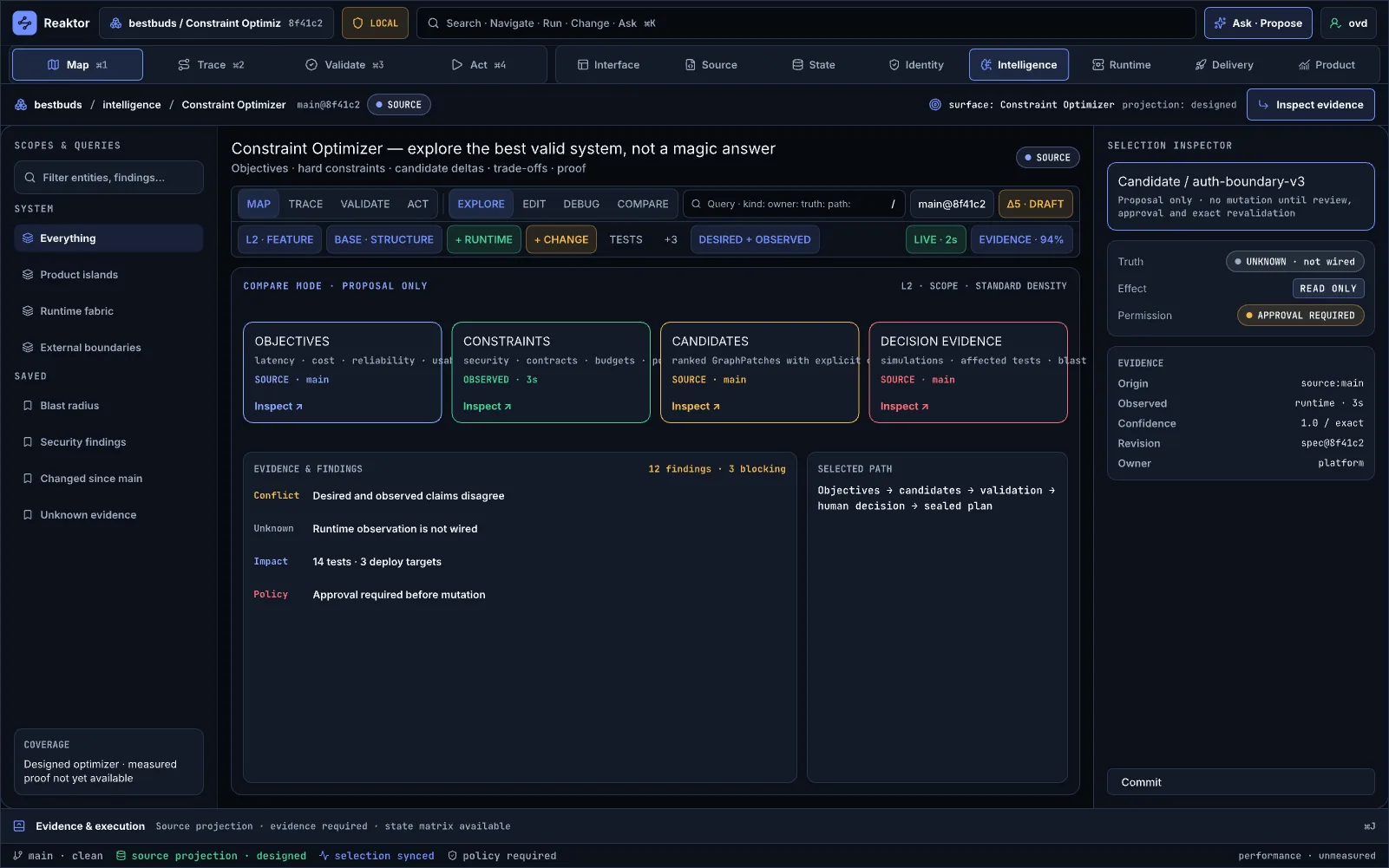
On the board. Template board. Four cards under COMPARE MODE · PROPOSAL ONLY: OBJECTIVES — latency · cost · reliability · usability · maintainability, CONSTRAINTS — security · contracts · budgets · policy · platform, CANDIDATES — ranked GraphPatches with explicit compromises, and DECISION EVIDENCE — simulations · affected tests · blast radius · confidence. Coverage reads Designed optimizer · measured proof not yet available, the subtitle is explore the best valid system, not a magic answer, the path is Objectives → candidates → validation → human decision → sealed plan, and the inspector reads Candidate / auth-boundary-v3 — Proposal only · no mutation until review, approval and exact revalidation with Truth UNKNOWN · not wired.
Vision tie. It is reaching for something the vision does not actually claim. §1 never promises a solver. The nearest legitimate reading is that a live typed graph makes trade-offs computable, which is genuine, but the board goes further and asserts a ranked candidate generator with simulation-backed evidence. Given §2, simulations is the deepest unbuilt capability in the entire verification program — deterministic simulation testing is L5, the last level, and L0 CI does not exist yet.
Workflow tie. Notionally a quarterly architecture review. Realistically nobody opens this, because the input it needs — quantified objectives with agreed weights — is a thing organisations produce roughly never.
Agentic tie. Superficially the most agent-native board in the cluster and actually the least trustworthy one. An agent generating ranked architectural candidates against unmeasured objectives will produce confident nonsense, and the board's own evidence card offers simulations as the check. The governance framing is right (Proposal only · no mutation until review, approval and exact revalidation) but governance over fabricated rankings is not safety.
Blueprint tie. Closest to the lightmass or build-settings quality slider — trade compute for quality along a known curve. The analogy breaks badly because Unreal's curve is measured, whereas this board's objectives are five nouns with no units.
Replaces / augments. Infracost and cloud cost calculators, capacity planners, the architecture decision record, and the whiteboard session where three options are compared. In practice 11.04 Optimize · Costs already displaces more of these than this board does.
Improvements.
- Resolve the self-contradiction first.
Truth UNKNOWN · not wiredsits nine lines aboveConfidence 1.0 / exacton the same card. This is the sharpest internal contradiction in the cluster and it is a one-line fix. - Give objectives units and current values.
latency · cost · reliability · usability · maintainabilitycannot rank anything;p95 latency ms,$/month,error budget %can. Take the values from 11.04 and 04.01, which have real ones. - Show one real candidate with real numbers.
11.04 Optimize · Costsalready ships exactly this and does it better:route icebreaker drafts to haiku for circles < 4 days old (quality delta 0.02) → saves ~$31/mo · apply as command RouteModel(budbot.icebreaker, haiku, cond: circle.age<4d)— a named change, a measured quality delta, a price, and an executable command. This board names one candidate id and no numbers at all. - Show the frontier, not a list. An optimizer's product is the set of non-dominated options and the reason each dominated one lost. Add a two-axis plot with the dominated candidates greyed and a per-candidate
compromisestring. - Add an
INFEASIBLEpane explaining which constraints eliminated which candidates — that explanation is more valuable than the ranking and is what makes the board honest. - Replace the
simulationsclaim inDECISION EVIDENCEwith what actually exists today, which is affected tests and blast radius, and mark simulation asNotWiredYetwith theL5dependency named.
Verdict. Demote to Vision, or merge into 11.04 Optimize · Costs as a what-if tab. It asserts the least-built capability in the framework and is outperformed on its own subject by a board that already ships a priced, executable recommendation.
Cluster findings
Missing panes.
- Capability & Degradation Matrix. §1 says product code branches on capability and never on platform, and that degradation is designed rather than discovered. The word
degradappears zero times in all 104 boards. The composer's step 3 lets you pick "capability packs" and nothing anywhere shows what a target loses. This is half of a load-bearing idea with no surface. - Visitor Author & Run. §1's visitors are traversals you write. No board in the atlas lets you author, scope, dry-run or read the result of one; 03.01 shows an access-control card instead. This is the single largest gap in the cluster.
- Primitive Redundancy & Coverage. The basis test for the eigenvector claim.
eigenandredundaneach appear zero times atlas-wide, so the framework's central claim is asserted in prose and demonstrated nowhere. - Graph Code Push. §1 names it explicitly — marked subgraphs update and rewire at runtime, delivered as Kotlin/JS through Hermes, with typed boundaries governing what a pushed bundle may touch.
code pushappears zero times andHermesappears once, inside the design-system reference library rather than as a product surface. This belongs in Section 03 under Extend and has no board. - Choreography / Saga. §1 names cross-system flows as saga graphs executed by visitors, with session-typed wires for protocol conformance.
saga,choreographandsession-typare all zero atlas-wide. This pane would also confront §2's finding that the distributed plane has no queues at all and every pipeline iswaitUntilfire-and-forget. - Fingerprint Registry. §2 names one unified fingerprint system — port type identity, codec layout identity, FFI method identity — as the keystone primitive.
fingerprintappears twice in the atlas: once asPrepare a fingerprint-bound retryon the composer retry state, and once as an adjective in13.01. Neither is the keystone. The registry belongs adjacent to 02.03 and 03.02, both of which depend on it. - Migration Cost Ledger for 03.03. Promoting an entity from wrapped to native has a price in contracts declared and operations governed. The trust ladder is shown without its rungs.
- Boundary Conformance Runs. Both 03.02 and 13.03 carry a
CONFORMANCEcard and neither shows a run. Meanwhile §2 records that FlexBuffers has a differential C++ oracle, an adversarial suite and physical device runs — real cross-language conformance evidence that exists in code and appears on no board in the atlas.
Seams.
One template, seven skins. 02.02, 02.03, 02.04, 03.01, 03.02, 03.03 and 03.04 are identical outside roughly twelve lines, and the identical part includes all the evidence. The Symphony Contract promises that selection, revision, environment, principal, time and evidence survive every movement, but evidence cannot survive a movement between boards that report 12 findings · 3 blocking and EVIDENCE · 94% regardless of subject — moving between them carries nothing, because nothing on either side is about the subject.
02.01 and its own state board are the same artboard. Diffing 02.01 Create · New System Composer against STATE · Composer · 3 of 5 · Targets & Capabilities yields eleven differing lines out of about a hundred and seventeen, all of them chrome. The canonical product board is the degraded copy: the state version carries Source projection · 8 targets · 4 capability gaps · no side effects and policy not evaluated, and the product version replaced both with the generic evidence required · state matrix available and policy required.
The composer's state machine does not advance. Across all ten composer states the five bootstrap rows never change from 01 ready, 02 ready, 03 blocked, 04 blocked, 05 blocked. Provisioning · Complete reads 5 / 5 verified above three rows marked blocked. RECEIPT PREVIEW reads Plan not sealed and Rollback not applicable on the state captioned VERIFIED · RECEIPT ISSUED — whose own footer says receipt_0182 · verified · rollback window 15m — and on the state captioned ROLLING BACK · VERIFIED STEPS. The environment chip stays LOCAL while the effect chip escalates to REMOTE REVERSIBLE; only the rollback board flips to PROD. The state matrix is the atlas's proof that lifecycle is modelled independently of truth and effect, and it is the place the independence visibly fails.
One concept, five names. What 02.03 calls Port / ContractDescriptor is ContractDescriptor in 03.02's path, Contract / realtime.chat.v2 in 03.02's inspector, Boundary / chat.realtime in 13.03's inspector, and domain contract · named schema + compatibility in 04.02's taxonomy. An agent cannot join these.
Two of my boards are outranked on their own subjects by 04.02, which links to neither. 04.02 Map · Semantic Graph Editor & Compiler carries the real port taxonomy that 02.03 owes — exec, Session / domain types, Bool / primitives, String / text, Flow<T> / streams, navigation, containment, each with contract, label, shape and colour — and it states the visitor authority model that 03.01 owes, in the sentence agents are visitors alongside Authenticated read plane → snapshot/query/evidence · mutation broker → proposal/plan. Similarly, 05.01 outranks 02.02 and 11.04 outranks 03.04. The pattern is that the abstract Create/Govern board is consistently the weaker rendering of content another board already holds concretely.
Dead ends. 02.01's four Open in Graph ↗ links are the only cross-board navigation in the cluster. The seven template boards offer a per-card Inspect ↗ and a Commit button, with no route to 04.01 System Graph, 05.01 Atomic Catalog, 08.04 MCP & Memory or 11.04 Costs — precisely the boards holding the concrete versions of their content.
Honesty audit.
The single worst offence is shared by all seven template boards and is a direct self-contradiction, not merely unmarked data. Each board's findings block says Unknown — Runtime observation is not wired, and eighteen lines below, the evidence block says Observed — runtime · 3s and Confidence — 1.0 / exact. A three-second-old observation from an unwired runtime is not stale data, it is invented data, and the board states both facts about itself simultaneously. The honest version reads Observed — NotWiredYet and Confidence — none, with an EmptyReason naming what would have to be wired.
The same seven boards assert 12 findings · 3 blocking, 14 tests · 3 deploy targets, Δ5 · DRAFT and EVIDENCE · 94% with no provenance marker. These cannot be true of seven different subjects at once; identical values across unrelated subjects is the signature of sample data. The honest version strikes the block from six of them and gives each board its own count or an EmptyReason such as "no scan has been run on this scope".
03.04 is the extreme case. Truth — UNKNOWN · not wired and Confidence — 1.0 / exact appear nine lines apart on the same card, on a board whose coverage line already admits measured proof not yet available. It then offers simulations as decision evidence for a framework whose verification program places deterministic simulation testing at L5 and whose L0 CI does not exist.
02.03 claims exactness at the framework's known break. Port / ContractDescriptor — Canonical contract identity with schema compatibility evidence, marked Confidence 1.0 / exact, describes the precise thing audit D-6 says is unsound. The honest version is a Conflict finding citing D-6, with the inspector split into reified port · class carried and string-built port · class null and a real count of each.
03.02 makes the misleading claim its twin got right. Kotlin implemented · TS/C++ conformance designed with Truth SOURCE, for a module whose Transport is four TODO()s and which implements none of the seven-slot frame, nine verbs, six-function C ABI, credits or ownership table. 13.03 marks the same subsystem UNKNOWN · not wired. The honest version adopts 13.03's marking and shows the CONFORMANCE card as zero runs with an EmptyReason rather than listing golden round trips · version negotiation · trace parity as though they exist.
03.03's OBSERVED card is stamped SOURCE · main. The card claiming processes, endpoints, traces and runtime topology is itself not observed, on a board whose findings block says runtime observation is not wired.
02.01 is the honest counter-example and shows the pattern the others should copy: Targets proposed · provider access not exercised, Plan — not sealed, Rollback — not applicable, 0 / 5 executed, PENDING DECISIONS · 2. Its remaining flaw is small and fixable — the four quadrant numbers (3 apps · 18 routes, 7 services · 12 workers, 6 engines · 42 schemas, 8 targets · 14 gates) describe a system that does not exist yet and read as counts, so they need a PROPOSED marking to match the honesty of the rest of the board.
Part 6 · Section 04 — The Graph Substrate
Ten boards: 04.01, 04.02, 04.03, 04.04, 04.05, 04.06, 04.06A, 04.06B, 04.07, 04.08.
The section card SECTION 04 · GRAPH SUBSTRATE claims "6 SURFACES". There are ten boards. Either the index is stale or four boards accreted after the section was scoped. My consolidation in §Redundancy lands back on exactly six, which suggests the index is right and the section drifted.
Summary before the detail
Section 04 is the strongest thinking in the atlas and the weakest honesty. Three boards — 04.06/A/B, 04.07, 04.08 — contain the only file-and-line source citations, the only board that says MEASURED, and the only board that admits a current failure in the shipped product. Around them sit four boards that assert 73 unit-bearing numbers with no provenance, contradict each other's node counts under the same revision string, and in one case (04.04) reproduce a neighbouring board with its port rows mass-filled with wrong values.
Three structural facts govern everything below.
The truth vocabulary is completely absent here. Across all ten boards, the components Effect, Permission, Origin, Confidence, Revision, Owner appear zero times, and Truth appears once — as a plain row label on 04.03, not as a marker. Every peripheral board I cross-checked (01.03 System Fabric, 02.04 BestBuds Feature Graph, 13.03 FFI Switchboard, 13.04 Graph Projections) carries the full Truth / Effect / Permission block and the five-field EVIDENCE block. The atlas's evidence discipline reaches the periphery and stops at the core.
There are three chrome generations inside one section. 04.01, 04.02 and 04.03 carry the full mode band (EXPLORE · EDIT · DEBUG · COMPARE), the query facet band and the lens band. 04.04, 04.05, 04.06/A/B carry a reduced shell with the movement nav but no mode band, no query band and no lens band. 04.07 and 04.08 carry no shell at all — they are documentation posters. None of the ten uses the atlas-standard SCOPES & QUERIES rail; 04.03 invents its own.
The mode selector appears only on boards that do not use it. EXPLORE · EDIT · DEBUG · COMPARE is exactly the authoring-versus-runtime switch the section needs. It is printed on the three map boards and absent from 04.06 (which is EDIT), 04.08 (which is DEBUG), and from any board that would be COMPARE. The control exists nowhere near the thing it controls.
04.01 · Graph · System Graph
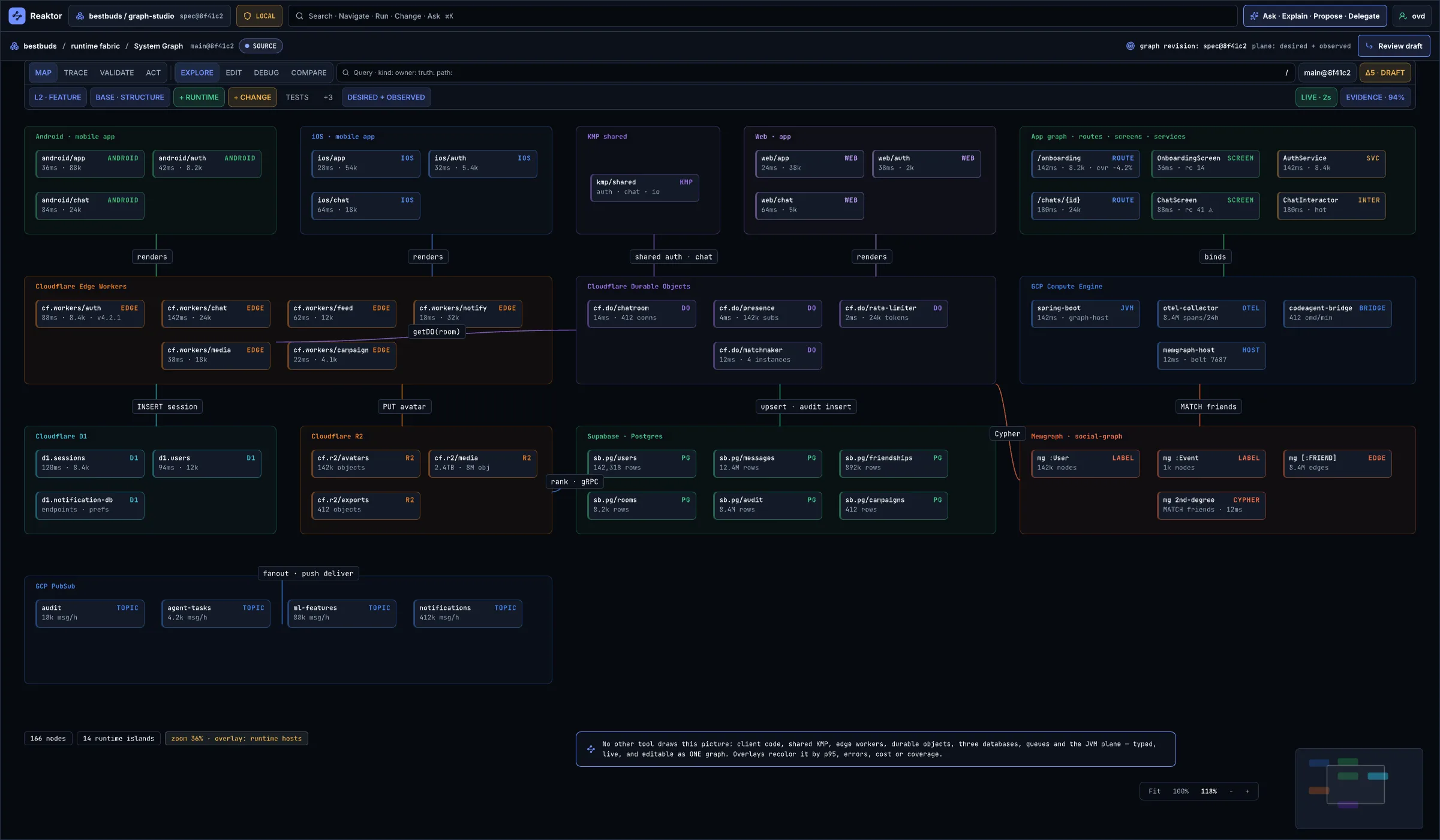
On the board. A single canvas at zoom 36% · overlay: runtime hosts grouping the whole product into thirteen labelled islands: Android · mobile app, iOS · mobile app, KMP shared, Web · app, App graph · routes · screens · services, Cloudflare Edge Workers, Cloudflare Durable Objects, GCP Compute Engine, Cloudflare D1, Cloudflare R2, Supabase · Postgres, Memgraph · social-graph, GCP PubSub. Every node card carries a kind chip and a metric footer (cf.do/presence · DO · 4ms · 142k subs, sb.pg/messages · PG · 12.4M rows). Cross-island edges are labelled with real verbs: getDO(room), INSERT session, PUT avatar, upsert · audit insert, Cypher, fanout · push deliver, MATCH friends. A summary chip reads 166 nodes / 14 runtime islands, and a prose block states the thesis: No other tool draws this picture: client code, shared KMP, edge workers, durable objects, three databases, queues and the JVM plane — typed, live, and editable as ONE graph.
Vision tie. This is the atlas's clearest picture of one graph spanning devices and cloud, and it is the only board where the KMP shared node visibly renders into three platform apps (renders, renders, shared auth · chat). It embodies the polyglot-on-one-data-plane claim structurally. It does not embody eigenvector primitives at all: nothing on the board shows a port, so the "typed" half of "typed, live, and editable" is asserted in prose and drawn nowhere.
Workflow tie. A staff engineer opens this in the first week on the team, or in the first ten minutes of an incident when the question is "what talks to what". Today that picture is assembled from a stale Miro board, the Cloudflare dashboard, a Terraform graph and someone's memory, and the four disagree.
Agentic tie. An agent reads island membership, kind, and a metric per node — but with no Origin or asOf on any datum it cannot tell a configured value from an observed one, so it cannot safely reason about anything. The chrome offers Ask · Explain · Propose · Delegate with no depicted agent surface. This is the most agent-legible structure in the cluster attached to the least agent-usable evidence.
Blueprint tie. This is the Level, not the Blueprint editor — the world outline showing every actor placed in the map. The analogy breaks in a way that favours Reaktor: Unreal's level contains one process on one machine, and this contains six runtimes across two clouds.
Replaces / augments. Structurizr and C4 diagrams, Backstage's software catalog and system diagrams, the Cloudflare dashboard's resource list, Datadog Service Map, AWS/GCP architecture diagram tools, Lucidchart.
Improvements.
- Obey 04.07's own contract. At
zoom 36%the L1 tier specifies that footers, ports and probes collapse and islands render as scope cards. This board draws a per-node footer with a latency on all fifty cards. Either raise the stated zoom to L2 or strip the footers and replace them with 04.07's specifiedowner · contract counts · healthchips. - Reconcile the counters against the canvas. The chip says
166 nodes / 14 runtime islands; the board draws fifty labelled cards in thirteen groups. Make the counter a computed field bound to the rendered set, and show50 of 166 rendered · 116 collapsedif that is what is meant. - Ghost the queue plane.
GCP PubSubshows four topics with throughput (notifications · 412k msg/h). Audit §2 states the distributed plane has no queues at all. Render that island in theDESIRED-only style with anEmptyReason: NotWiredYet — pipelines are waitUntil fire-and-forget. - Add a per-island identity coverage chip —
resolved 41 · nominal 7 · conflict 2— so the board that claims "typed" shows type soundness at the tier where you first meet the system. - Give every metric footer a two-character provenance prefix (
Ssource,Oobserved,?unknown) so 73 numbers stop reading as 73 measurements.
Verdict. Strengthen. Retitle as 04.01 · Map · System Landscape (L0/L1) so it reads as a tier of 04.07's contract rather than a competing product.
04.02 · Map · Semantic Graph Editor & Compiler
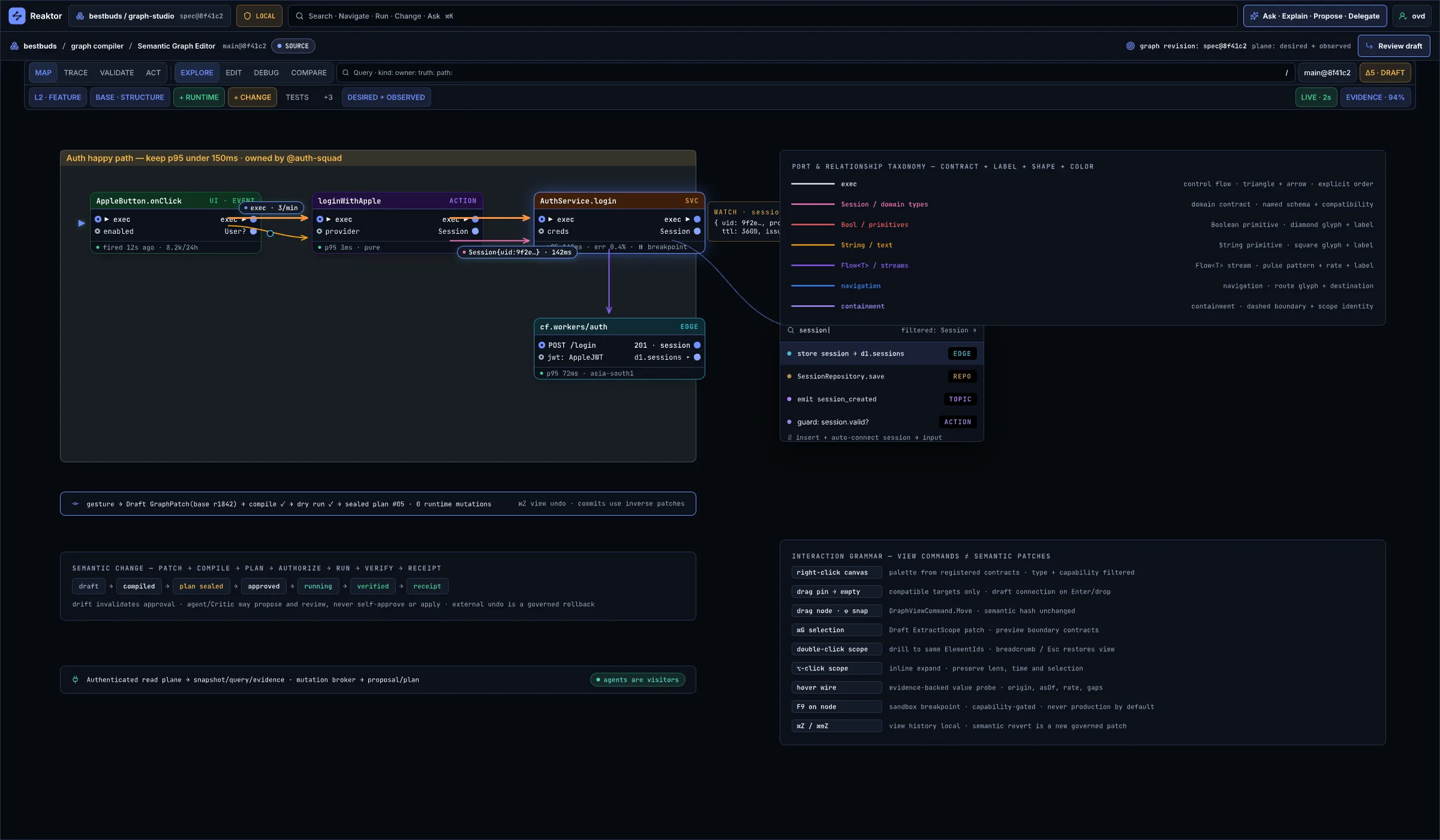
On the board. Four stacked panels above the standard chrome. A worked canvas titled Auth happy path — keep p95 under 150ms · owned by @auth-squad runs AppleButton.onClick → loginWithApple → AuthService.login → cf.workers/auth → d1.sessions, with ▶ exec / exec ▶ pins, a ⏸ breakpoint on AuthService.login, a WATCH · session popover showing { uid: 9f2e…, provider: apple, ttl: 3600, issued: 12s ago }, and an insert affordance ↵ insert + auto-connect session → input. Below it, PORT & RELATIONSHIP TAXONOMY — CONTRACT + LABEL + SHAPE + COLOR defines seven wire kinds (exec triangle+arrow, domain contract, Bool diamond, String square, Flow<T> pulse pattern with rate, navigation route glyph, containment dashed boundary). Then INTERACTION GRAMMAR — VIEW COMMANDS ≠ SEMANTIC PATCHES maps eight gestures to outcomes. Then SEMANTIC CHANGE — PATCH → COMPILE → PLAN → AUTHORIZE → RUN → VERIFY → RECEIPT with the caveat drift invalidates approval · agent/Critic may propose and review, never self-approve or apply.
Vision tie. The strongest single idea in the cluster is one line here: GraphViewCommand.Move · semantic hash unchanged. Separating view commands from semantic patches is what makes "the diagram and the system are the same object" survivable — you can rearrange the picture without lying about the system. Flow<T> stream · pulse pattern + rate + label is the only place the atlas gives streams a distinct visual identity, which is the polyglot data plane made visible. agents are visitors and Authenticated read plane → snapshot/query/evidence · mutation broker → proposal/plan is the cleanest statement of agent governance anywhere in the section.
Workflow tie. This is not a screen anybody opens on a Tuesday. It is the specification a designer and a graph engineer argue over once, and then implement. Its audience is internal.
Agentic tie. The best agentic board here. It states the read plane, the mutation broker, the prohibition on self-approval, and the drift-invalidates-approval rule. What it lacks is any depicted place where an agent's proposal appears — the Review draft button in chrome has no destination on this board.
Blueprint tie. This is the Blueprint editor's design document, covering pin taxonomy, the graph action menu, breakpoints and watches in one page. The taxonomy exceeds Blueprint: Unreal has exec, data and delegate pins, and no notion of a stream with a rate or a containment relationship.
Replaces / augments. The Blueprint reference documentation itself; Node-RED and n8n's wire model; Retool's binding editor; the design half of a graph IDE spec.
Improvements.
- Move the
PORT & RELATIONSHIP TAXONOMYonto 04.06, where wiring actually happens. Today 04.06/A/B draw undifferentiated pins and the taxonomy that would explain them lives on a board nobody has open. - Resolve the reroute contradiction against 04.06B. Here and on 04.07 reroute is a view-only patch with the spec hash unchanged; on 04.06B it is
GraphPatch revision 2producing1 node + 2 typed edges. Pick one and correct the other two boards. - Add a
NOMINALrow to the taxonomy. Seven wire kinds are drawn as if all seven have sound identity; the eighth state — a contract matched by name with an unresolved class — is the one a developer most needs to see. - Give the
WATCH · sessionpopover the four fields the board itself promises underhover wire:origin, asOf, rate, gaps. The popover shows values with none of them. - Add the counterexample lane to the seven-stage pipeline: what a
compiled ✗looks like, and where the finding surfaces. Today the strip only draws the happy path.
Verdict. Split into 04.06 (taxonomy), 04.07 (interaction grammar, which already duplicates it) and 04.08 (the patch pipeline, which already draws the same seven-stage strip). Nothing here needs its own board; everything here needs to be on the board where the gesture happens.
04.03 · Map · Full System + Fabric Studio — Command Density
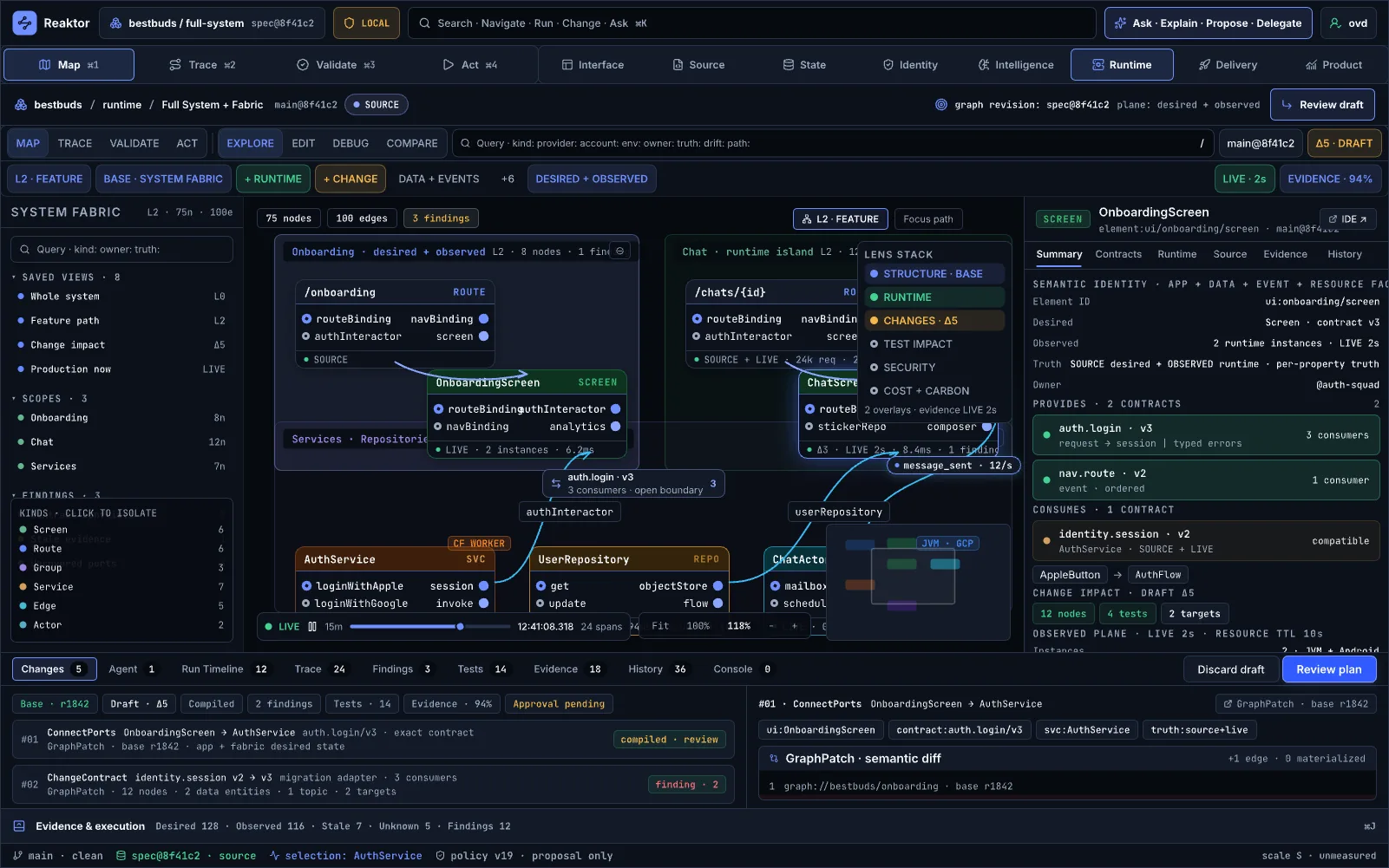
On the board. The only complete application in the section, and the densest board in the atlas at 296 extracted lines. Left rail: SAVED VIEWS · 8 (Whole system L0, Feature path L2, Change impact Δ5, Production now LIVE), SCOPES · 3, FINDINGS · 3 (Contract conflicts 2, Stale evidence 1, Uncovered ports 3), KINDS · CLICK TO ISOLATE. Canvas: three collapsible scopes with per-node truth footers that actually differ — LIVE · 2 instances · 6.2ms, SOURCE + LIVE · 24k req · 2s, PARTIAL · p95 94ms · source + trace, LIVE · 0 backlog · state rev 1842. A LENS STACK of six overlays (STRUCTURE · BASE, RUNTIME, CHANGES · Δ5, TEST IMPACT, SECURITY, COST + CARBON). A right inspector with six tabs — Summary, Contracts, Runtime, Source, Evidence, History — carrying SEMANTIC IDENTITY · APP + DATA + EVENT + RESOURCE FACETS, PROVIDES · 2 CONTRACTS (auth.login · v3 · request → session | typed errors · 3 consumers), CONSUMES · 1 CONTRACT, CHANGE IMPACT · DRAFT Δ5, and OBSERVED PLANE · LIVE 2s · RESOURCE TTL 10s. A bottom dock with nine counted tabs (Changes 5, Agent 1, Run Timeline 12, Trace 24, Findings 3, Tests 14, Evidence 18, History 36, Console 0). A patch queue with #01 ConnectPorts and #02 ChangeContract · identity.session v2 → v3 · migration adapter · 3 consumers, a semantic diff (+1 edge · 0 materialized) and Approval pending. Footer: policy v19 · proposal only · scale S · unmeasured.
Vision tie. This is the vision at working scale. Per-node truth footers make desired + observed real rather than a chrome band. Desired 128 · Observed 116 · Stale 7 · Unknown 5 · Findings 12 is the single best evidence line in the section: five buckets, summing, with Unknown as a first-class category. ChangeContract · migration adapter · 3 consumers is the only place in the cluster where a contract version bump shows its blast radius. scale S · unmeasured in the footer is an honest admission of exactly the kind §1 asks for.
Workflow tie. This is the daily driver — the pane a feature engineer keeps open while working, in the way an IDE is kept open. It replaces the tab strip of Datadog, GitHub, the Cloudflare dashboard and Linear that engineers currently arrange across two monitors.
Agentic tie. The one board with an agent seat at the table: an Agent · 1 dock tab, a patch queue where a proposal sits next to a human one, Approval pending, and policy v19 · proposal only. An agent can read contracts with versions and consumer counts, propose a ConnectPorts or ChangeContract patch, and be governed by the queue. The gap is that neither queue item shows who authored it.
Blueprint tie. This is the full Unreal editor window: world outliner (left rail), viewport (canvas), details panel (inspector), output log and content drawer (bottom dock). The lens stack has no Unreal equivalent — the closest is view modes on the viewport, and those recolor geometry rather than reproject semantics.
Replaces / augments. Backstage, Datadog APM's service page, Sentry issue detail, Linear's issue panel, GitHub's PR review, Terraform plan output, and the IDE's project view — merged into one selection-preserving surface.
Improvements.
- Fix the Element ID collision. The inspector header reads
element:ui/onboarding/screenand the identity block below it readsui:onboarding/screen. Two spellings of the same identifier, sixteen lines apart, on the board that defines semantic identity. Pick one grammar and enforce it in the component. - Reconcile the counters.
75 nodes · 100 edgessits above aKINDSlegend summing to twenty-nine and a canvas drawing seven nodes. Bind the totals to the query result and addshowing 7 of 75 · 3 scopes collapsed. - Add an author column to the patch queue.
#01and#02both readcompiled · reviewwith no principal. Agent-authored and human-authored patches must be visually distinguishable before approval, not after. - Make
EVIDENCE · 94%clickable and defined. The number appears in chrome on three boards and is defined nowhere. It should open theEvidencedock tab filtered to the 6% that is missing. - Add the identity facet to
SEMANTIC IDENTITY · APP + DATA + EVENT + RESOURCE FACETS. Four facets are named; the contract fingerprint is the fifth and the only one that determines whether a wire is legal. - Wire the
COMPAREmode. It is lit in this board's mode band and has no destination in the section.
Verdict. Keep. Make it the section's canonical studio and the only board carrying the full shell; every other board in section 04 should be framed as a panel of this one or a contract this one obeys.
04.04 · Graph · Launch
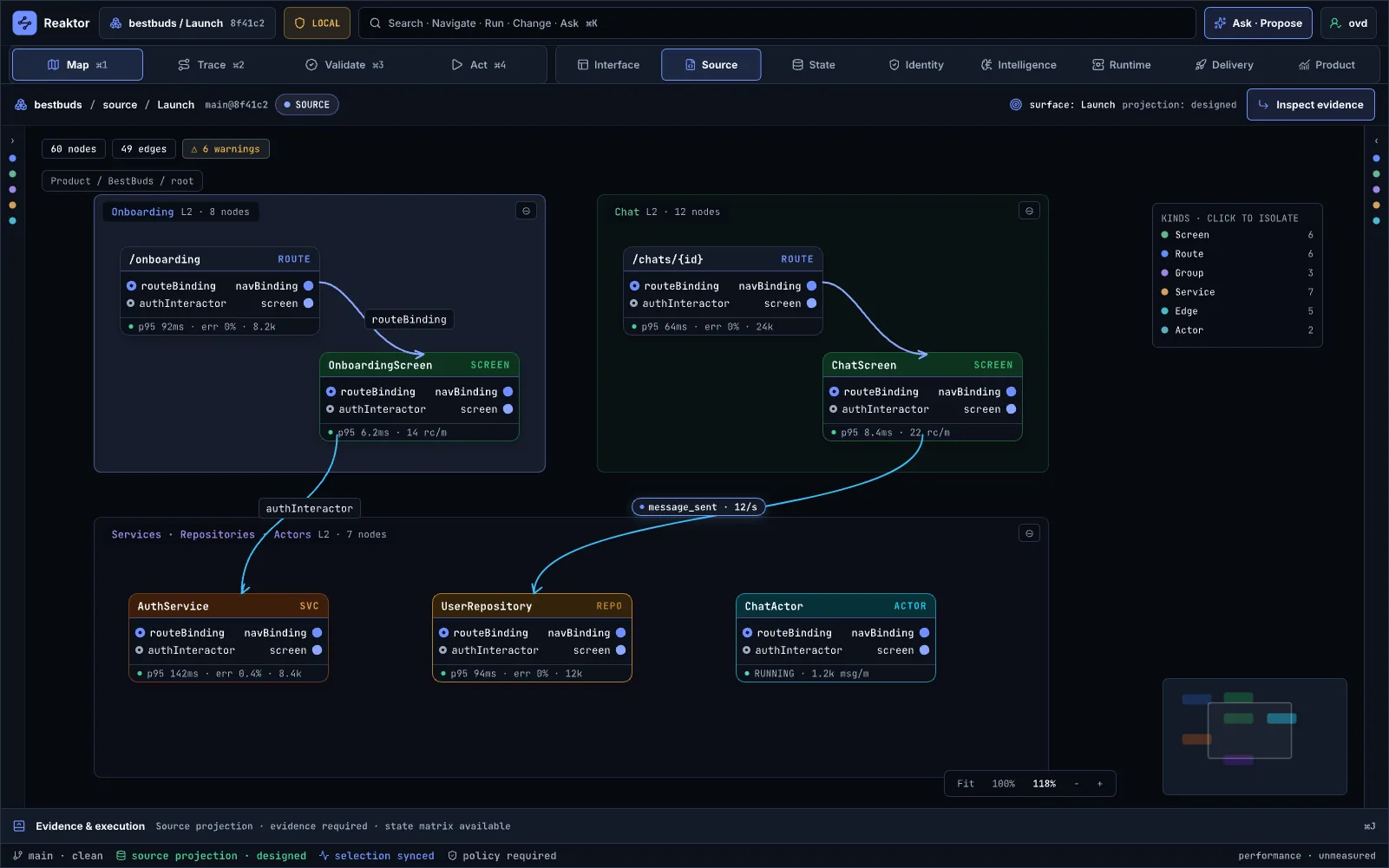
On the board. A reduced shell (movement nav and instrument row, no mode band, no query band, no lens band) over a canvas with the same three scope headers as 04.03 — Onboarding L2 · 8 nodes, Chat L2 · 12 nodes, Services · Repositories · Actors L2 · 7 nodes — and the same seven node cards. Chrome states projection: designed and the footer states performance · unmeasured, while the canvas asserts nine latencies (/onboarding · p95 92ms · err 0% · 8.2k, ChatActor · RUNNING · 1.2k msg/m). Counters read 60 nodes / 49 edges / ⚠ 6 warnings. The same KINDS · CLICK TO ISOLATE legend as 04.03, summing to twenty-nine.
Vision tie. None it does not borrow. It is 04.03 with the rail, inspector, dock, lens stack and mode band deleted.
Workflow tie. A launch or landing state — the first thing you see when the studio opens. That is a real need, but it needs the studio's affordances greyed, not removed.
Agentic tie. Agent-hostile. Chrome offers Ask · Propose with no queue, no findings list and no evidence surface. Nothing here is safely readable: every metric on the canvas contradicts the board's own projection: designed.
Blueprint tie. The Unreal project launcher screen, and it fails the same way — showing a thumbnail of the editor rather than the editor.
Replaces / augments. Nothing that 04.03 does not already replace.
Improvements. The board is not repairable as a separate surface, but if it survives: give every node its correct ports; drop the metric footers or change chrome to projection: observed; reconcile 60 nodes with the twenty-nine-item legend; and show the empty rail, inspector and dock in their zero states rather than omitting them, since a launch screen's job is to teach the layout.
Verdict. Cut. This is 04.03 with its data corrupted rather than simplified: every node — including AuthService · SVC, UserRepository · REPO and ChatActor · ACTOR — is given the identical four port rows routeBinding / navBinding / authInteractor / screen. A repository with a navBinding port is not a simplification of 04.03's correct rows (get / objectStore / update / flow); it is a mass-fill that makes the board actively misleading about what a port is. It also asserts a different node and edge count for the same revision 8f41c2. Fold the launch requirement into 04.03 as an empty state.
04.05 · Map · Semantic Depth × Density
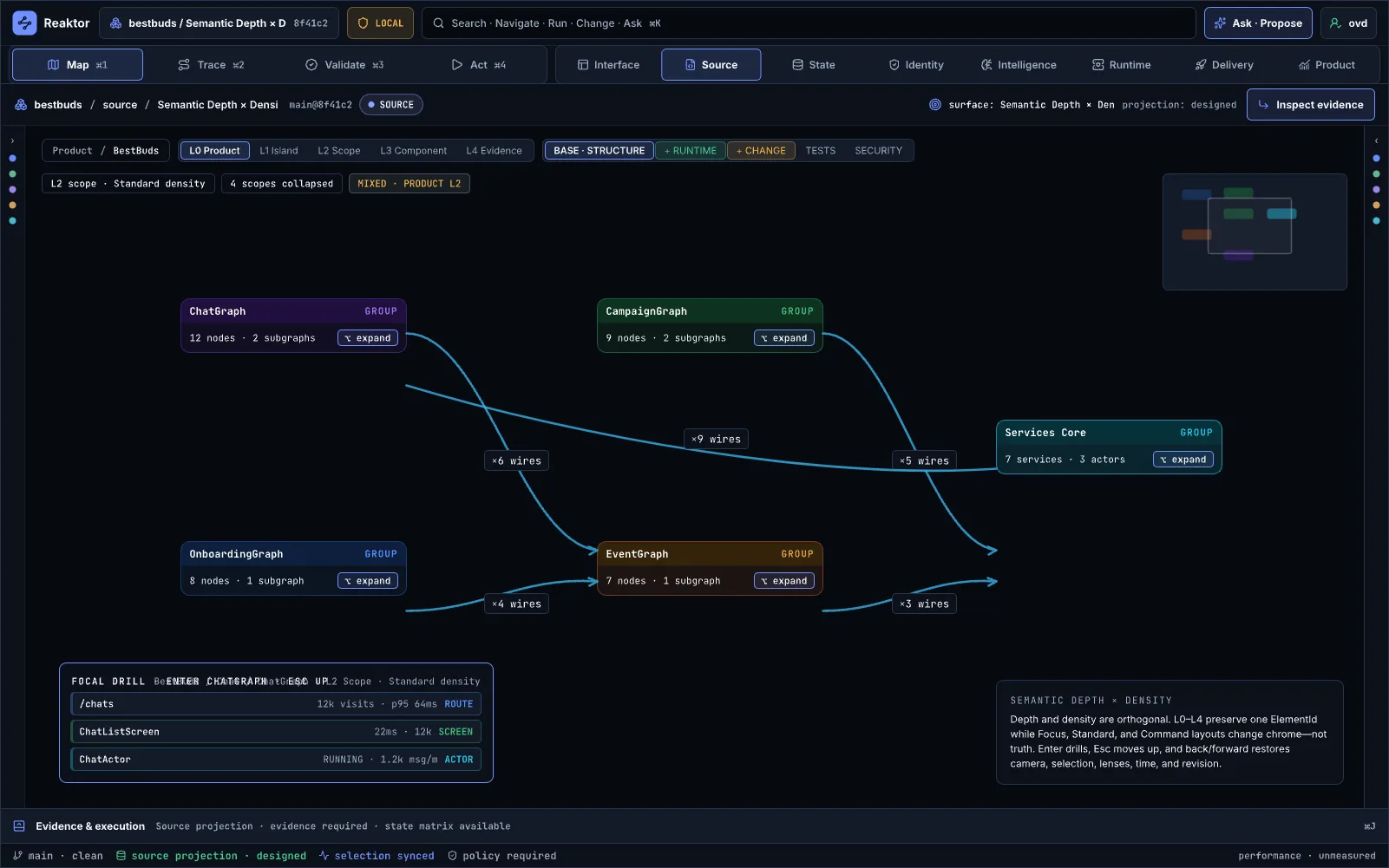
On the board. A depth strip (L0 Product, L1 Island, L2 Scope, L3 Component, L4 Evidence) and a lens strip (BASE · STRUCTURE, + RUNTIME, + CHANGE, TESTS, SECURITY) over five GROUP cards — ChatGraph · 12 nodes · 2 subgraphs, OnboardingGraph · 8 nodes · 1 subgraph, CampaignGraph · 9 nodes · 2 subgraphs, EventGraph · 7 nodes · 1 subgraph, Services Core · 7 services · 3 actors — each with ⌥ expand and an inter-group wire bundle count (×6 wires, ×9 wires). A status line reads L2 scope · Standard density · 4 scopes collapsed · MIXED · PRODUCT L2. Below, the thesis: Depth and density are orthogonal. L0–L4 preserve one ElementId while Focus, Standard, and Command layouts change chrome—not truth. Then FOCAL DRILL · ENTER CHATGRAPH · ESC UP showing a breadcrumb BestBuds / Chat / ChatGraph · L2 Scope · Standard density and three cards.
Vision tie. Bundled edges with a count (×6 wires) and collapsed scopes with node counts are the correct rendering of nested graphs — a collapsed subgraph that shows its weight is honest, a blank rectangle is not. The orthogonality claim is the load-bearing idea and it is stated well.
Workflow tie. Nobody opens this board. It is a design rationale, and it duplicates the rationale on 04.07.
Agentic tie. An agent gets group membership and subgraph counts, which is genuinely useful for scoping a query. But projection: designed sits above 12k visits · p95 64ms and RUNNING · 1.2k msg/m, so an agent parsing this board would attribute observed traffic to a designed projection.
Blueprint tie. Unreal has nothing here. Blueprint has one zoom continuum with LOD culling; it does not reproject the graph at each tier, and collapsing a node group does not summarize it. This is where Reaktor most clearly exceeds the analogy, and the board is the wrong place to say so.
Replaces / augments. The zoom behaviour of Figma and Miro; C4's level ladder; nothing operational.
Improvements. All of these apply after the merge below: carry the ×N wires bundle count into 04.07's L1 tier description, which currently says only edges bundled per island pair (×N); add the density axis (Focus / Standard / Command) to 04.07, which today has only the depth axis; fix 4 scopes collapsed against five drawn cards; and either drop the traffic metrics or switch the projection label.
Verdict. Merge into 04.07. Its unique content is one paragraph, one density axis and one focal-drill strip. 04.07 already owns L0–L4 and states the same navigation contract in more detail.
04.06 · Graph · Editing Connections
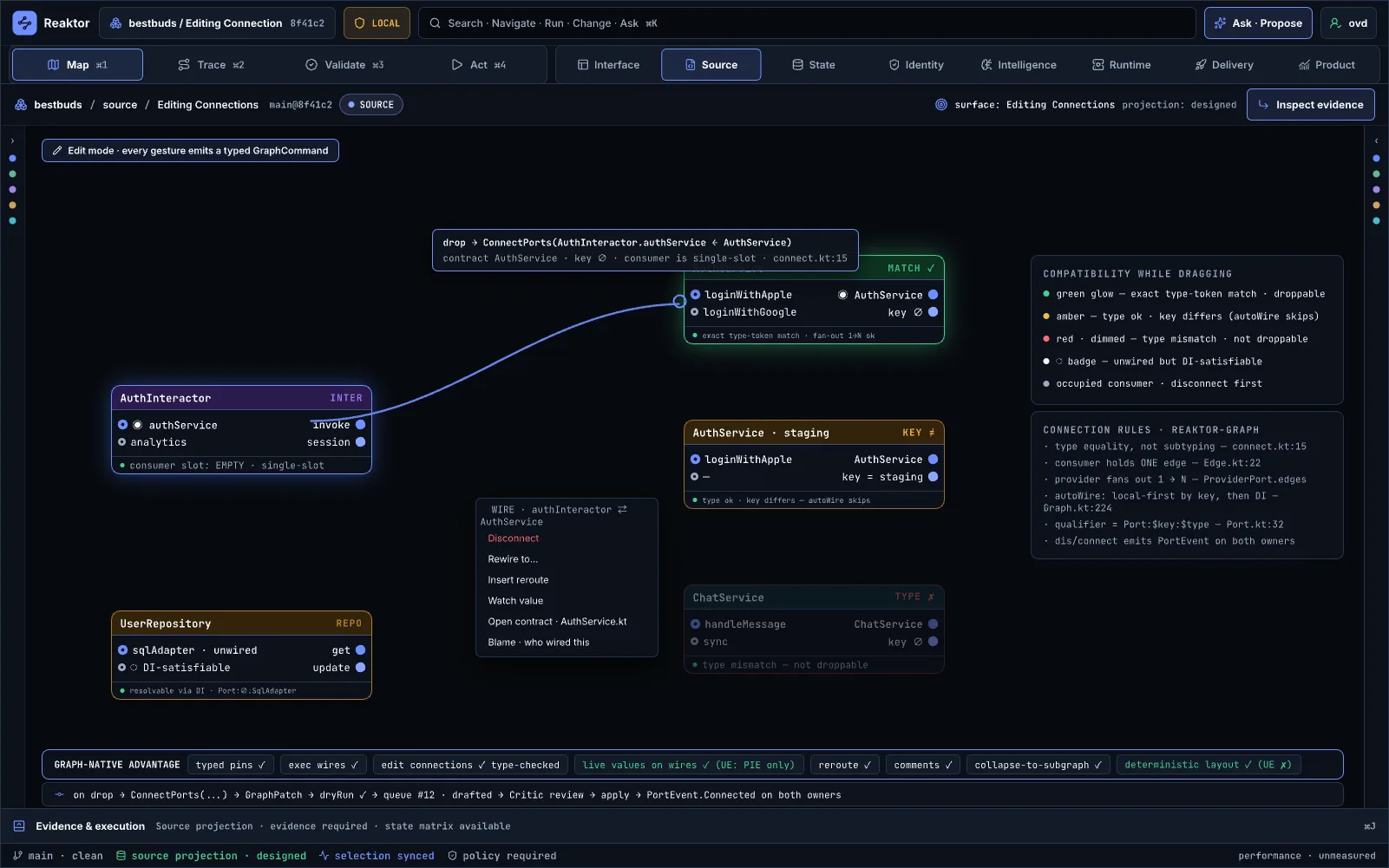
On the board. The compatibility board, and the most sourced content in the atlas. A canvas headed Edit mode · every gesture emits a typed GraphCommand shows a consumer AuthInteractor · ◉ authService with consumer slot: EMPTY · single-slot against four candidate providers in four distinct states: AuthService · MATCH ✓ · exact type-token match · fan-out 1→N ok; AuthService · staging · KEY ≠ · type ok · key differs — autoWire skips; ChatService · TYPE ✗ · type mismatch — not droppable; UserRepository · REPO · sqlAdapter · unwired · ◌ DI-satisfiable · resolvable via DI · Port:∅:SqlAdapter. A drop preview reads drop → ConnectPorts(AuthInteractor.authService ← AuthService) · contract AuthService · key ∅ · consumer is single-slot · connect.kt:15. Three reference panels follow: COMPATIBILITY WHILE DRAGGING (five states); CONNECTION RULES · REAKTOR-GRAPH with six rules each citing real code (type equality, not subtyping — connect.kt:15, consumer holds ONE edge — Edge.kt:22, provider fans out 1 → N — ProviderPort.edges, autoWire: local-first by key, then DI — Graph.kt:224, qualifier = Port:$key:$type — Port.kt:32, dis/connect emits PortEvent on both owners); a wire context menu (Disconnect, Rewire to…, Insert reroute, Watch value, Open contract · AuthService.kt, Blame · who wired this); and GRAPH-NATIVE ADVANTAGE, an eight-row comparison against Unreal. The commit path reads on drop → ConnectPorts(...) → GraphPatch → dryRun ✓ → queue #12 · drafted → Critic review → apply → PortEvent.Connected on both owners.
Vision tie. This is eigenvector primitives made touchable — one gesture, one typed command, one patch, one event on both owners. It is also the only place in the atlas where a UI claim is backed by a file and a line number, which is precisely what §1's evidence principle asks for.
Workflow tie. This is the moment of work: an engineer adding a dependency. Today they open AuthInteractor.kt, add a constructor parameter, run the build, discover the DI graph does not resolve, and read a stack trace. The board replaces a compile-and-guess loop with a drag whose legality is known before release.
Agentic tie. The best agent-readable spec in the cluster, because six rules with file citations are a machine-checkable contract. And it is the most dangerous, because the rule it teaches is unsound. An agent that internalises exact type-token match will confidently wire two string-constructed ports that share a name and disagree about their payload — which audit D-6 says is exactly what happens today.
Blueprint tie. This is the Blueprint pin-drag interaction, one-for-one, and it is better in three respects: the amber key differs state has no Unreal equivalent, the ◌ DI-satisfiable badge has no Unreal equivalent, and Blame · who wired this has none either. It is worse in one: Unreal will insert a conversion node for you, and this board's model refuses coercion without offering the graph-native substitute (an adapter node), even though 04.03 shows migration adapter exists.
Replaces / augments. Dagger/Hilt error output, Koin's runtime resolution failures, the IDE's "cannot resolve dependency" dialog, Blueprint's pin drag, and the manual reading of a DI module that today answers "what can satisfy this".
Improvements.
- Add the two missing compatibility states described in §The identity problem: a hatched
NOMINAL MATCH(name matches, class unresolved, droppable but generates a finding) and an outlinedDIGEST CONFLICT(same name, different content digest, not droppable). Three states become five. - Change the qualifier on the rules card from
Port:$key:$typetoPort:$key:$type#$digestand add a seventh rule:identity is the content digest, not the class token — D-6 open. - Put truth marks on
GRAPH-NATIVE ADVANTAGE. Two of its eight ticks are false against §2:edit connections ✓ type-checkedis whatD-6says is unsound, andlive values on wires ✓ (UE: PIE only)is not wired — 13.03 and 13.04 both carryUnknown · Runtime observation is not wired. Replace the ✓ column withSHIPPED / DESIGNED / NOT WIREDand add a ninth row for identity soundness markedDEFECT · D-6. - Add
Why does this match?to the wire context menu, opening a two-column derivation of both sides' declared shape with the differing field highlighted. This is the affordance that turns an unsound type system's failures from mysterious into teachable. - Adopt 04.02's port taxonomy so the pins on this canvas carry shape and colour. Right now the board that teaches wiring draws every pin identically.
Verdict. Strengthen. This is the cluster's keystone board and it needs one axis added, not a rebuild.
04.06A · Graph · Editing Connections — Connected
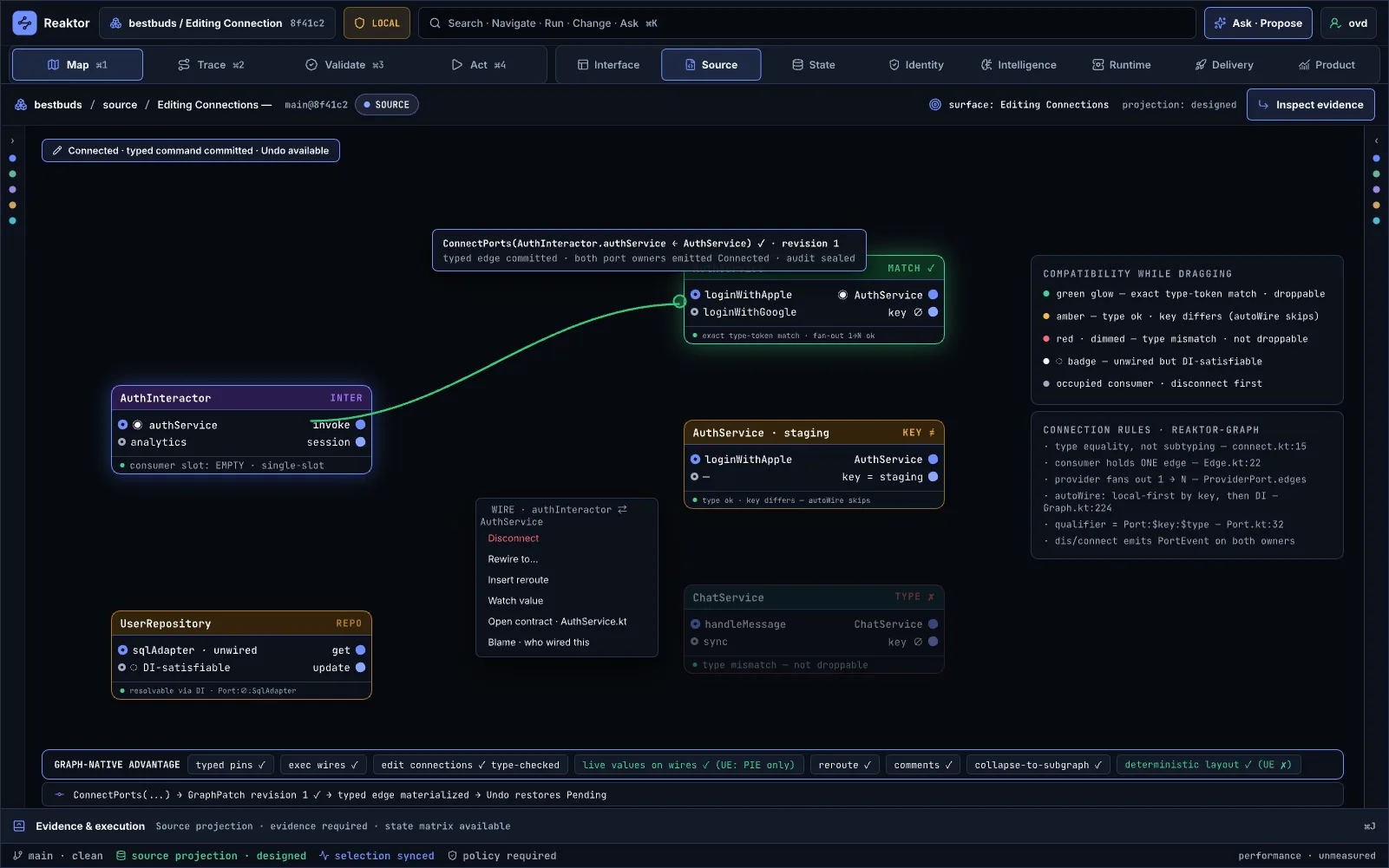
On the board. Identical to 04.06 except the canvas header (Connected · typed command committed · Undo available), the result card (ConnectPorts(AuthInteractor.authService ← AuthService) ✓ · revision 1 / typed edge committed · both port owners emitted Connected · audit sealed) and the footer path (ConnectPorts(...) → GraphPatch revision 1 ✓ → typed edge materialized → Undo restores Pending). All three reference panels are byte-identical to 04.06.
Vision tie. both port owners emitted Connected is the live graph asserting itself — the edit is not a file write that a rebuild later notices, it is an event on two resident objects. audit sealed and revision 1 carry the governance spine into the smallest possible action.
Workflow tie. This is the second frame of a two-second interaction. Its purpose is a design contract for the commit state, and as a state board that is correct practice.
Agentic tie. revision 1 and audit sealed are precisely what an agent needs to confirm its own patch landed. What is missing is the receipt identifier — the seven-stage pipeline on 04.02 and 04.08 ends in receipt, and this board, which is where a receipt would first exist, does not show one.
Blueprint tie. Blueprint has no equivalent. Connecting a pin in Unreal produces no revision, no event, no audit entry and no undo target beyond the editor's transaction buffer.
Replaces / augments. A git commit of a DI module, plus the CI run that validates it, collapsed into an audited moment.
Improvements.
- Show the receipt:
receipt r1843 · sealed 12:41:08 · principal ovd · policy v19. It is the payoff of the pipeline and it is missing at the only point it exists. - Make the wire visually different from the pending state — this is a state board and the only difference an engineer can see in the extracted text is the caption.
- Show the identity that was committed on the result card:
identity #a41c9e2f ⇄ #a41c9e2f · exact. - Show what the commit invalidated: if any approval elsewhere was drift-invalidated (04.02's rule), name it here.
Verdict. Keep.
04.06B · Graph · Editing Connections — Rerouted
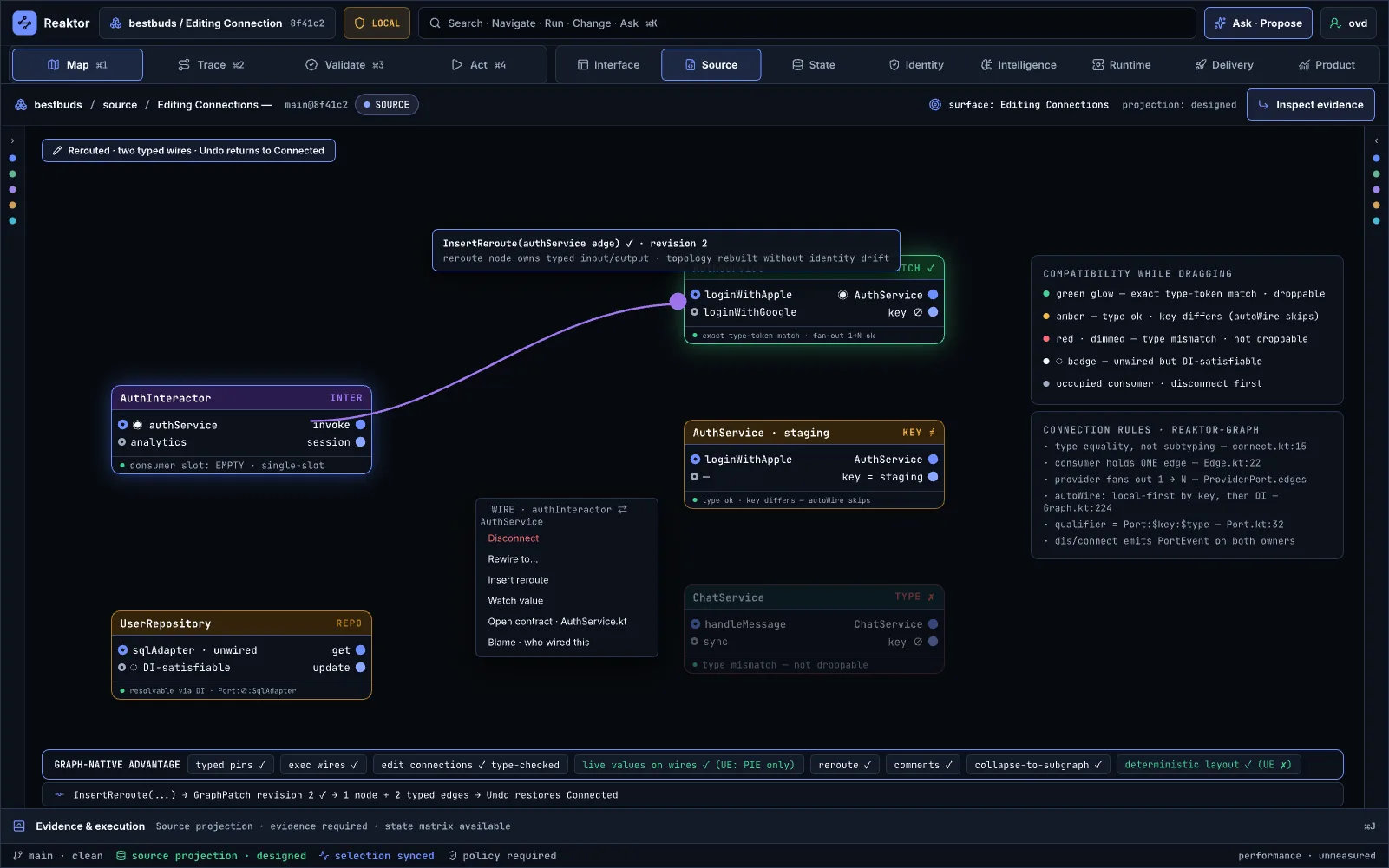
On the board. Again identical chrome and reference panels; the deltas are the header (Rerouted · two typed wires · Undo returns to Connected), the result card (InsertReroute(authService edge) ✓ · revision 2 / reroute node owns typed input/output · topology rebuilt without identity drift) and the footer (InsertReroute(...) → GraphPatch revision 2 ✓ → 1 node + 2 typed edges → Undo restores Connected).
Vision tie. topology rebuilt without identity drift is the exact right sentence: the picture changed, the identities did not. That is the diagram-cannot-lie thesis at the scale of one node.
Workflow tie. Reroute is a readability edit. Its whole value depends on being free — if straightening a wire costs a review cycle, nobody does it and the graph becomes unreadable.
Agentic tie. An agent doing layout hygiene across a large graph is an obvious and safe use — but only if reroute is a view command. As drawn it is GraphPatch revision 2, which means an agent tidying two hundred wires would generate two hundred governed patches.
Blueprint tie. Unreal's reroute node, exactly. Unreal's is purely cosmetic and does not affect compilation.
Replaces / augments. Blueprint reroute nodes; the manual node-nudging in any diagram tool.
Improvements.
- Resolve the classification, which is the sharpest contradiction in the section. This board makes reroute a semantic patch producing a new revision. 04.07 says
double-click wire · InsertReroute · view patch only · spec hash unchangedand 04.08 labels the same thingreroute · view patch. The correct answer is that a reroute node is a rendering artefact and must not bump the revision; change this board toInsertReroute ✓ · view patch · spec hash 8f41c2 unchangedand keepUndo restores Connected. - If reroute genuinely materialises a node, show what the compiler does with it — a reroute that survives into the bundle is a runtime hop, and 04.08's determinism claim depends on knowing whether it does.
- Add a
Straighten all in scopebulk action, sinceQ · align and straightenon 04.07 and 04.08 implies one and no board offers it.
Verdict. Strengthen — specifically, correct the patch classification.
04.07 · Map · Zoom & Level of Detail
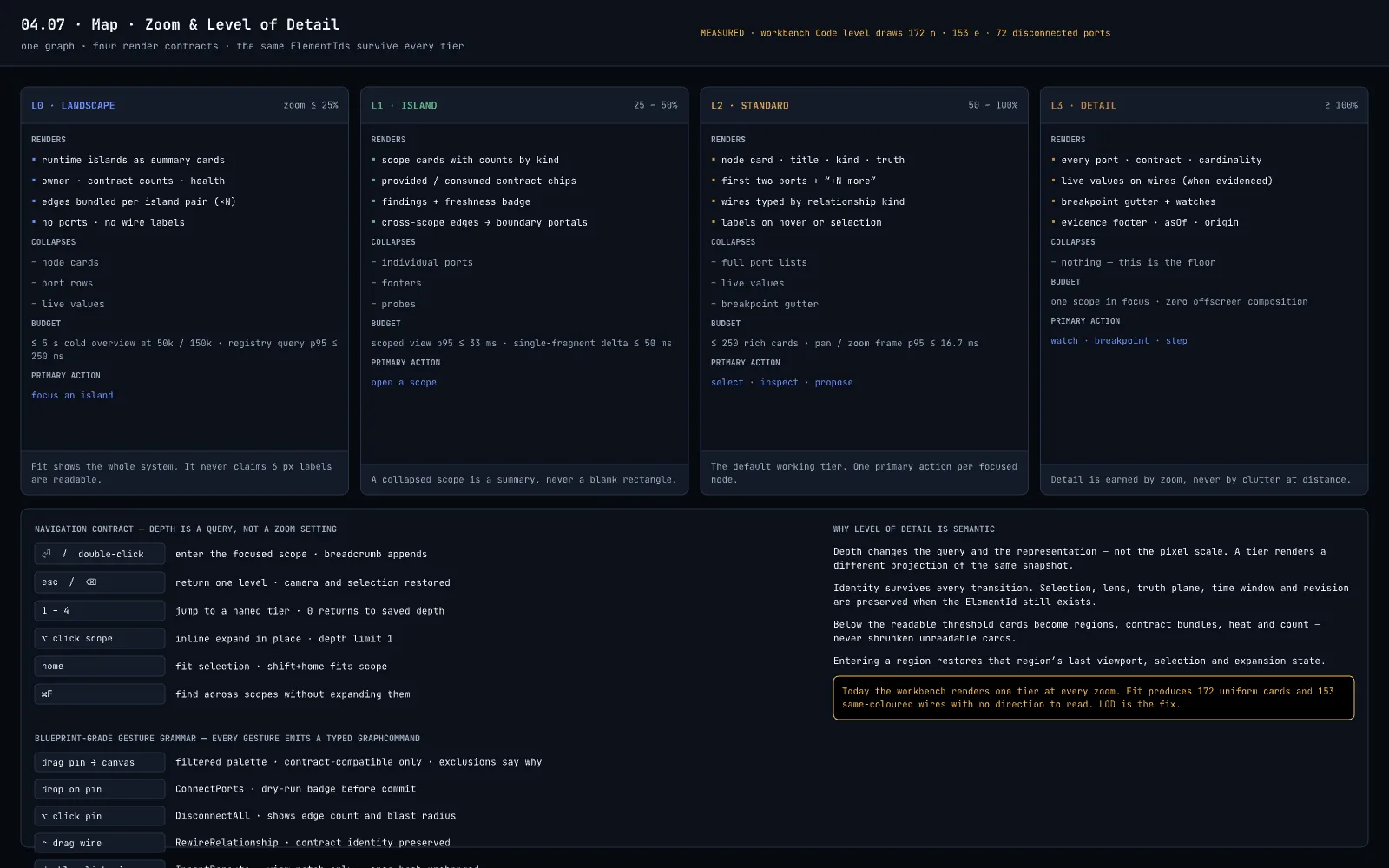
On the board. No app chrome; a four-tier specification. Header: one graph · four render contracts · the same ElementIds survive every tier, and beneath it the only MEASURED claim in the section — MEASURED · workbench Code level draws 172 n · 153 e · 72 disconnected ports. Four tier cards, each with RENDERS, COLLAPSES, BUDGET, PRIMARY ACTION and a one-line principle: L0 · LANDSCAPE · zoom ≤ 25% (budget ≤ 5 s cold overview at 50k / 150k · registry query p95 ≤ 250 ms, principle Fit shows the whole system. It never claims 6 px labels are readable.); L1 · ISLAND · 25 – 50% (A collapsed scope is a summary, never a blank rectangle.); L2 · STANDARD · 50 – 100% (≤ 250 rich cards · pan / zoom frame p95 ≤ 16.7 ms, The default working tier.); L3 · DETAIL · ≥ 100% (collapses nothing — this is the floor, primary action watch · breakpoint · step). Then NAVIGATION CONTRACT — DEPTH IS A QUERY, NOT A ZOOM SETTING with six bindings, BLUEPRINT-GRADE GESTURE GRAMMAR — EVERY GESTURE EMITS A TYPED GRAPHCOMMAND with eight, and WHY LEVEL OF DETAIL IS SEMANTIC closing with the section's most honest sentence: Today the workbench renders one tier at every zoom. Fit produces 172 uniform cards and 153 same-coloured wires with no direction to read. LOD is the fix.
Vision tie. "Depth is a query, not a zoom setting" is the deepest idea in the cluster. It is what separates a live semantic graph from a picture of one: at each tier the system runs a different query against the same snapshot and renders a different projection, while ElementId — and with it selection, lens, truth plane, time window and revision — survives. That is the Symphony Contract stated more precisely than 00 · START HERE states it.
Workflow tie. This is a performance and interaction contract that a rendering engineer implements against and a reviewer tests against. Its budgets are the acceptance criteria.
Agentic tie. Indirectly excellent. ⌘F · find across scopes without expanding them and the depth-as-query framing mean an agent can request a tier rather than simulating zoom — an agent should never need a camera. But no board shows the query language that would express give me L1 for island X.
Blueprint tie. Unreal has no equivalent and the board knows it — the gesture grammar is titled BLUEPRINT-GRADE, which is a claim of parity on gestures and superiority on projection. Blueprint's zoom is a scale transform with text culling; there is no tier at which a Blueprint graph becomes a set of summary cards with contract counts.
Replaces / augments. Figma and Miro zoom semantics; Google Maps' tile-and-label LOD; the "collapse all" of any IDE — and, more to the point, it replaces the current workbench behaviour it names.
Improvements.
- Mark each
BUDGETasTARGETorMEASURED.≤ 5 s cold overview at 50k / 150kandpan / zoom frame p95 ≤ 16.7 msare goals typeset identically to the one number on the board that was actually observed. - Add an identity coverage line to each tier's
RENDERSlist —resolved / nominal / conflictcounts per island at L0 and L1, per node at L2, per port at L3 — so type soundness is legible at the distance you are standing. - Absorb the density axis from 04.05. The board has depth and no density; 04.05 has
Focus, Standard, and Commandand the assertion that the two are orthogonal. A four-by-three matrix showing which combinations are legal is one panel. - State what happens when an
ElementIddoes not survive a transition. The board promises preservationwhen the ElementId still existsand never shows the other case, which is the one that happens after a refactor. - Add the
72 disconnected portsfigure to L0's rendered summary. It is the most alarming fact the section knows and it appears once, in small type, in a header.
Verdict. Keep. This is the best board in the cluster and one of the best in the atlas. It should absorb 04.05 and 04.02's interaction grammar.
04.08 · Act + Source · Authoring, Compile & Debug
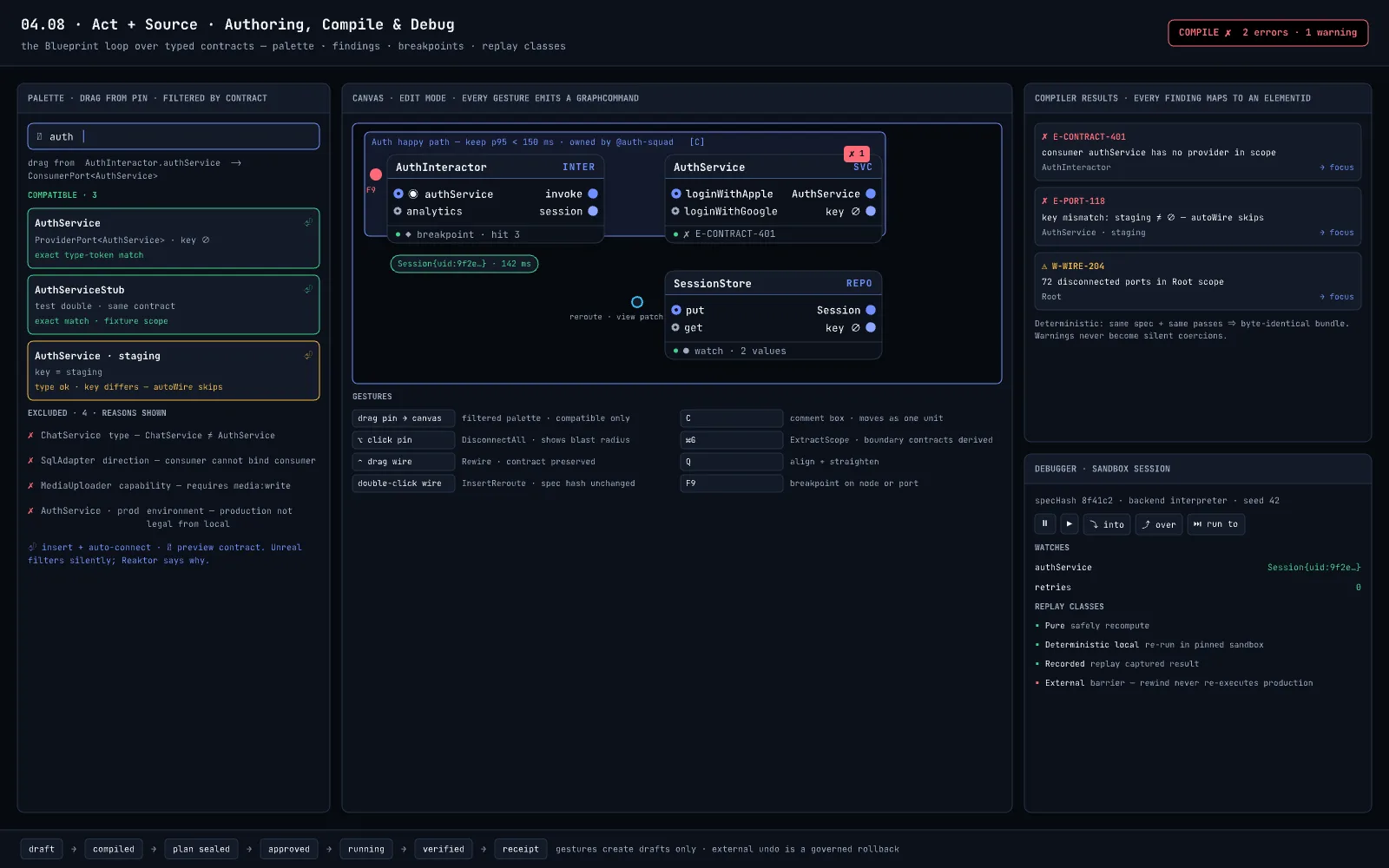
On the board. No chrome; five panels forming the full authoring loop. A status strip COMPILE ✗ 2 errors · 1 warning. PALETTE · DRAG FROM PIN · FILTERED BY CONTRACT with a search field (⌕ auth), a context line (drag from AuthInteractor.authService ⟶ ConsumerPort<AuthService>), COMPATIBLE · 3 (AuthService, AuthServiceStub · test double · same contract, AuthService · staging) and — the best idea on the board — EXCLUDED · 4 · REASONS SHOWN, listing four different classes of exclusion: ChatService · type — ChatService ≠ AuthService, SqlAdapter · direction — consumer cannot bind consumer, MediaUploader · capability — requires media:write, AuthService · prod · environment — production not legal from local, closing with Unreal filters silently; Reaktor says why. CANVAS · EDIT MODE shows a comment strip (Auth happy path — keep p95 < 150 ms · owned by @auth-squad [C]), a ◆ breakpoint · hit 3 on AuthInteractor, an ✗ E-CONTRACT-401 on AuthService, a ● watch · 2 values on SessionStore, and Session{uid:9f2e…} · 142 ms. A GESTURES table of seven. COMPILER RESULTS · EVERY FINDING MAPS TO AN ELEMENTID with three coded findings each with → focus, closing Deterministic: same spec + same passes ⇒ byte-identical bundle. Warnings never become silent coercions. DEBUGGER · SANDBOX SESSION with specHash 8f41c2 · backend interpreter · seed 42, transport controls ⏸ ▶ ⤵ into ⤴ over ⏭ run to, WATCHES, and REPLAY CLASSES — Pure · safely recompute, Deterministic local · re-run in pinned sandbox, Recorded · replay captured result, External · barrier — rewind never re-executes production. Footer: the seven-stage pipeline and gestures create drafts only · external undo is a governed rollback.
Vision tie. Two ideas here are genuinely new and neither exists in Unreal. EXCLUDED · 4 · REASONS SHOWN with four exclusion classes turns the palette from a filter into an explanation, and capability — requires media:write is §1's capability tiers appearing at the moment of authoring rather than as documentation. REPLAY CLASSES is the deeper one: it is a formal answer to "what is safe to re-execute", and External · barrier — rewind never re-executes production is the sentence that makes a time-travelling debugger safe to point at a real system. No debugger I know of makes this distinction explicit.
Workflow tie. This is the inner loop — the fifteen-second cycle an engineer runs a hundred times a day. Today that cycle is: edit a file, wait for Gradle, read a stack trace, add a print statement, rebuild. This board proposes: drag from a pin, read the compile findings, set a breakpoint on a port, step, watch.
Agentic tie. The single most machine-actionable artefact in the cluster is COMPILER RESULTS · EVERY FINDING MAPS TO AN ELEMENTID. A coded finding bound to an ElementId is a perfect agent work item — an agent can claim E-CONTRACT-401, propose the ConnectPorts patch that resolves it, and be checked by recompilation. And there is no depicted way for it to do so, because this board has no chrome, no queue, no Propose affordance and no agent lane. The crux board of the section is the one an agent cannot enter.
Blueprint tie. This is the closest board to Unreal's Blueprint editor and it wins on three axes and loses on one. It wins on the palette (reasoned exclusion versus silent filtering), on breakpoints (F9 · breakpoint on node or port — Unreal breaks on nodes only), and on replay classes (Unreal has no concept of what is safe to re-run). It loses on the debugger's scope: SANDBOX SESSION · backend interpreter · seed 42 is Play-In-Editor. 04.06's boast that Unreal has live values on wires ✓ (UE: PIE only) is undercut by this board, where the only debugger drawn is also a PIE.
Replaces / augments. The IDE debugger (IntelliJ, Xcode), rr and time-travel debuggers, the Kotlin compiler's error output, Blueprint's compile button and results panel, and — through replay classes — what teams currently do with VCR cassettes and recorded HTTP fixtures.
Improvements.
- Give it the chrome. This board carries no revision band, no environment, no principal, no
DESIRED + OBSERVEDplane, no mode band. It should render withDEBUGlit in the mode band and an explicitenv: local · sandboxchip, because its own palette excludes a provider on environment grounds and there is nowhere to read what environment you are in. - Add a third diagnostic class for identity. The panel has
E-CONTRACT-*(missing provider) andE-PORT-*(key mismatch) and nothing for the defect that actually exists:E-IDENT-207 · nominal match — AuthService (kotlin #a41c9e2f) ⇄ AuthService (ts, class ∅), plus a scope-levelW-IDENT-211 · 14 nominal edges in Root scopesitting next to the existingW-WIRE-204 · 72 disconnected ports in Root scope. - Give findings a quick fix, not only
→ focus.E-CONTRACT-401 · consumer authService has no provider in scopehas exactly one obvious remedy and the palette already knows the three compatible providers. OfferFix…that opens the filtered palette pre-scoped to the finding. - Mark the determinism claim.
Deterministic: same spec + same passes ⇒ byte-identical bundleis unproven — audit §2 records no CI and no differential conformance. Render it as aDESIREDclaim withevidence: none · L2 differential conformance not yet run, in the style 13.03 uses fornative parity not yet proven. - Add a call stack pane to the debugger.
⤵ intoand⤴ overimply a stack and none is drawn; on a graph the stack is the chain of nodes that led here, which is more useful than a source stack and is a genuine differentiator. - Add a warning waiver control.
W-WIRE-204 · 72 disconnected portswill be present for months; without an owner, a reason and an expiry, it becomes wallpaper and the panel stops being read.
Verdict. Strengthen. It is the most important board in the section and currently the least connected to it.
Blueprint parity table
Status values: Depicted (drawn on a board with concrete affordances), Partial (named or claimed but not fully drawn), Omitted (absent from all ten boards).
| Blueprint capability | Status | Evidence on these boards | Gap |
|---|---|---|---|
| Node palette with contextual search | Depicted, exceeds UE | 04.08 PALETTE · DRAG FROM PIN · FILTERED BY CONTRACT, ⌕ auth, COMPATIBLE · 3, EXCLUDED · 4 · REASONS SHOWN with four exclusion classes; 04.02 right-click canvas · palette from registered contracts · type + capability filtered; 04.07 exclusions say why | No non-contextual browse mode (UE's "all actions"), no favourites, no recently-used, no palette when nothing is selected |
| Typed pin compatibility | Depicted but unsound | 04.06 five drag states; type equality, not subtyping — connect.kt:15; qualifier = Port:$key:$type — Port.kt:32 | The model has a key axis and a type axis and no identity axis. Audit D-6 says the type token itself is unreliable, so the green MATCH ✓ state is not trustworthy |
| Automatic coercion nodes | Deliberately omitted | 04.08 Warnings never become silent coercions; 04.06 type equality, not subtyping | Correct to refuse implicit coercion, but no adapter-insertion affordance is offered in its place at drag time, even though 04.03 shows migration adapter · 3 consumers exists as a concept |
| Reroute nodes | Depicted, but classified two ways | 04.06 menu Insert reroute; 04.06B InsertReroute ✓ · revision 2 · 1 node + 2 typed edges; 04.07 view patch only · spec hash unchanged; 04.08 reroute · view patch | Semantic patch on one board, view command on two others. Also no bulk straighten, and no statement of whether a reroute survives compilation |
| Collapsed subgraphs | Depicted | ⌘G · ExtractScope · boundary contracts derived automatically on 04.02, 04.07, 04.08; ⊖ collapse on 04.03/04.04; ⌥ expand · depth limit 1 on 04.05/04.07; 2 subgraphs counts on 04.05 | Collapse is depicted; the collapsed thing is never named, versioned or reused |
| Reusable functions / macros / event dispatchers | Omitted | 04.06's advantage table claims collapse-to-subgraph ✓ and nothing more | No board shows a collapsed scope becoming a named, versioned node with its own contract instantiated at N call sites. §1 says "a feature is a subgraph of an app" and there is no authoring surface for that |
| Graph variables / locals panel | Omitted | — | Nothing corresponds to UE's My Blueprint panel. Node-local state, graph-scoped variables and default values appear nowhere; 04.03's inspector has six tabs and none of them is editable properties |
| Comment boxes | Partial | Claimed on 04.06 (comments ✓), bound on 04.07 (C on selection · comment / scope box · moves as one unit) and 04.08 (C · comment box). Exactly one is rendered: Auth happy path — keep p95 < 150 ms · owned by @auth-squad [C] on 04.08, and the same string without the marker on 04.02 | No colour, no nesting, no comment as a governed object with an owner and a lifetime — even though the one drawn comment contains a budget and an owner and therefore wants to be one |
| Execution flow vs data flow wires | Depicted, exceeds UE — but stranded | 04.02's seven-row PORT & RELATIONSHIP TAXONOMY: exec (triangle + arrow), domain contract, Bool (diamond), String (square), Flow<T> (pulse pattern + rate), navigation, containment; ▶ exec / exec ▶ pins on 04.02's canvas | The taxonomy exists on exactly one board. 04.06/A/B — the wiring boards — draw undifferentiated pins, and 04.08's canvas has no exec pins at all |
| Breakpoints | Depicted, exceeds UE | 04.02 ⏸ breakpoint and F9 on node · sandbox breakpoint · capability-gated · never production by default; 04.08 ◆ breakpoint · hit 3 and F9 · breakpoint on node or port; 04.07 L3 breakpoint gutter + watches | No conditional breakpoints, no breakpoint list/manager, no disable-all |
| Watch values | Depicted, exceeds UE | 04.02 WATCH · session { uid: 9f2e…, provider: apple, ttl: 3600, issued: 12s ago } and hover wire · evidence-backed value probe · origin, asOf, rate, gaps; 04.06 menu Watch value; 04.08 WATCHES / authService / retries 0 | The promised four-field provenance (origin, asOf, rate, gaps) is never actually rendered on any watch popover |
| Per-node hit counts | Partial | 04.08 hit 3; 04.02 fired 12s ago · 8.2k/24h and exec · 3/min; 04.04 14 rc/m | No execution-count heat overlay. 04.03's LENS STACK has six overlays and none of them is hit count, despite the section's live-graph claim making this cheap |
| Step debugging | Partial | 04.08 only: ⏸ ▶ ⤵ into ⤴ over ⏭ run to, specHash 8f41c2 · backend interpreter · seed 42, and REPLAY CLASSES (Pure / Deterministic local / Recorded / External barrier) | No call stack pane, no variable scope view, no thread or actor selector. The stepping is over a sandbox interpreter, not a live graph |
| Compile with error panel | Depicted, exceeds UE | 04.08 COMPILE ✗ 2 errors · 1 warning and COMPILER RESULTS · EVERY FINDING MAPS TO AN ELEMENTID with E-CONTRACT-401, E-PORT-118, W-WIRE-204, each → focus | No quick fixes, no waiver with owner and expiry, no identity diagnostic class, no incremental compile timing, and the determinism claim under it is unbacked |
| Diff of two versions | Omitted | COMPARE is lit in the mode band on 04.01, 04.02 and 04.03 with no destination. 04.03 shows a patch diff — GraphPatch · semantic diff · +1 edge · 0 materialized and three unified-diff lines — which is not a revision comparison | The largest omission in the section. Blueprint diffing is Unreal's weakest feature and a semantic graph with stable ElementIds is exactly the substrate that would beat it. Nothing in section 04 attempts it |
| Find references / search | Depicted | 04.07 ⌘F · find across scopes without expanding them; 04.03 Query · kind: provider: account: env: owner: truth: drift: path: | The query grammar is drawn as a facet strip and never as a result list |
| Node alignment | Depicted, parity | Q · align and straighten connections (04.07, 04.08) | Bulk operation implied, never offered |
| Bookmarks | Partial | 04.03 SAVED VIEWS · 8 with four named | Views are saved; positions within a graph are not |
| Play-In-Editor / simulate | Partial, and the analogy inverts | 04.08 DEBUGGER · SANDBOX SESSION; 04.02 sandbox breakpoint · capability-gated · never production by default | Reaktor's whole claim is that the graph is live and does not need a PIE. The only debugger drawn is a sandbox, which makes 04.06's jab at Unreal (live values on wires ✓ (UE: PIE only)) unsupported by any board in the section |
Scoring the twenty rows: seven are depicted at or above Blueprint parity, six are partial, three are omitted, one is deliberately refused with a stated rationale, and three are depicted but internally inconsistent or unsound. The authoring and debugging half of Blueprint is well covered. The reuse half — functions, variables, libraries — and the versioning half — diff and merge — are almost entirely absent, and those are the two halves that decide whether a graph tool survives its second year.
The identity problem
Audit D-6 says port type identity is unsound because Type is (String, KClass?) with two non-interoperating construction paths: reified ports carry a real class, string-built ports — every ServiceNode endpoint and every JS caller — carry null. Same-named ports on different paths refuse to connect; differently-classed ports on the string path connect happily. The keystone fix is one content-derived fingerprint unifying port identity, codec layout identity and FFI method identity. The word fingerprint appears twice in the whole atlas, on 13.01 and on a Composer provisioning state board, and never in section 04.
These boards do not merely fail to depict the defect. They depict its cause as a feature. 04.06's compatibility model has exactly two axes — type and key — and its green state is captioned exact type-token match. The type token is the unsound thing. The board teaches a developer, and teaches an agent, that a green glow means the contract matches, when in the string-construction path a green glow means only that two names are spelled the same. Meanwhile the amber state, type ok · key differs — autoWire skips, gives a whole visual state to the less dangerous failure, because a skipped autoWire is loud and a false match is silent.
What the surfaces must show
A fingerprint is the primitive, and it must be visible without opening anything. Every contract gets an eight-character content digest derived from its declared shape — field names, field types, ordering, version — and never from the runtime class token. Render it in the monospace face at the trailing edge of the port row: ◉ authService AuthService #a41c9e2f. The same eight characters must appear in three places: the port row here, the codec layout row on the FlexBuffers and schema surfaces, and the FFI method row on 13.03 · Extend · FFI Switchboard. If a reader can see #a41c9e2f in all three places, the keystone claim is legible without a sentence of prose. That is the cheapest possible way to make §2's keystone primitive real in the atlas.
Every port carries a three-state resolution badge. RESOLVED — reified construction, class present, digest computed from the declared shape; render as a solid filled chip. NOMINAL — string construction, class ∅; the name matched and the shape was never verified; render as a hollow chip with a dotted outline carrying the literal text class ∅. CONFLICT — two ports share a name and disagree on digest; render as a filled warning chip showing both digests. This badge belongs on the port row at L3, on the node card's port summary at L2 (4 ports · 1 nominal), and as an island-level count at L1 and L0.
The drag grammar goes from three states to five. 04.06's COMPATIBILITY WHILE DRAGGING panel currently lists green (exact match), amber (key differs), red (type mismatch), the ◌ DI-satisfiable badge, and occupied-consumer. Add:
- Blue hatched ·
NOMINAL MATCH— "name matches; one side is string-constructed and its shape is unverified. This will connect at runtime and may be wrong." Droppable, because forbidding it would break everyServiceNodeendpoint and every JS caller, but the drop produces a finding rather than a clean commit. - Red outline ·
DIGEST CONFLICT— "both sides resolved, same name, different shape:#a41c9e2fversus#7d20b155." Not droppable, and the rejection card offersInsert adapter…rather than a dead end.
The connection card gains an identity line. Today 04.06's drop preview reads contract AuthService · key ∅ · consumer is single-slot · connect.kt:15. It needs a third line: identity #a41c9e2f ⇄ #a41c9e2f · exact, or identity #a41c9e2f ⇄ class ∅ · nominal · will not be re-checked at runtime. The qualifier on the CONNECTION RULES card changes from Port:$key:$type to Port:$key:$type#$digest, and a seventh rule appears: identity is the content digest, not the class token — defect D-6 open. Citing the defect on the rules card is what turns a marketing panel into an engineering one.
The wire itself must carry identity. This is the single highest-value pixel change in the cluster. Today every wire on every board is a solid stroke of equal weight, so every edge looks equally trustworthy. Render nominal edges with a hatched or dashed stroke and conflicted edges with a doubled stroke in the warning colour. A developer scanning a scope at L2 should be able to see, without clicking anything, which of their edges are load-bearing but unverified. At L1 and L0, where 04.07 says edges bundle into (×N) counts, the bundle splits: ×6 wires · 2 nominal.
The context menu gains an explanation. 04.06's wire menu already has Blame · who wired this. Add Why does this match?, opening a two-column derivation showing both sides' declared shape field by field with the differing or unverifiable field highlighted, and a footer stating which construction path each side used. An unsound type system's failures are survivable if they are teachable and fatal if they are mysterious; this menu item is the difference.
The compiler gains a diagnostic class. 04.08 has E-CONTRACT-* for a missing provider and E-PORT-* for a key mismatch. It needs E-IDENT-*: E-IDENT-207 · nominal match across boundary — AuthService (kotlin, #a41c9e2f) ⇄ AuthService (ts, class ∅) with → focus, and a scope-level counter W-IDENT-211 · 14 nominal edges in Root scope standing beside the existing W-WIRE-204 · 72 disconnected ports in Root scope. The two numbers together are the honest health line for the graph substrate, and 72 disconnected ports currently stands alone.
A dedicated validation board is required, described under Missing panes as 04.10. Fingerprints on port rows tell you about the edge in front of you; the burn-down of D-6 needs a scope-wide table.
Editing versus runtime
Section 04 has the vocabulary to separate authoring from observing and does not consistently use it.
The vocabulary is the mode band EXPLORE · EDIT · DEBUG · COMPARE, the plane band DESIRED + OBSERVED, the per-node truth footers on 04.03, the TruthMark values SOURCE / OBSERVED / PARTIAL / UNKNOWN used everywhere else in the atlas, and the seven-stage pipeline draft → compiled → plan sealed → approved → running → verified → receipt. Where these are used the distinction is crisp. 04.03 is the model: OnboardingScreen is LIVE · 2 instances · 6.2ms, /chats/{id} is SOURCE + LIVE · 24k req · 2s, UserRepository is PARTIAL · p95 94ms · source + trace. Three nodes on one canvas with three different epistemic statuses, and the inspector splits into Desired · Screen · contract v3 against Observed · 2 runtime instances · LIVE 2s with Truth · SOURCE desired + OBSERVED runtime · per-property truth. That last phrase — per-property truth — is the correct granularity and it appears once.
Where the vocabulary is not used, the boards contradict themselves outright. 04.04 and 04.05 both declare projection: designed in chrome and performance · unmeasured in the footer, and then paint observed latencies across the canvas: /onboarding · p95 92ms · err 0% · 8.2k, ChatActor · RUNNING · 1.2k msg/m, /chats · 12k visits · p95 64ms. A board cannot be a designed projection and report production traffic. A board cannot say performance · unmeasured in its status bar and assert nine latencies in its body. This is not a nuance; it is the same board asserting and denying the same thing eighty pixels apart, and it is mechanically fixable by binding the metric footer's visibility to the projection selector.
04.06, 04.06A and 04.06B get this right by omission — they are purely structural, they carry performance · unmeasured, and they assert no metrics at all. That is why they are the most honest boards in the section.
04.08 is the crux and it is half right. It draws the correct conceptual apparatus for the transition. REPLAY CLASSES is a real answer to when you may cross from observing into re-executing: Pure · safely recompute, Deterministic local · re-run in pinned sandbox, Recorded · replay captured result, External · barrier — rewind never re-executes production. 04.02 supplies the complementary rule — sandbox breakpoint · capability-gated · never production by default — and the drift rule, drift invalidates approval. Together these are a better safety model than any debugger I know of ships.
But three things break it.
First, the debugger drawn is a sandbox, not a live attach: specHash 8f41c2 · backend interpreter · seed 42. That is Play-In-Editor. The section's differentiator — 04.06's own boast, live values on wires ✓ (UE: PIE only) — is contradicted by the only debugger the section draws. There is no board showing watches on a running production graph with an effect mark of read-only and a capability gate, which is the thing that would make the boast true.
Second, 04.08 has no chrome, so the transition it governs is invisible in it. You cannot read from that board which environment you are in, which revision you are debugging, who you are, or whether the sandbox's specHash 8f41c2 still matches what is deployed. Its own palette excludes a provider with environment — production not legal from local, which proves an environment axis exists and that the board does not display it. Every guarantee 04.02 states about drift and capability is absent from the board where those guarantees are exercised.
Third, and largest: the moment of transition has no board at all. §1's graph code push — marked subgraphs updating and rewiring at runtime, delivered through Hermes, with typed boundaries governing what a pushed bundle may touch — is the whole payoff of keeping the graph resident. Section 04 shows a live map (04.01), an approved patch queue (04.03) and a compile-and-debug loop (04.08), and never the frame where a sealed plan lands on a running graph. The seven-stage pipeline is drawn three times and the stages approved → running → verified → receipt are never depicted, only labelled. That is the section's biggest hole and it is precisely at its thesis.
Redundancy and consolidation
Six map and graph boards were assigned: 04.01, 04.02, 04.03, 04.04, 04.05, 04.07. Honestly counted, there are four distinct things, and two of the four are specifications rather than screens.
- A whole-system landscape — 04.01. Real and unique: it is the only board showing client, edge, durable objects, three databases, queues and the JVM plane as one graph.
- The working studio — 04.03. Real and unique: rail, canvas, lens stack, inspector, dock, patch queue. It is the application.
- A level-of-detail contract — 04.07. A specification, not a screen, and the best one in the atlas.
- A semantic-editing contract — 04.02. Also a specification: taxonomy, gesture grammar, patch pipeline.
04.04 and 04.05 are not distinct. 04.04 is 04.03 with its chrome deleted and its data corrupted. The two boards share the identical KINDS · CLICK TO ISOLATE legend (Screen 6, Route 6, Group 3, Service 7, Edge 5, Actor 2), the identical three scope headers (Onboarding L2 · 8 nodes, Chat L2 · 12 nodes, Services · Repositories · Actors L2 · 7 nodes), the identical seven-node roster and the identical Product / BestBuds / root footer node. What differs is that 04.03 gives each node its correct ports (AuthService: loginWithApple / session / loginWithGoogle / invoke; UserRepository: get / objectStore / update / flow; ChatActor: mailbox / events / schedule / ask) while 04.04 gives every node the same four rows, routeBinding / navBinding / authInteractor / screen. A repository with a navBinding port and an actor with a screen port are not simplifications; they are a mass-fill. And the totals were retyped rather than recomputed, so the same twenty-nine-item legend backs 75 nodes · 100 edges on one board and 60 nodes / 49 edges on the other, both under revision 8f41c2.
04.05 is 04.07's contract illustrated. Its unique content is one paragraph on orthogonality, one density axis (Focus, Standard, Command), five group cards with ×N wires bundle counts, and one focal-drill strip. 04.07 already owns L0 through L4, already states the navigation contract in more detail, and already mentions edge bundling.
Recommended consolidation
- Cut 04.04. Fold the launch requirement into 04.03 as an empty state showing the rail, inspector and dock in their zero states.
- Merge 04.05 into 04.07. Carry across the density axis, the
×N wiresbundle count and the focal-drill breadcrumb as two panels. - Split 04.02 three ways: the port taxonomy onto 04.06 where wiring happens, the interaction grammar into 04.07 where it is already partially duplicated, and the
PATCH → COMPILE → PLAN → AUTHORIZE → RUN → VERIFY → RECEIPTpipeline plusagents are visitorsinto 04.08, which already draws the same seven-stage strip without the governance rules. - Retitle 04.01 to
04.01 · Map · System Landscape (L0/L1)and make it obey 04.07's tier contract at its stated zoom. - Keep 04.03 as the section's only fully-chromed board and frame every other board as either a panel of it or a contract it obeys.
That leaves 04.01, 04.03, 04.06 (with 04.06A and 04.06B as its state boards), 04.07 and 04.08 — five numbered surfaces plus the two states, and room for the compare board the mode band already promises. The section card's own claim of "6 SURFACES" is very close to the right answer; the section grew to ten without the index noticing.
Cluster findings
Missing panes
04.09 · Act · Graph Code Push (Hot Swap). §1's marked subgraphs updating and rewiring at runtime through Hermes with typed boundaries is the payoff of keeping the graph resident, and no board depicts the frame where a sealed plan lands on a running graph. The stagesapproved → running → verified → receiptare labelled three times and drawn zero times.04.10 · Validate · Contract Identity & Fingerprints. §2's keystone primitive — one fingerprint unifying port type identity, codec layout identity and FFI method identity — has no surface anywhere. A scope-wide table of resolved, nominal and conflicting digests with aD-6burn-down count is the board that turns the atlas's central technical debt from invisible into managed.04.11 · Compare · Graph Revision Diff.COMPAREis lit in the mode band on three of my boards and leads nowhere. Blueprint diffing is Unreal's weakest capability and a graph with stableElementIds is exactly the substrate that beats it; with no git tags and no API-stability tooling per §2, a semantic diff of two revisions is also the only depicted way a team would notice a breaking contract change.04.12 · Create · Subgraph Library & Reusable Contracts. §1 says a feature is a subgraph of an app and an app is a node in a product.⌘G · ExtractScopeappears on three boards and there is no surface where a collapsed scope becomes a named, versioned node with its own contract instantiated at multiple call sites. Without it the graph has composition and no reuse.04.13 · Trace · Flow Backpressure on the Wire. 04.02's taxonomy givesFlow<T>a pulse pattern and a rate, and §1's polyglot data plane runs on credit-based backpressure. No board draws credits, queue depth or a stalled stream. This is the one wire kind that behaves unlike anything in Blueprint and it is currently a line style.04.14 · Validate · Determinism & Layout Receipt. 04.08 assertssame spec + same passes ⇒ byte-identical bundleand 04.06 assertsdeterministic layout ✓ (UE ✗). Both are unbacked against §2's finding that no CI exists. A board showing two compiles of one spec, their bundle digests and a differential run converts two marketing ticks into evidence.04.15 · Debug · Attach to Live Graph. 04.08's debugger is a sandbox interpreter withseed 42. The differentiator is observing a graph that is actually running; a read-only attach surface with watches on production wires, anEffectMarkof read-only and a capability gate is what would make 04.06'slive values on wires ✓ (UE: PIE only)true.
Seams
- Three chrome generations in one section. Full shell with mode band, query band and lens band on 04.01, 04.02 and 04.03; reduced shell with neither on 04.04, 04.05 and 04.06/A/B; no shell at all on 04.07 and 04.08. And none of the ten uses the atlas-standard
SCOPES & QUERIES / SYSTEM / SAVED / COVERAGErail that 01.03, 02.04, 13.03 and 13.04 all share — 04.03 invents a bespoke one. The most important cluster is the least conformant. - The mode band appears only where it is not used.
EXPLORE · EDIT · DEBUG · COMPAREis exactly the authoring-versus-observing switch, and it is printed on the three map boards and absent from 04.06 (which is EDIT) and 04.08 (which is DEBUG). Every board in the section should show it with its own mode lit. - Node counts do not reconcile under one revision. Every board carries
8f41c2, and the counts are166 nodes / 14 runtime islands(04.01, against fifty labelled cards in thirteen groups),75 nodes · 100 edges(04.03),60 nodes / 49 edges(04.04), forty-six across five groups (04.05) and172 n · 153 e(04.07, markedMEASURED). Five totals for one revision, on the boards whose thesis is that the diagram cannot lie. - Reroute is classified two incompatible ways.
GraphPatch revision 2 · 1 node + 2 typed edgeson 04.06B, againstview patch only · spec hash unchangedon 04.07 andreroute · view patchon 04.08. - The port taxonomy is stranded. 04.02 defines seven wire kinds with shape and colour. The wiring boards 04.06/A/B draw undifferentiated pins and 04.08's canvas has no exec pins at all.
- The element ID has two spellings on one board. 04.03's inspector header reads
element:ui/onboarding/screenand its identity block readsui:onboarding/screen, sixteen lines apart, on the board that defines semantic identity. - Findings counts do not survive movement.
FINDINGS · 3on 04.03,⚠ 6 warningson 04.04,COMPILE ✗ 2 errors · 1 warningon 04.08, and12 findings · 3 blockingon every peripheral board. The Symphony Contract promises evidence survives every movement; the count changes every time. - Environment and principal are never carried.
ovdappears in every header with no role.policy v19 · proposal onlyappears once, on 04.03. 04.08's palette excludes a provider on the grounds thatproduction not legal from local, which proves an environment axis exists and that no chrome band displays it. - The agent affordance is chrome-only on six boards.
Ask · Explain · Propose · Delegateappears three times andAsk · Proposefive times; only 04.03 has a place for an agent to act (Agent · 1, the patch queue,policy v19 · proposal only). 04.08, which holds the most machine-actionable artefact in the section, has no agent entry point at all.
Honesty audit
04.01 is the worst offender in the section and possibly in the atlas. It carries seventy-three unit-bearing numeric assertions — roughly one in nine of the 661 across all 104 boards — with zero provenance markers of any kind. Several are contradicted by §2 outright. GCP PubSub is drawn with four topics and throughput figures (notifications · 412k msg/h, ml-features · 88k msg/h) for a plane the audit says has no queues at all and is waitUntil fire-and-forget throughout. The honest version renders that island as DESIRED-only ghost cards with EmptyReason: NotWiredYet — every pipeline is waitUntil fire-and-forget; no queue exists, and drops the four throughput figures entirely. Similarly otel-collector · 8.4M spans/24h and codeagent-bridge · 412 cmd/min need either a SourceRef or a ? prefix. The board's own summary chip (166 nodes / 14 runtime islands against fifty cards in thirteen groups) should be computed, not typed.
04.04 and 04.05 assert and deny the same thing. Both declare projection: designed in chrome and performance · unmeasured in the footer, then paint nine and five observed metrics respectively across the canvas. The honest version binds metric footers to the projection selector: in a designed projection they do not render at all, and the node card shows port count · contract version · owner instead.
04.06's GRAPH-NATIVE ADVANTAGE table is a marketing panel in an engineering section. Eight ✓ marks with no truth marks, and two are false against §2. edit connections ✓ type-checked is the precise claim D-6 refutes. live values on wires ✓ (UE: PIE only) describes something 13.03 and 13.04 both label Unknown · Runtime observation is not wired, and the only debugger the section draws is a sandbox. The honest version replaces the ✓ column with SHIPPED / DESIGNED / NOT WIRED, which would read roughly: typed pins SHIPPED, exec wires DESIGNED, edit connections DESIGNED with a defect link, live values NOT WIRED, reroute DESIGNED, comments DESIGNED, collapse-to-subgraph DESIGNED, deterministic layout NOT PROVEN — and adds a ninth row, identity soundness, marked DEFECT · D-6. Everything else on these three boards is exemplary: connect.kt:15, Edge.kt:22, ProviderPort.edges, Graph.kt:224 and Port.kt:32 are the only real source citations in the section and possibly the atlas.
04.07 is nearly honest and typesets its aspirations like its measurements. It is the only board that says MEASURED and names its instrument (workbench Code level draws 172 n · 153 e · 72 disconnected ports) and the only one that admits a current failure (Today the workbench renders one tier at every zoom). But ≤ 5 s cold overview at 50k / 150k, registry query p95 ≤ 250 ms, scoped view p95 ≤ 33 ms and pan / zoom frame p95 ≤ 16.7 ms are targets rendered in the same weight as the one observation. Each BUDGET row needs a TARGET or MEASURED chip.
04.08 draws a compiler that does not exist and is otherwise the section's most careful board. COMPILE ✗ 2 errors · 1 warning with plausible codes implies a working compile pipeline; §2 records no CI, no differential conformance and no API-stability tooling. Deterministic: same spec + same passes ⇒ byte-identical bundle is the strongest unbacked claim in the section and should be marked in 13.03's style — desired · determinism not yet proven · L2 differential conformance not run. Against that, the board is scrupulous where it counts: the debugger is explicitly labelled a sandbox, External · barrier — rewind never re-executes production is a real safety statement, and gestures create drafts only is exactly the right constraint.
04.02 and 04.03 sit in the middle. 04.02's sealed plan #05 · 0 runtime mutations is an honest statement of an inert plan; its scattered metrics (p95 142ms · err 0.4%, p95 72ms · asia-south1, fired 12s ago · 8.2k/24h) are not. 04.03's Desired 128 · Observed 116 · Stale 7 · Unknown 5 · Findings 12 is the best evidence line in the section because it makes Unknown a first-class bucket, and scale S · unmeasured in the footer is exactly the kind of admission §1 asks for. But EVIDENCE · 94% appears in chrome on three boards and is defined on none of them, which makes the section's most repeated number its least accountable one.
The section-wide honest fix is one component. Across all ten boards the truth vocabulary — Effect, Permission, Origin, Confidence, Revision, Owner — appears zero times, and Truth appears once as a plain label. Every peripheral board carries the full block. Applying the existing 13.03 inspector pattern to 04.03's inspector, and the existing TruthMark chip to every metric footer in the section, would resolve most of what is listed above without designing anything new.
Part 7 · Section 05 — The Interface System and the Shell
Boards covered: 10 — 05.00, 05.01, 05.02, 05.03, 05.04, and the five STATE · System Studio Shell boards (Compact 390, Medium 768, Expanded 1600 Dark, Light, High Contrast).
Method note. Board text files are the primary source. Where I make a counting claim I derived it from the data-pencil-name layer names and inline hex fills in atlas.html, and I state the counting basis inline so it can be checked. My instance counts use exact component-name prefixes (TruthMark / …), which is a stricter basis than the atlas-wide figure in the brief's §3; the two point the same way, mine harder.
05.00 · Interface System — Machine Signal Design System
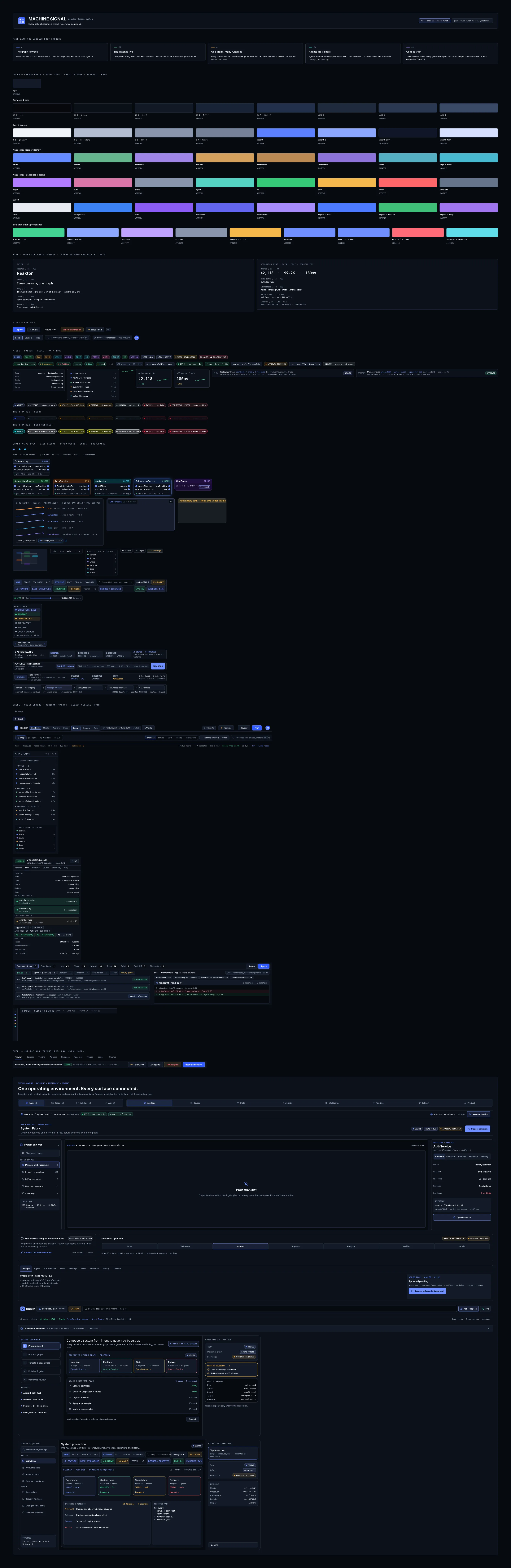
On the board. This is the largest board in the atlas: 14,507 characters, 923 text lines, 2,084 named layers, 3,160 units wide. Its panes in order are the manifesto header (MACHINE SIGNAL / reaktor design system / Every action becomes a typed, reviewable command / v1 · 2026-07 · dark-first / pairs with Human Signal (BestBuds)); FIVE LAWS THE VISUALS MUST EXPRESS (typed, live, one graph many runtimes, agents are visitors, code is truth); COLOR — CARBON DEPTH · STEEL TYPE · COBALT SIGNAL · SEMANTIC TRUTH in five swatch rows (surfaces and lines, text and accent, node kinds, node kinds continued plus status, wires) closing with a Semantic truth & provenance row of nine chips; TYPE — INTER FOR HUMAN CONTROL · JETBRAINS MONO FOR MACHINE TRUTH; ATOMS — CONTROLS; ATOMS — BADGES · PILLS · DATA ROWS, which is where the entire truth vocabulary lives; three TRUTH MATRIX panes (implicit dark, · LIGHT, · HIGH CONTRAST) each showing the same seven states from SOURCE to PERMISSION DENIED · scope hidden; GRAPH PRIMITIVES — LIVE SIGNAL · TYPED PORTS · SCOPE · PROVENANCE; WIRE KINDS — BEZIER · ARROWCLOSED · Z-ORDER NAV>ATTACH>DATA>CONTAIN; a canvas-chrome specimen with the lens stack (STRUCTURE · BASE, RUNTIME, CHANGES · Δ5, TEST IMPACT, SECURITY, COST + CARBON); fabric organisms (SYSTEM FABRIC, a Postgres read card reading READ ONLY · bound params · 500 rows · 5 MB · 10 s · export denied, a Worker card with DESIRED / OBSERVED / DRIFT UNASSESSED, and a topic chain carrying contract message.sent.v3 · at-least-once · idempotency REQUIRED); SHELL — QUIET CHROME · DOMINANT CANVAS · ALWAYS-VISIBLE TRUTH, a full workbench mock with left outline, inspector, drawer, command queue and a read-only CodeDiff; SHELL — SUB-TAB ROW; SYSTEM GRAMMAR · MOVEMENT × INSTRUMENT × CONTEXT with the governed-operation lifecycle Draft → Validating → Planned → Approval → Applying → Verified → Receipt; and a SYSTEM COMPOSER preview with RECEIPT PREVIEW and the good line Receipt appears only after verified execution.
Vision tie. It is the only board that states the thesis as visual law — law 05, "The canvas is a lens. Every gesture compiles to a typed GraphCommand and lands as a reviewable CodeDiff", is §1's "the diagram and the system are the same object" written as a rendering rule. Law 03, colouring nodes by deploy target, is the adapter-and-capability idea made legible. But the board embodies the thesis and simultaneously falsifies it, because the documented palette is not the palette the atlas is drawn in. Counting bare hex literals in the export: bg-0 #06080D appears 3 times in an 18 MB file, accent #5C80FF 4 times, ok #35C978 5, warn #F3B84B 3, error #FF666B 3, t-3 #8995AD 7 — essentially only inside their own swatch chips. The colours that actually paint the atlas are #9EABC1 (7,178), #F4F7FB (3,977), #263349 (2,842), #6F8FFF (2,057), #121A27 (1,776), #0C111A (1,059), #42D392 (1,007), #F5B84B (579), #070A0F (502) and #FF6B78 (238). Eighteen documented tokens, all dead. The node-kind row is the honourable exception and is genuinely in service (screen #65B58E 133 uses, edge #48B8D0 130, container #9D85E6 125, service #D2A05C 118, route #658BFF 116), but the wire-kind row is dead too (exec #E6EAF2 4, navigation #3B82F6 4, data #8B5CF6 5, attachment #6366F1 2). A design system board that documents a version of itself that no longer exists is the same failure mode the atlas exists to prevent.
Workflow tie. Opened by whoever adds a new surface or a new kind of number, roughly weekly. Today the same person opens Figma, a token file, MachineSignal.kt and a running desktop build, and reconciles four sources by eye. This board wants to be the single source, and 05.01 already reports the failure of that ambition as a finding on itself: accent.brand · 14 uses · drift: web diverged.
Agentic tie. An agent reads this board to learn how to render a claim, and gets three incompatible answers. The colour pane enumerates seven truth classes (RUNTIME LIVE, SOURCE-DERIVED, INFERRED, FIXTURE, PARTIAL / STALE, FAILED / BLOCKED, IMPORTED / OBSERVED); the component set enumerates a different seven (TruthMark / Live | Source | Fixture | Stale | Partial | Unknown | Failed); the truth matrix shows a third seven whose last cell, PERMISSION DENIED · scope hidden, is not a truth class at all but a permission state. Inferred and Observed have colours and no component; Unknown has a component and no colour. An agent asked to render an observed value has no correct choice. Worse, the marks do not use the tokens: reading the fills straight out of the export, TruthMark / Live is #42D3921F while the documented live green is #35C978; TruthMark / Source is #8DA7FF1F while SOURCE-DERIVED is #5C80FF. Six of six marks are off-token.
Blueprint tie. This is Unreal's FSlateStyleSet plus the editor style guide — not a game-facing tool at all, but the thing that makes every other tool legible. The analogy breaks in the decisive place: in Unreal the editor style is code, so it cannot document a colour it does not use. Here the guide is a drawing, so it can and does.
Replaces / augments. Figma Tokens, Style Dictionary, Zeroheight, Storybook Docs, Backlight, and the informal "design principles" Notion page.
Improvements.
- Delete the
COLORpane's hard-coded hexes and regenerate it fromMachineSignal.kt— a token row must show name, value, live usage count, and a redDEADstate at zero uses. As drawn today, sixteen of eighteen rows would showDEAD. - Add two columns to every swatch row:
lightandhigh contrast. Three themes ship (see the shell states) and only one is documented; the lightokis#087A4Aand the high-contrast accent is#00FFFF, and neither value appears anywhere on this board. - Collapse the three conflicting truth enumerations into one
TRUTH AXESpane with four labelled columns — Origin, Grade, Effect, Permission — and one row per value. Nothing may appear in two columns. - Give every mark a glyph and a word in addition to a colour, then re-render the
TRUTH MATRIX · HIGH CONTRASTpane using only the glyphs. Today the high-contrast board differentiates by hue alone (#00FFFF,#00FF88,#FFFF00,#FF3355), which does nothing for colour-blind readers. - Move the
SYSTEM GRAMMAR,SYSTEM COMPOSERandSYSTEM FABRICpanes off this board. They are second copies of04.03,02.01and13.01; when those boards change, this one silently lies. Replace them with a singleSHELL FRAMEcomponent specimen plus a slot table. - Add a
PROVENANCE ANATOMYpane showing each data component with its evidence slot filled, empty, and in conflict — three states side by side — so the empty state is a designed thing rather than an accident.
Verdict. Split into 05.00 · Machine Signal — Tokens, Marks & Anatomy (laws, colour, type, atoms, marks, matrices, graph primitives, wires) and 05.05 · Machine Signal — Shell Frame & Slots (the shell, sub-tab row, system grammar). Cut the Composer and Fabric specimens entirely; they belong to their own boards.
05.01 · Interface · Atomic Catalog
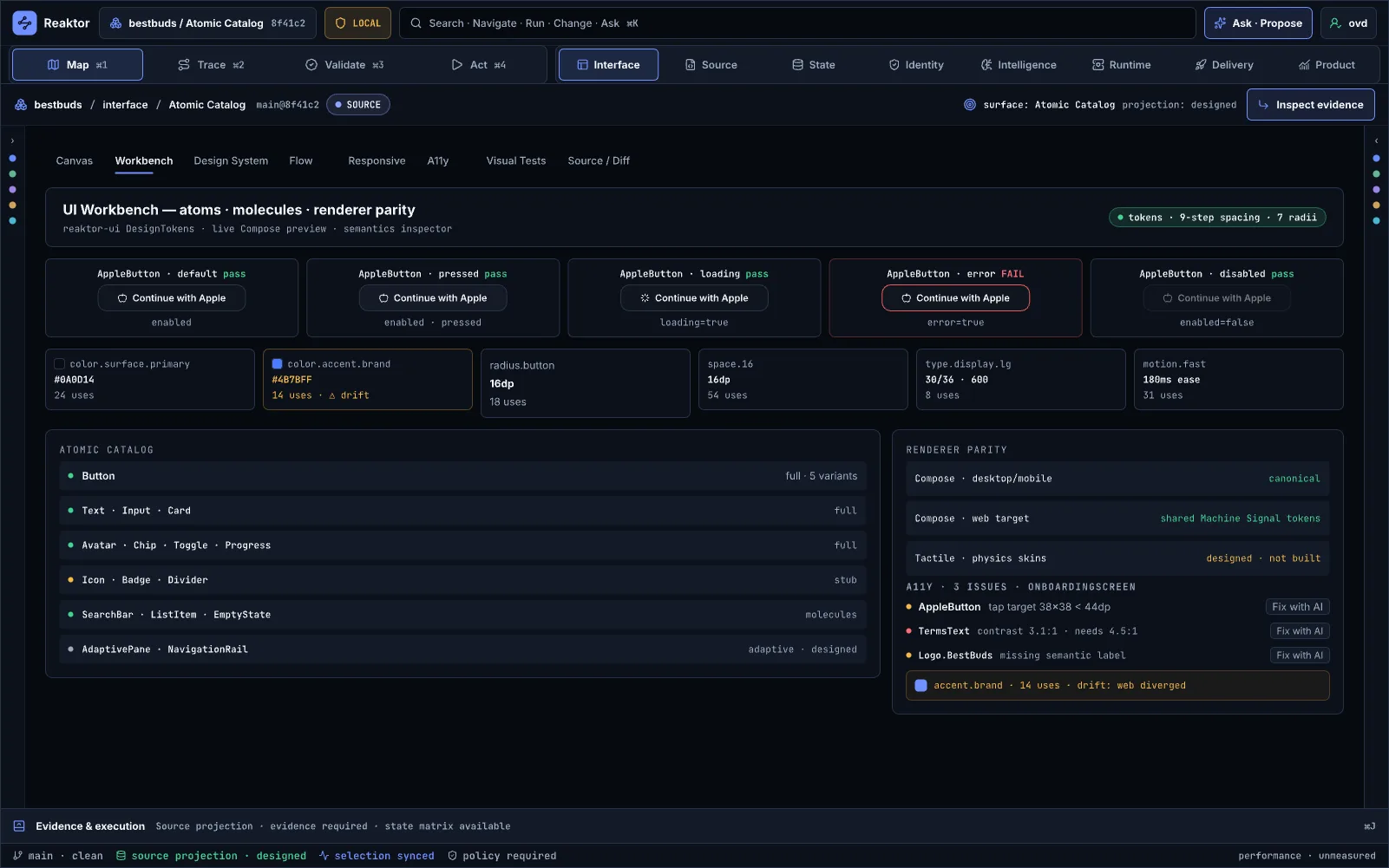
On the board. Under the standard shell it declares an eight-item sub-tab row — Canvas, Workbench, Design System, Flow, Responsive, A11y, Visual Tests, Source / Diff — and then shows four panes. The workbench pane (UI Workbench — atoms · molecules · renderer parity, reaktor-ui DesignTokens · live Compose preview · semantics inspector) shows five AppleButton states, of which AppleButton · error reads FAIL and the rest pass. A token strip lists six tokens with usage counts (color.surface.primary #0A0D14 · 24 uses, color.accent.brand #4B7BFF · 14 uses · ⚠ drift, radius.button 16dp · 18 uses, space.16 · 54 uses, type.display.lg 30/36 · 600 · 8 uses, motion.fast 180ms ease · 31 uses). ATOMIC CATALOG grades six component families as full, stub, molecules or adaptive · designed. RENDERER PARITY grades three renderers, closing with Tactile · physics skins — designed · not built. A11Y · 3 ISSUES · ONBOARDINGSCREEN lists a 38×38 tap target, a 3.1:1 contrast failure and a missing semantic label, each with a Fix with AI button.
Vision tie. This is "adapter + capability" applied to rendering: Compose · desktop/mobile — canonical, Compose · web target — shared Machine Signal tokens, Tactile · physics skins — designed · not built. Grading renderers by tier rather than by platform is exactly the capability idea, and designed · not built is the most honest string in my entire cluster — it matches the audit's finding that reaktor-tactile is an empty placeholder. The board earns credit for that.
Workflow tie. A UI engineer opens this on a Tuesday to add a variant and check nothing drifted. Today that is Storybook in one tab, an accessibility scanner in another, and a grep for the token name in a third.
Agentic tie. Fix with AI appears three times and is the most agent-forward control in the section. It is also ungoverned: no EffectMark, no blast radius, no diff preview, no approval, on a board whose own status bar reads policy required. An agent fixing a contrast failure edits a token, and a token edit is not local — color.accent.brand is claimed at 14 uses and already drifting. The correct control is Propose fix, producing a GraphPatch with the affected-use count on it.
Blueprint tie. Unreal's asset validator plus the Widget Reflector. The pass/FAIL column is Map Check. The analogy holds well, except that Unreal's validator runs on cook and blocks the build, and here there is nothing to block: the audit says no CI exists.
Replaces / augments. Storybook, Chromatic's component review, Zeroheight, Style Dictionary, axe DevTools, Accessibility Insights.
Improvements.
- Add a
Sourcecolumn to the token strip so24 usessays where it was counted (scan · reaktor-ui@8f41c2 · asOf 12m). Six numbers, zero provenance, on the board that reports drift for a living. - Split the sub-tab row's undelivered tabs into real states:
Canvas,Flow,A11yandSource / Diffare declared here and have no board anywhere. Either build them or render them disabled withnot wired. - Change all three
Fix with AIbuttons toPropose fixand add anaffectscolumn showing the count of call sites the fix touches, taken from the token usage count already on the board. - Add a
renderer parity matrix: components down, renderers across, cells carrying pass / fail / not built. Today parity is three prose grades, soIcon · Badge · Divider — stubgives no clue which renderer is stubbed. - Give the
AppleButton · error — FAILstate a finding row with aRunRef, so a failing state is traceable to the run that failed it rather than being a red word.
Verdict. Strengthen. This is the second-most honest board in the section and needs provenance columns, not redesign.
05.02 · Interface · Responsive & Visual Tests
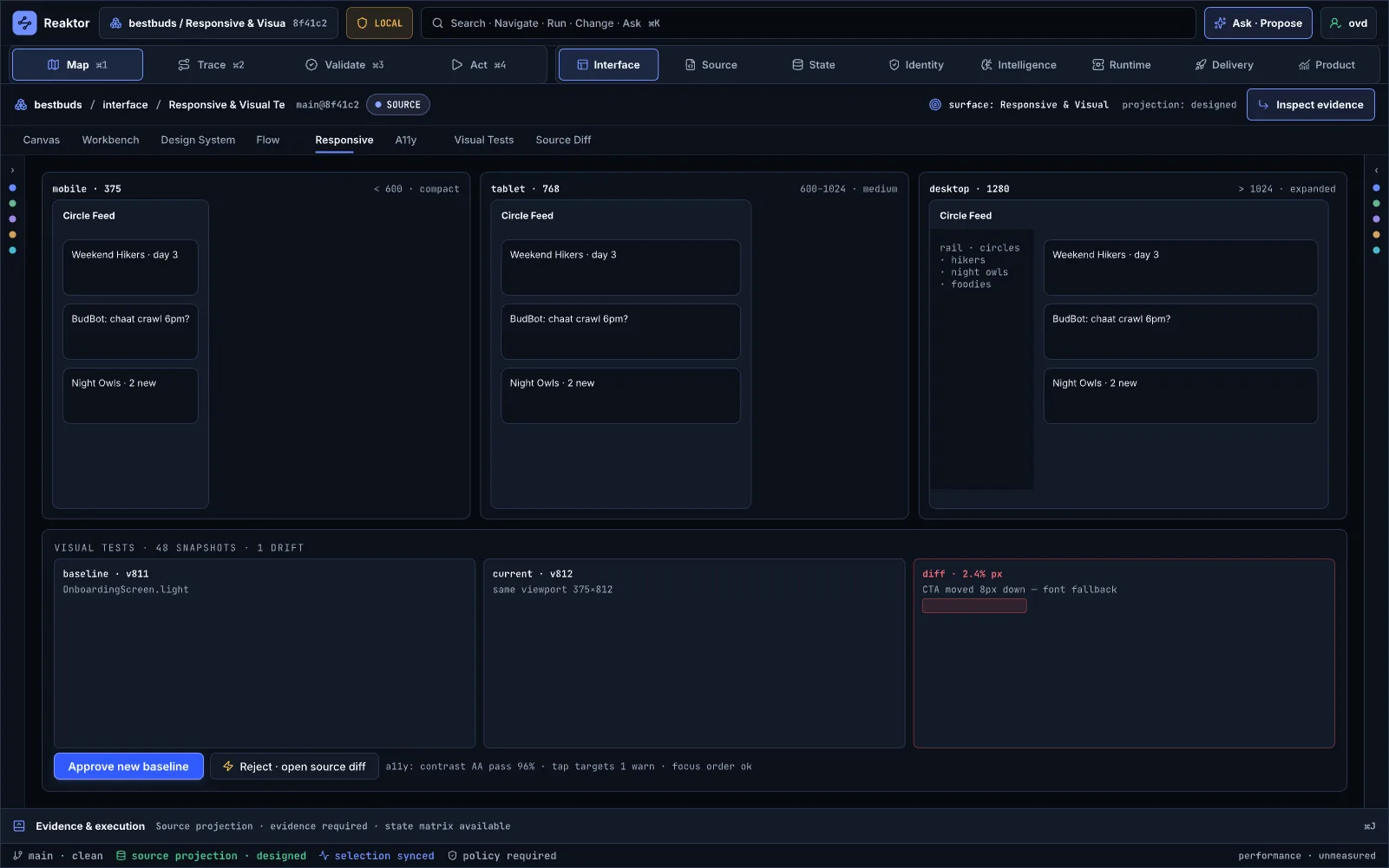
On the board. Two panes under the shell. A responsive strip shows the BestBuds Circle Feed at mobile · 375 (< 600 · compact), tablet · 768 (600–1024 · medium) and desktop · 1280 (> 1024 · expanded), the desktop frame gaining a rail · circles list. A verification pane titled VISUAL TESTS · 48 SNAPSHOTS · 1 DRIFT puts baseline · v811 / OnboardingScreen.light beside current · v812 / same viewport 375×812, reports diff · 2.4% px with the diagnosis CTA moved 8px down — font fallback, offers Approve new baseline and Reject · open source diff, and closes with a11y: contrast AA pass 96% · tap targets 1 warn · focus order ok.
Vision tie. Weak. Responsiveness is a UI concern, not a graph concern, and nothing here is expressed as nodes, ports, visitors or capabilities. The one available tie is unused: a snapshot suite is exactly the "visitor" idea — a traversal that renders every screen node at every breakpoint — and the board never says so.
Workflow tie. Opened when a pull request goes red. Today that is a Chromatic or Percy web UI in a browser tab, far from the code, with an Approve button that half the team clicks without looking.
Agentic tie. Agent-hostile in a specific way: Approve new baseline is a write that changes what every future build is compared against, and it carries no EffectMark, no PermissionGate and no receipt. It is the one place in my cluster where a single click silently redefines truth for everyone, and there is nothing on the board that would stop an agent from pressing it.
Blueprint tie. Unreal's automation screenshot comparison (FAutomationScreenshotComparison / Gauntlet), which likewise stores a baseline per platform and requires a human to promote it. The analogy is close and the gap is the same one Epic solved: baselines are per-RHI and per-platform, and this board has one baseline for one viewport.
Replaces / augments. Chromatic, Percy, Applitools, Playwright and Paparazzi snapshot testing, BrowserStack, and the a11y half of Lighthouse.
Improvements.
- Put
Approve new baselinebehind the governed path the rest of the atlas uses:EffectMark / Remote Reversible,PermissionGate, a sealed plan and a receipt naming the approver and the superseded baselinev811. - Replace the three-frame responsive strip with the five real breakpoints the shell boards ship — 390, 768, 1280, 1600 and the high-contrast fork — because the shell states use 390 and this board uses 375, and the two must not disagree.
- Add a
coveragerow to the verification pane:48 snapshotscovering how many of how many screens, at how many breakpoints, in how many themes. A snapshot count without a denominator is not evidence. - Add a
causecolumn linkingfont fallbackto the commit or environment that produced it, so the diagnosis is a claim with an origin rather than a caption. - Add a
flakystate beside pass and fail, with a run count, so1 DRIFTdistinguishes a real regression from a non-deterministic render.
Verdict. Strengthen, and re-scope it as 05.02 · Validate + Interface · Visual & Responsive Conformance. It is the Interface instrument's Validate cell and should say so.
05.03 · Interface · Command Palette
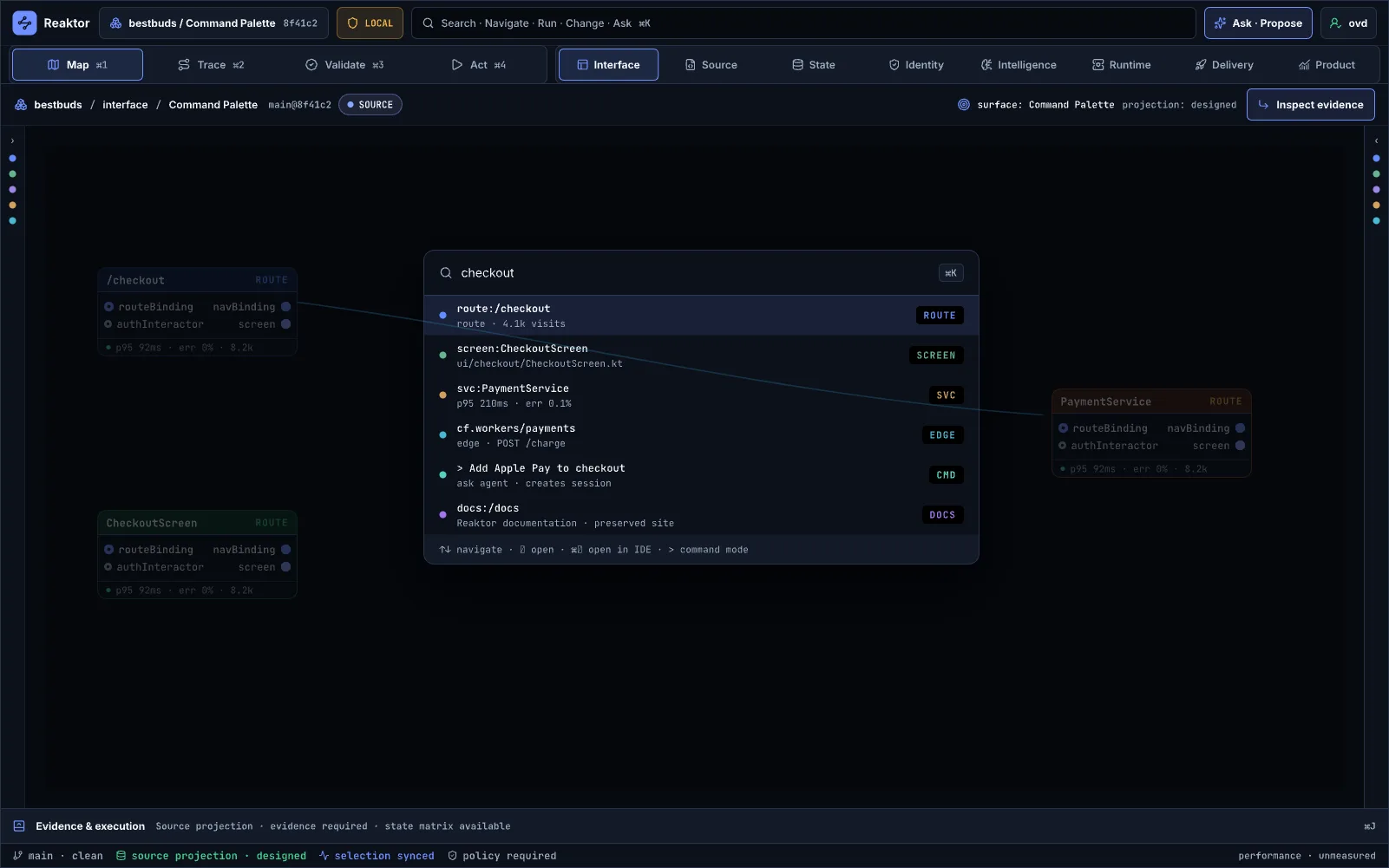
On the board. The smallest board in the section — 1,240 characters, 86 lines. One palette over the standard shell. The query is checkout; six results are listed: route:/checkout · route · 4.1k visits · ROUTE, screen:CheckoutScreen · ui/checkout/CheckoutScreen.kt · SCREEN, svc:PaymentService · p95 210ms · err 0.1% · SVC, cf.workers/payments · edge · POST /charge · EDGE, > Add Apple Pay to checkout · ask agent · creates session · CMD, and docs:/docs · Reaktor documentation · preserved site · DOCS. A key legend reads ↑↓ navigate · ↵ open · ⌘↵ open in IDE · > command mode. Below sits a three-node preview strip.
Vision tie. This is the strongest vision claim in the section and the weakest execution. "Agents as first-class operators" requires one governed doorway that humans and agents both walk through, and this is the atlas's only drawing of that doorway. The shell string Search · Navigate · Run · Change · Ask appears on 85 of the 104 board texts, so the palette is the atlas's most-repeated promise and its least-developed board.
Workflow tie. Opened fifty times a day by everybody. Today those five verbs are five tools: ⌘P in the IDE, a Grafana explore tab, wrangler tail, a kubectl shell, and a Slack thread that ends in "can someone deploy this".
Agentic tie. The board shows one agent row and governs it with the prose creates session. There is no effect mark, no permission gate, no blast radius, no dry run, no plan. The preview strip is worse than absent: CheckoutScreen and PaymentService are both tagged ROUTE, all three nodes carry the identical port list routeBinding / navBinding / authInteractor / screen, and all three carry the identical metrics p95 92ms · err 0% · 8.2k — so PaymentService reports p95 210ms in the result row and p95 92ms four lines below it. On the board whose entire job is finding the truth about an entity, the same entity has two different latencies and the wrong kind. Read charitably it is a copy-paste artifact; read as the atlas asks to be read, it is a live demonstration of defect D-6, where a service and a screen connect happily because the port identity is only a string.
Blueprint tie. Unreal's right-click Blueprint context search, plus the Content Browser search, plus the ~ console, fused into one line. Unreal deliberately keeps them separate, and the console executes immediately with no plan and no receipt. The fusion is the genuinely new claim here; the no-receipt part is what Reaktor must not copy.
Replaces / augments. VS Code's command palette, Raycast, Alfred, Sourcegraph, Grafana Explore, the Kubernetes dashboard, Postman's collection runner, and the Slack-bot deploy.
Improvements. Detailed in section D below; the five headline changes are a typed query grammar shared with the canvas chrome, an origin and asOf on every result row, effect and permission and reversibility on every actionable row, a NotWired result kind that carries the connect action, and a hard rule that no palette keystroke may apply — the maximum is to seal a plan.
Verdict. Rebuild. This board is three panes short of carrying the most important idea in the atlas.
05.04 · Interface · Drawer States
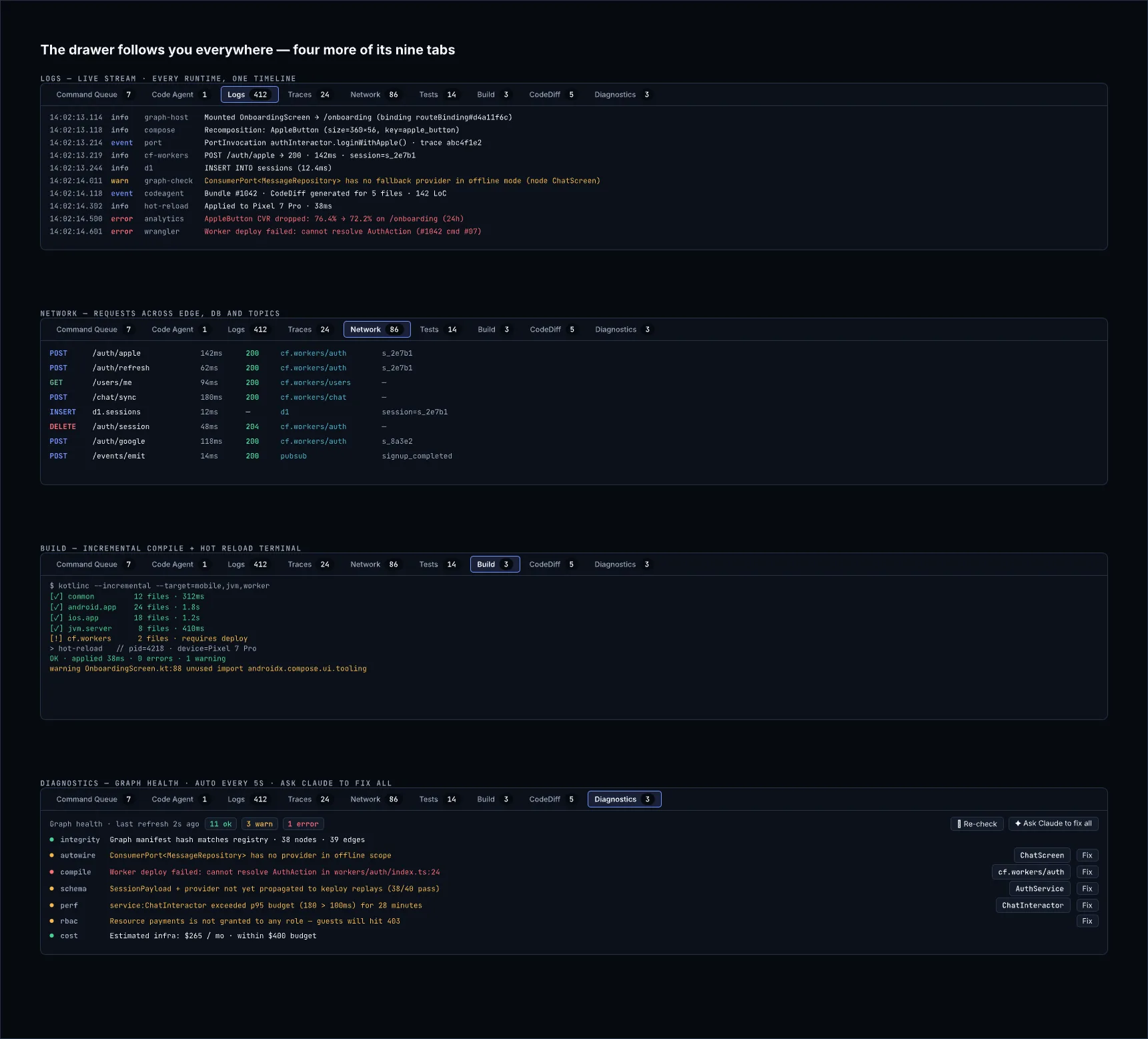
On the board. Titled "The drawer follows you everywhere — four more of its nine tabs", it shows four of the nine drawer tabs, each with the same badge row (Command Queue 7 · Code Agent 1 · Logs 412 · Traces 24 · Network 86 · Tests 14 · Build 3 · CodeDiff 5 · Diagnostics 3). LOGS — LIVE STREAM · EVERY RUNTIME, ONE TIMELINE interleaves ten entries across graph-host, compose, port, cf-workers, d1, graph-check, codeagent, hot-reload, analytics and wrangler, ending on Worker deploy failed: cannot resolve AuthAction (#1042 cmd #07). NETWORK lists eight calls across edge, D1 and Pub/Sub with a session column. BUILD is a terminal running kotlinc --incremental --target=mobile,jvm,worker with per-target timings and [!] cf.workers 2 files · requires deploy. DIAGNOSTICS — GRAPH HEALTH · AUTO EVERY 5S · ASK CLAUDE TO FIX ALL shows 11 ok · 3 warn · 1 error over six rows: integrity, autowire, compile, schema, perf, rbac, cost, with Fix on five and ✦ Ask Claude to fix all at the top.
Vision tie. The strongest genuine embodiment in the section. One timeline across graph-host, compose, port, cf-workers, d1 and pubsub is "polyglot on one data plane" made visible, and it is a real product idea — nobody ships a console where a Compose recomposition, a port invocation, a Worker response and a D1 insert are the same stream. The autowire row (ConsumerPort<MessageRepository> has no provider in offline scope) is the eigenvector-primitive idea producing a diagnostic that could not exist in a non-graph system. And the integrity row — Graph manifest hash matches registry · 38 nodes · 39 edges — is the only place in my cluster that touches §2's keystone fingerprint. It is buried as row one of six.
Workflow tie. Open all day while the app runs. Today it is Logcat, the Xcode console, wrangler tail, Chrome DevTools' network tab, the Gradle build panel and a Sentry tab, six windows, none sharing a clock.
Agentic tie. ✦ Ask Claude to fix all is the single most dangerous control in my cluster. One click covers a Worker deploy failure, an RBAC grant (Resource payments is not granted to any role), a schema propagation, an autowire fix and a performance budget breach — spanning read-only, local-write and production effects — with no plan, no blast radius, no approval and no receipt. Given §2's twelve security findings, a button that can grant a role is a governance hole, not a convenience. This is also the board an agent would most want to read, because the diagnostics list is a machine-readable finding set.
Blueprint tie. Unreal's Output Log plus Message Log plus Map Check plus the Blueprint debugger, docked as one panel. The analogy is exact and flattering, and it extends further than Unreal does: Unreal's Map Check has no equivalent of the rbac or cost rows.
Replaces / augments. Chrome DevTools console and network, Logcat, the Xcode console, Datadog Live Tail, Sentry Issues, wrangler tail, the Gradle build panel, Infracost, and a lightweight slice of Snyk.
Improvements.
- Promote
integrityout of the diagnostics list into a permanentFINGERPRINTstrip in the drawer header, showing the graph manifest hash, the codec layout hash and the FFI ABI digest side by side with match or mismatch. That is §2's keystone and it currently reads like a lint rule. - Replace
✦ Ask Claude to fix allwithPropose fixes (5), opening a plan whose rows are individually checkable, each carrying its ownEffectMark. Therbacrow must be unselectable without an approval. - Add a
Tracesand aTestspane. The board's own header says nine tabs; six are drawn across this board and 05.00, and Traces and Tests — the two the verification programme depends on — are the missing ones. - Add a window and an origin to every badge count.
Logs 412is the same number on this board and on 05.00 with no time window, which makes the drawer's most-read element unfalsifiable. - Add diagnostic rows for the defects §2 actually found: a port-identity check for string-built ports carrying a null class, a lifecycle check for effects fired on rejected transitions, and a queue check for
waitUntilfire-and-forget pipelines. The diagnostics list currently checks things that pass and omits the things that fail. - Give the
costrow a source.Estimated infra: $265 / mo · within $400 budgetis a confident number with no provider, no period and no method.
Verdict. Keep, and elevate. This is the best board in the section and should absorb the Command Queue and CodeDiff specimens currently stranded on 05.00.
STATE · System Studio Shell · Compact 390
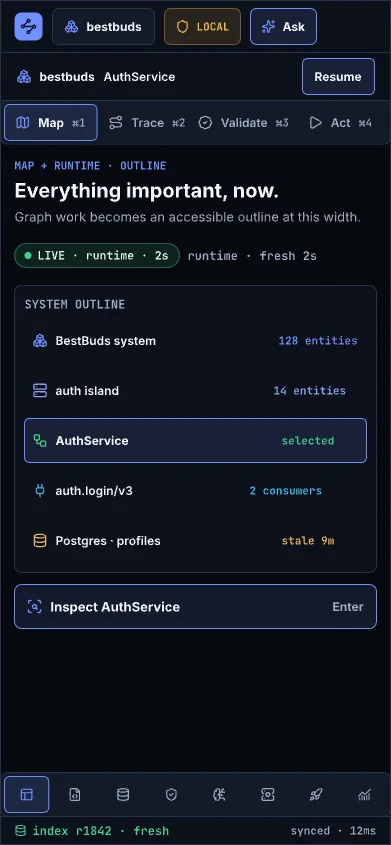
On the board. 516 characters — the smallest board in the atlas that is not a section divider. Top bar: bestbuds, LOCAL, Ask. Context line: bestbuds / AuthService with Resume. The four movements survive with their desktop shortcuts intact (Map ⌘1, Trace ⌘2, Validate ⌘3, Act ⌘4). The body is MAP + RUNTIME · OUTLINE / Everything important, now. / Graph work becomes an accessible outline at this width., stamped LIVE · runtime · 2s and runtime · fresh 2s. SYSTEM OUTLINE lists BestBuds system · 128 entities, auth island · 14 entities, AuthService · selected, auth.login/v3 · 2 consumers, Postgres · profiles · stale 9m. Footer: Inspect AuthService / Enter, index r1842 · fresh, synced · 12ms.
Vision tie. The outline is a genuine expression of "one graph, many projections" — a tree is a legitimate projection of a port graph, and the line Graph work becomes an accessible outline at this width is a good design law. It is undercut by keeping ⌘1–⌘4 chips on a touch device, which is the tell that this is a shrunken desktop drawing rather than a designed compact product.
Workflow tie. The only honest 390 moment is 2 a.m.: a gate failed, you are holding a phone, and you need to know what broke and whether to roll back. This board serves a different moment — casual browsing of a system outline — which nobody does on a phone.
Agentic tie. The Ask · Propose control of the wide shell becomes plain Ask here. If Propose is the governed verb that produces a patch, then the compact shell advertises an ungoverned Ask; if it is only a label, then the label lies at two of five breakpoints. Either way the agent contract changes with screen width, which no contract should do.
Blueprint tie. There is no analogy. Nobody ships the Unreal Editor on a phone. This is either the section's boldest original claim or its most decorative board, and the atlas has not decided which.
Replaces / augments. In its current form, nothing. In the form proposed below, it displaces PagerDuty's mobile app, the GitHub mobile review flow, and the Slack "approve" button.
Improvements.
- Replace
SYSTEM OUTLINEas the default body withPENDING APPROVALSandACTIVE RUNS; demote the outline to a second tab. Approve and roll back are the two things a phone is genuinely for. - Put the principal chip and the revision short-sha into the top bar. A receipt binds actor, approver and revision, so a surface intended for approvals must never drop the two fields the receipt is made of.
- Add an evidence handle to every outline row —
Postgres · profiles · stale 9mneedsSourceRefand anasOf, or it is a rumour. - Replace the
⌘1–⌘4chips with a segmented control and add a swipe gesture between movements. - Add a
read-onlystate banner when the principal's grant does not permit action at this surface, rather than showing anAskbutton that cannot act.
Verdict. Rebuild as STATE · Studio Compact 390 · Approve & Recover. As drawn it is a courtesy; the job it should do is real and different.
STATE · System Studio Shell · Medium 768
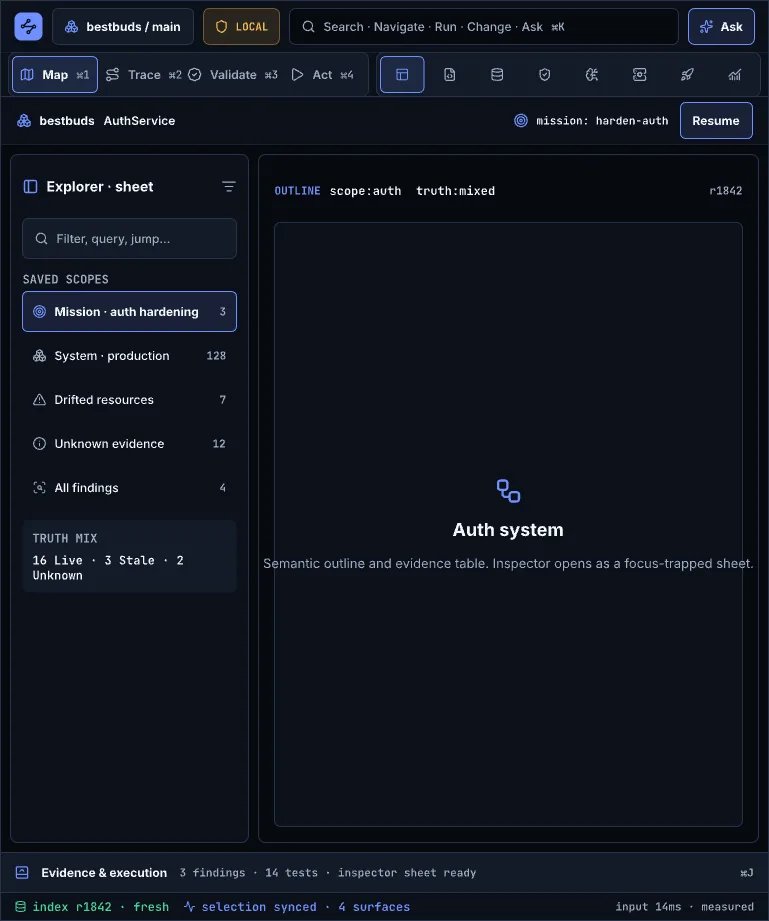
On the board. 701 characters. Top bar keeps bestbuds / main, LOCAL, the full palette placeholder Search · Navigate · Run · Change · Ask ⌘K, and Ask. Context line: bestbuds, AuthService, mission: harden-auth, Resume. Explorer · sheet holds Filter, query, jump…, the five saved scopes (Mission · auth hardening 3, System · production 128, Drifted resources 7, Unknown evidence 12, All findings 4) and a TRUTH MIX reading 16 Live · 3 Stale · 2 Unknown. The body is OUTLINE with scope:auth truth:mixed, r1842, and the caption Semantic outline and evidence table. Inspector opens as a focus-trapped sheet. Footer: Evidence & execution · 3 findings · 14 tests · inspector sheet ready ⌘J, index r1842 · fresh, selection synced · 4 surfaces, input 14ms · measured.
Vision tie. Inspector opens as a focus-trapped sheet is a real adaptive decision rather than a shrink, and the saved-scope list surviving intact is right — scopes are how a graph stays navigable when the canvas is gone. But the TRUTH MIX here reads 16 Live · 3 Stale · 2 Unknown where the 1600 shells read 128 Source · 16 Live · 3 Stale · 2 Unknown. The Source count is silently dropped, so the same system reports 149 entities at one width and 21 at another. A breakpoint has changed a fact.
Workflow tie. A tablet or a half-screen window beside an editor, used for review: reading a diff's blast radius, checking findings before approving. That is exactly the task this board strips the tools for.
Agentic tie. No principal is shown, so nothing on this board says who is asking. The Evidence & execution drawer drops 18 evidence · 1 approval and keeps 3 findings · 14 tests — the two counts an agent needs to reason about governance are the ones removed.
Blueprint tie. The closest thing is Unreal's undocked, single-panel layouts. The analogy is thin, and the honest reading is that 768 is a review surface, not an editing surface.
Replaces / augments. GitHub's PR review on a tablet, Linear's tablet view, the Datadog mobile dashboard.
Improvements.
- Restore the revision short-sha and the principal chip to the top bar. Chrome is seven short strings and costs one 28-pixel row; the canvas is what should be sacrificed at 768, not the spine.
- Restore the full
TRUTH MIXincluding128 Source, or label the reduced mix explicitly as a filtered count. - Draw the focus-trapped inspector sheet as its own state. It is described in a caption and never shown, which makes the board's central adaptive decision unreviewable.
- Add the evidence handle (
source://AuthGraph.kt:42) to the outline rows, since the wide shell's dedicated evidence pane has no room here. - Change
Askback toAsk · Propose, or state on the board that proposing is unavailable below 1024 and why.
Verdict. Strengthen. The layout thinking is sound; the invariant loss is not.
STATE · System Studio Shell · Expanded 1600 · Dark
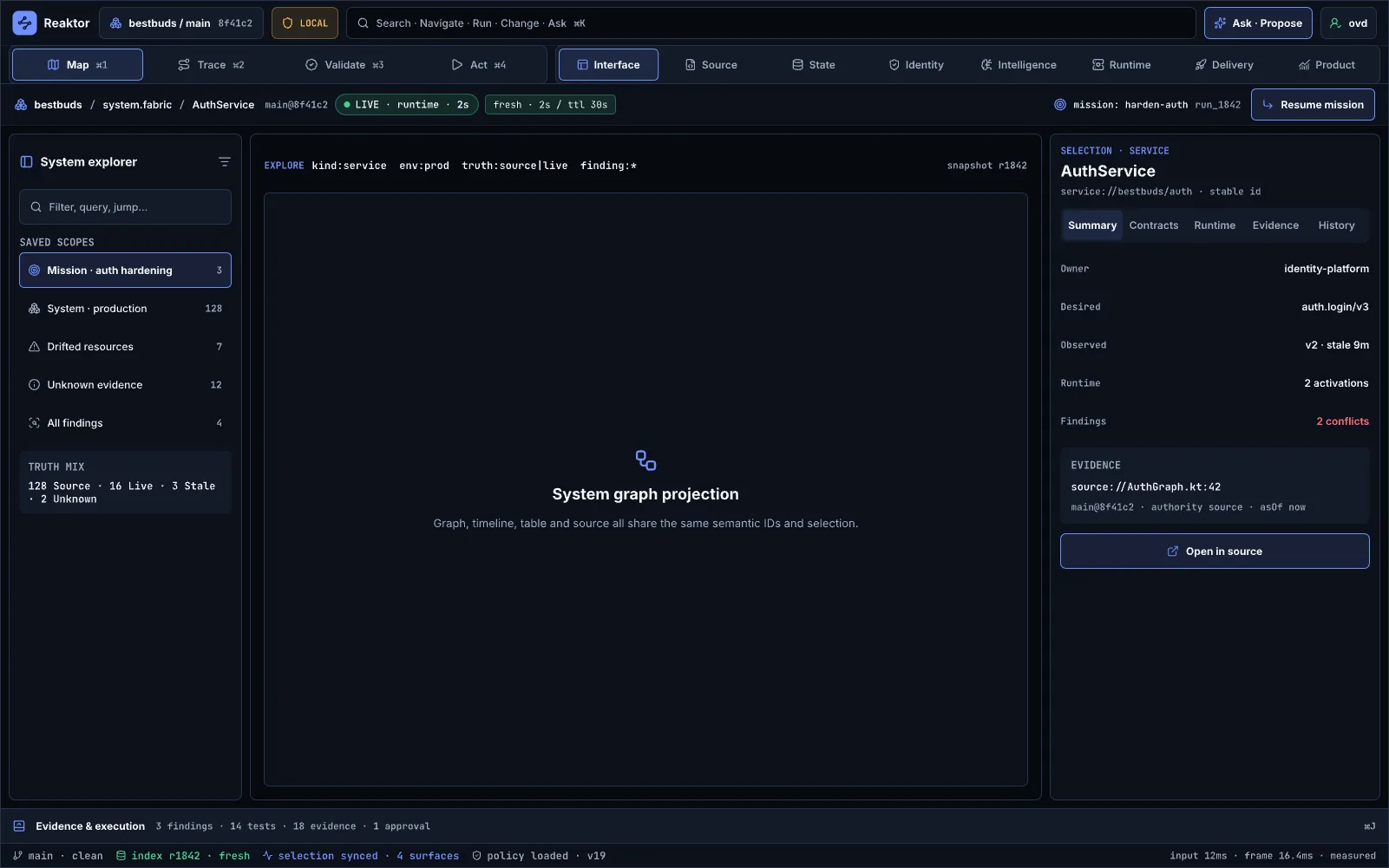
On the board. The canonical shell. Command bar: Reaktor, bestbuds / main, 8f41c2, LOCAL, Search · Navigate · Run · Change · Ask ⌘K, Ask · Propose, ovd. Movements Map ⌘1 through Act ⌘4; the eight instruments Interface · Source · State · Identity · Intelligence · Runtime · Delivery · Product. Context spine: bestbuds / system.fabric / AuthService, main@8f41c2, LIVE · runtime · 2s, fresh · 2s / ttl 30s, mission: harden-auth, run_1842, Resume mission. Left rail: System explorer, Filter, query, jump…, five saved scopes, TRUTH MIX 128 Source · 16 Live · 3 Stale · 2 Unknown, and EXPLORE kind:service env:prod truth:source|live finding:* · snapshot r1842. Centre: System graph projection — Graph, timeline, table and source all share the same semantic IDs and selection. Right: SELECTION · SERVICE AuthService · service://bestbuds/auth · stable id with five tabs (Summary, Contracts, Runtime, Evidence, History), six fields including Desired auth.login/v3 versus Observed v2 · stale 9m and Findings 2 conflicts, then EVIDENCE source://AuthGraph.kt:42 · main@8f41c2 · authority source · asOf now · Open in source. Footer: Evidence & execution · 3 findings · 14 tests · 18 evidence · 1 approval ⌘J, main · clean, index r1842 · fresh, selection synced · 4 surfaces, policy loaded · v19, input 12ms · frame 16.4ms · measured.
Vision tie. This carries the whole Symphony Contract in one frame, and the desired-versus-observed pair with 2 conflicts is the same honest structure that makes 13.03 the model board. service://bestbuds/auth · stable id is the atlas's clearest statement that identity is a URI, not a label — which is the primitive that would fix D-6 if it reached the code.
Workflow tie. This is the product. Every engineer, all day.
Agentic tie. The best agentic surface in my cluster: an agent reads Desired auth.login/v3 against Observed v2 · stale 9m, sees 2 conflicts, follows source://AuthGraph.kt:42, and proposes against a named revision and snapshot. What it cannot do is state its own confidence — every field here is presented with equal authority, and input 12ms · frame 16.4ms · measured sits in the same footer as policy loaded · v19 with no way to tell which is measured and which is asserted.
Blueprint tie. The Unreal Editor's main window, with the World Outliner as the left rail, the viewport as the centre and the Details panel as the inspector. The addition Unreal does not have is the context spine: Unreal has no revision, environment, principal or evidence in its chrome, because Unreal edits a file and Reaktor edits a live distributed system. That is the strongest original claim in the section.
Replaces / augments. Backstage, Datadog Service Catalog, Grafana, the Cloudflare and GCP consoles, Retool, and the IDE's project view.
Improvements.
- Make the shell one instanced component. In the export the shell exists as per-board copies: 86 layers named
<board> / Command Bar, 82Workspace Bar, 86Context Spine, 84Instruments, 83Evidence Handle, 84Status. Nothing here is shared, which is why the invariants drift. - Fix the stale status pill. 82 boards carry a layer named
Status / policy loaded · v19, but only 4 board texts still show that string; 75 showpolicy requiredinstead. The layer name is the fossil of the copy and the label was retyped over it, which is exactly the drift an instanced component makes impossible. - Add an origin mark to each footer status pill, so
frame 16.4ms · measuredandpolicy loaded · v19are visibly different kinds of claim. - Add a
principaltooltip to theovdchip listing the grants in force, sinceAsk · Proposeis enabled or disabled by exactly those grants. - Give
TRUTH MIXclickable segments that set theEXPLOREquery. It is currently a read-out of the one number that should be a filter.
Verdict. Keep. This is the reference frame for the whole atlas and should be promoted from a STATE board to 05.05 · Interface · Shell Frame.
STATE · System Studio Shell · Expanded 1600 · Light
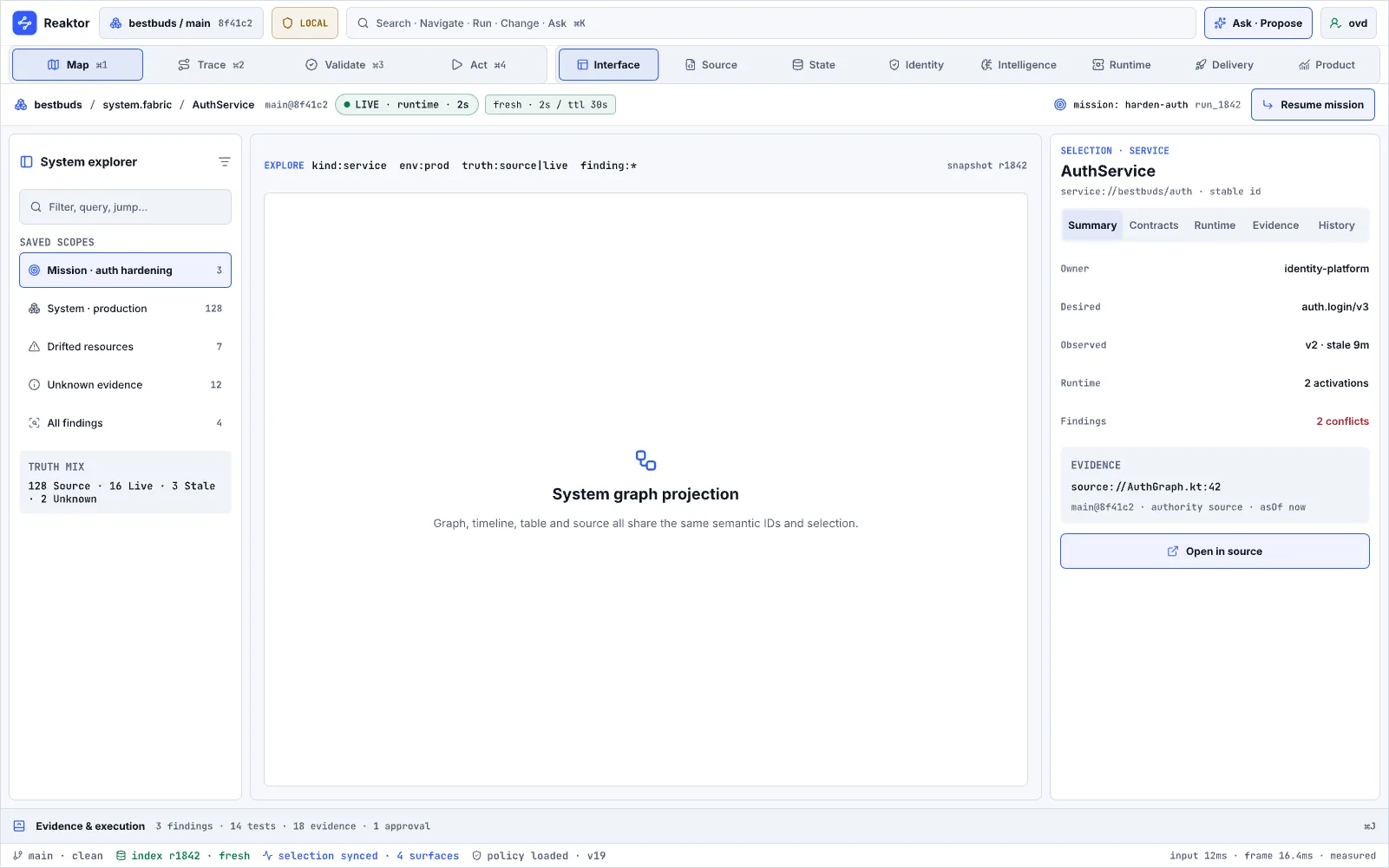
On the board. Every visible string is byte-identical to the Dark board — I diffed them and the bodies match exactly, 87 lines each. What differs is only the paint: the light fork is drawn with #526078 body text on #FFFFFF and #F7F8FC grounds, accent #315BFF, and #087A4A where dark uses #42D392. Geometry is effectively identical (182,428 bytes against 182,424; 165 colour references each).
Vision tie. None of its own. It is a theme fork of the previous board, and a competent one — the recolour is complete and consistent rather than an inverted screenshot.
Workflow tie. Daylight, projectors, and the half of any team that cannot read dark UI. Real need.
Agentic tie. Nothing an agent reads here differs from the dark board. The value is purely in the token mapping, and that mapping is not written down anywhere — this board is the only record that the light ok is #087A4A, and 05.00's palette pane never mentions it.
Blueprint tie. Unreal ships a light editor theme almost nobody uses; the analogy is not instructive.
Replaces / augments. Nothing new.
Improvements.
- Delete this board as a separate artefact and make theme a property of the single shell component, with a
THEMEtoggle rendered on the board. - Extract the light values into the
COLORpane on 05.00 as alightcolumn. Three themes ship and one is documented. - If the board is kept, mark it as generated from the dark board and stamp the source board id, so a shell change cannot land in one fork and not the others.
Verdict. Merge into STATE · System Studio Shell · Expanded 1600 as a theme variant.
STATE · System Studio Shell · Expanded 1600 · High Contrast
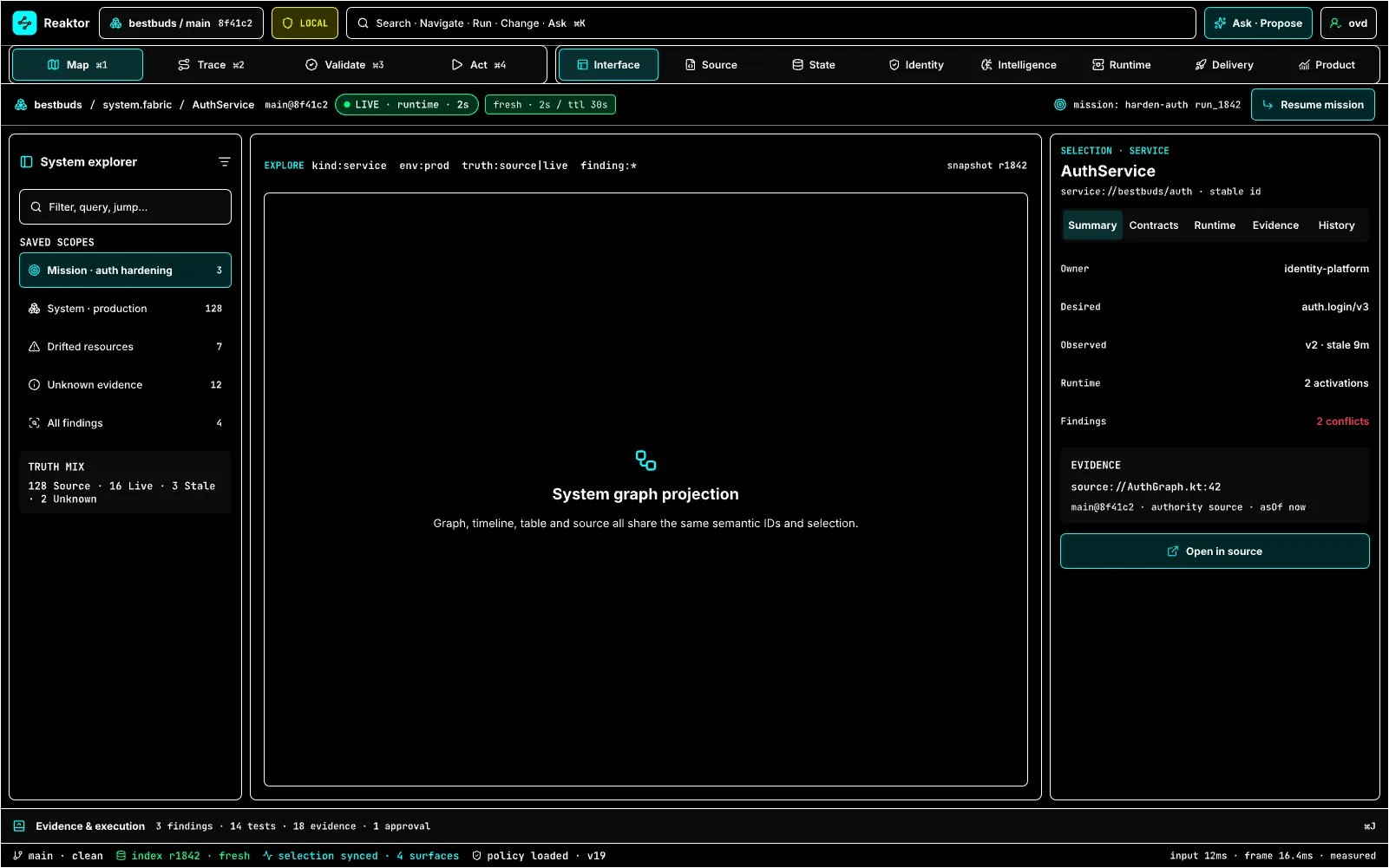
On the board. Again byte-identical in text to the Dark and Light boards, and again a genuine repaint: #FFFFFF dominates (114 references), the accent becomes pure cyan #00FFFF (23), ok becomes #00FF88, warn #FFFF00, error #FF3355, on #000000 and #0A0A0A grounds. 168 colour references against the dark board's 165.
Vision tie. This should be the most important of the three, because it is the accessibility conformance proof for the truth vocabulary — the test of whether truth survives when colour is reduced. It does not currently function as that proof: differentiation is by hue alone, so it helps low-vision users and does nothing at all for colour-blind ones, and the underlying mark collisions survive the repaint unchanged.
Workflow tie. Accessibility review, procurement questionnaires, and any user with low vision. Also the state a projector forces.
Agentic tie. Indirect but real. If the marks are only distinguishable by fill, then any rendering path that loses colour — a terminal, a diff, a screen reader, an agent's own textual view of the UI — loses the truth class entirely. High contrast is the canary for whether the vocabulary has a non-colour channel. It does not.
Blueprint tie. No Unreal analogue. This is a product-grade concern Unreal handles poorly and Reaktor could handle well.
Replaces / augments. The accessibility half of a design system audit; Stark; Accessibility Insights.
Improvements.
- Re-render the truth marks with glyphs — a filled dot for Live, a hollow dot for Observed, a square bracket for Source, a dashed outline for Declared, a slash for NotWired — and verify the board is readable in greyscale.
- Add a
TRUTH AXES · HIGH CONTRASTconformance strip showing every mark against every other, so the collisions catalogued below become visible failures. - State the contrast ratio achieved for each pair on the board itself;
05.02already assertscontrast AA pass 96%for the product, and the studio chrome should hold itself to the same claim with the same evidence. - Make the board the target of an automated check rather than a drawing: every token must have a high-contrast value, and every pair on independent axes must differ in a non-colour channel.
Verdict. Merge into the single shell board as a theme variant, then split out a new 05.06 · Interface · Truth Rendering Conformance that does the job this board is standing in for.
A. The truth vocabulary, judged and completed
What is actually there
By exact component-name prefix, the atlas contains 19 instances of the truth vocabulary, and all 19 are on 05.00 itself: seven TruthMark, four EffectMark, two PermissionGate, and one each of FreshnessStamp / Fresh, SourceRef / Runtime, RunRef / Correlated, EmptyReason / Unknown, PlanSummary / Sealed and ApprovalReceipt / Independent. Outside 05.00 the count is zero. The same is true of the five data-bearing components: Tile / Metric, Chip / Metric, Row / KV, Sparkline and Badge / Count exist exactly once each, on the design system board, while 96 layer names elsewhere contain "Metric", 61 contain "Chip", 27 "Badge", 29 "Tile" and 22 "KV". The single most repeated data element in the atlas is a text group called Foot Metrics, hand-drawn 51 times. The vocabulary is not under-used; it is undeployed. It has a swatch and no reach.
Three defects in the vocabulary itself
It conflates three questions into one enum. TruthMark mixes origin (Live, Source, Fixture), quality (Stale, Partial) and absence (Unknown, Failed). These are independent: a Live reading can be stale, a Source fact can be partial, and a Fixture can be complete. That conflation is why TruthMark / Stale and TruthMark / Partial ended up painted with the identical fill — they are not two classes, they are two values of a modifier that was forced into a class enum.
The axes collide on colour. Reading the fills straight from the export, four colours carry twelve meanings:
| fill | meanings sharing it |
|---|---|
#F5B84B1F | TruthMark / Stale, TruthMark / Partial, EffectMark / Remote Reversible, PermissionGate / Approval Required |
#FF6B781F | TruthMark / Failed, PermissionGate / Denied, EffectMark / Production Destructive |
#8DA7FF1F | TruthMark / Source, EffectMark / Read Only, EffectMark / Local Write |
#42D3921F | TruthMark / Live, FreshnessStamp / Fresh |
#9EABC11F | TruthMark / Unknown, EmptyReason / Unknown |
The Symphony Contract's second clause is "Truth · effect · permission · lifecycle stay independent". Rendered, they are not independent at all — and the worst pair is Read Only and Local Write, where a component that writes and a component that cannot write are the same pill. None of these fills matches the documented tokens either: the board's own palette says live is #35C978, source-derived is #5C80FF, partial/stale is #F3B84B, failed is #FF666B and fixture is #748198; six of six marks use something else, and #9EABC1 is not in the palette at all.
It has no vocabulary for verified truth. Given §2's verification programme, the enum is missing every category above "someone observed it": no mark for proved, model-checked, property-tested, differentially conformed, measured on device, or deterministically simulated. Live is currently the strongest available mark, which means a Lean 4 proof of Kahn determinism and a Cloudflare metrics scrape would render identically, and the proof would render as the weaker of the two if the metric were fresher. It is also missing the two marks the atlas most needs today: Declared, the honest label for the 661 unmarked numbers, and Conflict, which 13.03 treats as a finding rather than as a state of the datum.
The proposed final vocabulary
Four independent fields on every datum, then three orthogonal axes on every action. Nothing appears twice.
Field 1 — Origin. Exactly one, required, never defaulted silently.
| Mark | Means | Must be used when | Must carry |
|---|---|---|---|
Proved | A machine-checked proof asserts it | Lean 4 results: FlexBuffers format, visual-language semantics, port-graph kernel, Kahn determinism | theorem id, prover, revision |
Checked | A model checker explored the state space of a model | TLA+ / Quint results for protocol claims | spec id, checker, bound, counterexample if any |
Conformant | Two or more implementations agreed | Differential C++ / Kotlin oracle runs; FFI ABI digest round-trips | pair of implementations, digest, run id |
Tested | An executed test established it | Property, lincheck, fuzz, adversarial, unit | run id, seed, level, pass count |
Measured | Observed on named hardware by a stated method | Device benchmarks, frame and input timings, p95 from a profiler | device, method, sample count, window |
Observed | Read back from a provider at a point in time | A single scrape or API read of live infrastructure | provider, asOf, endpoint |
Live | Subscribed stream with a heartbeat | Anything updating on the surface right now | stream id, last heartbeat, ttl |
Source | Derived from committed source or spec | Anything read from the graph, schema or config | SourceRef, revision |
Inferred | Static analysis derived it under stated assumptions | Blast radius, reachability, unreachable routes | analysis id, assumptions |
Projected | A model extrapolated it | Cost, carbon, capacity, forecast | model id, inputs, horizon |
Fixture | Scenario data, real shape, invented values | Demos, empty-state seeding, design boards | scenario id |
Declared | A human asserted it and nothing checks it | Every number with no other origin | author, date |
Declared is the load-bearing addition. Without it, enforcement is a wall that stops work; with it, an unsupported number is authorable in one keystroke and permanently marked. It is also the honest label for most of what the atlas asserts today.
Field 2 — Grade. Always present, two measures rather than an enum: staleness (age against ttl, rendering fresh, aging, stale, expired) and coverage (observed over expected, rendering complete or partial with the shortfall named, replacing TruthMark / Partial with coverage 37/40). Grade is a decoration on the origin mark, never its own pill.
Field 3 — Conflict. A boolean overlay, not a class. When desired and observed disagree the value splits and shows both with their own origins. 13.03's Conflict · Desired and observed claims disagree is the right idea living at the wrong altitude; it must be a property of the number, not a row in a findings list.
Field 4 — Absence. Used instead of a value, never alongside one.
| Mark | Means | Must carry |
|---|---|---|
NotWired | No adapter is connected | the adapter that would supply it, last attempt, connect action |
Denied | The principal may not see it | the missing scope, and who can grant it |
Failed | Retrieval was attempted and failed | run id, error, retry action |
Empty | Retrieved successfully, no rows | the query and the window |
NotApplicable | The field does not apply to this entity kind | the kind |
§1 says "NotWiredYet that states what is missing is a better answer than an invented number", and NotWired is the mark that keeps that promise: it names the remedy, which Unknown never could. 05.00 already draws the affordance — Unknown — adapter not connected … Connect Cloudflare observer · last attempt · never — so the pattern exists and only the component is missing.
Action axes, unchanged in shape and extended in range. EffectMark gains Broadcast — leaves the system and cannot be recalled, which is the correct mark for a push to 42,000 devices and is exactly the case §2 says has no idempotency — and splits ProductionDestructive into Destructive · recoverable and Destructive · irreversible. PermissionGate gains Independent approval required (the sealed-plan pane already types this in prose), Break-glass · always recorded, and Not permitted for agents, which is the only way §1's "governed, permissioned interfaces" becomes real rather than rhetorical. Every mark additionally carries a principal field valued human, agent or system, so the question "did an agent assert this?" has an answer at the level of a single number.
One rendering law. Origin is a glyph plus a word; grade is a decoration; effect, permission and absence each have their own reserved channel. No two axes may share a fill, and every mark must remain distinguishable in greyscale. That law alone would have prevented all five collisions above.
B. Enforcement — making provenance impossible to omit
Enforcement has to work in three places, because the drift happens in three places: the pen file, the Kotlin implementation, and the seam between them.
In the components
Restructure the five data-bearing components so a number cannot exist outside an evidence-carrying container.
Tile / Metricgets required slotslabel,value,origin,asOf, plussourceRefrequired unless origin isDeclared, andrunRefrequired when origin isTested,Measured,ConformantorSimulated. Its variant set is generated as origin × grade, so there is no variant without an origin. The default variant isDeclared, rendered muted with a dotted outline and the wordDECLARED. This is the key inversion: the path of least effort must produce the least authority. A designer who does nothing gets a visibly unsupported number instead of an authoritative-looking one.Chip / Metricis the same contract compressed to a glyph plus value. It has no glyph-less variant.Row / KVgetskey,value,origin, and aconflictboolean that splits the value cell into desired and observed when true.Sparklinegetsseries,window,origin,sampleCountandgapPolicy, and must draw gaps rather than interpolate. A sparkline that bridges missing buckets invents data with geometry, which no mark can catch afterwards. There is exactly one sparkline in the atlas today and it has none of these.Badge / Countgetscount,scope,window,origin. A bare412with no window is the most-repeated unfalsifiable element in the atlas.
Two structural rules make those slots stick. First, evidence is inherited from the container: every pane declares an EvidenceScope of origin, asOf, revision and snapshot, and leaves may only narrow it; a leaf claiming a stronger origin than its scope is an error. That single rule retires the 51 hand-drawn Foot Metrics. Second, numbers become a primitive: a Value type of magnitude, unit, precision, origin and asOf, so that any text layer matching a digit and not inside a Value is mechanically findable.
In the file
One Shell / Frame component, instanced everywhere, with breakpoint and theme as properties. Today the shell is 86 hand-copies — 86 Command Bar layers, 82 Workspace Bar, 86 Context Spine, 84 Instruments, 83 Evidence Handle, 84 Status — which is precisely why invariants vanish at 768 and why 82 boards carry a status pill named Status / policy loaded · v19 while displaying policy required.
The parity check
Extract two artefacts on every commit: pen-truth.json from the .pen file, and machine-signal.json from MachineSignal.kt plus a compile-time component registry. Then assert:
- Token identity. Every hex literal in the pen file resolves to a named token, and every named token has at least one use. Today this fails on both sides: sixteen documented tokens would report
DEAD, and thousands of instances of#9EABC1,#6F8FFFand#42D392would reportORPHAN. - Axis disjointness. The fill and outline sets of the truth, effect and permission axes must not intersect. Today this reports five collisions covering twelve meanings.
- Theme completeness. Every token has a value in dark, light and high contrast, and every mark is distinguishable in greyscale. Today light and high-contrast values exist only as paint on three shell boards and are documented nowhere.
- Instancing. No board may contain a hand-drawn node whose name matches
<board> / <catalog component>. Today 86 command bars and 84 status bars fail. - Name and content coherence. A layer named after its own content must display that content. Today 82 layers fail on the policy version alone.
- Provenance coverage. Every
Valuehas a non-null origin; every origin other thanDeclaredresolves itsSourceReforRunRef. Report per board asn values · m declared · k unsourced, and gate onunsourced = 0. This is the check that turns §3's "49 boards assert 5+ numbers with no provenance marker" into a build failure. - Kotlin binding, forward. Every catalog component has a
@MachineSignalComponent("Tile / Metric")composable whose parameters are a superset of the pen slots, withorigintyped as the sealedOriginclass. A Kotlin caller then physically cannot render a metric without choosing an origin. - Kotlin binding, reverse — the important one. Any composable annotated
@DataBearingthat emits a numeral without anEvidenceparameter is a build error. §2 notes the green build already proves roughly fifteen source-text conventions; this is convention sixteen, and it is the cheapest high-value check available given that no CI exists yet. - One fingerprint. Compute a digest over component name, slot names, slot types and token ids, stamp it into both the pen file and the generated Kotlin, and fail when they differ. This is deliberately the same primitive §2 calls the keystone for port type identity, codec layout identity and FFI method identity — the design system should be its first customer, because it is the cheapest place to prove the mechanism works.
Two designer-facing affordances keep this from being pure policing: a hover on any value that answers "where did this come from?" by showing origin, asOf, SourceRef and RunRef; and a palette command > mark board as declared that bulk-tags a work-in-progress board, so honesty costs one keystroke and dishonesty costs a failed check.
C. The shell across breakpoints
00 · START HERE promises action "without losing workspace, revision, environment, selection, time, principal, or evidence". Here is what each shell state actually carries.
| Invariant | 1600 (all three themes) | 768 | 390 |
|---|---|---|---|
| Workspace | bestbuds / main plus the Reaktor wordmark | bestbuds / main | bestbuds only — branch lost |
| Revision | 8f41c2, main@8f41c2, snapshot r1842, index r1842 · fresh | r1842 and index r1842 · fresh — commit sha lost | index r1842 · fresh — sha and branch lost |
| Environment | LOCAL | LOCAL | LOCAL |
| Selection | bestbuds / system.fabric / AuthService plus a five-tab inspector | bestbuds / AuthService, inspector described as a sheet but not drawn | AuthService · selected plus Inspect AuthService / Enter |
| Time | LIVE · runtime · 2s, fresh · 2s / ttl 30s, asOf now | no freshness stamp at all | LIVE · runtime · 2s, runtime · fresh 2s — kept |
| Principal | ovd avatar, Ask · Propose | Ask — principal lost | Ask — principal lost |
| Evidence | source://AuthGraph.kt:42 · authority source, Open in source, 3 findings · 14 tests · 18 evidence · 1 approval | 3 findings · 14 tests · inspector sheet ready — evidence and approval counts lost, no evidence handle | nothing |
The eight instruments are present only at 1600. The four movements survive everywhere, including their ⌘1–⌘4 chips on a 390 touch screen. And one number changes meaning with width: TRUTH MIX reads 128 Source · 16 Live · 3 Stale · 2 Unknown at 1600 and 16 Live · 3 Stale · 2 Unknown at 768, so the same system reports 149 entities on a desktop and 21 on a tablet.
Two conclusions follow.
The degradation order is backwards. The seven invariants are seven short strings and cost one row of chrome; the graph canvas costs everything else. The compact shells sacrifice the spine and keep a projection. The rule the boards should state is chrome degrades last: at 768 drop the canvas and keep revision, principal and evidence, because the tasks that are actually done at 768 are review tasks, and review is exactly what those three fields are for.
A 390 system studio is a courtesy as drawn and a real product if rebuilt. Nobody browses a system outline on a phone. Two things genuinely happen on a phone: approving a plan you already understand, and reading a failed gate at 2 a.m. and deciding whether to roll back. Both need principal, revision and evidence — the three the current compact state drops — and neither needs the outline it keeps. Rebuilt around PENDING APPROVALS and ACTIVE RUNS, with the outline demoted to a second tab, 390 becomes the surface that displaces the PagerDuty app and the Slack approve button, and it becomes the strongest argument for the receipt model, because a receipt is the only artefact small enough to be trustworthy on a phone.
One correction to the framing worth stating plainly: the three 1600 boards are not duplicates. Their text is byte-identical — I diffed all three bodies and they match exactly — but the paint is completely reworked and the geometry is the same to within four bytes (182,424 / 182,428 / 182,426). They are honest theme forks maintained as three separate copies, which is a maintenance problem rather than a dishonesty problem. Fold them into one board with a theme property, and give the high-contrast fork a new and better job as the conformance sheet for the truth vocabulary.
D. The command palette as the agentic seam
05.03 is the smallest board in the section and carries the largest claim. The string Search · Navigate · Run · Change · Ask appears in 85 of the 104 board texts, so every board in the atlas advertises this palette, and the palette itself is 86 lines with one query, six results and a broken preview strip.
It is the most important agentic surface because it is the only place where the same input accepts all five verbs the Symphony Contract requires humans and agents to share. If an agent gets its own RPC and humans get the palette, then "human and agent changes share one patch → plan → receipt path" becomes an aspiration with two implementations, and the audit trail splits permanently. Everything else in the atlas can be a projection; this has to be one door.
What it must do that it does not:
- Parse the query and show the parse. The canvas chrome already defines a grammar —
Query · kind: owner: truth: path:andkind:service env:prod truth:source|live finding:*— and the palette accepts a bare word. One grammar, two surfaces. The parsed query must render as removable chips so the human sees what the machine understood and the agent receives the same parse tree. - Rank by evidence and show why. Every result carries origin and
asOfand a one-linematched onexplanation. Ranking aFixtureabove anObservedresult is a lie told by ordering, and today nothing on a result row states which it is. - Show the effect before the keystroke. Every actionable row needs effect, permission, blast radius and reversibility on the row itself. Rows exceeding the principal's grant render disabled with the missing scope named, never hidden — hiding is how you get
05.04's own finding,Resource payments is not granted to any role — guests will hit 403. - Be the agent's only door, and record every pass through it. One API —
resolve(query) → candidates,propose(command) → plan,apply(planId, approval) → receipt— used identically by the keyboard and by an agent. Add anorigincolumn to a persistent palette history stamped human or agent. Since §2 says the distributed plane has no queues and no idempotency anywhere, the palette's command log is the most plausible home for a deduplication key, which makes this the rare design change that fixes a real defect. - Refuse rather than invent. With roughly 30 of 74 panes wired, most real queries resolve to nothing.
NotWiredmust be a first-class result kind carrying the remedy —no adapter for the Cloudflare observer · last attempt never · Connect— which is a pattern 05.00 already draws in the fabric pane and the palette does not borrow. - Never apply.
↵opens,⌘↵opens in the IDE, and the strongest thing any palette keystroke may do is seal a plan. Applying happens in the drawer, where the receipt appears. Write that as a law on the board, because a command line that can deploy is how every incident review starts. - Render agent work as an overlay. Law 04 on 05.00 says agent traversals and proposals are "visible overlays, not chat logs". The palette's one agent row,
> Add Apple Pay to checkout · ask agent · creates session, produces a session that appears nowhere. Draw the session as a traversal overlay on the graph with its proposal diff attached, or law 04 is unimplemented in the one place it was supposed to start. - Fix the preview strip, and fix it as a lesson.
CheckoutScreenandPaymentServiceare both taggedROUTE, share a screen's port list, and reportp95 92mswhile the result row above reportsp95 210msfor the same service. Correct kinds and correct ports, and add akind mismatchstate to the strip, because a service that renders as a route is the visual signature of defectD-6and the palette is where a developer would first notice it.
Cluster findings
Missing panes
05.05 · Interface · Shell Frame & Slots. The canonical shell exists only as threeSTATEcopies and a pane buried inside 05.00; the invariants have no board that owns them, which is why they leak at 768 and 390.05.06 · Interface · Truth Rendering Conformance. Every data component against every origin, grade, effect and permission, in three themes and in greyscale. This is the board that would have caught four fills carrying twelve meanings, and it is the board that makes §1's "every datum carries a truth class" checkable rather than aspirational.05.07 · Interface · Empty, Denied & NotWired States.EmptyReasonhas one instance atlas-wide, and with roughly 30 of 74 panes wired the empty state is the product's most common state. §1 says aNotWiredYetthat names what is missing beats an invented number; no board draws one.05.08 · Act + Interface · UI Change as a Governed Plan. The Interface instrument has no Act cell. The Command Queue, the read-onlyCodeDiffand the#01 SetProperty AppleButton.backgroundColor #FFFFFF → #1E232Bspecimens are stranded inside the design system board, which is exactly the material for the board that would prove law 05.05.09 · Interface · Motion & Live Signal. Law 02 says "Data pulses along wires", the palette listsREACTIVE SIGNAL #60DDEB(used twice in the whole file), the shell claimsframe 16.4ms · measured, and the only motion token ismotion.fast 180ms ease. Nothing specifies the pulse, the frame budget, or what happens to motion when truth is stale.05.10 · Interface · Agent Overlay. Law 04 promises agent traversals as visible overlays. No board in the atlas draws one, and the two agent controls in this section (Fix with AI,Ask Claude to fix all) are ungoverned buttons instead.- Drawer
TracesandTestspanes. The drawer declares nine tabs; six are drawn across 05.00 and 05.04. The two missing are the two the whole verification programme in §2 depends on.
Seams
The shell is copied, not composed. 86 command bars, 82 workspace bars, 86 context spines, 84 instrument rows, 83 evidence handles and 84 status groups exist as independent per-board layers. Every promise about invariants surviving movement is currently kept by hand, once per board.
The status bar has already drifted, provably. 82 boards carry a layer named Status / policy loaded · v19; only 4 board texts still display that string, while 75 display policy required. The same pattern holds for Status / index r1842 · fresh (84 layers) and Status / selection synced · 4 surfaces (83). The artefact whose thesis is that the diagram cannot lie contains eighty-odd layers whose name and content disagree about the policy version.
The design system documents a version of itself that no longer exists. Eighteen palette tokens appear between two and eleven times each in an 18 MB export, while the colours that actually draw the atlas — #9EABC1, #F4F7FB, #263349, #6F8FFF, #121A27, #42D392, #F5B84B, #FF6B78 — appear thousands of times and are documented nowhere. Node-kind colours survived the migration; surfaces, text, accent, status and wire colours did not.
Truth is named three different ways on one board. Nine colour swatches, seven components, and a seven-cell matrix whose last cell is a permission state. Inferred and Observed have colours and no components; Unknown has a component and no colour; Observed is used constantly in the fabric panes and has no mark at all.
The agent's contract changes with screen width. Ask · Propose at 1600 becomes Ask at 768 and 390. Either the capability is different at small widths, or the label is wrong at small widths.
Section 05 declares eight interface sub-tabs and delivers two. Canvas, Workbench, Design System, Flow, Responsive, A11y, Visual Tests, Source / Diff appear in the sub-tab row on both 05.01 and 05.02; only Workbench and Responsive-plus-Visual-Tests have boards. The section header's own count, LIBRARY ↗ + 4 SURFACES, disagrees with its own navigation.
One entity, two latencies, one board. PaymentService is p95 210ms in the palette result row and p95 92ms in the palette preview strip, four lines apart, and is tagged ROUTE in both.
Honesty audit
05.02 is the least honest board in the cluster. 48 SNAPSHOTS · 1 DRIFT, baseline · v811, current · v812, diff · 2.4% px and a11y: contrast AA pass 96% all assert the output of a snapshot runner, and §2 says no CI exists — the only framework workflow file is fully commented out. The board also asserts a measured accessibility percentage in the same frame whose footer says performance · unmeasured. The honest version keeps the layout and changes the marks: 48 snapshots · Declared beside runner NotWired — no CI workflow; connect, with the a11y line reading contrast · not run until something runs it. The Approve new baseline button should render disabled with the reason no baseline store wired.
05.04's diagnostics are the right shape with invented content. 11 ok · 3 warn · 1 error, 38/40 pass, p95 180 > 100ms for 28 minutes and Estimated infra: $265 / mo · within $400 budget are all confident numbers with no origin and, per §2, no subsystem behind most of them. The cost row is the clearest case: there is no cost adapter anywhere in the audit. The honest version marks integrity as Source, autowire as Inferred, compile as Observed from the actual build, and everything else as NotWired with the adapter named. That version is more persuasive, not less, because the checks that would be real are exactly the checks a graph runtime uniquely enables.
05.01 is the honest one and should be the template. Tactile · physics skins — designed · not built and AppleButton · error — FAIL are both true statements that cost the board nothing, and accent.brand · 14 uses · drift: web diverged reports a defect against itself. What it still owes is provenance on its six token usage counts.
05.00 asserts a palette it does not use. This is the cluster's central honesty problem and it is measurable rather than rhetorical: sixteen of eighteen documented tokens are effectively unused in the file they govern. The honest version regenerates the colour pane from MachineSignal.kt with a live usage count per row, which would show most rows as DEAD on the day it ships, and which is precisely the kind of uncomfortable truth the atlas exists to make visible.
The shell asserts a measurement it has no source for, and the rest of the atlas admits it has none. input 12ms · frame 16.4ms · measured appears on exactly 4 boards and input 14ms · measured on 1 — the shell states — while performance · unmeasured appears on 76. So the word measured is doing precisely the job a Measured origin mark should do, in prose, five times, with no device, method or sample count, on the five boards that depict the studio itself. That is the whole vocabulary problem in a single string: the atlas has one claim of measurement, it is unsupported, and it appears only where the product is showing itself off.
Part 8 · Section 06–07 — Inner Loop, Ship and Release
Fourteen boards: 06.01–06.05, 07.01–07.04, and the five STATE · Deploy boards.
Section 06 declares itself as "Preview, storyboard, record, trace, and test without losing causality. 5 SURFACES". Section 07 declares "Validate targets, execute pipelines, release, and pass deployment gates. 4 SURFACES". Both section cards are accurate counts. The five deploy states hang off Section 07 without a section card of their own.
06.01 · Trace + Interface · Live Preview
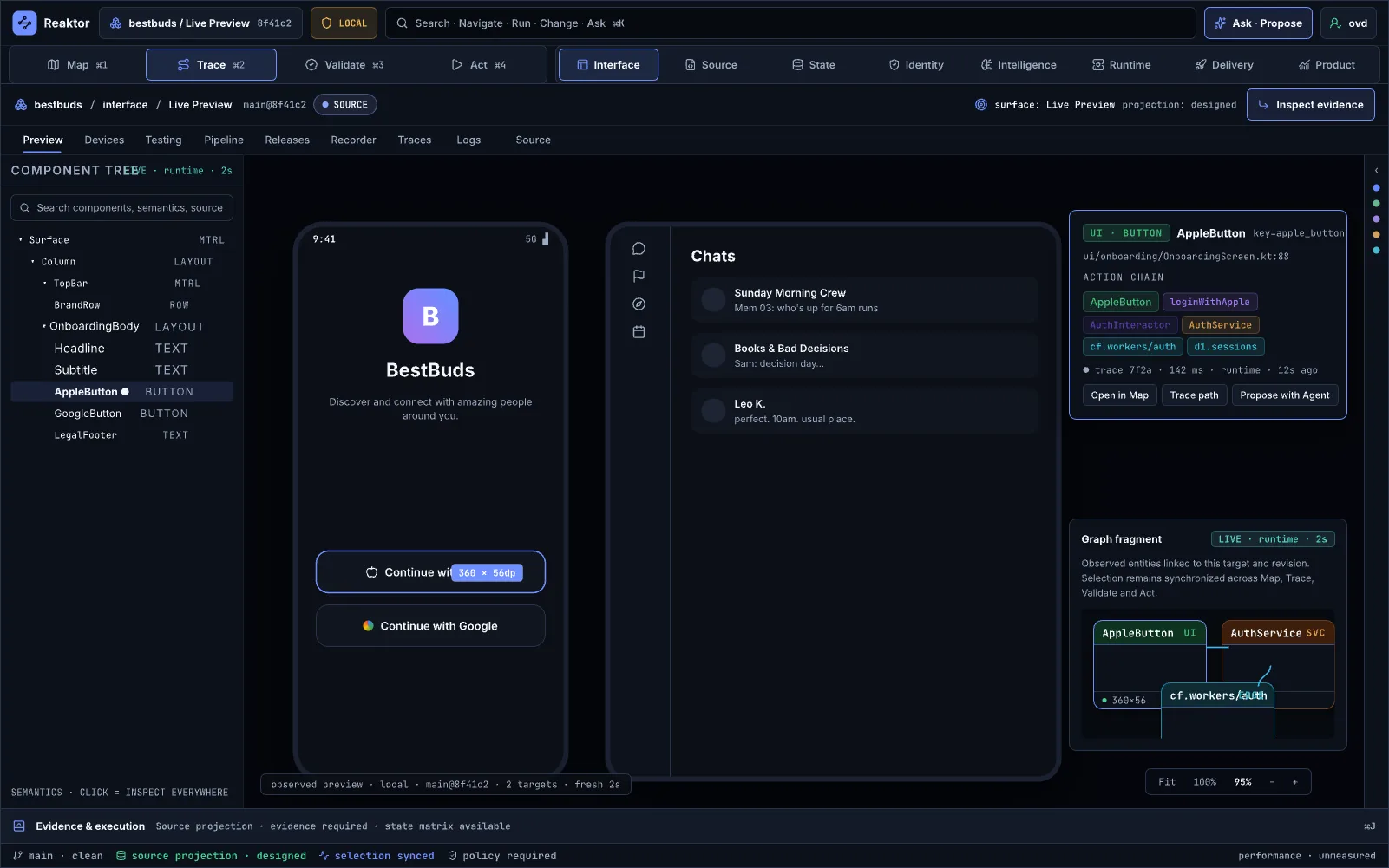
On the board. Three panes under the standard studio chrome, breadcrumbed bestbuds / interface / Live Preview at main@8f41c2. Left is COMPONENT TREE stamped LIVE · runtime · 2s, with a search field reading "Search components, semantics, source" and a typed tree — Surface MTRL, Column LAYOUT, TopBar MTRL, BrandRow ROW, OnboardingBody LAYOUT, Headline TEXT, Subtitle TEXT, AppleButton ● BUTTON, GoogleButton BUTTON, LegalFooter TEXT. Centre is a rendered BestBuds onboarding screen plus a chats screen, banner SEMANTICS · CLICK = INSPECT EVERYWHERE, size readout 360 × 56dp, caption observed preview · local · main@8f41c2 · 2 targets · fresh 2s. Right is an inspector — UI · BUTTON / AppleButton / key=apple_button / ui/onboarding/OnboardingScreen.kt:88, an ACTION CHAIN running AppleButton → loginWithApple → AuthInteractor → AuthService → cf.workers/auth → d1.sessions, a run chip ● trace 7f2a · 142 ms · runtime · 12s ago, and three actions Open in Map, Trace path, Propose with Agent. Below sits Graph fragment (LIVE · runtime · 2s) with AppleButton UI 360×56, AuthService SVC 142ms, cf.workers/auth EDGE 72ms, and the promise "Selection remains synchronized across Map, Trace, Validate and Act."
Vision tie. This is the clearest single expression of "the diagram of the system and the system are the same object": one click on a rendered pixel resolves to a node, a source line, a port chain and a graph fragment. It is also the best argument in the atlas that keeping the graph resident at runtime buys something — a compiled-away Blueprint could not answer "which service does this button reach" from a live process. Where it falls down is evidence: the header says projection: designed and the status bar says source projection · designed, while two panes are stamped LIVE · runtime · 2s and the caption says observed preview. The board asserts designed and observed simultaneously.
Workflow tie. A UI engineer opens this the moment a screen renders wrong or a tap does nothing, which is most mornings. Today they run the app, open the Layout Inspector or the Xcode View Debugger to find the composable, then switch to the editor to grep for the click handler, then to the network tab to see which endpoint it hit, then to the Cloudflare dashboard to see whether the worker was reached. Four tools, four selections, no shared identity. This board collapses that to one selection.
Agentic tie. An agent reads the component tree as typed nodes with source anchors, the action chain as a port path, and the trace chip as one run. Propose with Agent is the only agent affordance and it is unqualified — nothing on the board says what the agent may change, what capability it holds, or where the proposal lands. The board would become genuinely agent-legible with a permission chip next to that button and a SourceRef on every tree row so the agent can cite rather than infer.
Blueprint tie. This is Play-In-Editor plus the Widget Reflector. Unreal lets you pick a widget in a running game and jump to the blueprint that built it; this does the same and then keeps going across the process boundary into the worker and the database, which Unreal cannot do because Unreal's world stops at the executable.
Replaces / augments. Android Studio Layout Inspector, Xcode View Debugger, React DevTools, Storybook, Flipper, and the "inspect element → find the handler" half of Chrome DevTools.
Improvements.
- Resolve the designed-versus-live contradiction with a per-pane truth chip rather than a board-level one. The component tree is derivable from source today and should read
DERIVED · source; the142 msand72msfigures are not and should readNOT WIRED · no span adapter. - Add a
TARGETSstrip above the preview. The caption already claims "2 targets" but the board shows one phone; render the same selection on Android, iOS, Web and Desktop side by side, since cross-platform divergence is the reason a KMP developer opens a preview. - Give the
ACTION CHAINa port-identity column. With defectD-6unresolved,AuthServicereached through a string-built port and through a reified port are different objects; the chain should show which kind each hop is, and flag the string hops. - Make
Trace pathcarry the selection into06.04rather than opening a second trace. Right now the two boards show the same chain twice with no stated relationship. - Add an
EmptyReasonstate for the inspector: what this pane looks like when the clicked element has no action chain, which is the common case forHeadline TEXTandLegalFooter TEXT.
Verdict. Strengthen.
06.02 · Inner Loop · Flow Storyboard
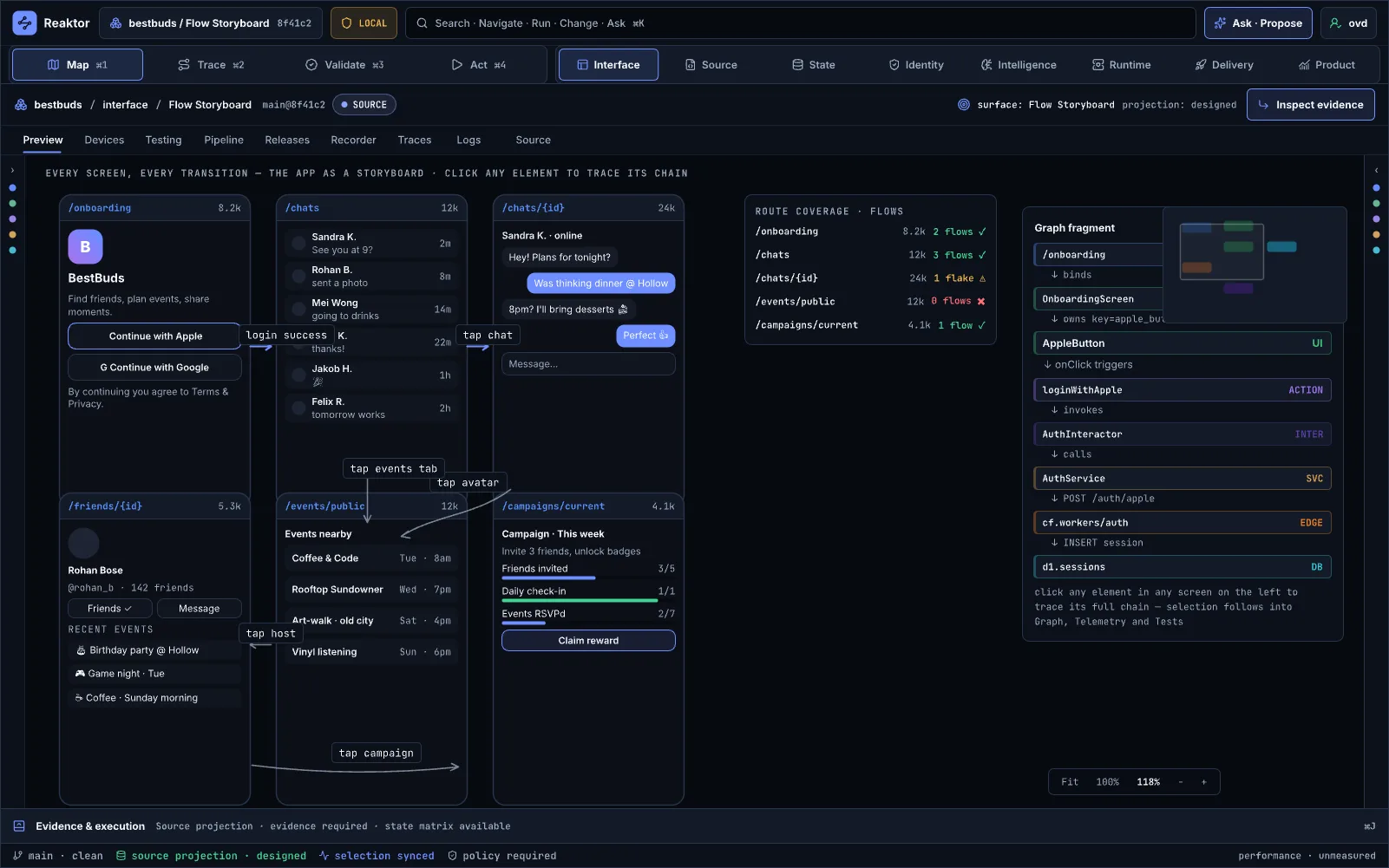
On the board. A wide screen-flow canvas under the banner "EVERY SCREEN, EVERY TRANSITION — THE APP AS A STORYBOARD · CLICK ANY ELEMENT TO TRACE ITS CHAIN". Six rendered screens carry route labels and traffic numbers: /onboarding 8.2k, /chats 12k, /chats/{id} 24k, /friends/{id} 5.3k, /events/public 12k, /campaigns/current 4.1k, joined by labelled transitions login success, tap chat, tap avatar, tap events tab, tap host, tap campaign. A Graph fragment pane expands the selected element into a full vertical chain with edge verbs — /onboarding ROUTE ↓ binds OnboardingScreen SCREEN ↓ owns key=apple_button AppleButton UI ↓ onClick triggers loginWithApple ACTION ↓ invokes AuthInteractor INTER ↓ calls AuthService SVC ↓ POST /auth/apple cf.workers/auth EDGE ↓ INSERT session d1.sessions DB. A ROUTE COVERAGE · FLOWS pane lists five routes with verdicts: 2 flows ✓, 3 flows ✓, 1 flake ⚠, 0 flows ✖, 1 flow ✓.
Vision tie. This is the eigenvector-primitive argument made visually: route, screen, UI, action, interactor, service, edge, database are eight node kinds and every arrow is a typed port with a named verb. The edge verbs (binds, owns, triggers, invokes, calls, POST, INSERT) are the strongest typed-port vocabulary anywhere in my cluster. The board also embodies the visitor idea implicitly: route coverage is a traversal result, not a hand-maintained list.
Workflow tie. A product engineer or designer opens this at sprint planning to answer "what does the app actually consist of, and which parts are untested", and a new hire opens it in week one instead of reading the router file. Today that artefact is a stale Figma prototype with screens nobody re-exported after the last three releases.
Agentic tie. This is the most useful board in my cluster for an agent, because the route set plus coverage verdicts is a work queue: /events/public 0 flows ✖ is a directly actionable task. An agent could propose the missing Maestro flow, and 06.03 is where it would be recorded. Nothing on the board wires that loop — there is no "generate flow" action and no link from a red coverage row to the recorder.
Blueprint tie. The World Outliner and the level itself: the whole game laid out so you can see where every room connects. It also does something Unreal does not, which is annotate each room with how many players entered it and whether an automated test walks through it.
Replaces / augments. Figma prototype mode, Xcode Storyboards, the funnel view in Amplitude or Mixpanel, Maze, and the route table in a router config file.
Improvements.
- Add the sixth coverage row.
/friends/{id}appears in the storyboard and is missing fromROUTE COVERAGE, which silently undercounts the untested surface. - Split the traffic number from the route.
8.2kis unmarked invented analytics; move it to a separateEXPOSUREcolumn with an explicitnot wiredstate, so the route topology stays trustworthy when analytics is absent. - Add a
DEAD ROUTESpane. The vision claims "unreachable routes are found by query"; this board is the only place that claim can be shown, and it currently is not. A route with no inbound transition is exactly what a visitor traversal would surface. - Make the transition labels clickable as first-class objects.
login successis a navigation edge with a condition; selecting it should show the condition, the failure branch and whether the failure branch has a screen. - Add per-screen capability variance. The same route renders differently when a capability is absent (no camera, no push permission); show a small badge per screen for "renders differently at capability tier X".
Verdict. Strengthen.
06.03 · Inner Loop · Recorder
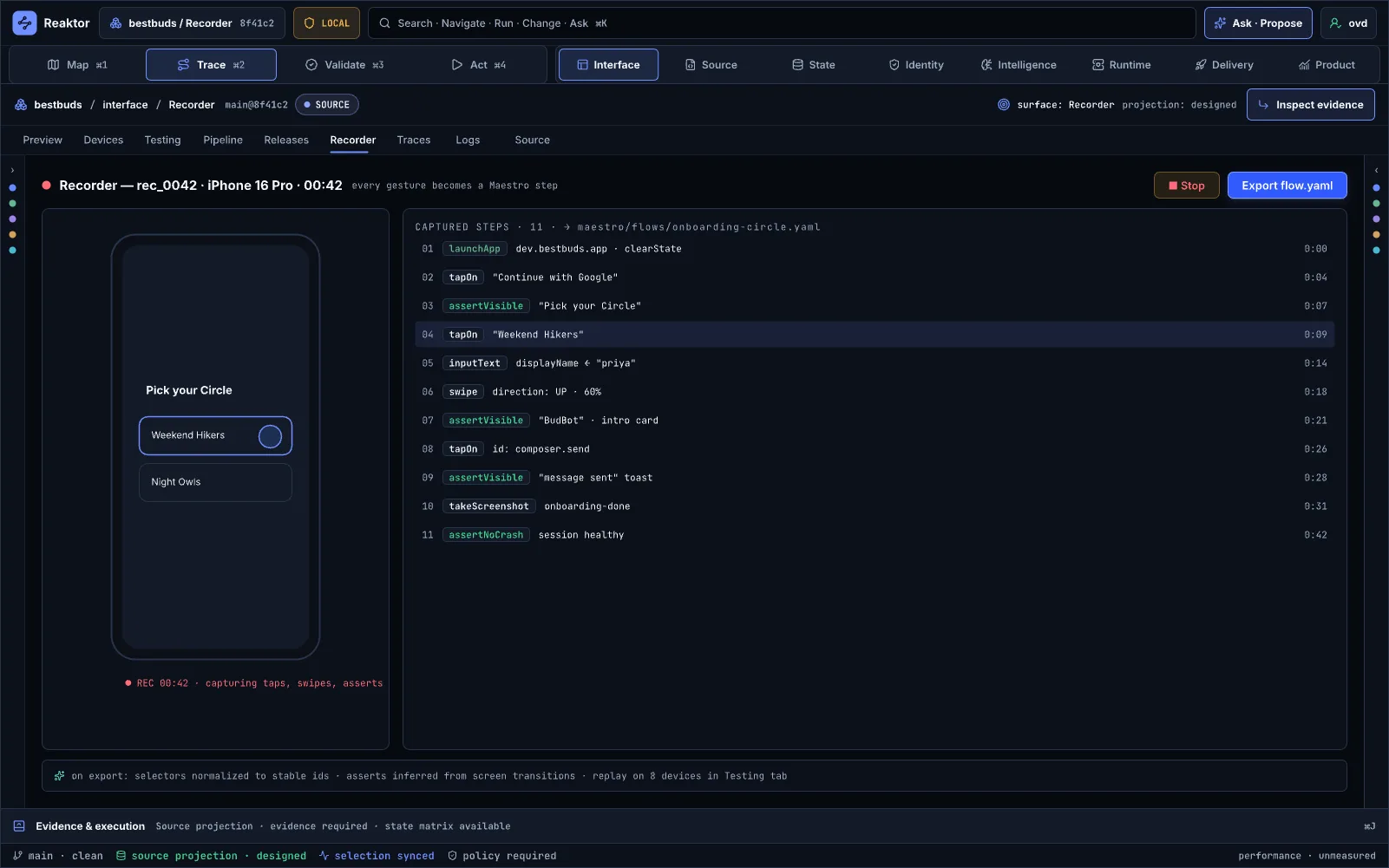
On the board. The thinnest board in the cluster: a header Recorder — rec_0042 · iPhone 16 Pro · 00:42 with the subtitle "every gesture becomes a Maestro step", a ■ Stop and an Export flow.yaml control, a device pane showing a "Pick your Circle / Weekend Hikers / Night Owls" screen with ● REC 00:42 · capturing taps, swipes, asserts, and a single list CAPTURED STEPS · 11 · → maestro/flows/onboarding-circle.yaml. The eleven steps are typed Maestro commands with timestamps: launchApp dev.bestbuds.app · clearState 0:00, tapOn "Continue with Google" 0:04, assertVisible "Pick your Circle" 0:07, tapOn "Weekend Hikers" 0:09, inputText displayName ← "priya" 0:14, swipe direction: UP · 60% 0:18, assertVisible "BudBot" · intro card 0:21, tapOn id: composer.send 0:26, assertVisible "message sent" toast 0:28, takeScreenshot onboarding-done 0:31, assertNoCrash session healthy 0:42. A footer states the export contract: "selectors normalized to stable ids · asserts inferred from screen transitions · replay on 8 devices in Testing tab".
Vision tie. Weak. Nothing here is graph-shaped. The captured steps are a flat list keyed on labels and one id (composer.send), which is the fragile selector model every record-and-replay tool has always used. The Reaktor-specific version of this board would record node and port identities rather than screen text, because the graph is resident at runtime and knows which node received the tap. The footer's "selectors normalized to stable ids" gestures at this without showing it. This is the one board in my cluster that could have been drawn for any framework.
Workflow tie. A QA engineer or a product engineer opens this after fixing a bug, to lock the fix in with a flow, or before a release to add coverage to a red route from 06.02. Today they hand-write YAML against a running emulator, guess at selectors, and discover the flakiness a day later in CI.
Agentic tie. Two-way potential, none realised. An agent should be able to write a recording (propose a flow for an uncovered route) and read one (explain why auth-login.google is flaky 2 of 3, per 07.02). Neither direction is drawn — there is no agent control on this board at all.
Blueprint tie. Unreal's automation recorder and Sequencer's take recording. The analogy holds well for capture; it breaks on replay, because Unreal replays into a deterministic simulation while this replays into eight physical devices with real network.
Replaces / augments. Maestro Studio, Playwright codegen, Detox recorder, Appium Inspector, and Keploy's record mode.
Improvements.
- Add a
GRAPH FRAGMENTpane, which every other Section 06 board has and this one lacks. Each captured step should resolve to the node it touched, so the flow is a path through the graph rather than a list of strings. - Add a
SELECTOR STABILITYcolumn per step.tapOn "Continue with Google"breaks on the first copy change;tapOn id: composer.senddoes not. Colour the eleven steps by that risk and offer a one-click promotion to a node key. - Add a
COVERAGE IMPACTpane. Recording this flow should show which red rows in06.02's route coverage turn green, which is the reason to record at all. - Add the assertion-authoring state. "asserts inferred from screen transitions" is a claim about generated asserts; show the inferred assert before it is written, with accept and reject, because a wrong inferred assert is worse than none.
- Show the replay target set inline rather than pointing at a "Testing tab" that has no board behind it.
Verdict. Strengthen.
06.04 · Inner Loop · Causal Trace
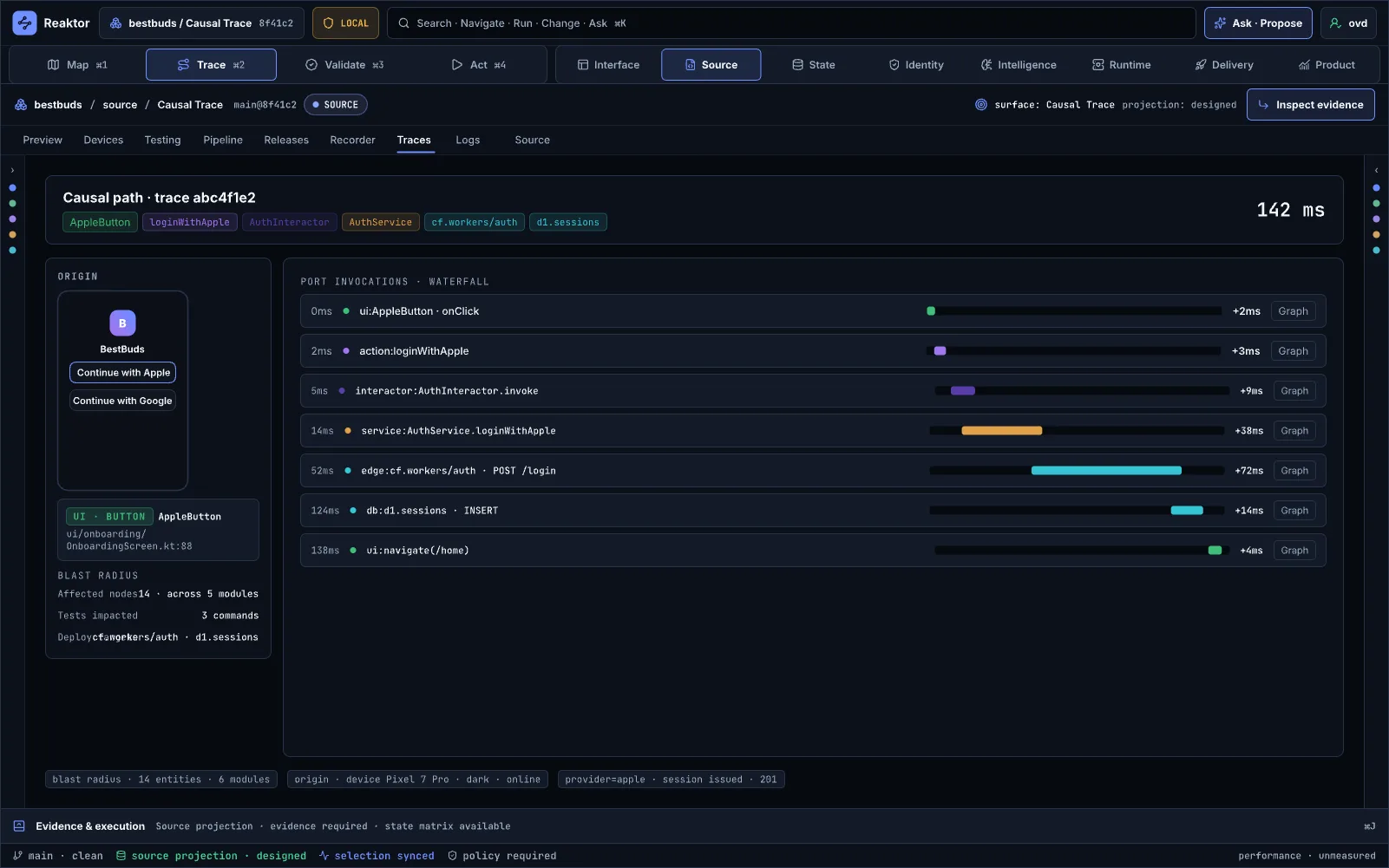
On the board. Breadcrumbed bestbuds / source / Causal Trace. The header runs the chain AppleButton → loginWithApple → AuthInteractor → AuthService → cf.workers/auth → d1.sessions with a total 142 ms, labelled Causal path · trace abc4f1e2. An ORIGIN pane shows the onboarding screen thumbnail and UI · BUTTON / AppleButton / ui/onboarding/OnboardingScreen.kt:88. A BLAST RADIUS pane gives three figures — Affected nodes 14 · across 5 modules, Tests impacted 3 commands, Deploy targets cf.workers/auth · d1.sessions. The main pane is PORT INVOCATIONS · WATERFALL, seven rows each with a cumulative offset, a span label, a delta and a Graph link: 0ms ui:AppleButton · onClick +2ms, 2ms action:loginWithApple +3ms, 5ms interactor:AuthInteractor.invoke +9ms, 14ms service:AuthService.loginWithApple +38ms, 52ms edge:cf.workers/auth · POST /login +72ms, 124ms db:d1.sessions · INSERT +14ms, 138ms ui:navigate(/home) +4ms. Footers read blast radius · 14 entities · 6 modules, origin · device Pixel 7 Pro · dark · online, provider=apple · session issued · 201.
Vision tie. The strongest board in the cluster and the best case for a live graph. A conventional tracer gives spans; this gives port invocations, which means each row is an edge in the resident graph and therefore has a Graph link back to structure. Blast radius is the payoff of the graph being alive: the set of entities a change to AppleButton can reach is a traversal, computable now, on real data, with no telemetry adapter required. That makes half this board buildable today and the other half — the timings — dependent on a span collector the audit says does not exist.
Workflow tie. A backend or mobile engineer opens this during an incident or while chasing a latency regression, and a reviewer opens it before approving a change to shared code. Today the same question requires Xcode Instruments or the Chrome performance panel for the client half, a Jaeger or Datadog waterfall for the server half, and a manual grep to guess the blast radius, with no object connecting the three.
Agentic tie. Excellent raw material and no affordance. The waterfall plus blast radius plus source anchors is exactly what an agent needs to propose a fix and predict what it will break — and the atlas's 08.x agent boards would consume it. There is no Send to Agent, no Explain this trace, and no way to attach the trace to a task, which is a gap given that 06.05 has Send to Agent on every crash group.
Blueprint tie. Unreal Insights fused with the Blueprint debugger's call stack. Where the analogy breaks is scope: Unreal Insights profiles one process; this crosses device, edge worker and database in one waterfall, which is a genuinely different object and the atlas should say so rather than borrowing the profiler idiom silently.
Replaces / augments. Xcode Instruments, Android Studio Profiler, Chrome DevTools performance, Jaeger, Tempo, Datadog APM flame graphs, Sentry performance traces.
Improvements.
- Fix the module count.
Affected nodes 14 · across 5 modulesandblast radius · 14 entities · 6 modulesare on the same board. Whichever is right, the disagreement makes both unusable. - Split the board's truth classes visibly. Draw a divider: blast radius and the port chain are
DERIVED · graph, the seven timings areNOT WIRED · no span adapter. A half-honest board is more persuasive than a uniformly confident one. - Reconcile the endpoint name. This board says
POST /login;06.02saysPOST /auth/apple. One endpoint, two names, in adjacent boards. - Add a
COMPAREcontrol. A waterfall is only actionable against a baseline; give it "compare with previous trace" and "compare with p50", with an explicit unknown when no baseline exists. - Make
Tests impacted 3 commandsenumerable. Three named commands with run status is a work item; the number alone is trivia. - Add the failure variant. Every trace here succeeds (
session issued · 201). The board a developer actually opens is the one where the chain stopped atedge:cf.workers/auth, and that state is not drawn.
Verdict. Keep.
06.05 · Validate + Delivery · Harnesses & Shadow E2E
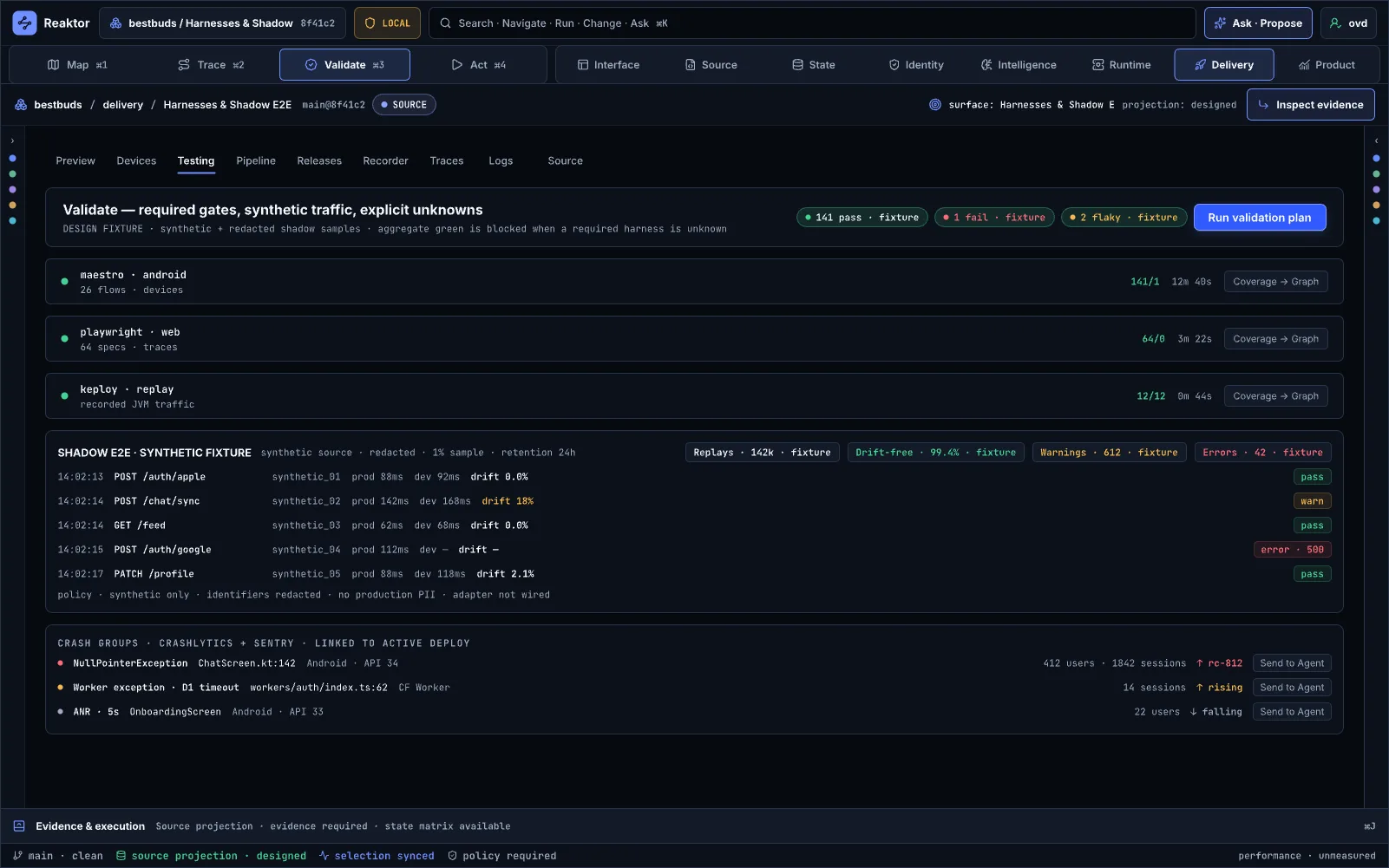
On the board. Breadcrumbed delivery / Harnesses & Shadow E2E, titled "Validate — required gates, synthetic traffic, explicit unknowns" with the scope banner DESIGN FIXTURE · synthetic + redacted shadow samples · aggregate green is blocked when a required harness is unknown. Three counters read 141 pass · fixture, 1 fail · fixture, 2 flaky · fixture, next to Run validation plan. A harness list gives three rows, each with a Coverage → Graph link: maestro · android / 26 flows · devices / 141/1 / 12m 40s, playwright · web / 64 specs · traces / 64/0 / 3m 22s, keploy · replay / recorded JVM traffic / 12/12 / 0m 44s. A SHADOW E2E · SYNTHETIC FIXTURE pane declares synthetic source · redacted · 1% sample · retention 24h, four aggregates (Replays · 142k · fixture, Drift-free · 99.4% · fixture, Warnings · 612 · fixture, Errors · 42 · fixture) and five timestamped request rows comparing prod and dev latency with a drift percentage and a verdict, including POST /auth/google · synthetic_04 · prod 112ms · dev — · drift — · error · 500. Its policy line ends adapter not wired. The third pane, CRASH GROUPS · CRASHLYTICS + SENTRY · LINKED TO ACTIVE DEPLOY, lists NullPointerException / ChatScreen.kt:142 / Android · API 34 / 412 users · 1842 sessions / ↑ rc-812, Worker exception · D1 timeout / workers/auth/index.ts:62 / CF Worker / 14 sessions / ↑ rising, and ANR · 5s / OnboardingScreen / Android · API 33 / 22 users / ↓ falling, each with Send to Agent.
Vision tie. This board carries the evidence principle better than any other in my cluster and better than most in the atlas. The banner declares the fixture, every aggregate carries a · fixture suffix, the policy line ends adapter not wired, and — most importantly — it states a semantics for unknown: "aggregate green is blocked when a required harness is unknown". That single sentence is the honest-verification idea the rest of the atlas is missing, and it appears exactly once, in prose, on one board. See the focused section below on how to systematise it.
Workflow tie. A tech lead opens this before cutting a release candidate, and an on-call engineer opens the crash pane after a deploy. Today those are two different tools with no relationship: a Firebase Test Lab matrix or a Playwright HTML report on one side, Crashlytics and Sentry on the other, joined by a human remembering which release was live.
Agentic tie. The only board in my cluster with a per-item agent handoff. Send to Agent on a crash group with a source anchor and a release attribution (↑ rc-812) is a well-formed agent task. What governs it is not shown — no permission chip, no statement of what the agent may do with a production crash, no receipt for the resulting proposal. Given that this board sits one step from 07.x, the missing governance is conspicuous.
Blueprint tie. The asset validator plus the automation test session frontend. The shadow-E2E pane has no Unreal analogue at all; the nearest thing is a replay of recorded gameplay against a new build, which is closer than it first looks and is worth borrowing as a framing.
Replaces / augments. Firebase Test Lab, BrowserStack, Playwright report, Keploy, GoReplay and Diffy for shadow traffic, Crashlytics, Sentry.
Improvements.
- Mark the crash pane.
412 users · 1842 sessionsis unmarked under a header claiming a live Crashlytics and Sentry link. Either the fixture scope propagates into every pane automatically or the board's own honesty rule is optional, which defeats it. - Move crash groups to
10.04 · Observe · Errors, which already carries the sameNullPointerExceptionat line 142 under a different filename. One crash group, one home. - Turn "aggregate green is blocked when a required harness is unknown" into a visible computation. Show the required-harness list, which of them reported, and the resulting aggregate with the unknowns counted as blocking. Right now the rule is stated and the counters do not obey it.
- Add a
REQUIREDtoggle per harness row. The rule needs a subject: which harnesses are required for this target, and who declared them. - Rename the shadow rows'
error · 500to something that cannot be mistaken for production. A fixture failure and a live failure must not look identical, particularly on the board that teaches the rest of the atlas how to be honest. - Add a
FIXTURE LEDGERpane listing each fixture value and the real source that will replace it, turning the board into its own migration plan.
Verdict. Split into 06.05 · Validate · Harnesses (gates plus coverage), a Runtime-instrument board for shadow traffic, and a merge of the crash pane into 10.04.
07.01 · Ship · Device Lab
On the board. One pane, eight cards, breadcrumbed delivery / Device Lab, headed Device lab — 8 devices · 6 paired with + Add device and Reload all. Six paired cards — Pixel 7 Pro / Android 14 · v812 · emulator, iPhone 16 Pro / iOS 18.2 · v812 · simulator, iPad Pro 12.9 / iPadOS 18.2 · v811 · simulator, Web · Chrome 138 / macOS · v812 · devtools, Desktop · macOS / macOS 15.2 · v812 · dmg, Pixel Tablet / Android 14 · v812 · emulator — each carrying the identical trio live · mirrors, hot reloads, and the actions Preview, Hot reload, Capture. Two offline cards — Fold4 · device / Android 14 · v810 · real · 82% and iPhone SE / iOS 17.6 · simulator — carry reconnect, to pair, and the actions Pair, Logs.
Vision tie. This board should be the atlas's showcase for adapter and capability tiers and instead it is a device list. Every paired card asserts the same two capabilities in the same words. The vision says "Platform features are adapters that may be absent; what they can do is expressed as capability tiers... Degradation is designed, not discovered" — a lab of eight heterogeneous targets is the natural place to show that, and it shows nothing of the kind. A real desktop target does not hot-reload the way a Hermes-hosted web bundle does, and the board flattens that difference away.
Workflow tie. A developer opens this at the start of a task to pick where to run, and before a release to check that a real folding device and an old iPhone still work. Today this is the Xcode device menu, the Android Studio device manager, a browser, and a Slack message asking whether anyone has a Fold4 charged.
Agentic tie. Agent-hostile as drawn. There is nothing an agent can read that would let it choose a device for a task — no capability matrix, no last-run history, no queue, no notion of which device is free. An agent asked to "verify this on a small screen" has no queryable answer here.
Blueprint tie. Unreal's Launch On device menu and device profiles. Device profiles are precisely the missing half: Unreal expresses per-device capability and scalability settings as data, which is what this board needs and lacks.
Replaces / augments. Firebase Test Lab, BrowserStack Live, Xcode devices window, Android device manager, Expo dev clients, Flipper.
Improvements.
- Add a
CAPABILITYblock per card, with tiers rather than booleans:hot reload: full / restart-only / none,push: full / local-only / none,camera,biometrics,background execution. This is the single change that makes the board Reaktor-shaped. - Add a version-skew warning.
iPad Pro 12.9 · v811andFold4 · v810are behind the other six onv812, and the board says nothing about it. A skew column is what a lab is for. - Add per-device evidence. Which flow last ran here, when, with what result — otherwise
07.01cannot serve the "replay on 8 devices" promise06.03makes. - Add a run-targeting control: select a flow or a preview and cast it to a chosen device subset, which is the action every user of this board actually wants.
- Give the offline cards an
EmptyReason.reconnect / to pairsays nothing about why the device dropped or what to do.
Verdict. Merge into Section 06. Nothing on this board is about shipping — no artefact leaves the building, there is no gate, no target promotion and no release. Section 07's own card says its scope is "Validate targets, execute pipelines, release, and pass deployment gates", and a lab of paired emulators with hot reload does none of the four. Renumber it as the first surface of the inner loop, where 06.01 Preview, 06.03 Recorder and 06.05 harness replay all already point at it.
07.02 · Ship · Pipeline
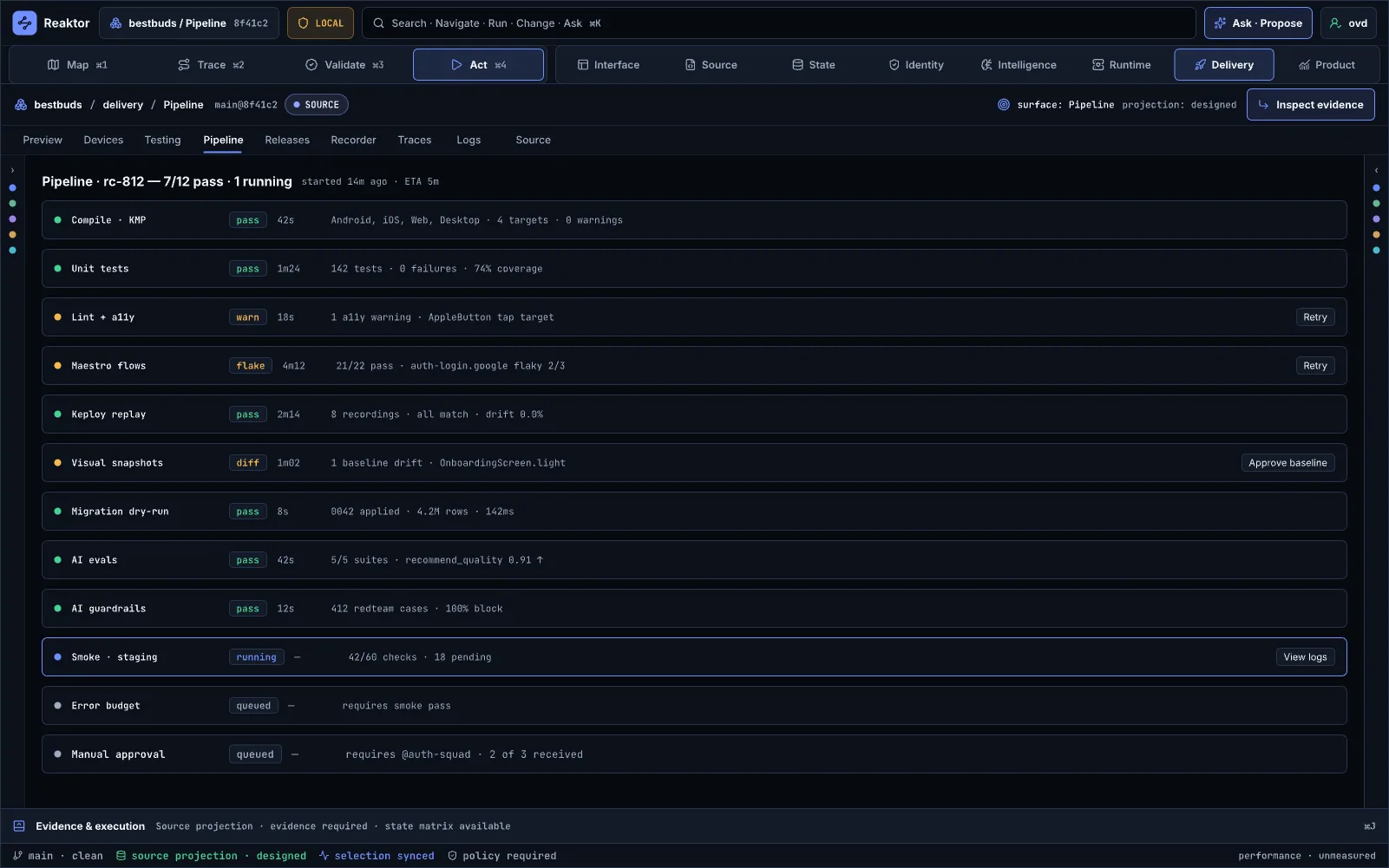
On the board. A single vertical stage list headed Pipeline · rc-812 — 7/12 pass · 1 running, with started 14m ago · ETA 5m. Twelve stages, each with a status, a duration and a one-line result, several with an inline action: Compile · KMP / pass / 42s / Android, iOS, Web, Desktop · 4 targets · 0 warnings; Unit tests / pass / 1m24 / 142 tests · 0 failures · 74% coverage; Lint + a11y / warn / 18s / 1 a11y warning · AppleButton tap target / Retry; Maestro flows / flake / 4m12 / 21/22 pass · auth-login.google flaky 2/3 / Retry; Keploy replay / pass / 2m14 / 8 recordings · all match · drift 0.0%; Visual snapshots / diff / 1m02 / 1 baseline drift · OnboardingScreen.light / Approve baseline; Migration dry-run / pass / 8s / 0042 applied · 4.2M rows · 142ms; AI evals / pass / 42s / 5/5 suites · recommend_quality 0.91 ↑; AI guardrails / pass / 12s / 412 redteam cases · 100% block; Smoke · staging / running / 42/60 checks · 18 pending / View logs; Error budget / queued / requires smoke pass; Manual approval / queued / requires @auth-squad · 2 of 3 received.
Vision tie. None, and that is the problem — see the focused section below. The board depicts a generic CI pipeline that could belong to any product. Nothing here is graph-shaped: no stage takes a subgraph as input, no stage emits a graph diff, no stage is a visitor over the node set. The one Reaktor-specific stage that exists elsewhere in the cluster (GraphManifest, Graph integrity, on 07.04) is absent here.
Workflow tie. Everyone opens this, several times a day, when a red check blocks a merge. Today it is the GitHub Actions run page — except that in this repository there is no such page, because the workflow is commented out and the Dagger pipeline is dispatch-only.
Agentic tie. No agent affordance at all, on the board where agents would be most useful: a flaky Maestro flow (auth-login.google flaky 2/3) and a visual baseline drift are both well-scoped agent tasks with clear accept-or-reject outcomes. The absence of any Send to Agent here, next to 06.05 where every crash group has one, is an inconsistency rather than a policy.
Blueprint tie. The build and cook pipeline — UnrealBuildTool and BuildGraph. The analogy is exact and unflattering: Unreal's BuildGraph is a declared dependency graph of build nodes that you can inspect and re-enter, whereas this board is a flat list. A framework whose thesis is that everything is a graph draws its build as twelve stacked rectangles.
Replaces / augments. GitHub Actions, CircleCI, Bitrise, Buildkite, Dagger, and the check list on a pull request.
Improvements.
- Add a
TRIGGERheader. Today it must readmanual dispatch only · no push trigger · no required checks, because that is the truth. AfterL0, it becomes an event matrix. - Classify every stage by existence, not just by status:
RUNS TODAY,DEFINED · NOT TRIGGERED,NOT BUILT. On current evidence,Keploy replay,Visual snapshots,AI guardrailsandError budgetbelong in the third group. - Replace
142 tests · 0 failures · 74% coveragewith a module ledger: how many of the thirty framework modules execute tests, how many have none, and what coverage is actually measured. The honest string is closer to "3 modules run JVM tests · 12 modules have zero tests · coverage not measured". - Delete every invented duration or bind it to a
RunRef.42s,1m24,4m12,started 14m ago · ETA 5mare fabrications on a board whose entire purpose is to report what happened. - Draw the pipeline as a dependency graph rather than a list, with fan-out per target and the four KMP targets as parallel branches.
Error budget / requires smoke passandManual approval / requires @auth-squadare already edges written as prose. - Reconcile with
07.04. One release candidate cannot have both a twelve-stage and an eleven-step pipeline with different unit-test counts.
Verdict. Rebuild.
07.03 · Ship · Releases
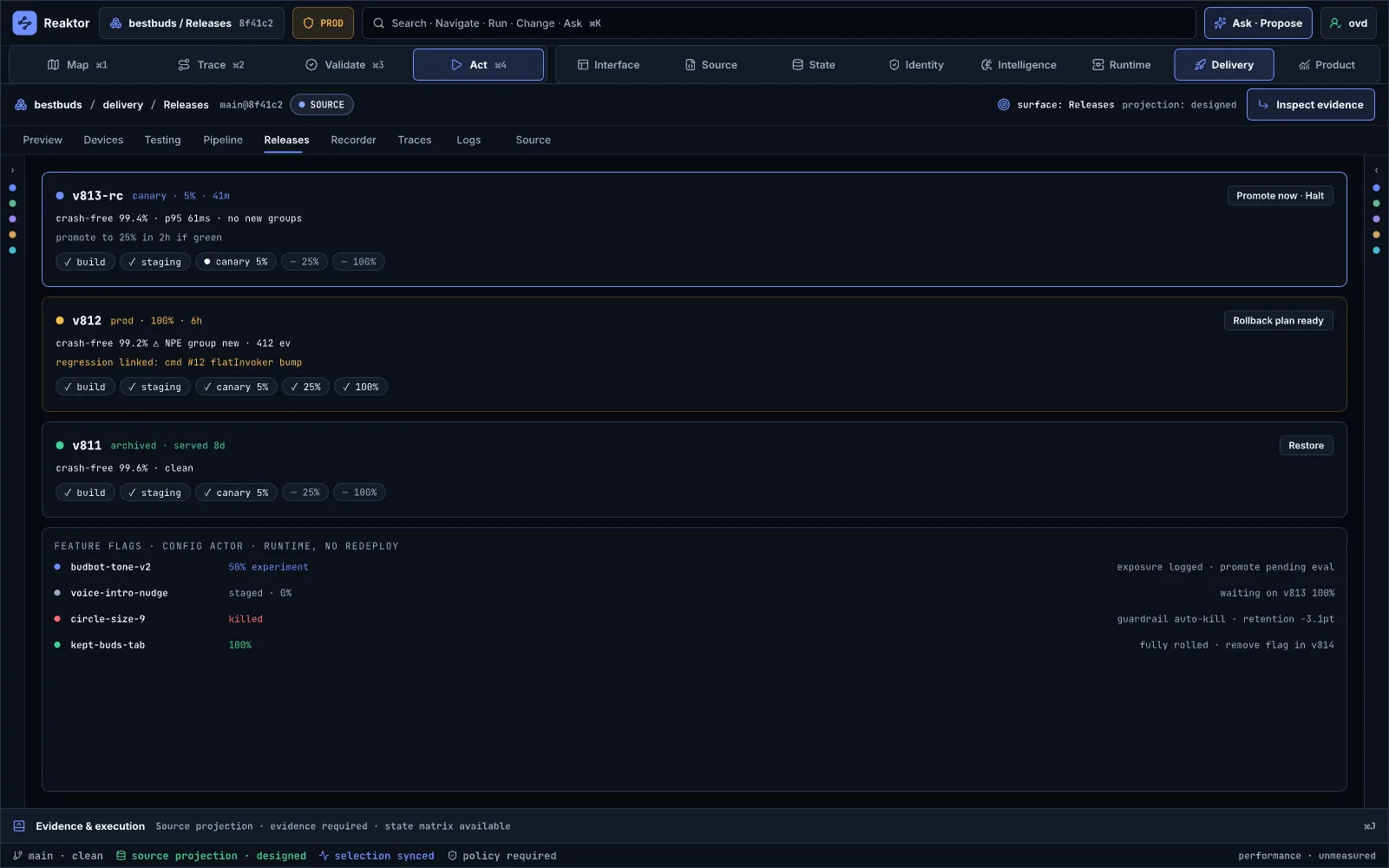
On the board. The first board in the cluster whose environment chip reads PROD. Three release cards. v813-rc / canary · 5% · 41m with Promote now · Halt, the evidence line crash-free 99.4% · p95 61ms · no new groups, the policy promote to 25% in 2h if green, and a five-rung ladder ✓ build / ✓ staging / ● canary 5% / — 25% / — 100%. v812 / prod · 100% · 6h with Rollback plan ready, crash-free 99.2% ⚠ NPE group new · 412 ev, regression linked: cmd #12 flatInvoker bump, and a fully ticked ladder. v811 / archived · served 8d with Restore, crash-free 99.6% · clean, and a ladder showing ✓ canary 5% / — 25% / — 100%. Below, FEATURE FLAGS · CONFIG ACTOR · RUNTIME, NO REDEPLOY lists budbot-tone-v2 / 50% experiment / exposure logged · promote pending eval, voice-intro-nudge / staged · 0% / waiting on v813 100%, circle-size-9 / killed / guardrail auto-kill · retention −3.1pt, kept-buds-tab / 100% / fully rolled · remove flag in v814.
Vision tie. Partial and mostly by accident. regression linked: cmd #12 flatInvoker bump is the best line on the board and the only place in the cluster where a production regression is attributed to a specific graph command rather than a commit — that is the live-graph thesis paying off in release management. The flags pane, labelled CONFIG ACTOR · RUNTIME, NO REDEPLOY, is the nearest thing the atlas has to code push and is not the same thing: a flag chooses between paths already shipped, whereas code push replaces the paths.
Workflow tie. A release manager or tech lead opens this daily during a rollout to decide promote or halt, and a product manager opens the flags pane to check an experiment. Today that is App Store Connect phased release plus Play Console staged rollout plus LaunchDarkly plus a crash dashboard, with the correlation done by hand.
Agentic tie. No agent affordance, and here the omission is defensible but undrawn. Promote now and Halt are irreversible production actions; an agent should be able to recommend and never execute. The board should show that boundary as a permission chip rather than leaving agents silently absent.
Blueprint tie. No good Unreal analogue; the closest is the Epic launcher's patch channels, and the analogy is weak enough to abandon. This board's ancestors are Spinnaker and LaunchDarkly, not the editor.
Replaces / augments. App Store Connect phased release, Play Console staged rollout, LaunchDarkly, Statsig, Firebase Remote Config, Argo Rollouts.
Improvements.
- Fix the version namespace. This board says
v811 / v812 / v813-rc; every other board in the section saysrc-810 / rc-811 / rc-812.07.04manages to use both in one pane. - Fix the
v811ladder. An archived release that "served 8d" cannot show— 25%and— 100%as never reached. - Move
FEATURE FLAGSout. Flags with exposure and eval are experiments, and11.03 · Learn · Experimentsalready exists. What should stay is the flags-as-release-lever view: which flags are load-bearing for the current rollout and which must be removed before the next. - Attribute
guardrail auto-kill · retention −3.1ptto a guardrail definition. An automated production kill needs a visible rule, a threshold, a window and a receipt; as drawn it is a machine acting without a stated licence. - Add a
PER-TARGETbreakdown to each release card.v813-rc canary · 5%is a single number covering five heterogeneous targets, and mobile in particular cannot be at 5% and instantly promotable. - Add an
EVIDENCElink on each metric.crash-free 99.4% · p95 61mshas no source, no window and no freshness.
Verdict. Split into a release-rollout board and a flags-and-guardrails board.
07.04 · Act + Delivery · Deployment Plan & Gates
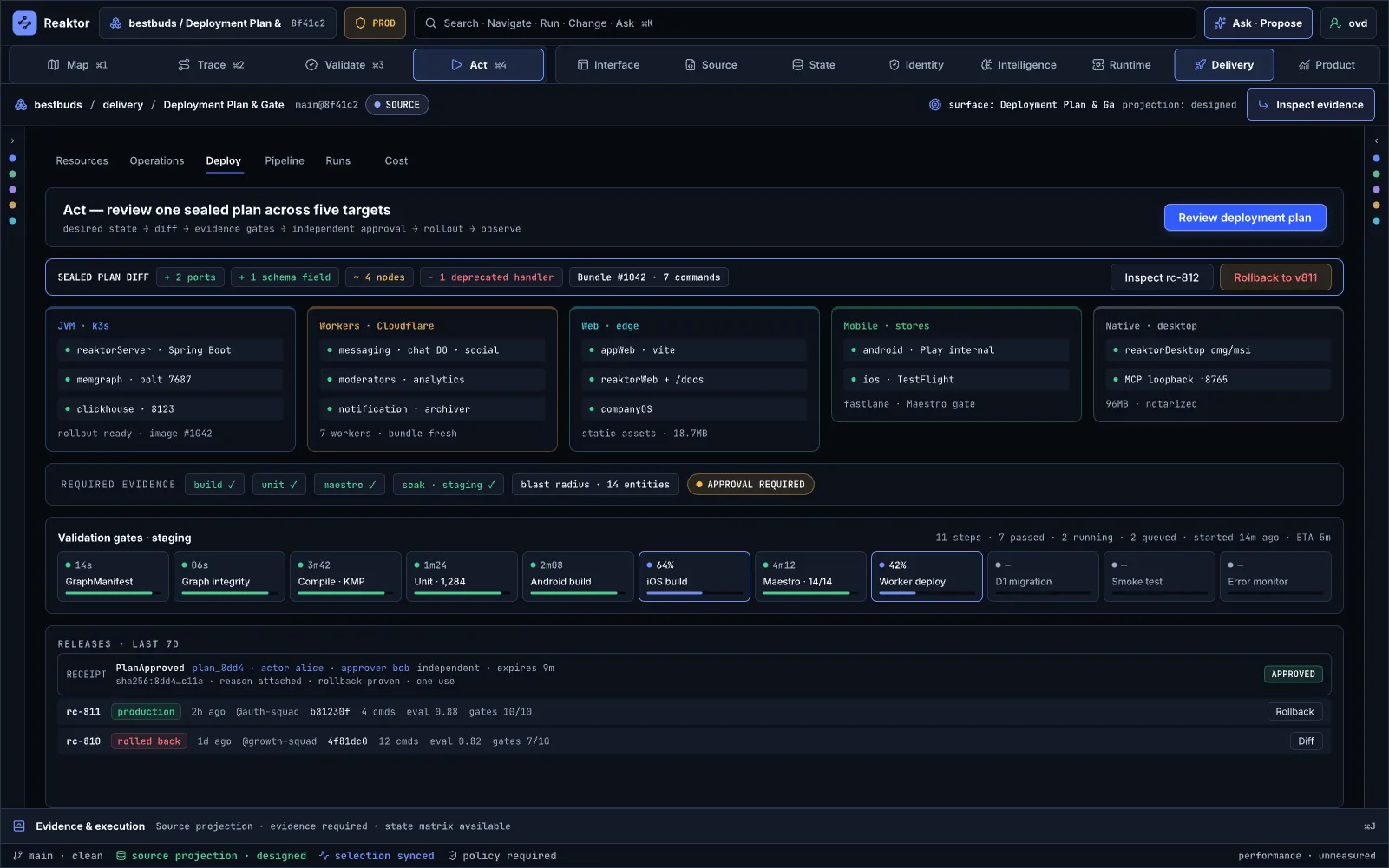
On the board. The richest board in the cluster and the only one carrying a receipt. Its secondary nav changes to Resources · Operations · Deploy · Pipeline · Runs · Cost. Titled "Act — review one sealed plan across five targets" with the subtitle "desired state → diff → evidence gates → independent approval → rollout → observe" and the action Review deployment plan. A SEALED PLAN DIFF pane reads + 2 ports / + 1 schema field / ~ 4 nodes / − 1 deprecated handler, Bundle #1042 · 7 commands, with Inspect rc-812 and Rollback to v811. Five target cards: JVM · k3s (reaktorServer · Spring Boot, memgraph · bolt 7687, clickhouse · 8123, rollout ready · image #1042); Workers · Cloudflare (messaging · chat DO · social, moderators · analytics, notification · archiver, 7 workers · bundle fresh); Web · edge (appWeb · vite, reaktorWeb + /docs, companyOS, static assets · 18.7MB); Mobile · stores (android · Play internal, ios · TestFlight, fastlane · Maestro gate); Native · desktop (reaktorDesktop dmg/msi, MCP loopback :8765, 96MB · notarized). A REQUIRED EVIDENCE strip reads build ✓ / unit ✓ / maestro ✓ / soak · staging ✓ / blast radius · 14 entities, followed by APPROVAL REQUIRED. Validation gates · staging shows 11 steps · 7 passed · 2 running · 2 queued · started 14m ago · ETA 5m over the eleven-row list GraphManifest 14s, Graph integrity 06s, Compile · KMP 3m42, Unit · 1,284 1m24, Android build 2m08, iOS build 64%, Maestro · 14/14 4m12, Worker deploy 42%, D1 migration —, Smoke test —, Error monitor —. A RECEIPT block reads PlanApproved / plan_8dd4 · actor alice · approver bob / independent · expires 9m / sha256:8dd4…c11a · reason attached · rollback proven · one use / APPROVED. RELEASES · LAST 7D lists rc-811 / production / 2h ago / @auth-squad / b81230f / 4 cmds / eval 0.88 / gates 10/10 / Rollback and rc-810 / rolled back / 1d ago / @growth-squad / 4f81dc0 / 12 cmds / eval 0.82 / gates 7/10 / Diff.
Vision tie. The best in the cluster. A deployment expressed as a graph diff (+2 ports, ~4 nodes, −1 deprecated handler) rather than a commit range is exactly what the thesis promises, and Bundle #1042 · 7 commands makes the change a set of graph commands with a blast radius attached. GraphManifest and Graph integrity as the first two gates is the right instinct: before you build, prove the graph is coherent. The receipt — sealed hash, independent approver, expiry, single use — is the Symphony Contract's patch → plan → receipt path actually drawn, once, here.
Workflow tie. A release manager and an approver open this together at the promotion moment, which is the highest-stakes ten minutes of the week. Today that is a Terraform plan in one window, an Argo CD sync in another, a change ticket in a third and a Slack thread asking someone to look.
Agentic tie. Structurally the most agent-ready board and the most agent-empty. Everything an agent needs to reason about a deploy is present — a typed diff, blast radius, evidence, an approval object with an expiry. What is missing is the agent's side of the contract: a plan authored by an agent, with the same receipt shape and an explicit agent may propose · human must approve permission. The contract promises human and agent changes share one path; this board shows one traveller on it.
Blueprint tie. Cook, package and deploy, plus a terraform plan that has grown a real approval object. The Unreal analogy is weakest here because Unreal has no notion of an independent approver or of a diff over a live system.
Replaces / augments. Terraform and Pulumi plan-and-apply, Argo CD, Spinnaker, Jenkins deployment jobs, ServiceNow change approvals, and the release checklist in a Notion page.
Improvements.
- Make
rollback provenclickable. It is the most consequential claim on the board and the only one with no evidence behind it. Link it to the rehearsal run that proved it, or downgrade the string torollback · unproven. - Show per-target reversibility on each of the five cards. Workers revert in seconds, a D1 schema change may not revert at all, and mobile cannot revert an installed binary. One
Rollback to v811button across five targets with different physics is the cluster's central design error. - Add an
agentrow to the receipt.actor alice · approver bobshould have a third slot for the principal that authored the plan, which may be a model, with its capability set. - Carry the receipt into the deploy states. It appears here and disappears in the four boards that perform the act.
- Reconcile
Unit · 1,284with07.02's142 tests, andMaestro · 14/14with07.02's21/22. - Show what the
+1 schema fielddoes to rollback. A forward schema change is the reason a rollback becomes lossy, and this pane is where that consequence should surface before approval, not after.
Verdict. Keep.
STATE · Deploy · Blocked by Failed Gate
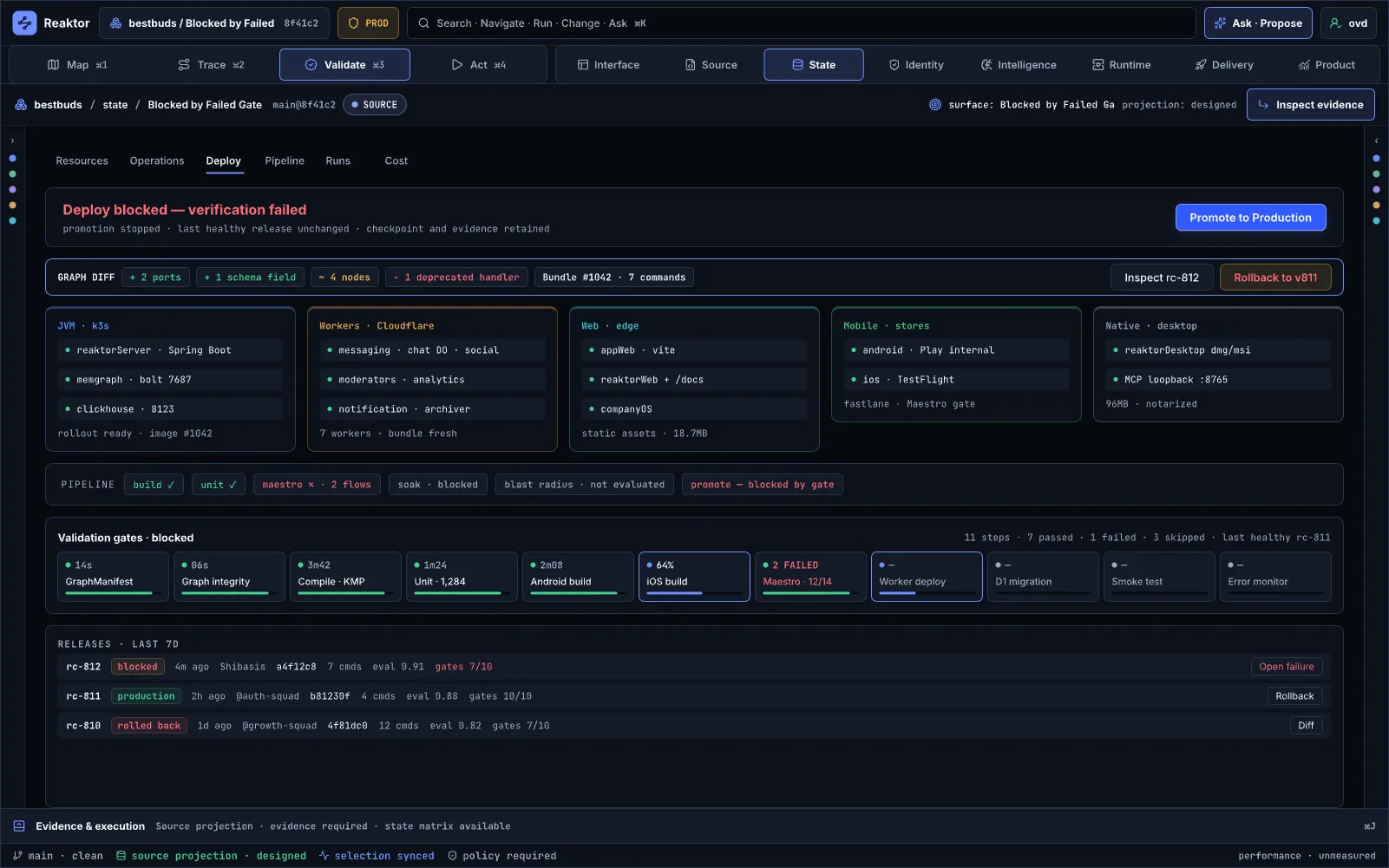
On the board. The 07.04 layout in a failed condition. Titled "Deploy blocked — verification failed" with "promotion stopped · last healthy release unchanged · checkpoint and evidence retained", and — jarringly — a primary button still reading Promote to Production. The GRAPH DIFF pane and all five target cards are byte-identical to 07.04, including rollout ready · image #1042 and 7 workers · bundle fresh on a blocked deploy. A PIPELINE strip reads build ✓ / unit ✓ / maestro ✕ · 2 flows / soak · blocked / blast radius · not evaluated / promote — blocked by gate. Validation gates · blocked shows 11 steps · 7 passed · 1 failed · 3 skipped · last healthy rc-811, with iOS build 64% and 2 FAILED / Maestro · 12/14. RELEASES · LAST 7D adds rc-812 / blocked / 4m ago / Shibasis / a4f12c8 / 7 cmds / eval 0.91 / gates 7/10 / Open failure.
Vision tie. blast radius · not evaluated is the single best string across all five states. It refuses to invent a number for something the run never reached, which is precisely the NotWiredYet principle applied to a runtime condition. Everything else on the board inherits 07.04's vision credit without adding to it.
Workflow tie. Opened by whoever tried to promote and by the on-call engineer who gets paged five minutes later. Today: a red GitHub check, a Slack alert, and a hunt through logs to find which of fourteen jobs failed and whether it matters.
Agentic tie. Open failure is the only action, and it goes to a human. The obvious agent task — two named Maestro flows failed, here is the diff that broke them, propose a fix or a quarantine — is not offered even though 06.05 offers exactly that shape for crashes.
Blueprint tie. A cook failure in Unreal, where the editor tells you which asset failed validation and refuses to package. The analogy is good and the board is weaker than the analogy, because Unreal names the asset and this names a count.
Replaces / augments. A red PR check, Argo CD's degraded state, Spinnaker's failed stage, PagerDuty change events.
Improvements.
- Disable or relabel
Promote to Production. A blocked board whose primary action is promote teaches the wrong reflex. It should readPromotion blockedand be inert, withOverrideas a separate, receipted, second-class action. - Name the two failed flows.
maestro ✕ · 2 flowsand2 FAILED / Maestro · 12/14never say which, which is the first thing anyone needs. - Grey the five target cards. They still advertise
rollout readyandbundle freshfor a deploy that will not happen. - Explain
iOS build 64%inside a run that is blocked. Either it is still running, in which case the run is not fully stopped, or it was abandoned, in which case it should say so. - Reconcile
7 passed / 1 failed / 3 skippedout of eleven with the release row'sgates 7/10. The denominator differs from the list on the same screen. - Add the
blocked atreceipt: which gate, which policy required it, who can override, and whether an override has been requested.
Verdict. Strengthen.
STATE · Deploy · Rollback Confirmation
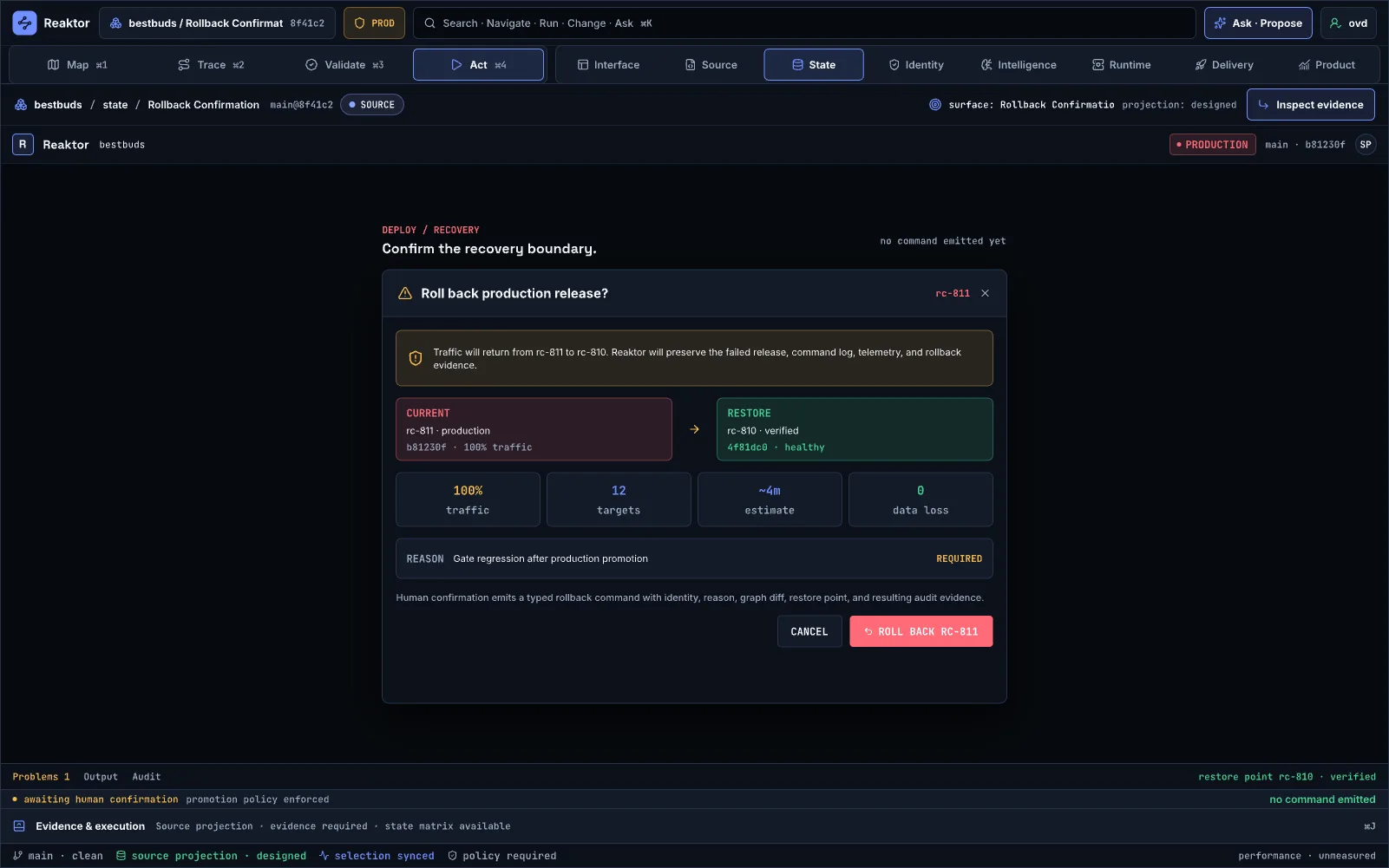
On the board. The only board in my cluster that changes application shell. Beneath the usual studio chrome sits a second application frame — R Reaktor / bestbuds / PRODUCTION / main · b81230f / SP — and a bottom bar reading Problems 1 · Output · Audit, which is the desktop IDE shell rather than the studio shell. The content is a confirmation dialog: section label DEPLOY / RECOVERY, instruction "Confirm the recovery boundary.", status no command emitted yet, and the question "Roll back production release? rc-811" with the body "Traffic will return from rc-811 to rc-810. Reaktor will preserve the failed release, command log, telemetry, and rollback evidence." Two comparison blocks: CURRENT / rc-811 · production / b81230f · 100% traffic and RESTORE / rc-810 · verified / 4f81dc0 · healthy. Four statistics: 100% traffic, 12 targets, ~4m estimate, 0 data loss. A REASON field reads "Gate regression after production promotion". A REQUIRED note states "Human confirmation emits a typed rollback command with identity, reason, graph diff, restore point, and resulting audit evidence." Actions CANCEL and ROLL BACK RC-811. Status line: restore point rc-810 · verified, awaiting human confirmation, promotion policy enforced, no command emitted.
Vision tie. The REQUIRED sentence is the right idea stated exactly once — a destructive act becomes a typed command carrying identity, reason, diff and restore point, which is the graph-command model applied to operations. The board then contradicts its own care by asserting 0 data loss as a certainty and by proposing a restore point the rest of the cluster records as failed.
Workflow tie. The single most stressful screen in the product: it is opened at 2am with a page in hand. Everything on it must be true, because nobody re-reads it.
Agentic tie. Correctly locked — an agent must never press this. But no command emitted yet and awaiting human confirmation describe a state an agent should be able to prepare: assemble the rollback command, fill the reason from the incident, and hand a human the confirm. That authorship handoff is not drawn.
Blueprint tie. None. This is an operations confirmation dialog and the Unreal analogy adds nothing.
Replaces / augments. The Argo CD rollback dialog, Spinnaker's manual judgement stage, kubectl rollout undo with a human in front of it.
Improvements.
- Fix the release identity. This dialog rolls back
rc-811torc-810; the blocked, running, complete and recovery boards are all aboutrc-812and namerc-811as the healthy restore point. As drawn it is a different incident bolted into the same sequence. - Stop offering a known-bad restore point.
rc-810isverified · healthyhere androlled back · 1d ago · eval 0.82 · gates 7/10on four other boards, with the same sha4f81dc0. - Replace
0 data losswith a computed reversibility statement per target. The plan contains+1 schema fieldand the recovery board runsReverse migrations; a forward migration on4.2M rowscannot promise zero loss. Show writes-since-promotion and which of them will be orphaned. - Replace
12 targetswith the five named targets from07.04, each withrevertible / partially / not revertible. Mobile in particular cannot be reverted; only what is served to it can. - Make the
REASONan editable required field, not a pre-filled label. TheREQUIREDnote says the reason goes into the command; the design must therefore capture it, andROLL BACK RC-811should stay disabled until it is present. - Show the receipt that will be produced, before it is produced — principal, approver, hash preimage — so the operator confirms an object rather than a sentence.
- Return to the studio shell. A modal must not change the host application.
Verdict. Rebuild.
STATE · Deploy · Production Rollout Running
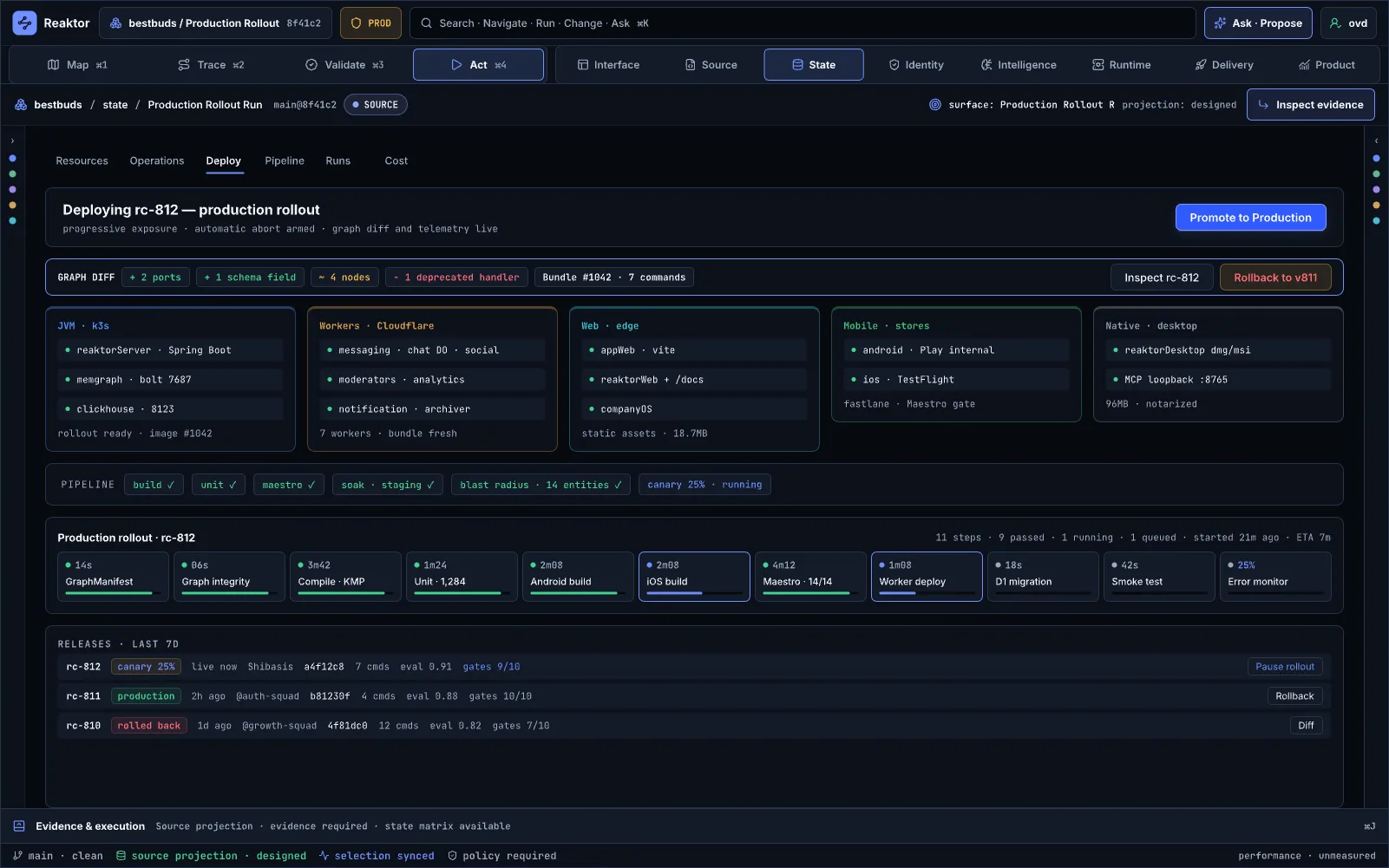
On the board. "Deploying rc-812 — production rollout" with "progressive exposure · automatic abort armed · graph diff and telemetry live". GRAPH DIFF and the five target cards are identical to 07.04 and to the other three full-shell states. The PIPELINE strip reads build ✓ / unit ✓ / maestro ✓ / soak · staging ✓ / blast radius · 14 entities ✓ / canary 25% · running. Production rollout · rc-812 reports 11 steps · 9 passed · 1 running · 1 queued · started 21m ago · ETA 7m over the same eleven rows, now with Maestro · 14/14 4m12, Worker deploy 1m08, D1 migration 18s, Smoke test 42s, Error monitor 25%. RELEASES shows rc-812 / canary 25% / live now / Shibasis / a4f12c8 / 7 cmds / eval 0.91 / gates 9/10 / Pause rollout.
Vision tie. Thin. The graph diff carries over from 07.04, but the rollout itself is drawn as an eleven-row job list, not as a graph being progressively swapped across five targets. The vision's whole claim is that a deploy is a graph transformation; a running rollout is where that should be most visible and it is least visible here.
Workflow tie. Watched, not used. A release manager leaves this open for twenty minutes while a canary bakes, glancing at it for the one signal that would make them press Pause rollout.
Agentic tie. This is the strongest case in the cluster for an agent that watches rather than acts: an agent monitoring the canary against a baseline and raising a halt recommendation is genuinely valuable and carries no irreversible authority. Nothing on the board admits an agent exists.
Blueprint tie. No editor analogue. Argo Rollouts and Spinnaker canary analysis are the real ancestors.
Replaces / augments. Argo Rollouts, Spinnaker canary, Play Console staged rollout progress, LaunchDarkly progressive delivery.
Improvements.
- Show what arms the abort. "automatic abort armed" names no threshold, no metric, no window and no baseline. Give it an
ABORT POLICYblock with the exact rule and its current margin. - Show exposure per target.
canary 25%is one number spanning workers, edge assets, a JVM image and two store channels that cannot possibly be at 25% in the same sense. - Add a live health pane. A rollout board with no error rate, no latency and no crash signal is a progress bar; the decision it exists to support needs the numbers.
- Distinguish deployed from activated. Worker deploy completing does not mean devices are running the new graph, and the board treats them as the same event.
- Reconcile
gates 9/10with11 steps. - Show the receipt that authorised this rollout, carried forward from
07.04.
Verdict. Strengthen.
STATE · Deploy · Complete and Healthy
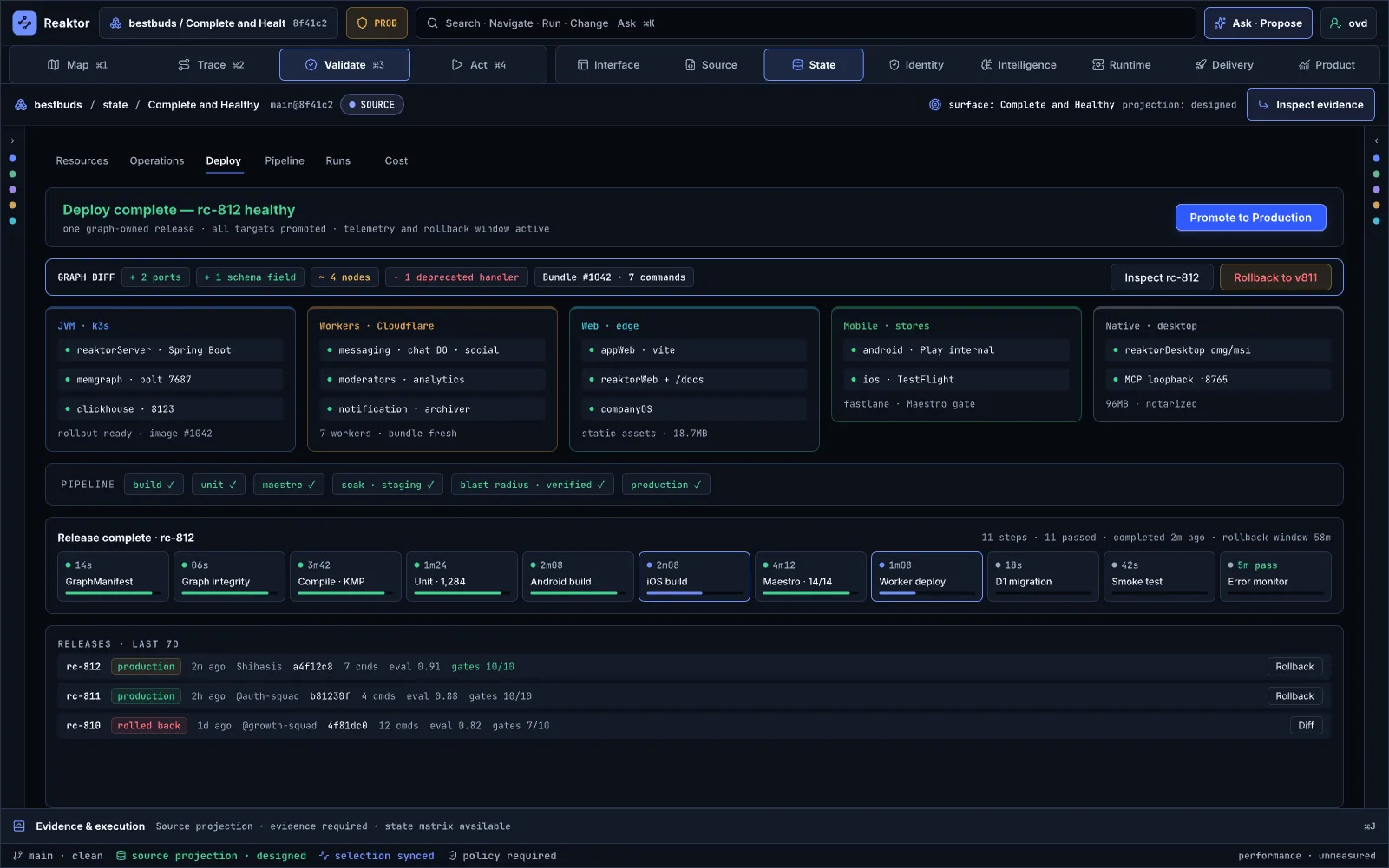
On the board. "Deploy complete — rc-812 healthy" with "one graph-owned release · all targets promoted · telemetry and rollback window active", and — again — a primary button reading Promote to Production on a completed deploy. Identical GRAPH DIFF and target cards. PIPELINE reads build ✓ / unit ✓ / maestro ✓ / soak · staging ✓ / blast radius · verified ✓ / production ✓. Release complete · rc-812 reports 11 steps · 11 passed · completed 2m ago · rollback window 58m, with Error monitor 5m pass. RELEASES shows rc-812 / production / 2m ago / gates 10/10 / Rollback.
Vision tie. "one graph-owned release" is a real claim and the board does not support it. If the release is graph-owned, the completed state should show the new graph as the live one, with the diff applied and the previous revision retained as a restore point. Instead it shows the same pre-deploy diff pane as the blocked and running states, so nothing on the board actually changes to reflect that the system is now different.
Workflow tie. Glanced at for ten seconds, then closed. Its real job is to be the thing linked in a Slack message saying "rc-812 is out".
Agentic tie. The natural moment for an agent to write the release note, close the linked tasks and record the receipt. No affordance.
Blueprint tie. None meaningful.
Replaces / augments. A green deploy notification in Slack, the Argo CD healthy state, a release page in GitHub.
Improvements.
- Retire the
Promote to Productionbutton on a completed deploy, and makeRollbackplusExtend rollback windowthe two live actions. - Resolve "all targets promoted" against
android · Play internalandios · TestFlighton the same screen. Internal testing and TestFlight are not production, and a twenty-one-minute mobile production rollout is not possible under store review. Either the mobile card must showawaiting review, or the thing that shipped to mobile was a pushed bundle — which is the board the atlas has not drawn. - Explain the
rollback window 58m. What ends at minute sixty, what becomes impossible after it, and why sixty. - Show the post-deploy graph.
+2 ports / +1 schema field / ~4 nodes / −1 deprecated handlershould now render as applied, with the previous revision reachable. - Add the receipt and the incident-free evidence that justifies the word "healthy" — five minutes of error monitor is a claim, and it should carry its window and its threshold.
Verdict. Strengthen.
STATE · Deploy · Recovery Complete
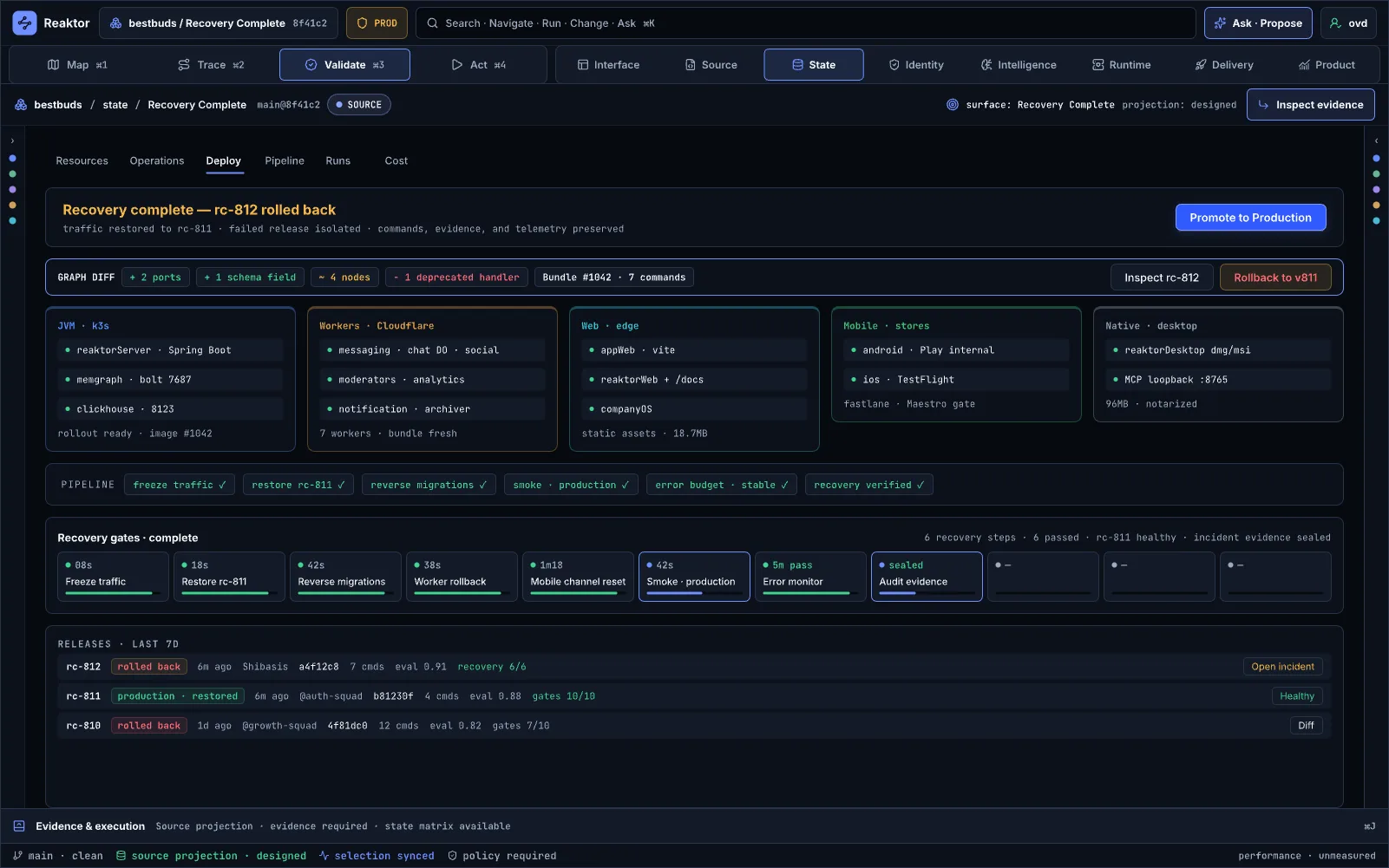
On the board. "Recovery complete — rc-812 rolled back" with "traffic restored to rc-811 · failed release isolated · commands, evidence, and telemetry preserved". The GRAPH DIFF and five target cards are again unchanged from 07.04, still advertising rollout ready · image #1042 after the rollout was reversed. The PIPELINE strip becomes a recovery strip: freeze traffic ✓ / restore rc-811 ✓ / reverse migrations ✓ / smoke · production ✓ / error budget · stable ✓ / recovery verified ✓. Recovery gates · complete reports 6 recovery steps · 6 passed · rc-811 healthy · incident evidence sealed over a list of eight named entries plus three blanks: Freeze traffic 08s, Restore rc-811 18s, Reverse migrations 42s, Worker rollback 38s, Mobile channel reset 1m18, Smoke · production 42s, Error monitor 5m pass, Audit evidence sealed, then — — —. RELEASES shows rc-812 / rolled back / 6m ago / recovery 6/6 / Open incident, rc-811 / production · restored / 6m ago / Healthy, rc-810 / rolled back / 1d ago.
Vision tie. Mobile channel reset is the one string in the entire cluster that acknowledges mobile cannot be rolled back the way a worker can — you reset the channel, you do not un-install the binary. That is the correct model and it appears once, unexplained. Otherwise the board asserts a clean, total, ninety-second recovery of a five-target distributed system, which is the opposite of what the vision's honesty principle demands.
Workflow tie. Read the morning after, during the incident review, by people deciding what to change. It is therefore the board most likely to be treated as the factual record, which makes its inaccuracies costly.
Agentic tie. Open incident is the only action. An agent should be writing the incident timeline from the sealed evidence here; nothing invites it.
Blueprint tie. None.
Replaces / augments. An incident timeline in PagerDuty or incident.io, a post-mortem template, the Argo CD rollback history.
Improvements.
- Fix the three conflicting enumerations of one recovery. The header says six steps, the
PIPELINEstrip names six different labels, and the gate list shows eight named rows plus three blanks. - Make
Reverse migrations ✓ 42shonest or remove it. The plan added a schema field and07.02reports the migration touching4.2M rows; a reversal is either lossy, long, or impossible, and stating it as a forty-two-second tick is the boldest false claim in my cluster. - Add an
UNRECOVEREDpane. A real recovery leaves residue: writes made against the new schema, devices still on the old bundle, workers in another region that did not acknowledge. The honest board has a section for what did not come back. - Grey the plan diff and the target cards, or replace them with the restored state. Advertising
rollout ready · image #1042after a rollback is actively misleading. - Make
incident evidence sealedan object with a hash, a principal and a link, matching thesha256:8dd4…c11areceipt grammar on07.04. - Reconcile
rc-810here (rolled back) with the rollback dialog that offers it asverified · healthy.
Verdict. Rebuild. The honest version of this board is a different shape — partial recovery, per-target outcomes, an unknown column — not the same shape with corrected numbers.
Focused judgements
1. The CI contradiction on 07.02
07.02 · Ship · Pipeline depicts a twelve-stage pipeline for rc-812 that started 14m ago with an ETA 5m, twelve wall-clock durations, and stage results down to 74% coverage and drift 0.0%. The audit is unambiguous that none of this can have happened: the framework's only workflow file is entirely commented out, BestBuds' Dagger pipeline is workflow_dispatch-only, and there are no git tags. There is no event that starts this pipeline, no record of it having run, and no branch protection that would require it. This is the sharpest planned-versus-built gap in my cluster, and it is worse than a fictional number because it is a fictional process — a reader takes away that the project has continuous integration, which changes how they read every green tick elsewhere in the atlas.
Two of the twelve stages are additionally untethered even from the project's own intentions. Keploy replay / 8 recordings · all match and Visual snapshots / 1 baseline drift · OnboardingScreen.light describe tooling the audit does not find, and AI guardrails / 412 redteam cases · 100% block asserts a perfect block rate against a moderation layer the audit reports as failing open (S-* security findings). A board claiming a hundred per cent redteam block sits in the same file as an audit finding that moderation fails open.
What the board should show today. Keep the twelve stages, because they are the right target state, and change what the board asserts about them. Add a TRIGGER line under the title reading manual dispatch only · no push trigger · no required checks · 0 tags. Give every stage a provenance class rather than only a status: RUNS TODAY for the Dagger targets that actually execute, DEFINED · NOT TRIGGERED for Gradle tasks that exist but nothing invokes on push, and NOT BUILT for the rest. Delete every duration and replace it with an empty RunRef slot carrying EmptyReason · no run recorded. Replace 142 tests · 0 failures · 74% coverage with the module ledger the audit supports: three modules execute JVM tests, twelve of thirty have none, coverage is not measured, and a green build additionally proves app compilation plus roughly fifteen source-text conventions. That last fact — that "green" currently means something much smaller than it appears — is the most useful thing this board could tell anyone, and it is the one thing it does not say.
What it should show after L0. L0 is exactly the work that makes this board stop lying, which is a good argument for prioritising it. Afterwards the board gains four things it cannot have now: a real trigger matrix (push, pull request, tag, nightly) crossed with branch; a required-checks pane tied to branch protection, so a red stage genuinely blocks a merge; a hygiene stage group (format, licence headers, API dump and binary-compatibility validation, dependency lock, generated-code drift) which is the substance of L0 and appears nowhere in the atlas; and a tags-and-versions pane whose current honest content is zero rows. At that point started 14m ago becomes a real RunRef with a run id, and the stage durations become measurements. I would also split the board at that point: the trigger matrix, required checks, hygiene and tags belong on a new 07.05 · Ship · Continuous Integration, and 07.02 becomes the run view of one execution of the pipeline that 07.05 proves exists.
2. 06.05 as the honesty exemplar, and how to systematise it
06.05 does four things no other board in my cluster does. It declares its scope up front: DESIGN FIXTURE · synthetic + redacted shadow samples. It suffixes each aggregate individually — 141 pass · fixture, Replays · 142k · fixture, Drift-free · 99.4% · fixture — so a number cannot be lifted out of context. It names the missing plumbing in the policy line: policy · synthetic only · identifiers redacted · no production PII · adapter not wired. And it states a rule for unknowns: "aggregate green is blocked when a required harness is unknown". That fourth item is the most important sentence in the atlas about verification, and it exists only as prose on one board.
It also demonstrates precisely why hand-typed honesty fails. The discipline lapses within the same board: the third pane, CRASH GROUPS · CRASHLYTICS + SENTRY · LINKED TO ACTIVE DEPLOY, asserts 412 users · 1842 sessions, 14 sessions and 22 users with no marker at all, under a header claiming two live vendor integrations. Nothing propagated the fixture scope into that pane because nothing could — the marking is a string style, so it depends on the designer remembering. Worse, none of it is queryable: you cannot ask the atlas "show me every fixture number" or "show me every unwired adapter", which is the whole point of having a component vocabulary in the first place. And the shadow row POST /auth/google · error · 500 renders a fixture failure identically to a production incident.
How to systematise it, in five moves.
First, make the truth class a property of the number, not of the prose. Define a fixed lattice — Observed, Recorded, Derived, Fixture, NotWiredYet — and require every numeric text style in Machine Signal to carry one, the way every fill must carry a colour token. A number without a truth token should fail the design lint exactly as an off-palette hex does. That is the mechanism that turns 2.5% vocabulary usage into 100%.
Second, make the banner a propagating scope rather than a caption. A FixtureScope wrapper should mark the board's rule and render every descendant number with the fixture treatment automatically. This one change fixes 06.05's own third-pane lapse and would fix the forty-nine boards that assert five or more numbers with no provenance marker.
Third, upgrade adapter not wired from a phrase to an EmptyReason with a required "what would make this real" field. 06.05 should read adapter not wired · needs: shadow-traffic tap in reaktorServer + 1% sampler. 13.01 already says the same thing in different words (OBSERVED · UNKNOWN · live adapters absent); unify the wording so one query returns every unwired adapter in the product, which is then a build backlog.
Fourth, promote "unknown blocks green" from a sentence to the arithmetic behind every aggregate in the atlas. Under that rule, 07.02's 7/12 pass and 094's gates 9/10 both become amber, because several of their inputs are unknown rather than passing. That result is uncomfortable and correct, and it is the difference between a dashboard and evidence.
Fifth, add a FIXTURE LEDGER pane — on 06.05 first, then as a standard board footer — listing each fixture value alongside the real source that will replace it and the ticket that wires it. That converts the honesty marking from an apology into a work plan, which is the only form of honesty that gets fixed.
3. Where the verification ladder belongs
The vocabulary check confirms the ladder is genuinely absent: lincheck, fuzz, property test, model check, differential, counterexample and defect return nothing across all 104 boards; fingerprint appears twice and neither is the keystone; invariant appears twice, both in North Star boards. My cluster owns the words "validate" and "ship" and hosts none of the concepts.
Allocation. L0 belongs to Section 07 and only to Section 07, because CI, hygiene, required checks, tags and API-stability tooling are delivery mechanics. Everything above L0 is not delivery.
L1, L2 and the replay half of L5 belong in Section 06, because they are things a developer authors and runs at their desk in seconds. Invariants are written next to the node they constrain; property tests and lincheck runs are pre-push activities; and replaying one failing deterministic seed is a debugging activity for which 06.04's causal waterfall is already the right viewer.
L3 protocol model checking and L4 Lean proofs belong in neither, and neither does the standing invariant register, the defect ledger D-1…D-n, or the fingerprint keystone. These are a body of evidence with their own lifecycle — a proof stays valid until a definition changes, which is a dependency relationship, not a pipeline stage. They need a new Section 14 · Assurance with four surfaces: Invariant Register, Defect Ledger, Model Checking, and Proofs. I would not fold them into Section 03 (Govern · Extend · Scale), which is about system evolution and would swamp them, nor into Section 09 (State & Trust), which is about runtime identity and data.
The two boards I would build in my cluster.
06.06 · Validate + Source · Invariants & Counterexamples. Five panes. INVARIANT LIST scoped to the current selection, each row an INV-… with its statement in prose, the nodes it constrains, the checker that enforces it (lincheck, property, model, proof, or none), and its last run — with none as the honest majority value today. COUNTEREXAMPLE showing a minimised failing schedule or input rendered on the same waterfall grammar 06.04 uses, so a concurrency counterexample reads as an interleaving of port invocations rather than a stack trace. SHRINK HISTORY showing how the minimiser got from the original failure to the minimal case, which is what makes a property-test failure comprehensible. SEED & REPLAY with a seed, a tick count and a replay action, which is the L5 inner-loop affordance. INVARIANT COVERAGE BY MODULE, whose honest content today is that most of thirty modules have zero invariants and twelve have zero tests. This board's headline figure should be open defects by class, not a pass count — D-6 · port type identity unsound deserves to be the largest number on a Reaktor validation board.
06.07 · Validate + Runtime · Conformance & Fingerprint. Four panes. ORACLE PAIRS for Kotlin against C++ against TypeScript on FlexBuffers, which is the one place the audit says real evidence exists — a differential C++ oracle, an adversarial suite and physical-device runs. CORPUS describing the adversarial inputs, the generation strategy and the last device run with device and build named. DIVERGENCES listing input, both outputs and the byte diff. FINGERPRINT showing the keystone for the current selection: port type identity, codec layout identity and FFI method identity side by side, with a conflict marker when they disagree — which is D-6 made visible in the one place it would change behaviour. This board is what would let 13.03 · Extend · FFI Switchboard move from asserting "native parity not yet proven" to showing the proof arriving.
Finally, 06.05 needs re-scoping to make room. It currently merges required gates, shadow traffic and crash groups, three things with different owners and different truth classes. Gates and coverage stay; shadow traffic moves to a Runtime-instrument board; crash groups merge into 10.04 · Observe · Errors, which already carries the same crash under a different filename.
4. Graph code push
Section 07 does not depict code push at all, and neither does any other board. The phrase returns zero hits across all 104 boards. Hermes appears exactly once, in 05.00, as a colour in a deploy-target legend — "Every node is colored by deploy target — JVM, Worker, Web, Hermes, Native" — which acknowledges the runtime and never says what it is for. The nearest approach is 07.03's FEATURE FLAGS · CONFIG ACTOR · RUNTIME, NO REDEPLOY, and it is a different capability: a flag selects between code paths that already shipped, whereas code push replaces the paths. 07.04's Bundle #1042 · 7 commands borrows bundle language but binds it to store channels (android · Play internal, ios · TestFlight), which is the opposite arrangement.
The omission matters more than a missing feature board usually would, for two reasons. First, it is the release-management consequence of the entire thesis: if the graph is alive at runtime and subgraphs are marked, then a subgraph is the unit of release and the store binary becomes a host rather than the product. Every board in Section 07 models a release as a whole-app artefact promoted through store channels, which is the pre-graph model. Second, the atlas is already leaning on the capability without naming it — 095 claims a completed production rollout twenty-one minutes after start with TestFlight on the mobile card, which is only defensible if what shipped to mobile was a pushed bundle.
The board. 07.06 · Act + Delivery · Graph Code Push, six panes.
PUSHABLE SURFACE renders the product graph with marked subgraphs highlighted and everything else dimmed, each marked subgraph annotated with its boundary ports and the revision since which that boundary has been frozen. The central assertion of this pane is that the boundary, not the code, is what governs.
BOUNDARY CONTRACT shows, for the selected subgraph, the typed ports a pushed bundle may touch, the capabilities it may request, and the explicitly denied set — native modules, storage schema, auth. This pane must display the port fingerprint, and today it must display it as unsound: with D-6 open, string-built ports carry a null class, so the boundary check that governs what a pushed bundle may touch does not currently hold. One honest row here makes the case for the fingerprint keystone more forcefully than any assurance board could.
BUNDLE carries bundle id, size, Hermes bytecode version, source graph revision, signature, compatible host binary versions, and the target engine per platform — including the honest answer for JVM and Native, where there is no JS engine, expressed as a capability tier: code push: full / flags-only / none. This is where the adapter-and-capability idea earns its place in Section 07.
ROLLOUT shows staged exposure by cohort with the distinction the docs demand. A pushed bundle's activation is a remote outcome the server cannot observe directly, so this pane shows four separate device-side counts — pushed, fetched, activated, reverted — plus unknown as a first-class fifth value, never a single "deployed" percentage.
REVERT shows the pinned last-good bundle, the automatic revert-on-crash-rate rule with its threshold, and the case that must be visible: the offline device still running the bad bundle, counted as unknown rather than as reverted.
APPROVAL reuses 07.04's receipt verbatim, because a code push is a production change with a smaller blast radius rather than a lesser one, plus a store-policy row recording what platform rules permit to be pushed.
The board opens today under a NOT BUILT banner naming the five missing pieces — subgraph marking, bundle format, host loader, boundary enforcement, revert — which makes it a Vision board and an unusually specific roadmap.
5. Are these the right five deploy states?
They are the right skeleton and the wrong set. The five cover blocked, confirm-rollback, rolling out, complete, recovered — one failure and four points on a clean path. The states that a five-target polyglot system spends most of its time in are missing.
Missing state: partially applied. The five targets deploy independently. Workers can succeed while the k3s image fails and mobile sits in review. There is no board for "three of five targets on rc-812, two on rc-811", and given the audit's finding that the distributed plane has no queues at all and every pipeline is waitUntil fire-and-forget, partial application is not an edge case — it is the expected outcome of any multi-target deploy. This is the most consequential gap in the set.
Missing state: outcome unknown. The docs say the system should not pretend it knows a remote outcome. Every one of these five states resolves. There is no board where a target's result never came back and the system says so.
Missing state: rollback not possible. The audit says rollback is only sometimes possible. The set contains a rollback confirmation and a recovery success, and nothing for the case where the plan's +1 schema field has been written against for forty-one minutes and the honest answer is "you can roll back the workers, you cannot roll back the data, here is the choice you actually have".
Missing state: awaiting store review. Mobile appears on all five boards as android · Play internal / ios · TestFlight, and no state acknowledges that mobile's clock runs in days.
The receipt chain. The Symphony Contract promises that human and agent changes share one patch → plan → receipt path. The receipt appears exactly once in my cluster, on 07.04: PlanApproved / plan_8dd4 · actor alice · approver bob / independent · expires 9m / sha256:8dd4…c11a · reason attached · rollback proven · one use. That is well designed — independence, expiry and single use are the three properties an approval object needs. It then vanishes. 094, 095 and 096 never say which receipt authorised the rollout that is running, completed or was reversed; 096 says incident evidence sealed with no hash, principal or link. 093 promises that "Human confirmation emits a typed rollback command with identity, reason, graph diff, restore point, and resulting audit evidence" and provides no field to type the reason into, no principal beyond an SP avatar, and no approver at all — so the most irreversible action in the product has the weakest approval chain in the cluster. The chain therefore breaks at exactly the point it exists to protect. The fix is a persistent receipt rail on all five states showing the receipt that authorised the current state with its principal, approver, expiry and single-use status, and on 093 a required free-text reason bound into the hash preimage before ROLL BACK RC-811 becomes enabled.
Is rollback depicted honestly? No, in three specific ways. 093 asserts 0 data loss and ~4m estimate as flat facts about a plan containing a forward schema change, and 096 ticks Reverse migrations ✓ 42s against a migration 07.02 describes as touching 4.2M rows. 093 says 12 targets where 07.04 says five. And 093 proposes restoring rc-810 as verified · healthy while four other boards in the same cluster record rc-810 — same sha, 4f81dc0 — as rolled back · 1d ago · eval 0.82 · gates 7/10. A rollback dialog offering a known-bad release as the healthy restore point is the precise failure the atlas exists to prevent, and it is drawn in the atlas.
The one honest note in the whole rollback story is 096's Mobile channel reset, which quietly concedes that mobile is reverted by changing what is served rather than by un-installing anything. That concession should be promoted into the design: per-target reversibility on every rollback surface, with three values — revertible, partially revertible, not revertible — and an explicit unknown for anything remote.
Cluster findings
Missing panes.
07.05 · Ship · Continuous Integration— trigger matrix, required checks, hygiene gates, tags and a first-green ledger per module. §2 says no CI exists, no tags and no API-stability tooling, and the atlas currently has no surface where that absence is visible;07.02actively conceals it.07.06 · Act + Delivery · Graph Code Push— §1 names graph code push a load-bearing capability and the atlas mentions it zero times, while095implicitly depends on it to claim a twenty-one-minute mobile production rollout.06.06 · Validate + Source · Invariants & Counterexamples— hostsL1,L2andL5replay. §3 of the brief records thatlincheck,property test,counterexampleanddefecteach appear zero times atlas-wide.06.07 · Validate + Runtime · Conformance & Fingerprint— hosts the differential oracle, which §2 identifies as the project's only genuinely strong evidence, and the fingerprint keystone that unifies port type, codec layout and FFI method identity.STATE · Deploy · Partially Applied— five targets deploy independently and §2 says the distributed plane has no queues, so partial application is the default outcome and is not drawn anywhere.STATE · Deploy · Outcome Unknown— the rule that the system must not pretend to know a remote outcome has no depiction; every existing state resolves.STATE · Deploy · Rollback Not Possible— §2 says rollback is only sometimes possible; the cluster only draws rollback succeeding in ninety seconds with zero data loss.07.07 · Ship · Store Channels & Review— mobile is on every target card asPlay internalandTestFlightwhile four boards claim production completion in minutes; store review is the one deploy constraint no gate can compress.- A board behind the
Logstab. All nine Section 06 and 07 boards render the sub-navPreview · Devices · Testing · Pipeline · Releases · Recorder · Traces · Logs · Source, andLogsleads nowhere;Testingleads to06.05, which is breadcrumbed underdeliveryrather thaninterface, so the tab and the board disagree about where it lives.
Seams.
The cluster contains two different sub-navigations and swaps between them without warning. 06.01–06.05 and 07.01–07.03 use the delivery set (Preview · Devices · Testing · Pipeline · Releases · Recorder · Traces · Logs · Source); 07.04 and the four full-shell deploy states use the runtime set (Resources · Operations · Deploy · Pipeline · Runs · Cost) borrowed from 13.01. The word Pipeline appears in both sets meaning two different things, and moving from 07.03 to 07.04 silently replaces the entire navigation the user was using.
One release candidate has two incompatible pipelines. 07.02 shows twelve stages including Unit tests / 142 tests and Maestro flows / 21/22; 07.04 and all four full-shell states show eleven steps including Unit · 1,284 and Maestro · 14/14, and 092 shows Maestro · 12/14. Same rc-812, three Maestro denominators and two unit-test counts. Neither list mentions the other exists.
Two version namespaces coexist. 07.03 uses v811 / v812 / v813-rc; everything else uses rc-810 / rc-811 / rc-812. 07.04 contains both, with Rollback to v811 eight lines above rc-811 · production.
Gate denominators disagree with gate lists. Every releases row reports gates 10/10, gates 9/10 or gates 7/10 while the gate list on the same board has eleven rows and the header counts eleven steps.
093 changes application shell mid-flow, nesting a second R Reaktor / bestbuds / PRODUCTION frame with a Problems 1 · Output · Audit bar inside the studio chrome. It also rolls back a different release (rc-811 → rc-810) from the one the surrounding states are about (rc-812 → rc-811), and offers as verified · healthy a release the other four states record as rolled back.
The receipt appears once and disappears where it matters, and the board revision never connects to the release revision: all fourteen boards carry main@8f41c2 in the chrome while releases carry b81230f, 4f81dc0 and a4f12c8. The contract's promise that revision survives every movement is drawn in the chrome and not wired to the content.
Agent affordances stop at the section boundary. Propose with Agent on 06.01 and Send to Agent on 06.05 are the only two in fourteen boards; nothing in Section 07 or any deploy state admits an agent exists. That may be correct policy for irreversible actions, but the boards should show the lock as a permission chip rather than expressing it by omission.
Crash-group identity differs across boards: 06.05 says ChatScreen.kt:142 and 10.04 says ChatActor.kt:142 for the same NullPointerException in the same release.
06.02's storyboard shows six screens and its coverage pane lists five; /friends/{id} has no coverage row, so the board's own honesty about untested routes stops one route short.
Finally, every board's status bar reads source projection · designed, policy required and performance · unmeasured, which is honest, while panes inside those same boards read LIVE · runtime · 2s and observed preview. The chrome tells the truth and the content contradicts it, on the same screen, fourteen times.
Honesty audit.
Ten of fourteen boards assert substantial unmarked invented data. 06.01 stamps two panes LIVE · runtime · 2s and captions a third observed preview ... fresh 2s on a board whose own header says projection: designed; the honest version marks the component tree DERIVED · source — it is computable today — and marks 142 ms and 72ms as NOT WIRED · no span adapter. 06.02 presents per-route traffic (8.2k, 12k, 24k, 5.3k, 4.1k) as fact for an app in internal testing with no analytics adapter; the honest version keeps the route topology as derived, moves traffic to a column with an explicit unwired state, and derives flow coverage from the Maestro files that do exist — which would show far more red. 06.03 presents rec_0042 and eleven captured steps with no marking at all and no evidence a recorder exists. 06.04 asserts a seven-span waterfall and provider=apple · session issued · 201 with no span collector behind it, and contradicts itself on module count (5 modules in the pane, 6 modules in the footer); its blast radius, by contrast, is genuinely computable and should be marked derived, splitting the board honestly in half.
06.05 is mostly honest and loses the thread in its third pane, where 412 users · 1842 sessions sits unmarked under a header claiming Crashlytics and Sentry are linked to the active deploy. 07.01 asserts hot reloads identically on five structurally different platforms; the honest version is a capability tier per device, which is also the version the vision demands. 07.02 is the least honest board in the cluster and the reasons are set out above. 07.03 asserts crash-free 99.4% · p95 61ms, 412 ev, retention −3.1pt and served 8d with no crash or analytics adapter, and describes an automated production intervention (guardrail auto-kill) with no visible rule.
Among the deploy states, 092 is the most honest — blast radius · not evaluated is a model refusal — while 093 asserts 0 data loss, ~4m estimate and 12 targets, and 096 asserts Reverse migrations ✓ 42s, 6 recovery steps over an eight-row list, and incident evidence sealed with no artefact. 095 claims all targets promoted on a screen that also says Play internal and TestFlight.
One structural tell runs through all of it. The digits 42 and 142 recur far past coincidence: 142 ms trace total, AuthService 142ms, 142 tests, migration 142ms, 142k replays, POST /chat/sync 142ms, ChatScreen.kt:142, 142 friends, 412 users, 412 ev, 412 redteam cases, rec_0042, 00:42, migration 0042, 42s three times, Errors · 42, 42/60 checks. These are one designer's house numbers reused as if measured, which is a useful diagnostic: wherever the same figure appears in unrelated units, no adapter was ever consulted. A FixtureScope that propagates and a truth token required on every numeric style would surface all of it mechanically, and would turn the atlas's most persuasive quality — that it looks like a real product — from a liability back into an asset.
Part 9 · Section 08 and 12 — Agent Operations and AI Engineering
Twelve boards: 08.01–08.05, 12.01–12.07. Cross-read for context: 01.04 Agent OS, 03.01 Visitor Lab, 04.02 Semantic Graph Editor, 07.04 Deployment Plan & Gates, 09.05 Governed Migrations, 10.01 Spans & eBPF, 11.04 Optimize Costs, and the two section covers.
0. The two planes, and which board belongs to which
There are indeed two different products in this cluster, and the atlas does not separate them cleanly.
Plane (a) — agents that operate on Reaktor. An AI reads the live graph, proposes a typed patch, and a human or a policy gates it. Boards: 08.01, 08.02, 08.03, 08.04, 08.05. The capability grammar for this plane does not live in section 08 at all — it lives in 03.01 Govern · Visitor Lab, which is the only board anywhere that names a principal (agent:codex · role:graph-auditor · session scoped), an allow set, a preview-only set, and a denied set (apply · deploy · secret access · self-approval), with capability expires with session.
Plane (b) — AI features inside a product built with Reaktor. Model routing, RAG, prompts, evals, guardrails for the app a customer ships. Boards: 12.02, 12.03, 12.04, 12.05, 12.07.
The conflation is real and it is concentrated in 12.01. That board's model roster is plane (a) spend: codex-5 · implementation · push+apply+tests · $61 · 24h, claude-sonnet-4.7 · critic · review-only · blocks apply · $38 · 24h, gemini-2.5-pro · cross-codebase ops · dep bumps · $19 · 24h. Those are the agents from 08.02's filter chips (claude codex gemini shepherd), priced on an AI-engineering board, and their spend is rolled into the same $124 · 24h chip as the product's llama-guard-3-8b moderation gate. One board, one budget line, two planes. 12.06 leaks the other way: its ask · sonnet-5 · grounded in cells 1–2 cell drafts SetProperty(matching.threshold, 0.68), which is a plane-(a) mutation proposal sitting in a plane-(b) section.
12.06 is in fact a third thing. Its content is product analytics — SQL over matches JOIN outcomes, a threshold knee study, a retention chart. Only one of its three cells is AI. It belongs with 11.05 Reports and 09.04 Data Studio.
Is the split coherent, and should both live in one atlas? They should live in one atlas, because both are governed change over one graph and the atlas's whole argument is that there is only one governance path. But they should not be two peer sections of equal weight. Plane (a) is who may change the system and how — it is a governance concern and belongs adjacent to 03 Govern, 04 Graph and 07 Ship, sharing their plan-and-receipt objects. Plane (b) is a subsystem of a product like any other, and 12.03 makes the argument for dissolving its own section: "chain = graph nodes · same command grammar as everything else / AddChainNode / ConnectPorts / SetProperty — reviewable, hot-swapped". If that sentence is true, an LLM chain does not need its own IDE any more than a repository does. Section 12 should be 04 (graph), 10 (observe) and 11 (learn) filtered to kind:llm, not a parallel studio with its own twelve-tab chrome, its own trace board, its own cost tiles and its own notebook list. Keeping it as a separate section is the atlas conceding that AI is special, which is the opposite of the thesis.
Board entries
08.01 · Agent · Conductor, Session & Critic
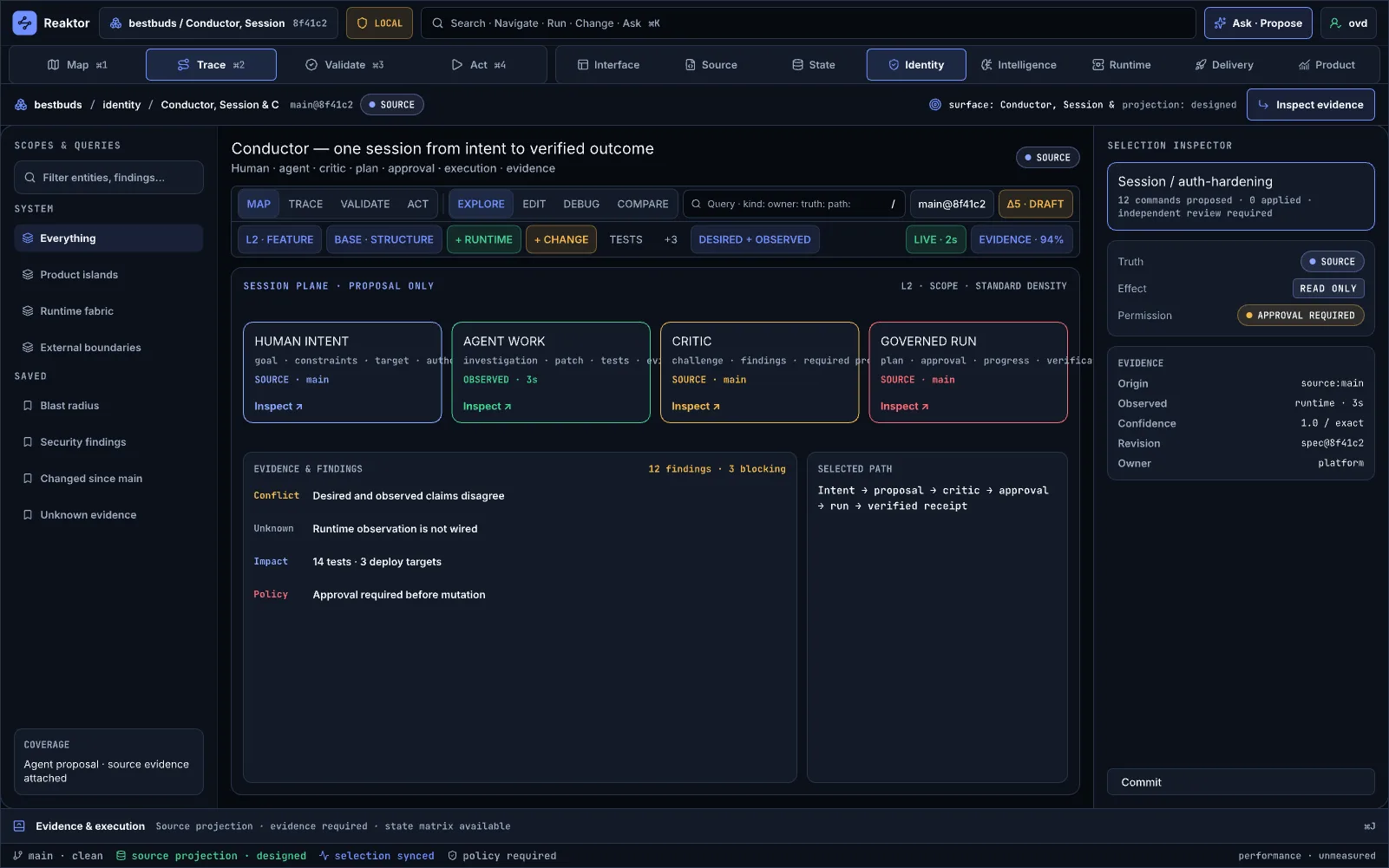
On the board. This uses the four-quadrant SCOPES & QUERIES shell from the 04-series, not section 08's tab strip. The four panes are HUMAN INTENT (goal · constraints · target · authority), AGENT WORK (investigation · patch · tests · evidence), CRITIC (challenge · findings · required proof · verdict) and GOVERNED RUN (plan · approval · progress · verification · receipt), under the banner SESSION PLANE · PROPOSAL ONLY. Beneath sit EVIDENCE & FINDINGS (12 findings · 3 blocking, with Conflict / Unknown / Impact / Policy rows), SELECTED PATH (Intent → proposal → critic → approval → run → verified receipt) and a SELECTION INSPECTOR reading Session / auth-hardening · 12 commands proposed · 0 applied · independent review required with Truth SOURCE, Effect READ ONLY, Permission APPROVAL REQUIRED.
Vision tie. Agents as first-class operators, and visitors. It states the separation of authority correctly in words — propose, critique, approve, run, receipt — but it depicts a policy diagram, not an instrument. Four labelled boxes with subtitles carry no session content: no intent text, no patch, no finding, no verdict.
Workflow tie. A senior engineer opens this after delegating a hardening epic, wanting one pane that shows what the agent did and whether the critic cleared it. Today that is a Claude Code transcript in one terminal, a GitHub PR in a browser tab, and a Slack thread, with no shared object between them.
Agentic tie. An agent reads nothing here, because nothing is enumerable. The thing it should read is the critic's required proof as a machine-checkable obligation set — a list of proofs it must produce before the plan seals. As drawn, "required proof" is a subtitle.
Blueprint tie. Closest to a code-review gate on a Blueprint changelist rather than to any Unreal surface. Unreal has no critic and no notion of a non-human author, so the analogy breaks at exactly the point this board is about.
Replaces / augments. Claude Code and Cursor agent transcripts, GitHub PR review, Devin's session view, Linear issue detail.
Improvements.
- Replace the four static quadrants with a SESSION TIMELINE pane: columns Time / Actor / Act / Effect / Evidence, reusing 08.05's audit row shape so one row type serves both boards.
- Add a PATCH pane that renders the "12 commands proposed" with before/after values and a
plan_xxxxchip, so "0 applied" becomes inspectable rather than asserted. - Turn CRITIC into a CRITIC OBLIGATIONS list: each finding as a proof obligation with state
unmet / met / waived, each met one linking to the run that satisfied it. - Add an INTERRUPT & STEER control with a reason field. Every competing agent product has stop-and-redirect; nothing in section 08 does.
- Change
Truth: SOURCEtoUNKNOWN · not wiredto match 01.04, and dropConfidence 1.0 / exactwhile the same board's findings block saysUnknown · Runtime observation is not wired. - Replace the shared
12 findings · 3 blocking / 14 tests · 3 deploy targetschrome with counts belonging to this session.
Verdict. Rebuild as a session transcript. As drawn it is 01.04 North Star · Agent OS with four subtitles reworded, one banner changed and the truth mark downgraded from honest to false.
08.02 · Agents · Kanban Orchestration
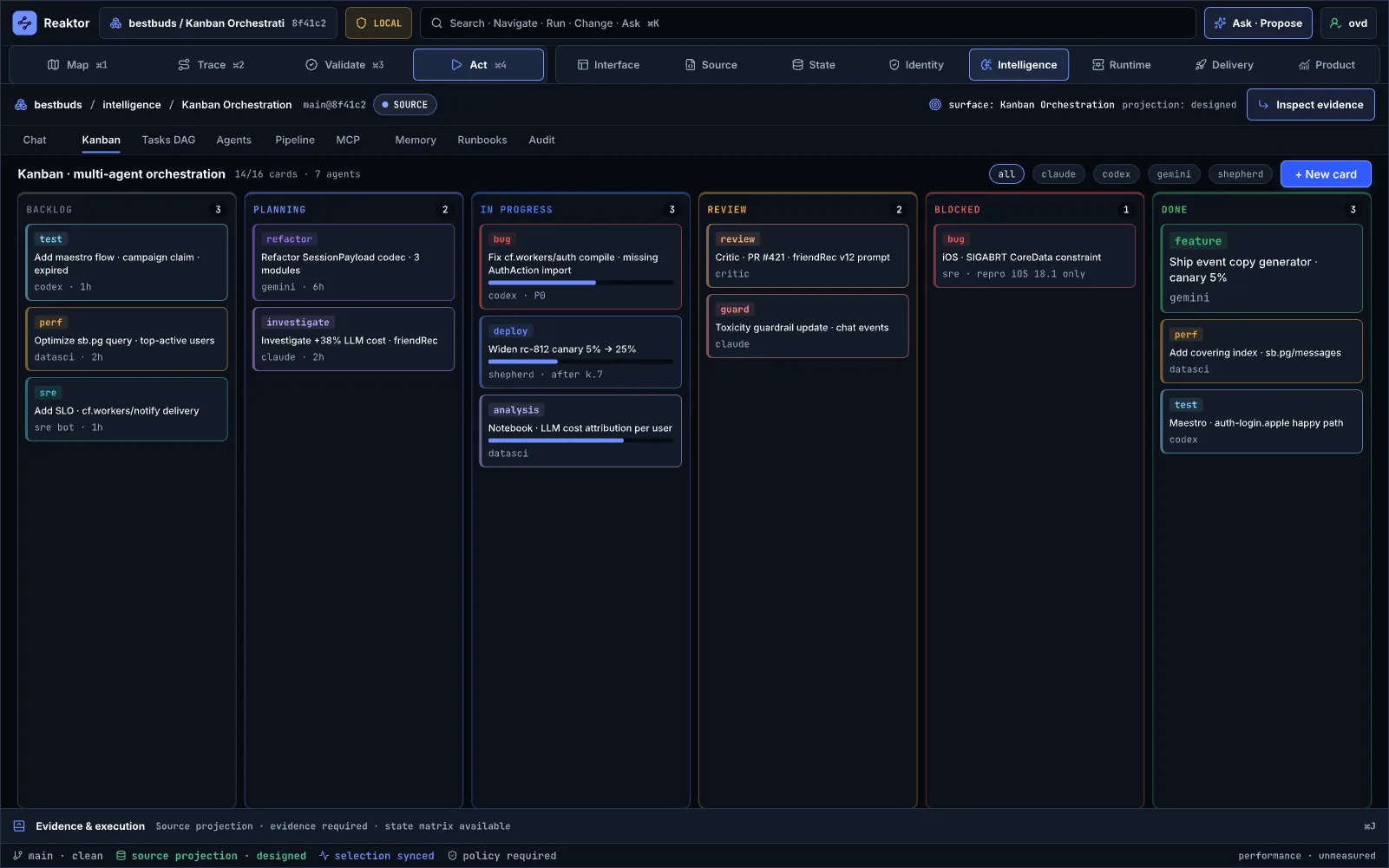
On the board. Section 08's tab strip (Chat · Kanban · Tasks DAG · Agents · Pipeline · MCP · Memory · Runbooks · Audit), a title reading Kanban · multi-agent orchestration · 14/16 cards · 7 agents, filter chips all / claude / codex / gemini / shepherd, a + New card control, and six columns: BACKLOG 3, PLANNING 2, IN PROGRESS 3, REVIEW 2, BLOCKED 1, DONE 3. Each card carries a type tag (test, perf, sre, refactor, investigate, bug, deploy, analysis, review, guard, feature), a title, an owner and an age or condition — for example bug · Fix cf.workers/auth compile · missing AuthAction import · codex · P0 and deploy · Widen rc-812 canary 5% → 25% · shepherd · after k.7.
Vision tie. Weak. Nothing here is graph-typed; strip the owner names and this is Jira. The single Reaktor-flavoured touch is that card subjects name graph entities (cf.workers/auth, sb.pg/messages, SessionPayload codec), which hints at a link that is never drawn.
Workflow tie. Monday standup, and any moment someone asks what the agents are doing. Today: a Linear board plus N terminal tabs plus Devin's session list, with the true state living in none of them.
Agentic tie. Agent-hostile in an instructive way — it is a board about agents that an agent cannot use. There is no claim or lease, no priority function, no capability check at card level, no budget. An agent approaching this board cannot answer the only question it has: may I take this card, with what authority, in which worktree, spending what.
Blueprint tie. None. This is the project tracker beside the editor. The nearest Unreal object is the build farm's job queue.
Replaces / augments. Linear, Jira, GitHub Projects, Devin's session list.
Improvements.
- Add a CLAIM / LEASE state per card: owning principal, lease expiry, and a Release control, so two agents cannot take one card and a dead agent's card returns to the pool.
- Add a BUDGET column per card (tokens, wall clock, dollars) that rolls up to the epic cap 08.03 already invents (
4.2M tok used / 10M epic cap). - Add an EFFECT CEILING chip to every card —
read-only,sandbox,staged,production. TodayWiden rc-812 canary 5% → 25%sits in the same column, in the same visual weight, as a read-only cost investigation. - Give each card a
plan_xxxxchip that opens 07.04's sealed plan. This is the single missing link between the agent plane and the deploy plane. - Reconcile
14/16 cards · 7 agentswith the fourteen cards and eight distinct owners actually drawn (codex, datasci, sre bot, gemini, claude, shepherd, critic, sre), and make the filter chips the real roster rather than four of eight. - Replace prose blockers with a BLOCKED-REASON class (
needs-human-scope,needs-credential,flaky-repro) so an escalation can be routed automatically;repro iOS 18.1 onlyis a sentence, not a state.
Verdict. Merge into 08.03. Kanban columns and DAG nodes are the same task objects in two projections and should be one board with a Board / DAG / Timeline toggle.
08.03 · Agents · Tasks DAG
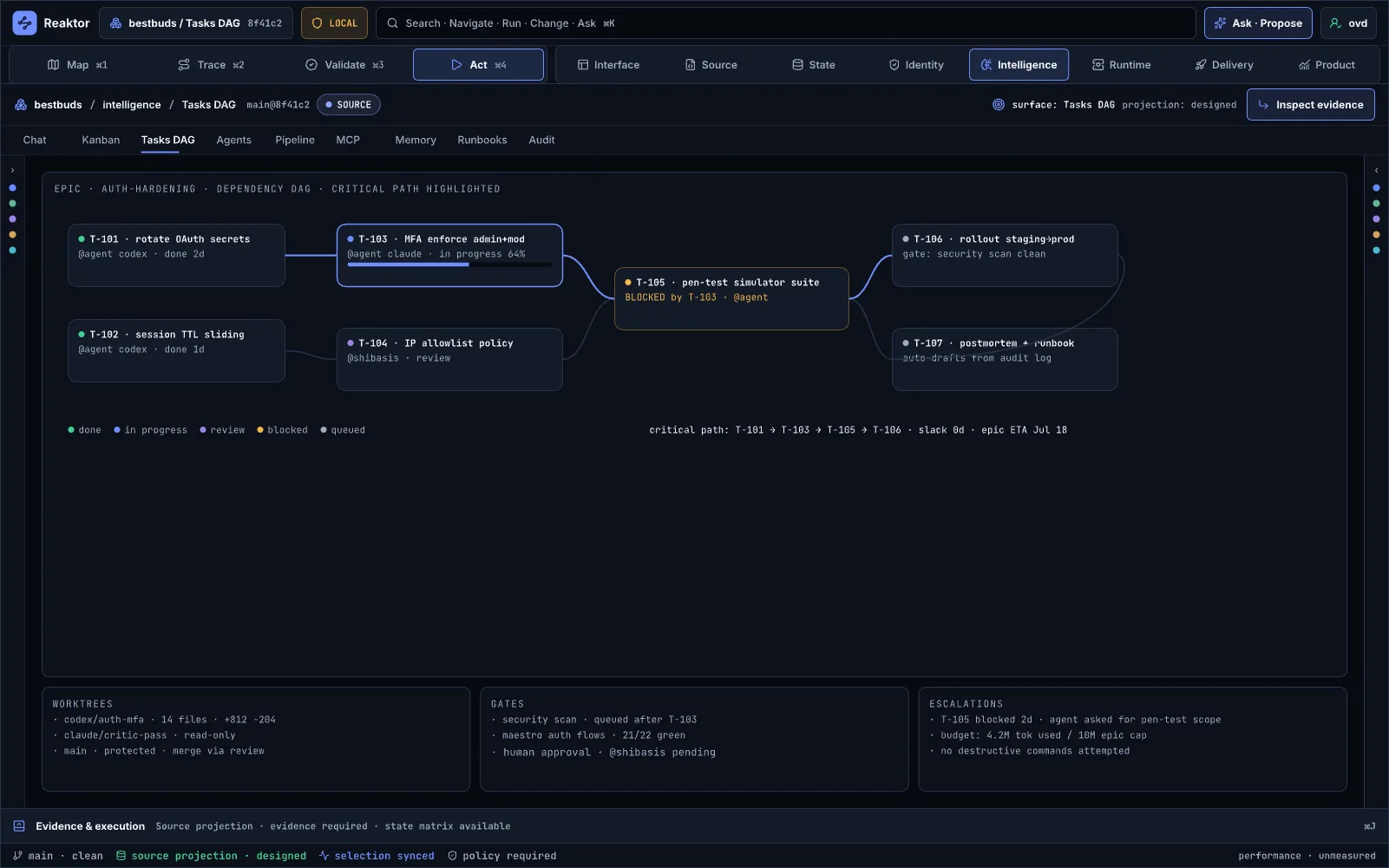
On the board. An EPIC · AUTH-HARDENING · DEPENDENCY DAG · CRITICAL PATH HIGHLIGHTED with seven nodes T-101 to T-107, each carrying an assignee and a state — T-103 · MFA enforce admin+mod · @agent claude · in progress 64%, T-105 · pen-test simulator suite · BLOCKED by T-103, T-106 · rollout staging→prod · gate: security scan clean, T-107 · postmortem + runbook · auto-drafts from audit log. A legend covers done / in progress / review / blocked / queued, and a critical-path line reads T-101 → T-103 → T-105 → T-106 · slack 0d · epic ETA Jul 18. Three side panels follow: WORKTREES (codex/auth-mfa · 14 files · +812 −204, claude/critic-pass · read-only, main · protected · merge via review), GATES (security scan · queued after T-103, maestro auth flows · 21/22 green, human approval · @shibasis pending) and ESCALATIONS (T-105 blocked 2d · agent asked for pen-test scope, budget: 4.2M tok used / 10M epic cap, no destructive commands attempted).
Vision tie. Choreography and orchestration, lifted from runtime sagas to units of work, plus the strongest embodiment of governed autonomy anywhere in the cluster. Worktree isolation, a gate list, a token budget cap and a standing "no destructive commands attempted" receipt are four real governance primitives on one board, and three of them appear nowhere else in the atlas.
Workflow tie. The lead's Tuesday view — will the epic land, and what is the agent stuck on. It is also the escalation surface: an agent has been blocked two days asking for pen-test scope, and no other board can answer it.
Agentic tie. The most agent-readable board in the cluster. An agent can read its own blocker, its remaining budget and the gate it must satisfy, and could propose a decomposition of a task into sub-tasks. What is missing is the return leg: a task should carry the capability grant it was issued under, so the agent knows what it may attempt without asking.
Blueprint tie. The build/cook pipeline's dependency graph. The analogy is close in shape and breaks in tempo — Unreal's task graph is machine-scheduled per frame, this is human-scale with human gates.
Replaces / augments. Linear cycles and dependencies, GitHub Projects roadmap, Devin's plan view, and the human-in-the-loop parts of Temporal or Airflow.
Improvements.
- Make ESCALATIONS actionable.
agent asked for pen-test scopeshould be a request-for-capability row with Grant / Deny / Narrow controls that mint a scoped, expiring, non-delegable capability. This is the one place in the atlas where "locks on the right doors" gets a key-cutting surface. - Absorb 08.02 as a second projection of the same task objects.
- Add a per-task BUDGET burn, not just the epic roll-up, so a runaway task is visible before the cap.
- Give each worktree its proposal state: which sealed plan, which base revision, and whether the base has drifted since (04.02 says
drift invalidates approval— this is where drift becomes visible). - Point
gate: security scan cleanat the actual gate row in 07.04's validation list so one gate object serves both boards instead of two boards naming the same gate independently. - Mark
in progress 64%andepic ETA Jul 18as estimates with a stated basis, or remove them; a percentage-complete on agent work has no defensible derivation.
Verdict. Strengthen, and absorb 08.02 into it. This is the second board to build.
08.04 · Agents · MCP & Memory
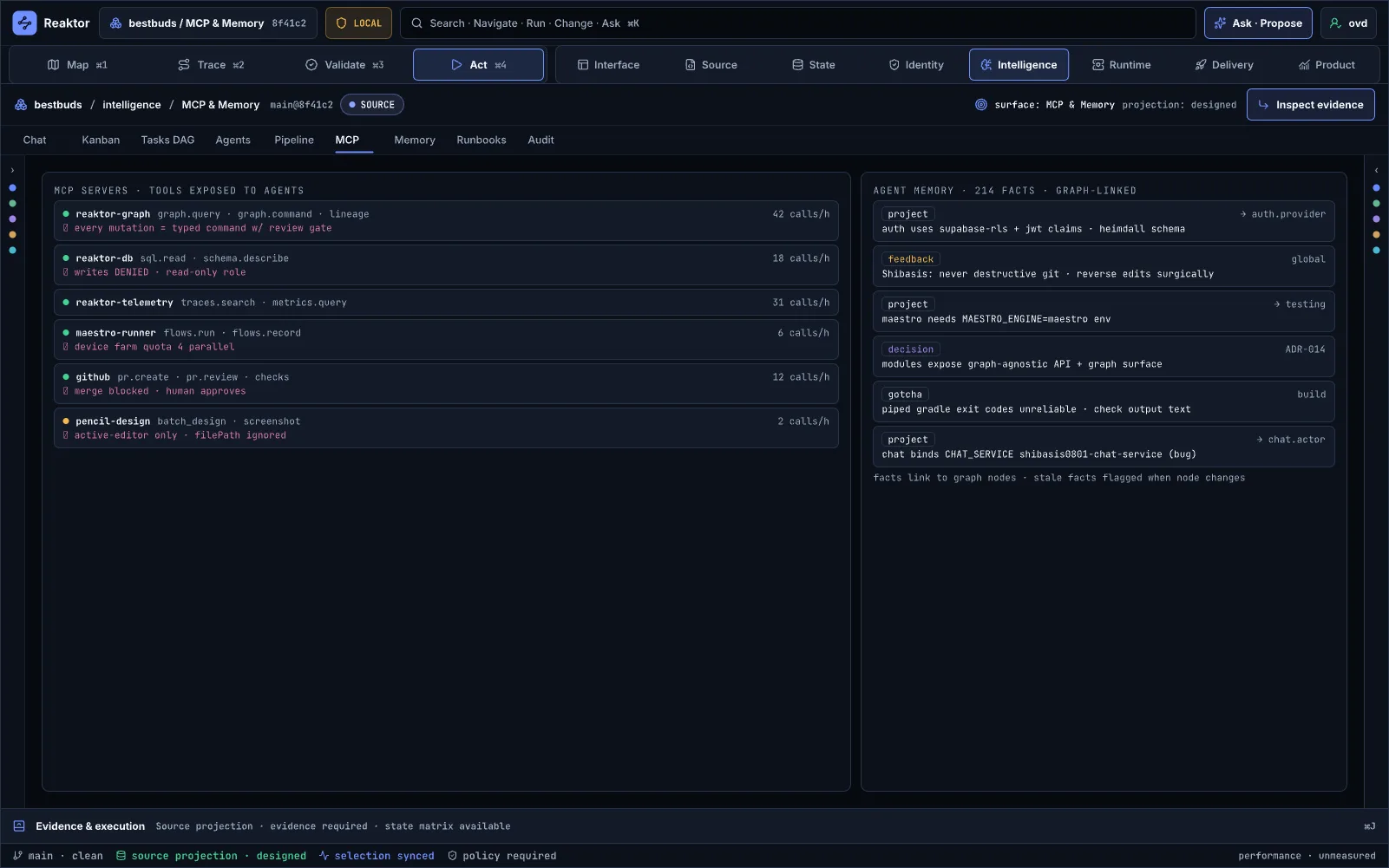
On the board. Two panes. MCP SERVERS · TOOLS EXPOSED TO AGENTS lists six servers with tool names, call rates and a prose shield: reaktor-graph · graph.query · graph.command · lineage · 42 calls/h · ⛨ every mutation = typed command w/ review gate; reaktor-db · sql.read · schema.describe · 18 calls/h · ⛨ writes DENIED · read-only role; reaktor-telemetry · traces.search · metrics.query · 31 calls/h with no shield at all; maestro-runner · flows.run · flows.record · 6 calls/h · ⛨ device farm quota 4 parallel; github · pr.create · pr.review · checks · 12 calls/h · ⛨ merge blocked · human approves; pencil-design · batch_design · screenshot · 2 calls/h · ⛨ active-editor only · filePath ignored. AGENT MEMORY · 214 FACTS · GRAPH-LINKED lists six typed facts (project, feedback, decision, gotcha) each anchored to a graph node (→ auth.provider, global, → testing, ADR-014, build, → chat.actor), closing with facts link to graph nodes · stale facts flagged when node changes.
Vision tie. This is the board that must carry the atlas's strongest strategic claim, and it argues the opposite case. It renders Reaktor as one MCP server among six, listing reaktor-graph in the same column, same row shape and same units as github and pencil-design. If Reaktor is a doorway in the same corridor as GitHub's doorway, there is no floor plan — the board concedes the argument in its layout before its shields can make it. The memory pane is the redeeming half and is genuinely novel: facts anchored to graph nodes, with staleness driven by node change, is something no competitor does. That one line deserves an entire board.
Workflow tie. Opened when an agent did something surprising and someone asks what it could even see, and when onboarding a new agent to a repository.
Agentic tie. An agent reads a tool list and a fact list. It cannot read which scopes it currently holds, when they expire, what a rejected call would say, or which calls are proposals versus executions. The ⛨ shields are prose for humans — writes DENIED · read-only role is not a machine-readable policy an agent can plan against, and reaktor-telemetry has no shield at all, which reads as an oversight rather than a decision.
Blueprint tie. Drawn as a plugin manager. It should be Unreal's reflection system: the editor introspects UCLASS/UPROPERTY to build its panels generically, and an agent on Reaktor should introspect the typed port graph the same way rather than calling a fixed list of seven verbs.
Replaces / augments. .mcp.json server configuration, Cursor rules and CLAUDE.md, Devin's Wiki, LangChain tool registries.
Improvements. Rebuild as five panes; the full design is in section D below. In short: SURFACE CATALOG (a queryable, fingerprinted enumeration of node kinds and port contracts, not a tool list), SUBSCRIPTIONS (event masks with credits and drop counts), PROPOSAL BROKER (patch in, plan or typed reason code out), CAPABILITY GRANT (principal × scope × verb class × effect ceiling × expiry × delegation), RECEIPT (07.04's object, returned to the agent). Beyond that: demote the six MCP servers to an ADAPTERS row beneath the native surface and retitle the pane so MCP is an adapter rather than the frame; add a D-6 column to the catalog naming which ports carry no class identity, since an agent that assumes port type soundness will propose patches that compile and misconnect; and give each memory fact a SourceRef and FreshnessStamp, showing the count of currently-stale facts rather than only the total 214.
Verdict. Rebuild. This is the most important board in my cluster and the furthest below its own brief.
08.05 · Agents · Runbooks & Audit
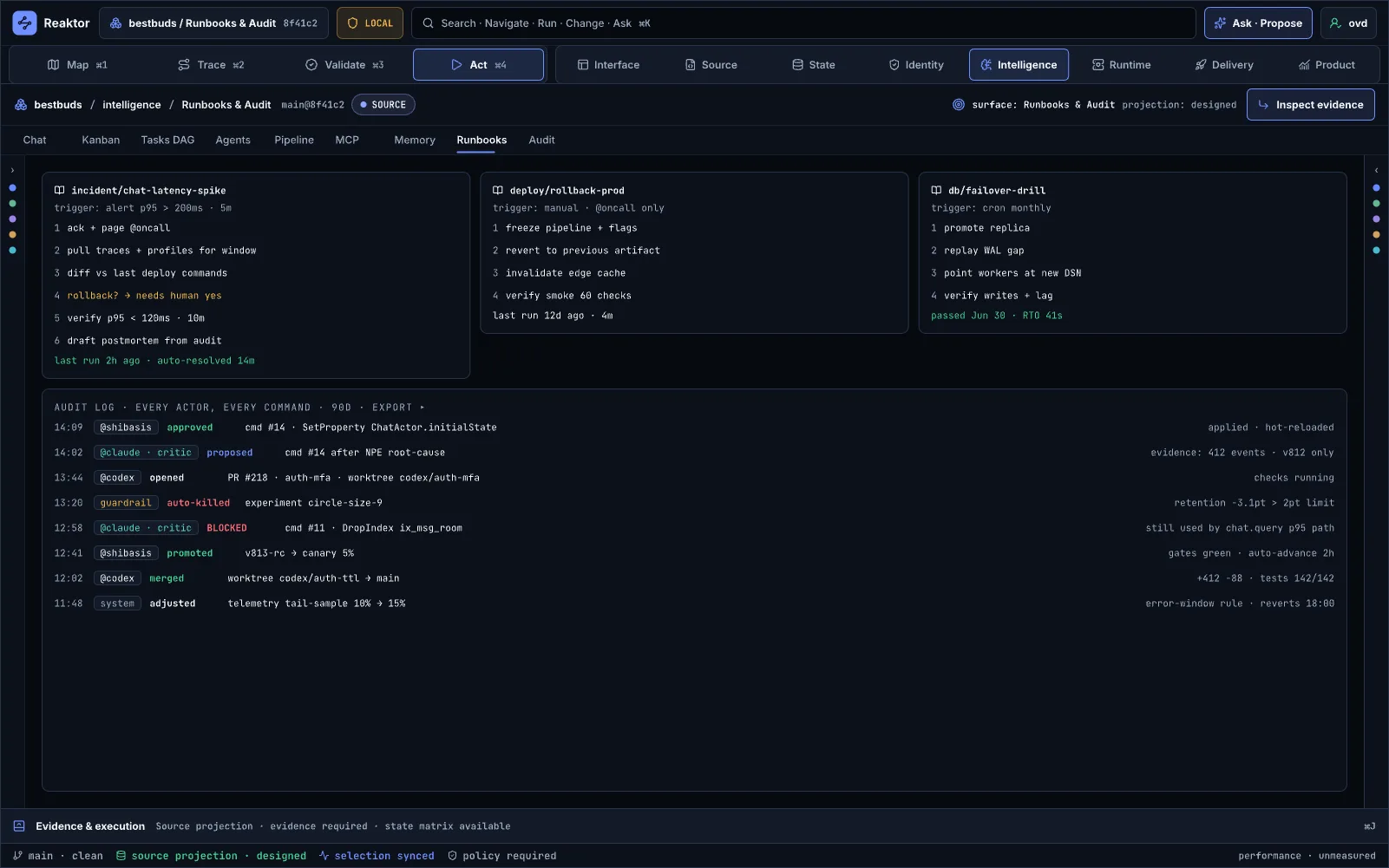
On the board. Three runbooks with triggers, numbered steps and last-run outcomes: incident/chat-latency-spike (trigger alert p95 > 200ms · 5m, six steps from ack + page @oncall through rollback? → needs human yes to draft postmortem from audit, last run 2h ago · auto-resolved 14m); deploy/rollback-prod (trigger: manual · @oncall only, four steps, last run 12d ago · 4m); db/failover-drill (trigger: cron monthly, four steps, passed Jun 30 · RTO 41s). Then AUDIT LOG · EVERY ACTOR, EVERY COMMAND · 90D · EXPORT with eight rows in which humans, agents, a critic, a guardrail and the system are peers — @shibasis approved cmd #14 · SetProperty ChatActor.initialState · applied · hot-reloaded, @claude · critic proposed cmd #14 after NPE root-cause · evidence: 412 events · v812 only, guardrail auto-killed experiment circle-size-9 · retention −3.1pt > 2pt limit, @claude · critic BLOCKED cmd #11 · DropIndex ix_msg_room · still used by chat.query p95 path, system adjusted telemetry tail-sample 10% → 15% · error-window rule · reverts 18:00.
Vision tie. Visitors and governed change, and the best single artifact in the cluster. One ledger where a human, an agent, a critic, a guardrail and the system all appear as actors with the same row schema is a genuinely new object. The critic row is the entire thesis compressed into one line: an agent blocked a DropIndex because the graph knew that index was on the chat.query p95 path. That is impact analysis only a live typed graph can perform, and it is the most persuasive sentence in the atlas.
Workflow tie. Incident review, compliance export, and the Friday "what changed this week" read. Today this is PagerDuty runbooks, a Datadog audit trail, a GitHub audit log and Slack scrollback, four logs with four schemas and no join key.
Agentic tie. An agent reads this to learn precedent — what has been allowed, what was blocked and why — and the board already assigns it the drafting job (draft postmortem from audit). It should also be queryable: "show every DropIndex I proposed that was blocked, and the reason", which is how an agent stops repeating a rejected proposal.
Blueprint tie. The build/cook log fused with the editor's undo history. Unreal has nothing that records a designer, a script and a safety rule in one ledger, so this is the analogy's most favourable point for Reaktor.
Replaces / augments. PagerDuty and Rundeck runbooks, Datadog and GitHub audit logs, Backstage, the Kubernetes event log, Slack incident channels.
Improvements.
- Give every audit row a
plan_xxxx/ receipt chip socmd #14resolves to a sealed plan and itssha256. Today the agent plane approves commands while the deploy plane approves bundles, and nothing reconciles the two units. - Add an ACTOR CLASS column (
human / agent / critic / guardrail / system) as a first-class filter, because cross-class comparison is what makes this log valuable. - Make each runbook step declare its effect ceiling and required capability, so
rollback? → needs human yesbecomes a policy row an agent can evaluate rather than prose it must parse. - Add a REVERSIBILITY column: inverse patch available or not, at the current revision. 04.02 promises
commits use inverse patches; this is the board where that promise pays out. - Put a query bar over the log using the same
kind: owner: truth: path:grammar as the omnibox, so the audit is searched the way the graph is. - Relabel the run outcomes (
auto-resolved 14m,RTO 41s,tests 142/142) as fixtures. The runbook steps are honest design; the outcomes describe runs that never happened.
Verdict. Keep, and build first. It is the highest-value, lowest-fabrication board of the twelve.
12.01 · AI · Models & Operators
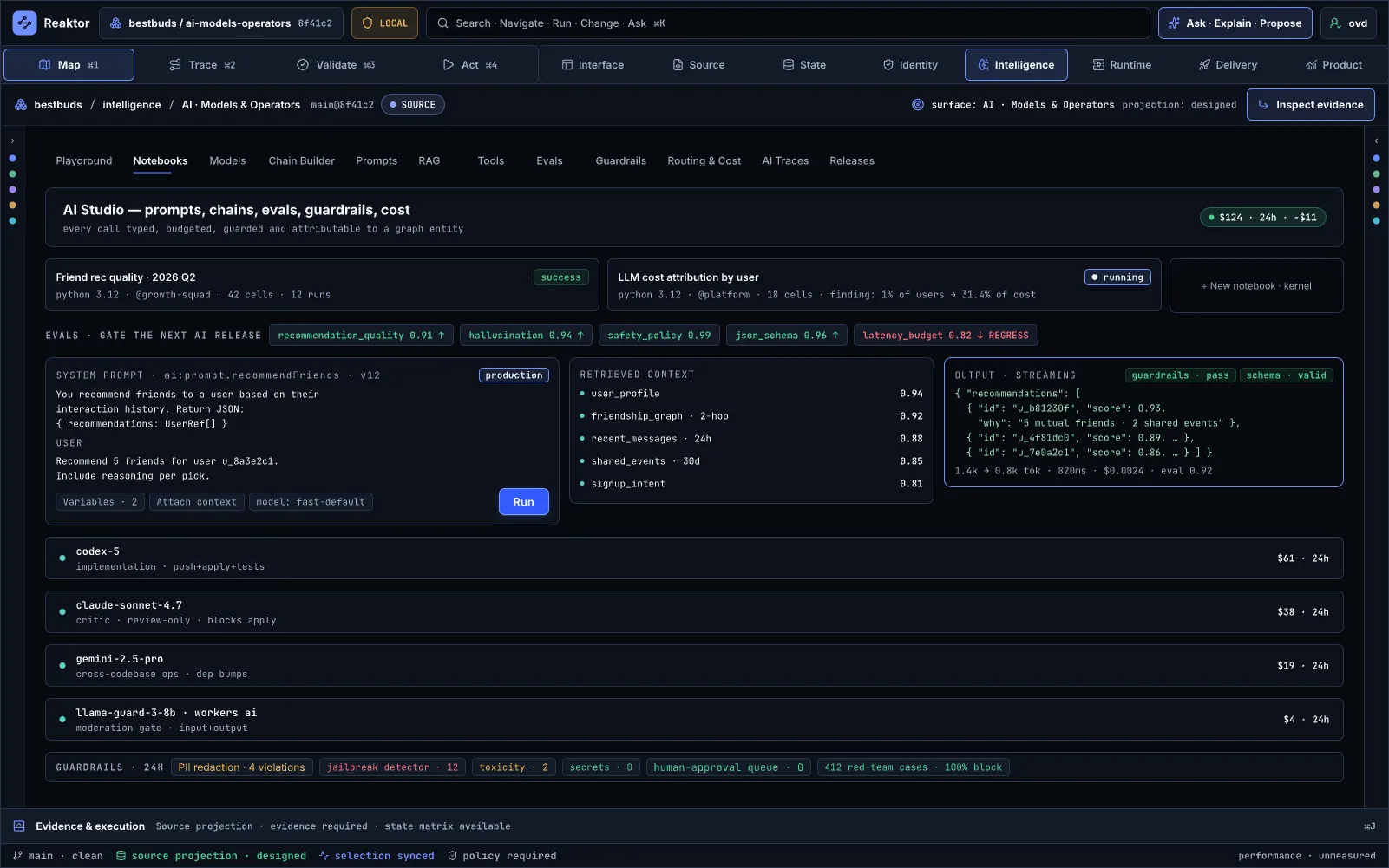
On the board. A mega-board titled AI Studio — prompts, chains, evals, guardrails, cost with the twelve-tab section-12 strip and a $124 · 24h · -$11 chip. It contains, in one screen: two notebook cards (Friend rec quality · 2026 Q2 · success · 42 cells · 12 runs, LLM cost attribution by user · running · finding: 1% of users → 31.4% of cost) with + New notebook · kernel; EVALS · GATE THE NEXT AI RELEASE (recommendation_quality 0.91 ↑, hallucination 0.94 ↑, safety_policy 0.99, json_schema 0.96 ↑, latency_budget 0.82 ↓ REGRESS); a prompt editor for ai:prompt.recommendFriends · v12 · production with Variables · 2, Attach context, model: fast-default and Run; RETRIEVED CONTEXT with five scored sources; OUTPUT · STREAMING with guardrails · pass, schema · valid, a JSON body and 1.4k → 0.8k tok · 820ms · $0.0024 · eval 0.92; a four-model roster; and GUARDRAILS · 24H (PII redaction · 4 violations, jailbreak detector · 12, toxicity · 2, secrets · 0, human-approval queue · 0, 412 red-team cases · 100% block).
Vision tie. Weak, and the board knows it should be stronger — its subtitle promises "every call typed, budgeted, guarded and attributable to a graph entity" and not one graph entity is named on any pane. Strip the subtitle and this is a competent LangSmith clone.
Workflow tie. An AI engineer's daily driver. Today: LangSmith plus a provider console plus a spreadsheet.
Agentic tie. Readable, not actionable. Nothing on this board is a command, in contrast to 12.05's PromoteChain and 12.03's AddChainNode / ConnectPorts / SetProperty. An agent can observe an eval regression here and has no verb with which to respond.
Blueprint tie. The content browser for AI assets — prompts, models, evals as browsable items with metadata. Not the graph editor, and not the profiler.
Replaces / augments. LangSmith, Weights & Biases Weave, Braintrust, Humanloop, the OpenAI and Anthropic consoles.
Improvements.
- Split out the model roster.
codex-5 · implementation · push+apply+tests,claude-sonnet-4.7 · critic · review-only · blocks applyandgemini-2.5-pro · cross-codebase opsare section-08 operators with section-08 spend; move them to a new08.06 Agent Fleet & Budgetand leave 12.01 the product's models. - Delete the notebook cards and eval tiles, which are 12.06's and 12.05's content with different numbers — and where they differ they contradict:
latency_budget 0.82 ↓ REGRESShere againstlatency_budget 0.96there, on the same revision8f41c2. - Rename
hallucination 0.94 ↑togroundednessto match 12.05. A defect metric carrying an up-is-good arrow is a chart that lies about its own direction. - Add a GRAPH ENTITY column to every row — which node consumes this prompt, which port carries its output, which actor called it. That column is the only thing that would distinguish this board from LangSmith.
- Apply 12.03's
DESIGN FIXTUREband to the whole board.
Verdict. Split into 08.06 Agent Fleet & Budget plus a slimmed 12.01 AI Playground. The remainder duplicates four sibling boards.
12.02 · AI · Models & Routing
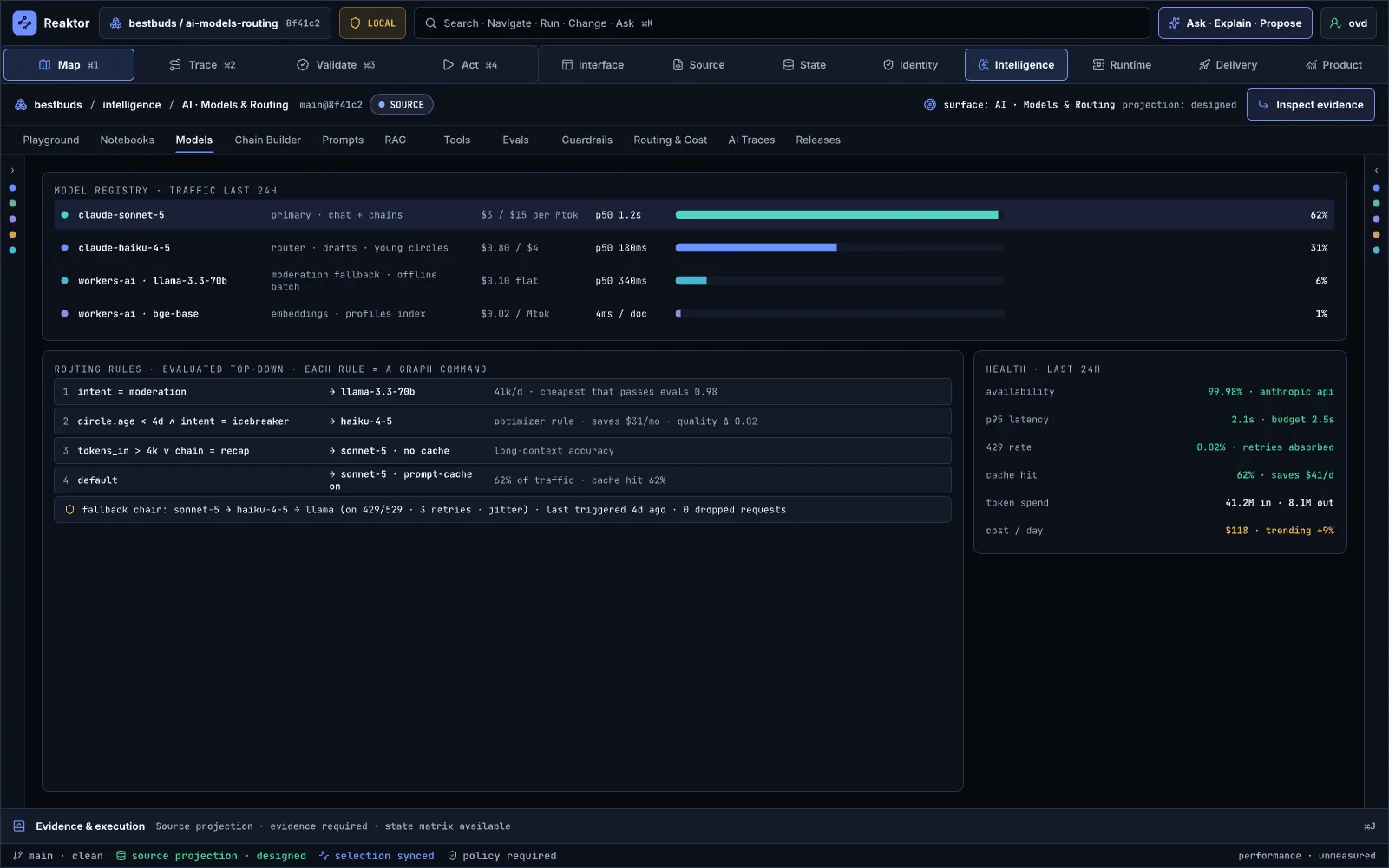
On the board. MODEL REGISTRY · TRAFFIC LAST 24H with four rows carrying role, price, latency and traffic share (claude-sonnet-5 · primary · chat + chains · $3 / $15 per Mtok · p50 1.2s · 62%; claude-haiku-4-5 · router · drafts · young circles · $0.80 / $4 · p50 180ms · 31%; workers-ai · llama-3.3-70b · moderation fallback · $0.10 flat · p50 340ms · 6%; workers-ai · bge-base · embeddings · $0.02 / Mtok · 4ms / doc · 1%). Then ROUTING RULES · EVALUATED TOP-DOWN · EACH RULE = A GRAPH COMMAND with four rules, each with a condition, a target and a rationale — including circle.age < 4d ∧ intent = icebreaker → haiku-4-5 · optimizer rule · saves $31/mo · quality Δ 0.02. A fallback line reads sonnet-5 → haiku-4-5 → llama (on 429/529 · 3 retries · jitter) · last triggered 4d ago · 0 dropped requests. HEALTH · LAST 24H closes with six tiles including cache hit 62% · saves $41/d and cost / day $118 · trending +9%.
Vision tie. The claim that each routing rule is a graph command is a genuine tie to the eigenvector-primitives idea: a router is not a special subsystem, it is typed conditions on a node. But the board never shows a rule in command form, so the claim is a caption rather than a demonstration. The deeper missed tie is adapter and capability — routing on model name is what everyone does; routing on capability tier is what Reaktor's own vision argues for.
Workflow tie. Opened when the AI bill jumps or a provider degrades. Today: a hand-rolled router in application code, provider status pages, and a cost dashboard that cannot explain itself.
Agentic tie. The best place in section 12 for an agent to earn its keep — propose a routing rule, back it with an eval delta and a cost delta, and let it be gated. Rule 2 is literally that proposal. But 11.04 shows the identical proposal as not yet applied (apply as command RouteModel(budbot.icebreaker, haiku, cond: circle.age<4d)) while this board shows it as live rule 2. Two boards on one revision disagree about whether a change shipped.
Blueprint tie. The platform / RHI abstraction — one call routed to different backends according to declared capability. This is the closest section-12 board to Unreal's actual architecture and it does not claim the resemblance.
Replaces / augments. LiteLLM, OpenRouter, Portkey, Cloudflare AI Gateway, Helicone.
Improvements.
- Render each rule in its command form with an
Edit as commandcontrol that opens the sealed-plan flow, delivering onEACH RULE = A GRAPH COMMANDinstead of asserting it. - Add a CAPABILITY TIER column to the registry (tool use, JSON mode, 200k context, vision, on-device) and let rules branch on tier rather than model id. Product code branching on capability rather than platform is §1's rule; this is that rule applied to models, and it is the board's strongest available differentiator.
- Add a SHADOW column: what the rule would have routed over the last window and what that would have cost, so a rule change is evaluable before approval rather than after.
- Reconcile the cost figure with 11.04 and 12.01.
$118appears here as a daily cost and on 11.04 asclaude api · budbot chains $118.00for the month to date. One of those is wrong by a factor of thirty. - Give provider prices a
SourceRefand an as-of date. They are the only externally verifiable numbers on the board and currently carry no more provenance than the invented ones. - Replace
last triggered 4d ago · 0 dropped requestswith a fallback timeline, since the interesting question during an incident is the shape of the degradation, not its age.
Verdict. Strengthen. It has the clearest reason to exist in section 12, but its health and cost tiles must merge with 11.04 rather than restate them differently.
12.03 · Map + Intelligence · Governed Chain Builder
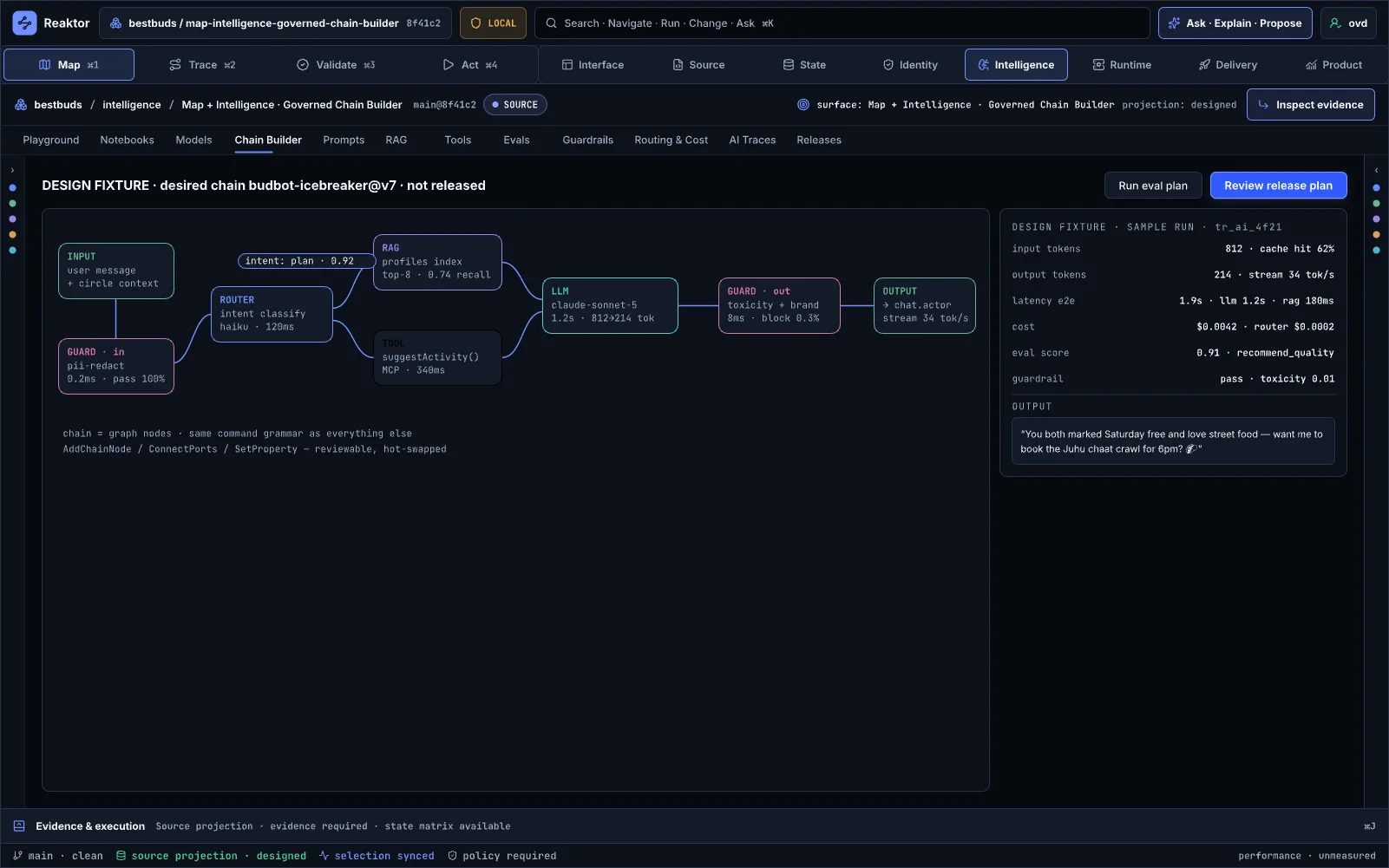
On the board. The honest board. A banner reads DESIGN FIXTURE · desired chain budbot-icebreaker@v7 · not released, with Run eval plan and Review release plan controls. An eight-node left-to-right chain follows: INPUT (user message + circle context), GUARD·in (pii-redact · 0.2ms · pass 100%), ROUTER (intent classify · haiku · 120ms), RAG (profiles index · top-8 · 0.74 recall), TOOL (suggestActivity() · MCP · 340ms), LLM (claude-sonnet-5 · 1.2s · 812→214 tok), GUARD·out (toxicity + brand · 8ms · block 0.3%), OUTPUT (→ chat.actor · stream 34 tok/s), captioned chain = graph nodes · same command grammar as everything else / AddChainNode / ConnectPorts / SetProperty — reviewable, hot-swapped. Below, DESIGN FIXTURE · SAMPLE RUN · tr_ai_4f21 gives six metric tiles and a sample output string.
Vision tie. The strongest in section 12 and among the strongest in the cluster. It states the thesis outright — an AI chain is not a special artifact, it is nodes and ports under one command grammar — and it labels its own numbers as fixture twice, which is precisely what §2's evidence standard asks for.
Workflow tie. Designing or changing a product AI feature, and the review moment before a chain ships.
Agentic tie. Excellent. The chain is enumerable, the mutation verbs are named, and reviewable, hot-swapped implies proposal then approval. An agent proposing AddChainNode meets the same gate as any other node change, which is exactly the property the whole atlas is selling.
Blueprint tie. This is the Blueprint graph editor, applied to an LLM pipeline. The truest analogy in section 12.
Replaces / augments. LangGraph and LCEL editors, Flowise, Dify, Vertex AI pipelines, n8n AI chains.
Improvements.
- Show the port contracts on the wires. Today the nodes are boxes joined by arrows with prose beneath; a typed chain (
Message → RedactedMessage → Intent → Context[] → ToolResult → Draft → SafeDraft) would prove the "same grammar" claim rather than assert it. - Add a CAPABILITY row per node: which node may egress to a provider, which may read unredacted PII, which may write to
chat.actor. The guards are the interesting part and their authority is invisible. - Wire
Review release planto a realplan_xxxxfrom 07.04. As drawn it is the only control on the board and it leads nowhere. - Add a FAILURE PATH overlay — tool timeout, guard block, provider 429 — because a chain without its error edges is a happy path, not a graph.
- Add the
DESIRED + OBSERVEDdual plane that 13.03 uses, so the fixture numbers sit beside empty observed slots markedNotWiredYetrather than standing alone.
Verdict. Keep, and make it the template against which the rest of section 12 is rebuilt.
12.04 · AI · RAG
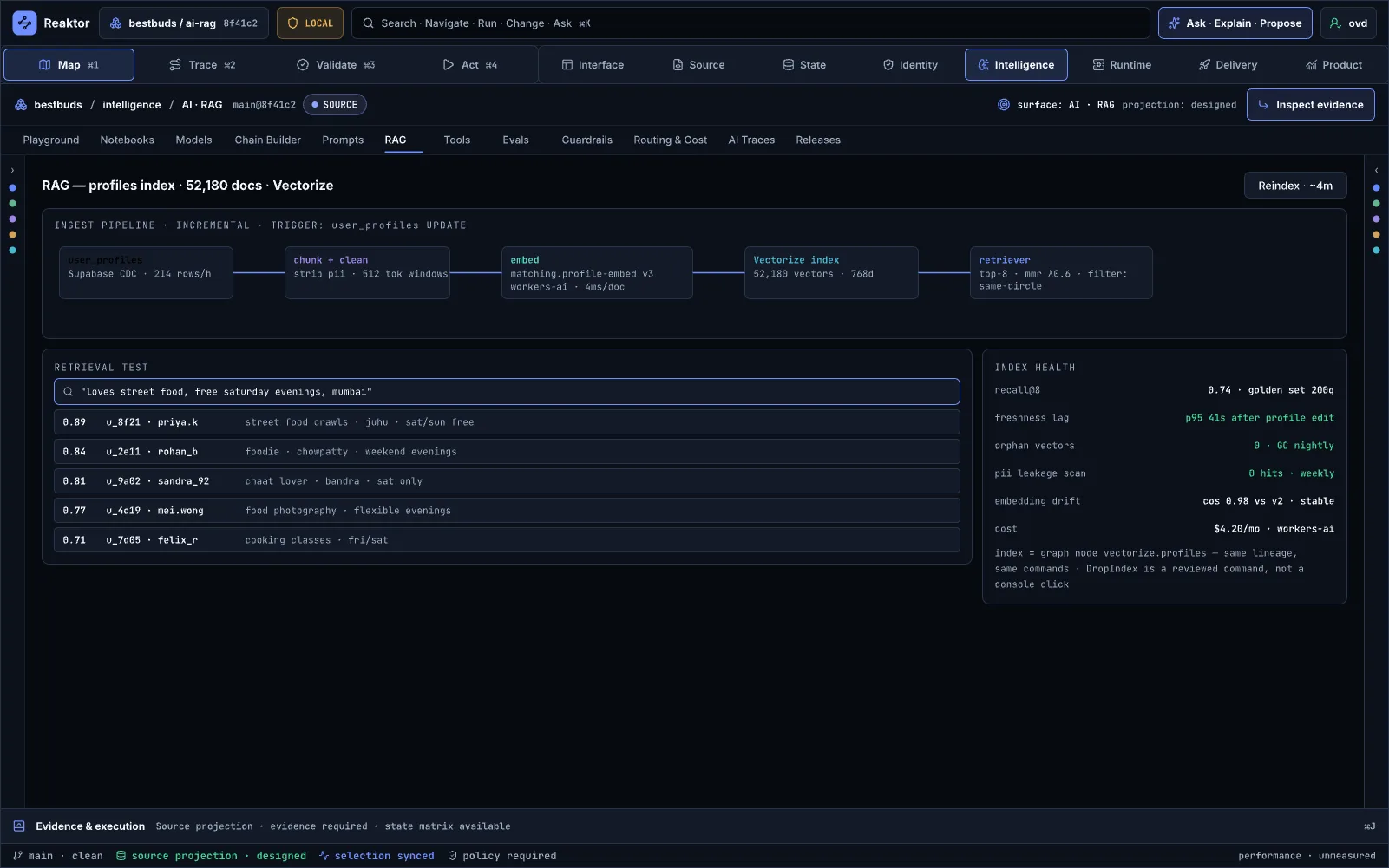
On the board. Header RAG — profiles index · 52,180 docs · Vectorize with a Reindex · ~4m control. INGEST PIPELINE · INCREMENTAL · TRIGGER: user_profiles UPDATE shows five stages: user_profiles · Supabase CDC · 214 rows/h → chunk + clean · strip pii · 512 tok windows → embed · matching.profile-embed v3 · workers-ai · 4ms/doc → Vectorize index · 52,180 vectors · 768d → retriever · top-8 · mmr λ0.6 · filter: same-circle. RETRIEVAL TEST runs a query with five scored hits. INDEX HEALTH gives six tiles: recall@8 0.74 · golden set 200q, freshness lag p95 41s after profile edit, orphan vectors 0 · GC nightly, pii leakage scan 0 hits · weekly, embedding drift cos 0.98 vs v2 · stable, cost $4.20/mo. The footer reads index = graph node vectorize.profiles — same lineage, same commands · DropIndex is a reviewed command, not a console click.
Vision tie. Good. The footer makes 12.03's argument again, and it echoes 08.05's audit row where the critic BLOCKED DropIndex ix_msg_room. That echo across two sections is the best latent seam in the cluster — and neither board links to the other, so it goes unclaimed.
Workflow tie. Opened when retrieval quality drops, or when a privacy review asks what is in the index and who can reach it.
Agentic tie. An agent could propose chunk-size, λ or top-k changes and measure them against the golden set, which is the one closed measurement loop in section 12. Governance is claimed in the footer and never shown.
Blueprint tie. The asset cook and derived-data pipeline — source assets in, derived index out, with staleness and invalidation. Genuinely close.
Replaces / augments. Pinecone and Weaviate consoles, the Vectorize dashboard, LlamaIndex observability, Ragas.
Improvements.
- Add a GOLDEN SET pane: 200 queries with per-query recall and a diff against the previous index build.
recall@8 0.74alone is not actionable; the twenty queries that regressed are. - Turn
Reindex · ~4minto a proposal that produces a plan with cost, read-path impact during rebuild, and a rollback to the previous index version. A bare button on this board contradicts the board's own footer. - Add INDEX VERSIONS with side-by-side serving and eval-based cutover. The pipeline shows
v3with no mechanism for shippingv4. - Surface the redaction rules behind
strip pii, with an audit of what was stripped.pii leakage scan 0 hitsis the claim; the rules are the mechanism, and only the claim is drawn. - Make
vectorize.profilesa selectable graph entity with visible lineage, so the footer's promise is a click rather than a sentence. - Mark every health tile as fixture; see the honesty audit.
Verdict. Strengthen.
12.05 · AI · Prompts & Evals
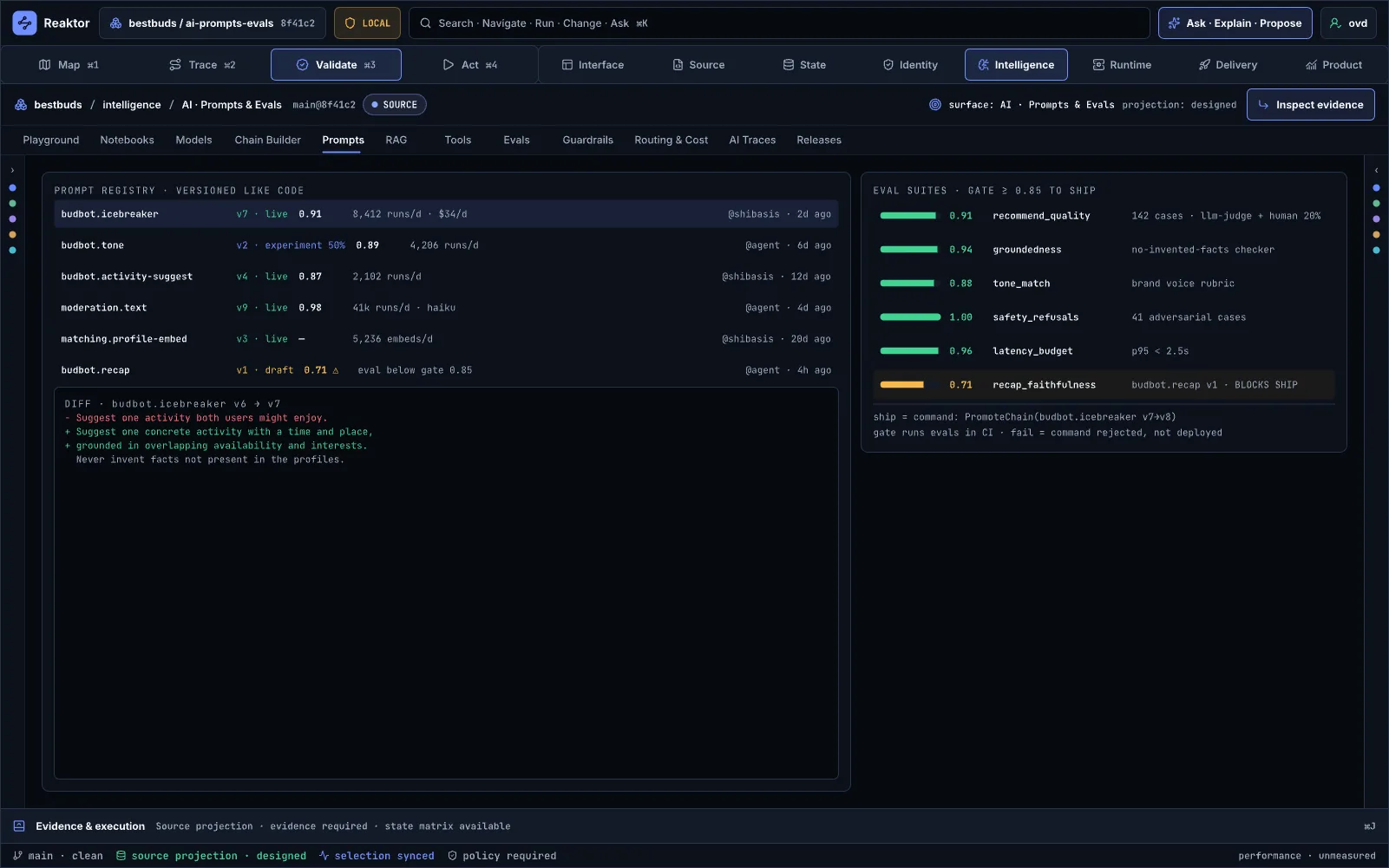
On the board. PROMPT REGISTRY · VERSIONED LIKE CODE lists six prompts with version, state, score, volume and author: budbot.icebreaker v7 · live · 0.91 · 8,412 runs/d · $34/d · @shibasis · 2d ago; budbot.tone v2 · experiment 50% · 0.89 · 4,206 runs/d · @agent · 6d ago; budbot.activity-suggest v4 · live · 0.87; moderation.text v9 · live · 0.98 · 41k runs/d · haiku · @agent · 4d ago; matching.profile-embed v3 · live · — · 5,236 embeds/d; budbot.recap v1 · draft · 0.71 ⚠ · eval below gate 0.85 · @agent · 4h ago. DIFF · budbot.icebreaker v6 → v7 shows the removed and added prompt lines verbatim. EVAL SUITES · GATE ≥ 0.85 TO SHIP lists six suites with scores and methods (142 cases · llm-judge + human 20%, no-invented-facts checker, brand voice rubric, 41 adversarial cases, p95 < 2.5s, and recap_faithfulness 0.71 · BLOCKS SHIP). The footer reads ship = command: PromoteChain(budbot.icebreaker v7→v8) / gate runs evals in CI · fail = command rejected, not deployed.
Vision tie. Moderate. "Versioned like code" and "ship = command" are the right instincts and the diff pane is the right control. But the gating claim rests on CI, and §2 establishes that no CI exists — the only framework workflow file is fully commented out. The board's entire safety argument is delegated to a system that has not been turned on.
Workflow tie. Every prompt change, plus the release gate before an AI feature ships. Today: a prompt in a string constant, a PR, and someone's judgement.
Agentic tie. The most consequential permission claim in the cluster is rendered here as a byline. Three of six prompts are authored by @agent, including moderation.text v9 — an agent editing the safety gate that guards the product's output — and no approver is shown for any of them. 03.01 says agents are DENIED apply; this board shows agent-authored prompts live.
Blueprint tie. The asset validator plus the content browser's version history. Close and useful.
Replaces / augments. LangSmith Prompt Hub, PromptLayer, Braintrust, Humanloop, Weights & Biases.
Improvements.
- Add an APPROVER column beside AUTHOR. An agent-authored change to
moderation.textmust show who approved it, under which capability, and against which eval run. - Make eval suites drill down to cases.
142 cases · llm-judge + human 20%needs a case list with input, output, verdict and judge rationale — the exact capability LangSmith ships today and this board lacks. - Show the eval delta caused by the diff. The v6→v7 text is visible; its effect on
recommend_qualityis not, which makes the diff pane decorative. - Resolve three cross-board contradictions:
latency_budgetat 0.96 here versus 0.82 REGRESS on 12.01; moderation served byhaikuhere, byllama-3.3-70bon 12.02 rule 1, byllama-guard-3-8bon 12.01 and by "workers-ai" on 11.04;8,412 runs/d · $34/dhere against 11.04's8.4k runs/dat$118.00for the month. - Replace
gate runs evals in CIwith the true state and its prerequisite:gate blocked · requires L0 CI · not started. - Register
PromoteChainin a command catalog with arity, inverse and required evidence. It is one of five verbs invented board-by-board across the atlas.
Verdict. Strengthen. The registry and the diff are right; the gate is an unbacked claim about a system that does not exist.
12.06 · AI · Notebooks
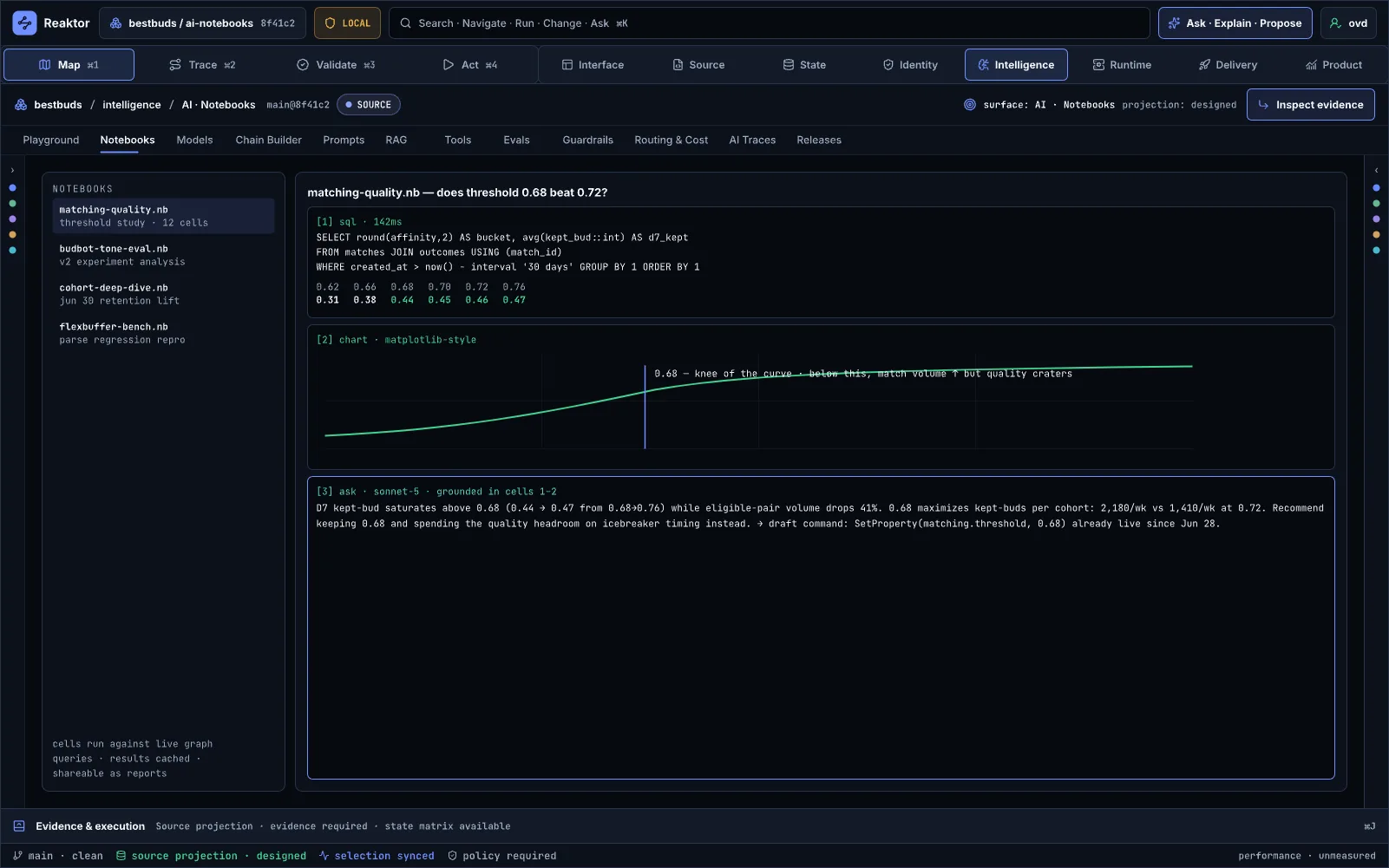
On the board. A notebook list (matching-quality.nb · threshold study · 12 cells, budbot-tone-eval.nb · v2 experiment analysis, cohort-deep-dive.nb · jun 30 retention lift, flexbuffer-bench.nb · parse regression repro) captioned cells run against live graph / queries · results cached · shareable as reports. Then an open notebook, matching-quality.nb — does threshold 0.68 beat 0.72?, with three cells: [1] sql · 142ms showing a real statement over matches JOIN outcomes USING (match_id) and a six-row result; [2] chart · matplotlib-style annotated 0.68 — knee of the curve · below this, match volume ↑ but quality craters; and [3] ask · sonnet-5 · grounded in cells 1–2 producing a written analysis that ends → draft command: SetProperty(matching.threshold, 0.68) already live since Jun 28.
Vision tie. The ask cell is the single best agentic interaction in the whole cluster and possibly in the atlas: analysis grounded in the preceding cells that terminates in a typed, reviewable draft command rather than a paragraph. Nothing on the market closes that loop. Everything else on the board is Jupyter.
Workflow tie. The analyst or engineer answering "did that threshold change help", mid-week, usually to settle an argument.
Agentic tie. This is the agent's own workbench, and it is ungoverned. The draft command targets matching.threshold — a live production parameter — with no plan, no blast radius, no approver and no effect ceiling anywhere in view.
Blueprint tie. None in Unreal. The nearest is the profiler's session comparison, but honestly this is Jupyter or Hex with a graph-aware kernel.
Replaces / augments. Jupyter, Hex, Deepnote, Mode, Metabase, Weights & Biases Reports.
Improvements.
- Make
→ draft commanda real control that opens the sealed-plan flow with blast radius and approver, closing the loop this board comes one pixel short of closing. - Add a PROVENANCE strip per cell: which datastore, which revision, which as-of time.
cells run against live graphmeans every cached result goes stale silently, and the board advertises caching in the same breath. - Give each cell a truth mark so the fixture chart is distinguishable from a live query at a glance.
- Move the board out of section 12 to sit beside 11.05 Reports and 09.04 Data Studio. Its subject is product analytics; only one of three cells is AI.
- Resolve the internal oddity that the analysis recommends 0.68 and then notes it is
already live since Jun 28, which makes the notebook a post-hoc justification rather than a decision. Either show the decision receipt from June or drop the recommendation framing.
Verdict. Merge into 11.05 Learn · Reports, carrying the ask-cell-to-command interaction as the reason it exists.
12.07 · AI · Traces
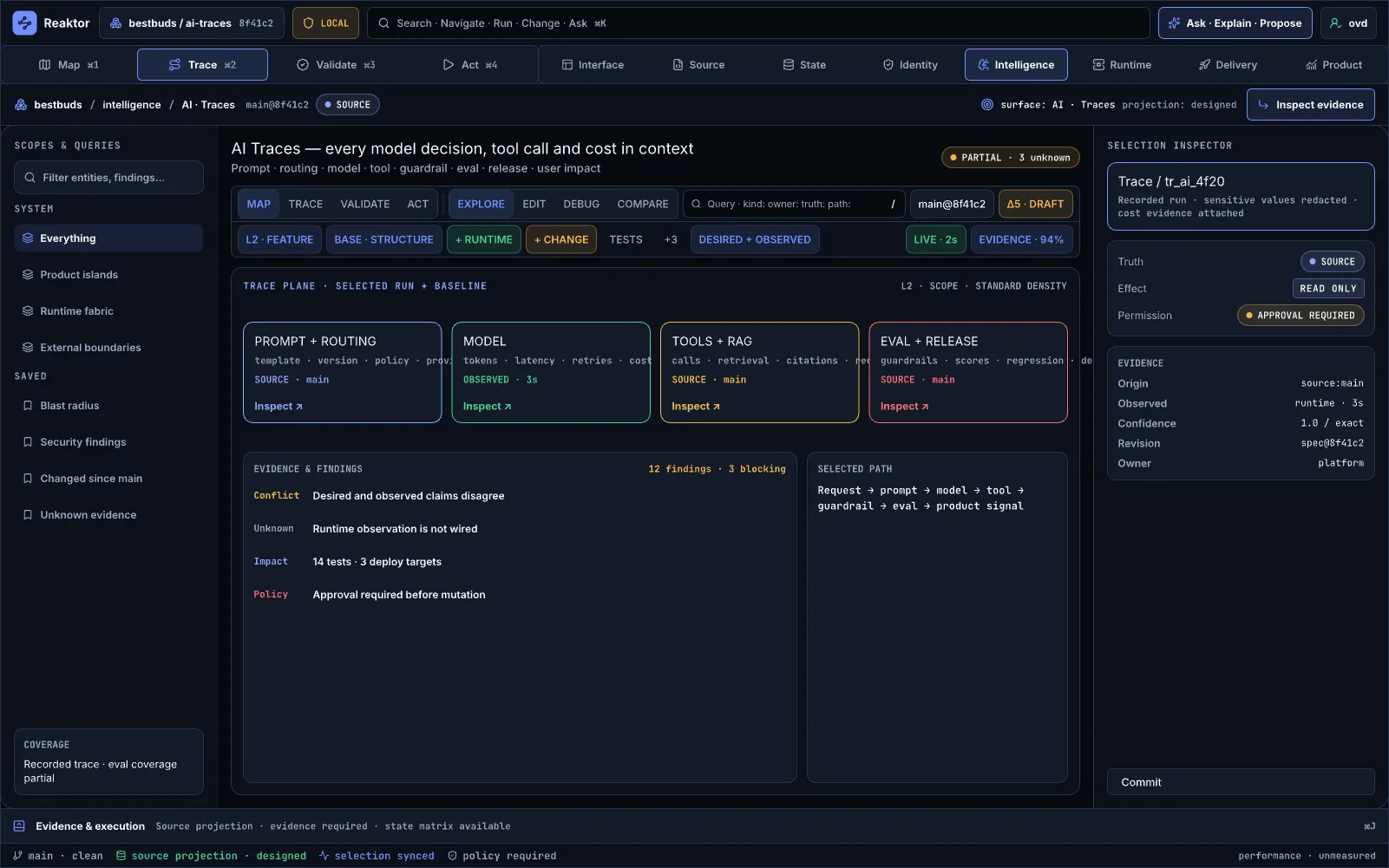
On the board. The 04-series four-quadrant shell again, with the panes retitled: PROMPT + ROUTING (template · version · policy · provider decision), MODEL (tokens · latency · retries · cost · output schema), TOOLS + RAG (calls · retrieval · citations · redactions · failures), EVAL + RELEASE (guardrails · scores · regression · deployed chain), under TRACE PLANE · SELECTED RUN + BASELINE. Coverage reads Recorded trace · eval coverage partial with a PARTIAL · 3 unknown chip. Below sit the same EVIDENCE & FINDINGS block as 08.01 (12 findings · 3 blocking, Conflict / Unknown / Impact / Policy), a SELECTED PATH (Request → prompt → model → tool → guardrail → eval → product signal), and a SELECTION INSPECTOR reading Trace / tr_ai_4f20 · Recorded run · sensitive values redacted · cost evidence attached with Truth SOURCE, Effect READ ONLY, Confidence 1.0 / exact.
Vision tie. Weak as drawn, and structurally backwards. An AI trace is a trace. The Reaktor-specific claim would be that the LLM span sits in the same span tree as the button press and the database insert that 10.01 already draws (AppleButton.onClick → AuthAction → … → d1.sessions). By giving AI its own trace plane, this board asserts that model calls are a different kind of event, which is the opposite of the one-graph thesis.
Workflow tie. Debugging a bad model output — why did it pick that model, what did it retrieve, what did the guard do.
Agentic tie. An agent could read a failing trace and propose a prompt or routing fix, but nothing here is enumerable: four labelled boxes with subtitles and no run content.
Blueprint tie. The profiler and debugger. The problem is that 10.01 is already the profiler, so this is a second profiler scoped to a subset of spans.
Replaces / augments. LangSmith traces, Weave, Langfuse, Datadog LLM Observability, Helicone.
Improvements.
- Merge into 10.01 as a
kind:llmlens with LLM spans nested inside the real request tree. That both delivers the one-graph claim and removes a duplicate board. - If kept, draw an actual run tree — nested spans with token counts, retries and tool results. Four static boxes are strictly worse than what LangSmith gives a developer today.
- Link
tr_ai_4f20to 12.03'str_ai_4f21. Two sample traces one digit apart in the same section, unlinked, is the clearest violation of the atlas's own "selection survives every movement" contract. - Drop
Confidence 1.0 / exactwhile the same board simultaneously reportsPARTIAL · 3 unknownandUnknown · Runtime observation is not wired. - Add the BASELINE control the header promises.
SELECTED RUN + BASELINEshows one run and no baseline.
Verdict. Merge into 10.01 Trace + Runtime as an LLM lens.
Cluster findings
Missing panes
08.06 Agent Fleet & Budget— a roster of agent principals with per-principal capability, spend, concurrency and a kill switch. §1 makes agents first-class operators; the atlas shows their work everywhere and the operators themselves nowhere. Section 08's own tab strip has anAgentstab with no board behind it, and 12.01 is currently holding the roster by accident.08.07 Agent Chat / Delegation— the section 08 tab strip listsChatfirst and no board exists. This is where intent becomes a task, and it is the one surface every competitor ships as their entire product.08.08 Capability Grant & Escalation— a pane to answer an agent's request for scope, minting a narrow, expiring, non-delegable capability with a reason. 08.03 raises the request (agent asked for pen-test scope) and no board can answer it. Without this, §1's "locks on the right doors" has no key-cutting surface anywhere in 104 boards.- Command Catalog / verb registry — the atlas invents
AddChainNode,ConnectPorts,SetProperty,PromoteChain,RouteModel,DropIndex,DataChange,ExtractScopeandGraphViewCommand.Moveacross nine boards with no list, no arity, no inverse and no required-evidence rule. §1's eigenvector-primitives claim is a claim about exactly this set, and it is undocumented. - Agent Failure & Rejection — every board shows agents succeeding. Nothing shows the reason-code taxonomy for a rejected proposal, a hallucinated node reference, a patch on a stale base, an exhausted budget, or a capability denial. Given §2's evidence standard this is the most important missing surface in the cluster: the honest agent story is mostly about what gets refused.
- Eval Case Explorer — 12.05 gates on
≥ 0.85and offers only aggregate scores. Without per-case drill-down the gate cannot be audited, and case-level inspection is precisely the feature LangSmith and Braintrust are bought for. 12.08 Tools & Function Registry— the section 12 tab strip listsToolswith no board. 12.03 drawsTOOL suggestActivity() · MCP · 340msas a chain node whose contract, permissions, failure modes and cost appear nowhere.12.09 AI Releases— the tab strip listsReleases; 12.05 assertsPromoteChainand 07.04 owns releases for everything else. Today an AI chain ships through neither.- Type-identity surface for agent reads — §2 names one fingerprint system as the verification keystone and
D-6as unsound port identity, where string-built ports carry anullclass. An agent reading the graph to plan a patch must be told which ports carry real identity. No board says so, so every agent proposal in the atlas is drawn as if the type system were sound.
Seams
One board drawn four times. 08.01, 01.04, 03.01 and 12.07 share the same four-quadrant template, and the EVIDENCE & FINDINGS block is byte-identical across all four: 12 findings · 3 blocking, Conflict · Desired and observed claims disagree, Unknown · Runtime observation is not wired, Impact · 14 tests · 3 deploy targets, Policy · Approval required before mutation. So is the evidence block: Origin source:main, Observed runtime · 3s, Confidence 1.0 / exact, Revision spec@8f41c2, Owner platform. Four boards report the same twelve findings about four different subjects. 08.01 and 01.04 in particular are the same board with four subtitles reworded — and 08.01 is the worse of the two, because it downgrades 01.04's honest Truth: UNKNOWN · not wired to Truth: SOURCE.
Two chromes with no bridge. 08.01 and 12.07 use the SCOPES & QUERIES shell; 08.02–08.05 and 12.01–12.06 use a tab strip. There is no route from the Conductor to the Kanban: 08.01 has no tab strip, and the tab strip has no Conductor entry.
Dead tabs. Section 08's strip lists nine tabs and the section has five boards — Chat, Agents and Pipeline lead nowhere, and MCP/Memory and Runbooks/Audit are each two tabs served by one board. Section 12's strip lists twelve tabs against seven boards — Tools and Releases lead nowhere, while Playground and Guardrails exist only as panes buried inside 12.01.
The capability model is in the wrong section. 03.01 Visitor Lab holds the only real agent authority grammar in the atlas: PRINCIPAL agent:codex · role:graph-auditor · session scoped, ALLOWED inspect graph · query evidence · explain findings, PREVIEW ONLY draft GraphPatch · calculate impact · request review, DENIED apply · deploy · secret access · self-approval, capability expires with session, and even PERMISSION DENIED · scope hidden. Section 08 never references it and 08.04 re-states it informally as ⛨ prose per MCP server. Two vocabularies for one concept, in two sections, with the weaker one placed on the board that most needs the stronger.
No diff anywhere in section 08. Five boards about agents changing a system, and not one line of proposed code, not one before/after property value, not one file hunk. 04.02 has the patch grammar and 07.04 has a diff summary (+ 2 ports · + 1 schema field · ~ 4 nodes · − 1 deprecated handler). Section 08 has card titles and log lines. This is the single largest competitive gap: reviewing the actual patch is the core loop of every tool this cluster claims to displace.
Selection does not survive. tr_ai_4f21 on 12.03 and tr_ai_4f20 on 12.07 are unlinked. cmd #14 on 08.05 resolves to no plan. rc-812 on 08.02 does not reach 07.04's Inspect rc-812. vectorize.profiles on 12.04 does not reach 08.05's blocked DropIndex ix_msg_room, which is the most persuasive cross-board story in the atlas and goes untold.
Cost is asserted four times in three denominations. 11.04 gives claude api · budbot chains $118.00 for the month at 8.4k runs/d; 12.02 gives cost / day $118; 12.01 gives $124 · 24h; 12.05 gives budbot.icebreaker · 8,412 runs/d · $34/d, where $34 is 11.04's monthly workers-ai line. The same fictional figures were copied between boards with the units scrambled. And the optimizer proposal appears in two states at once: 11.04 offers RouteModel(budbot.icebreaker, haiku, cond: circle.age<4d) as an un-applied suggestion while 12.02 shows it live as rule 2.
Moderation is routed four ways on one revision. 12.02 rule 1 sends it to llama-3.3-70b; 12.01 names llama-guard-3-8b · workers ai; 12.05 says moderation.text v9 · live · 41k runs/d · haiku; 11.04 books it under workers-ai · embeddings + moderation. One fact, four answers, all stamped main@8f41c2. This is the cluster's deepest structural failure, because the atlas's central promise is that "the diagram of the system and the system are the same object, so the diagram cannot lie." Hand-authored fixture data lies, and here it lies inconsistently with itself, which is proof that these boards are drawings rather than projections.
Eval suites are renamed between siblings. 12.01 has recommendation_quality / hallucination / safety_policy / json_schema / latency_budget; 12.05 has recommend_quality / groundedness / tone_match / safety_refusals / latency_budget / recap_faithfulness. The scores line up pairwise (0.91/0.91, 0.94/0.94) except latency_budget, which is 0.82 ↓ REGRESS on one board and 0.96 passing on the other.
Honesty audit
Ten of my twelve boards carry no truth-class component at all: 08.02, 08.03, 08.04, 08.05, 12.01, 12.02, 12.04, 12.05, 12.06, and 12.03's metric tiles. Only 08.01 and 12.07 carry Truth / Effect / Permission plus an evidence block, and both stamp Confidence 1.0 / exact on a plane whose own findings block reads Unknown · Runtime observation is not wired. A confident stamp on an admittedly unwired subsystem is worse than no stamp.
The fix is not invention. 12.03 already models it inside my cluster with DESIGN FIXTURE · desired chain budbot-icebreaker@v7 · not released and DESIGN FIXTURE · SAMPLE RUN; 09.05 does it with DESIGN FIXTURE · ESTIMATED PLAN ONLY and SOURCE · applied state UNKNOWN; 10.01 does it with FIXTURE · sample counts · not operational. Three boards already carry the band that the other nine need.
Board by board, what the honest version shows:
- 12.05.
0.91,8,412 runs/d,$34/d,142 cases · llm-judge + human 20%,41 adversarial casesare all fabricated; no eval harness exists. Honest board: keep the registry rows with name, version, state and author, replace the score column with—under a header reading no eval harness exists, and render the gate as blocked on its own prerequisite —gate ≥0.85 requires CI · L0 not started. The DIFF pane is real design work and should stay. - 12.02.
p50 1.2s,99.98%,0.02% 429 rate,62% cache hit,41.2M in / 8.1M out,$118/d,0 dropped requestsdescribe traffic that has never flowed. Provider list prices are externally verifiable and should stay with aSourceRefand an as-of date. Every traffic, latency and health tile becomesno traffic recorded, and the rules stay as desired routing beside anOBSERVED: nonecolumn. - 12.01.
hallucination 0.94,recommendation_quality 0.91,1% of users → 31.4% of cost,$124 · 24h,1.4k → 0.8k tok · 820ms · $0.0024 · eval 0.92are all fixture.412 red-team cases · 100% blockis the most dangerous single string in the cluster: a perfect safety record asserted for a guardrail that has not been written. Honest version:red-team suite not written · 0 cases. - 12.04. The ingest pipeline shape is a legitimate design claim and should stay.
52,180 docs,recall@8 0.74 · golden set 200q,freshness lag p95 41s,embedding drift cos 0.98becomeindex not built.pii leakage scan · 0 hits · weeklyis a compliance-grade assertion about a scan that has never run and must be removed or markedscan not implemented. - 12.06. The SQL is real design work;
142ms, the six-row result table,2,180/wk vs 1,410/wkandalready live since Jun 28are invented. Honest framing:WORKED EXAMPLE · synthetic results. - 08.02.
14/16 cards · 7 agentsand every card age are fixture. The honest board is mostly empty —no agent sessions recorded— with one worked example card showing the full field set. - 08.03. Separate policy from usage. The budget cap, the worktree protection rules, the gate list and
no destructive commands attemptedare policies, honest to show as desired state.+812 −204,64%,4.2M tok used,epic ETA Jul 18are usage and are invented. Note also thatmaestro auth flows · 21/22 greensits against §2's record of Maestro flows failing broadly on authenticated paths. - 08.04. No MCP server exists for
reaktor-graph,reaktor-dborreaktor-telemetry, so42 calls/h,18 calls/hand31 calls/hdescribe traffic to software that has not been written.214 FACTSlikewise. Honest version adds anEXISTScolumn readingdesigned / designed / designed / external / external / externaland shows the fact count as0 recorded · schema designed. - 08.05. The runbook steps are honest design and among the best content in the atlas. The outcomes —
last run 2h ago · auto-resolved 14m,passed Jun 30 · RTO 41s,tests 142/142,evidence: 412 events · v812 only,retention −3.1pt— describe runs that never happened. Retitle the audit paneWORKED EXAMPLE · no audit log existsand keep every row, because the row schema is the deliverable. - 08.01 and 12.07. The dishonesty here is subtler and worse than a fabricated number, because it is a false provenance mark rather than a false datum. Both assert
Confidence 1.0 / exactandTruth: SOURCEwhile their own findings blocks say the runtime is not wired. 01.04, the North Star board, gets this right withTruth: UNKNOWN · not wired. Section 08 regressed from its own North Star.
D. What a genuinely superior-to-MCP agent interface looks like
This is the design 08.04 should carry. The one-line difference: MCP's unit is a tool call; Reaktor's unit is a scoped capability over a typed live graph that returns proposals and receipts instead of effects. Enumeration becomes a query rather than a list, delivery becomes a subscription rather than a poll, writing becomes a proposal rather than an execution, and the answer is a receipt rather than a string. Five panes.
Pane 1 — SURFACE CATALOG (what the agent can enumerate). Not a list of seven verbs. A queryable projection of the graph's own type system, driven by the same omnibox grammar the human uses (kind: owner: truth: path:), which is the actual superiority claim: one query language, one result shape, for human and agent. Columns: entity kind (ServiceNode, Actor, Flow<T>, Adapter, Visitor), instance count, port contracts exposed, read verbs available, propose verbs available, and a fingerprint column — §2's keystone primitive unifying port type identity, codec layout identity and FFI method identity. One further column is non-negotiable given D-6: type identity, marking each port reified or string-built · class null. An agent told which ports lack class identity will propose differently from one that assumes soundness; hiding D-6 from the agent is how you get patches that compile and misconnect.
Pane 2 — SUBSCRIPTIONS (what the agent can subscribe to). MCP is request/response with no push, so every MCP agent works from a stale snapshot. Reaktor's entire differentiator is that the graph is alive, so the agent should hold subscriptions rather than poll: subscribe(scope, mask) over NodeAdded, PortsConnected, PropertySet, LifecycleTransition, EvidenceChanged, PlanSealed, ReceiptIssued, delivered as credit-based backpressured frames on the same reaktor-ffi data plane as everything else (§1's polyglot floor, which §2 notes is still a skeleton — so this pane ships marked designed). Columns: scope selector, event mask, credits outstanding, frames dropped, and facts invalidated — the link that turns 08.04's throwaway line stale facts flagged when node changes into a mechanism, because a subscription is exactly how a memory fact learns its anchor moved.
Pane 3 — PROPOSAL BROKER (what the agent may propose). 04.02 already names the mechanism — mutation broker → proposal/plan — and no board renders it. The agent submits GraphPatch(base=r1842, commands=[…]) and receives one of two things. On success: a compile result, a typed impact set, a blast-radius entity count, the list of evidence the plan will require, and a plan_xxxx id. On rejection: a typed reason code, not a string — TYPE_MISMATCH, SCOPE_DENIED, BASE_STALE, EVIDENCE_MISSING, BUDGET_EXHAUSTED, INVERSE_UNAVAILABLE. The reason code is the difference between an agent that recovers and one that retries the same mistake; MCP hands back an error string and the agent guesses. The pane must show rejected proposals as prominently as accepted ones, which also fixes the cluster's "agents only succeed" problem.
Pane 4 — CAPABILITY GRANT (what scopes the agent holds). 03.01's principal model, made per-scope and per-verb rather than per-server. Each row: principal (agent:codex), scope path (a subtree or query, not a server name), verb class (read, subscribe, propose, simulate, and apply which is never granted to an agent per 04.02's never self-approve or apply), effect ceiling (READ ONLY / SANDBOX / STAGED / PRODUCTION, reusing the atlas's existing EffectMark), expiry (expires with session, from 03.01), and delegation — whether this principal may mint a strictly narrower capability for a sub-agent, and to what depth. Delegation is the single strongest technical claim available here, because MCP has no vocabulary for it at all: an MCP client either has a server's tools or it does not, and it cannot hand a sub-agent a weaker version of what it holds. A denied row must render as 03.01 does — PERMISSION DENIED · scope hidden — so the agent learns a boundary exists without learning what is behind it.
Pane 5 — RECEIPT (what comes back). MCP returns tool output. Reaktor returns the object 07.04 already defines: PlanApproved · plan_8dd4 · actor · approver · independent · expires 9m · sha256:8dd4…c11a · reason attached · rollback proven · one use. For read-only calls the return is an evidence receipt: what was read, at which revision, with which freshness stamp, and therefore what the agent is licensed to assert downstream. This closes the loop three ways — the agent can cite the receipt into its memory facts, a stale receipt self-invalidates when its base revision moves (drift invalidates approval), and the audit log on 08.05 gains the join key it currently lacks.
The design is defensible because each pane names something MCP structurally cannot express: a type-system query instead of a tool list, a push subscription instead of a poll, a proposal tier between read and write, a delegable expiring scope, and a signed one-use receipt. That is the concrete content behind "MCP gives an agent a doorway; Reaktor gives it the floor plan with locks on the right doors" — and none of it is on 08.04 today.
E. Governed change — a serious structural flaw
The Symphony Contract promises that "human and agent changes share one patch → plan → receipt path". The canonical path is specified twice outside my cluster and instantiated once. 04.02 states it: SEMANTIC CHANGE — PATCH → COMPILE → PLAN → AUTHORIZE → RUN → VERIFY → RECEIPT, with drift invalidates approval · agent/Critic may propose and review, never self-approve or apply · external undo is a governed rollback. 09.05 restates it for data. 07.04 instantiates it with a real object: Bundle #1042 · 7 commands governed by RECEIPT · PlanApproved · plan_8dd4 · actor alice · approver bob · independent · expires 9m · sha256:8dd4…c11a · reason attached · rollback proven · one use.
None of my twelve boards shows a plan id, a receipt object, a content hash, or an approver distinct from the requester. Approval appears as a word — APPROVAL REQUIRED, human approval · @shibasis pending, approved cmd #14, merge blocked · human approves — never as the artifact. That alone is a chain break: the contract promises the receipt survives every movement, and it does not survive into either of my sections.
Worse, the unit of governance diverges. The deploy plane governs a bundle: one plan, seven commands, one sha, one use. The agent plane governs a command: 08.05 logs approved cmd #14 and BLOCKED cmd #11 individually, and 08.01 reports 12 commands proposed · 0 applied with no bundle anywhere. Approving twelve commands one at a time has different atomicity, different rollback and different drift semantics than approving one sealed plan — a partially approved set can leave the graph in a state no plan ever described. This is not a cosmetic inconsistency; it is two different transaction models wearing the same word.
Then section 12 invents a third mechanism and 11.04 a fourth. 12.05 ships by PromoteChain(budbot.icebreaker v7→v8) gated by evals in CI — neither a sealed plan nor a command approval, and gated on CI that §2 says does not exist. 11.04 proposes RouteModel(...) as an optimizer suggestion with no gate at all. 12.04's Reindex · ~4m is a bare button on a board whose own footer insists DropIndex is a reviewed command, not a console click. 12.06's ask cell drafts SetProperty(matching.threshold, 0.68) against a live production parameter with no gate in sight.
So the atlas has four governance mechanisms where it promises one: sealed bundle plan (07.04, 09.05), per-command approval (08.05, 08.01), eval-gated promotion (12.05), and unguarded console action (12.04, 12.02, 12.06). There is also an independence problem in the one place independence is drawn: 07.04 is careful to show actor alice · approver bob · independent, while 08.03 lists human approval · @shibasis pending on an epic where @shibasis also owns task T-104. The same principal is worker and approver on one epic.
The remedy is a single rule enforceable by a designer: no board may render a mutating control that does not produce a plan_xxxx. One PROPOSAL object, one RECEIPT object, rendered identically on every board that changes anything, with the effect ceiling and the approver visible in both. Every divergence listed above is then a lint failure rather than a design decision.
F. Competitive framing — against what Cursor, Claude Code, Devin, LangSmith and W&B ship today
Where these surfaces genuinely win.
- Computed blast radius. 07.04's
blast radius · 14 entitiesand 08.05's critic blocking aDropIndexbecause the indexstill used by chat.query p95 pathare impact analyses that require a live typed graph. Cursor greps and embeds; Claude Code reads files; Devin explores a repository. None of them can enumerate the true consumers of a database index or a port, because none of them has a runtime model of the system. This is the cluster's one unassailable advantage and it appears on exactly two rows of one board. - One approval object shared by humans and agents. An agent's change and a human's change producing the same sealed plan, with
drift invalidates approval, is something no competitor has. GitHub approves diffs, not plans; LangSmith approves nothing. - Budget and destructive-action receipts as governance primitives. 08.03's
4.2M tok used / 10M epic capandno destructive commands attemptedare per-epic policy objects. Devin meters ACUs per session for billing, not as a governance cap tied to a unit of work, and nobody surfaces "no destructive commands attempted" as a standing receipt. - Prompt changes and code changes in one ledger. Because 12.03 makes a chain into nodes, a prompt edit and a port rewire are the same kind of command in the same audit log. LangSmith versions prompts in a silo that has no relationship to your deploy; this cluster could make one release contain both.
- Graph-anchored memory. 08.04's
facts link to graph nodes · stale facts flagged when node changesbeats every competitor's memory model.CLAUDE.md, Cursor rules and Devin's Wiki are all prose that rots silently; a fact whose anchor node changed can be flagged automatically.
Where they tie. The kanban of agent sessions is Devin's session list. The memory pane is Devin's Wiki and Cursor's rules. The prompt registry with diff and an eval gate is LangSmith's Prompt Hub with CI evals. Index health is what every vector vendor's console shows. Notebooks are Hex. None of these is worse than the incumbent; none is better either, and all of them are drawn from further away than the incumbent's real screen.
Where they lose, concretely.
- No patch review anywhere in section 08. Cursor's core loop is reading and accepting the proposed diff hunk by hunk. Five agent boards show not one line of proposed code and not one before/after property value.
SetProperty ChatActor.initialStatewith no values shown is unreviewable. - No case-level eval drill-down. LangSmith lets you click a failing eval case and read the exact input, output and judge rationale. 12.05 shows six aggregate scores and
142 caseswith no way in. The gate cannot be trusted without it. - No real trace tree. 12.07 draws four labelled boxes where LangSmith and Weave show a nested run tree with token counts, retries, tool payloads and per-span cost. This is strictly worse than the incumbent, on the incumbent's home ground.
- No interrupt or steer. Cursor, Claude Code and Devin all let you stop an agent mid-run and redirect it. Nothing in section 08 has that control, which means the only lever a human holds is approval at the end.
- No cost attribution to a requester. 12.01 attributes spend to models, 11.04 to resources, 12.02 to days. None attributes to the person, the task or the PR that caused it — which is the question a lead actually asks, and which 12.06's own notebook is trying to answer (
1% of users → 31.4% of cost) on a different axis. - No local-first loop. Every competitor works in a checkout on a laptop with no server. These boards presume a live graph, a telemetry plane and an approval service, none of which exists per §2. The honest sequencing story — what an agent can do on day one with only the source projection — is missing entirely.
The strategic read: the cluster's claim to "demolish Cursor" rests on the graph, and the boards that actually use the graph are 08.05's critic row, 12.03's chain-as-nodes and 12.04's index-as-node. Everything else in twelve boards is a competent redraw of LangSmith and Linear with a Reaktor header. Cutting the redraws and building the three graph-native ideas properly is a stronger product argument than the current twelve.
Part 10 · Section 09 — State and Trust
Sixteen boards. Six Trust/State boards under bestbuds / identity and bestbuds / state, and ten
boards of a single wizard under bestbuds / state.
Two structural facts drive most of what follows, and both are mechanical rather than interpretive.
First, the six 09.x boards are not six surfaces. They are two surfaces with tab strips drawn on them.
09.01, 09.02 and 09.03 all carry the identical strip Providers · Roles & Permissions · Sessions · Audit · Security · Simulator, and each board is one or two of those six tabs rendered as
a whole board. 09.04, 09.05 and 09.06 carry a Schema · Data · Relationships · Query Plan · History · Migrations strip, which 09.04 alone prefixes with a seventh tab, Query.
Second, the ten Composer boards are one board. Steps 1, 2, 4 and 5 differ from each other by exactly
six lines out of 119: the title, three breadcrumb echoes, the headline verb, the draft chip, the
Next: line and the closing footnote. The five provisioning states differ by eight or nine lines out
of 120. Everything between those lines — the generated-graph summary and the five-step bootstrap
ledger — is byte-identical across all ten.
09.01 · Validate + Identity · Policy, RBAC & Explanation
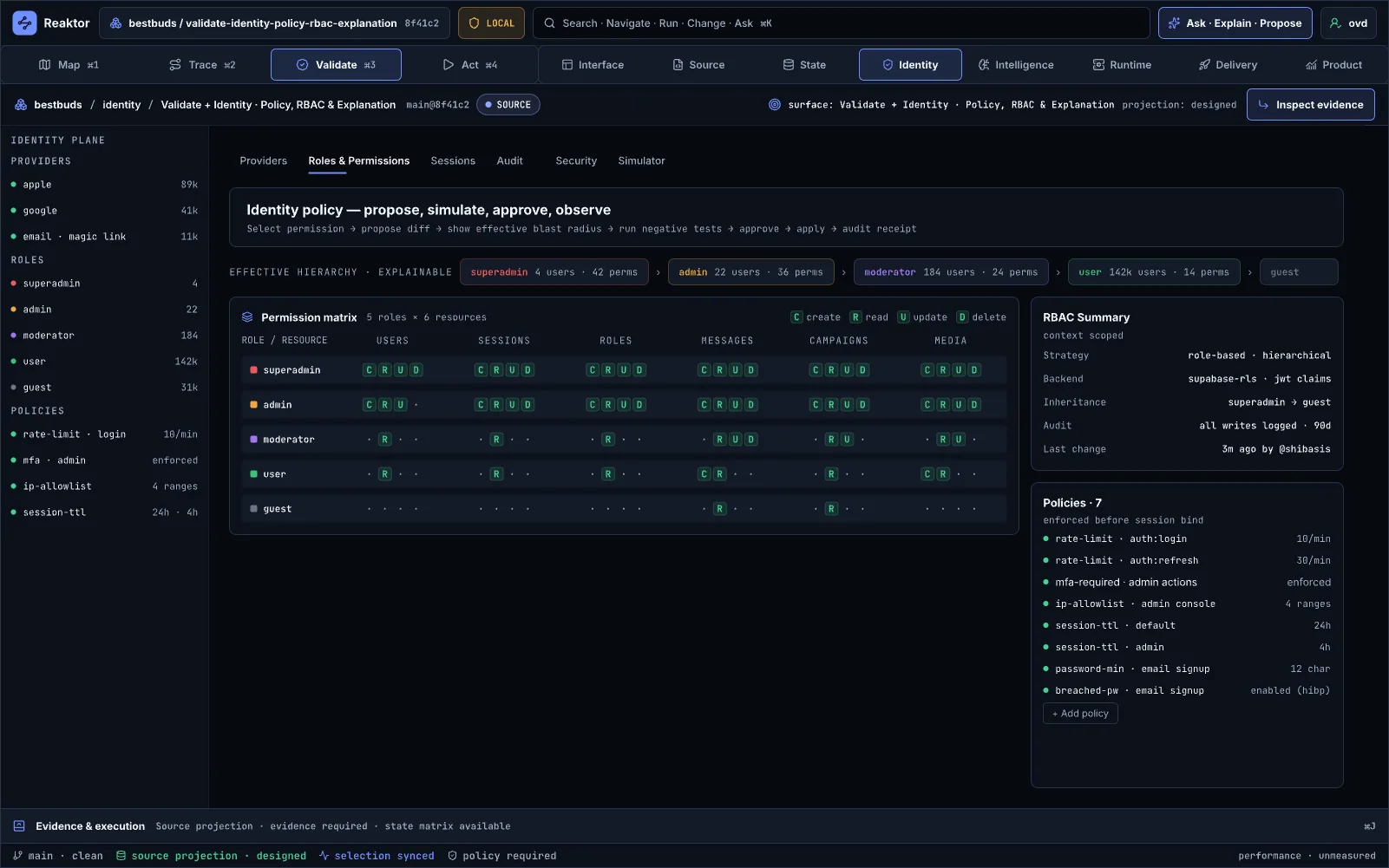
On the board. Under the shared identity tab strip, a left IDENTITY PLANE rail lists PROVIDERS
(apple 89k, google 41k, email · magic link 11k), ROLES (superadmin 4 through guest 31k)
and POLICIES (rate-limit · login 10/min, mfa · admin enforced, ip-allowlist 4 ranges,
session-ttl 24h · 4h). The centre carries a prose contract, "Select permission → propose diff →
show effective blast radius → run negative tests → approve → apply → audit receipt", then an
EFFECTIVE HIERARCHY · EXPLAINABLE chain from superadmin 4 users · 42 perms down to guest, then
the board's bulk: a Permission matrix of 5 roles × 6 resources with C R U D letters or · in
every cell across USERS · SESSIONS · ROLES · MESSAGES · CAMPAIGNS · MEDIA. A right rail holds
RBAC Summary (Strategy role-based · hierarchical, Backend supabase-rls · jwt claims,
Inheritance superadmin → guest, Last change 3m ago by @shibasis) and Policies · 7 with an
+ Add policy control.
Vision tie. It embodies almost none of §1. Nothing here is a node, a port or a traversal. RBAC is
modelled as a static configuration table of the kind any framework ships, and the one genuinely
Reaktor-shaped promise on the board — "show effective blast radius", which would require walking the
live graph from a permission to every node that consumes it — exists only as prose in a caption. The
Backend supabase-rls · jwt claims line quietly concedes that authorization lives in Supabase, not
in the graph, which makes the whole surface a viewer over someone else's policy engine rather than an
instrument of the framework.
Workflow tie. Someone opens this the week a role is added, or during a SOC 2 evidence pull, to
answer "who can do what". It is the screen a new engineer is shown on day three and never returns to.
Today that work happens in the Supabase dashboard, in a policy/*.yaml file, and in a Notion table
that drifts from both.
Agentic tie. An agent reads a clean, dense, structured matrix — and is thereby actively misled. The matrix is a total function from (role, resource-class) to CRUD, so an agent that reads it concludes the authorization model is fully specified and closed. It is not: every instance-scoped rule in the real system is invisible here. An agent asked "can this user read that room" cannot even form the query, because the board has no axis for a resource instance. The board is worse than agent-hostile; it is agent-deceiving.
Blueprint tie. This is Unreal's collision matrix in Project Settings — an object-type by object-type grid resolving to block, overlap or ignore. The analogy is exact and it is also the indictment. Unreal's collision matrix is famous for being unable to express per-instance exceptions; that is why per-actor overrides exist alongside it. This board has the matrix and no overrides.
Replaces / augments. Okta and Auth0 role dashboards, the AWS IAM policy editor, the Supabase RLS editor, and the playground UIs of Oso, OpenFGA and Cedar.
Improvements.
- Add a third axis to the permission matrix: a Scope column group per resource with the values
global,owned,member-of,tenant.user × MESSAGESbecomesR (member-of)rather thanR, which makes the relationship predicate a first-class cell value instead of an omission. - Add a
Rulescount and aPredicatecolumn to thePolicies · 7list, so a policy row states which function enforces it and at which callsite; a policy with zero callsites renders as a finding, not a row. - Replace
Last change 3m ago by @shibasiswith aFreshnessStampcomponent bound to the policy store, and mark the entireIDENTITY PLANErailFIXTURE · identity adapter not connecteduntil it is — the counts89k / 41k / 11k / 142k / 31kcurrently carry no provenance of any kind. - Make "show effective blast radius" a real control: a
Blast radiusbutton on each matrix cell that opens the set of graph nodes reached by that permission, with a count in the cell gutter. - Add an
Unenforcedstate to the matrix cell vocabulary alongsideC R U Dand·. A cell that policy grants but no code checks is the single most important state this board could show, and it is the state that describesS-1. - Link the
EFFECTIVE HIERARCHYchain to01.02'schat.membershipfinding so that a blocking authorization finding surfaces on the board where permissions are read, not only on the North Star board.
Verdict. Rebuild. The policy list, the RBAC summary and the propose-simulate-approve contract are worth keeping; the permission matrix, which is more than half the board's content, is structurally incapable of answering the question the board's own title promises to explain.
09.02 · Trust · Auth Sessions
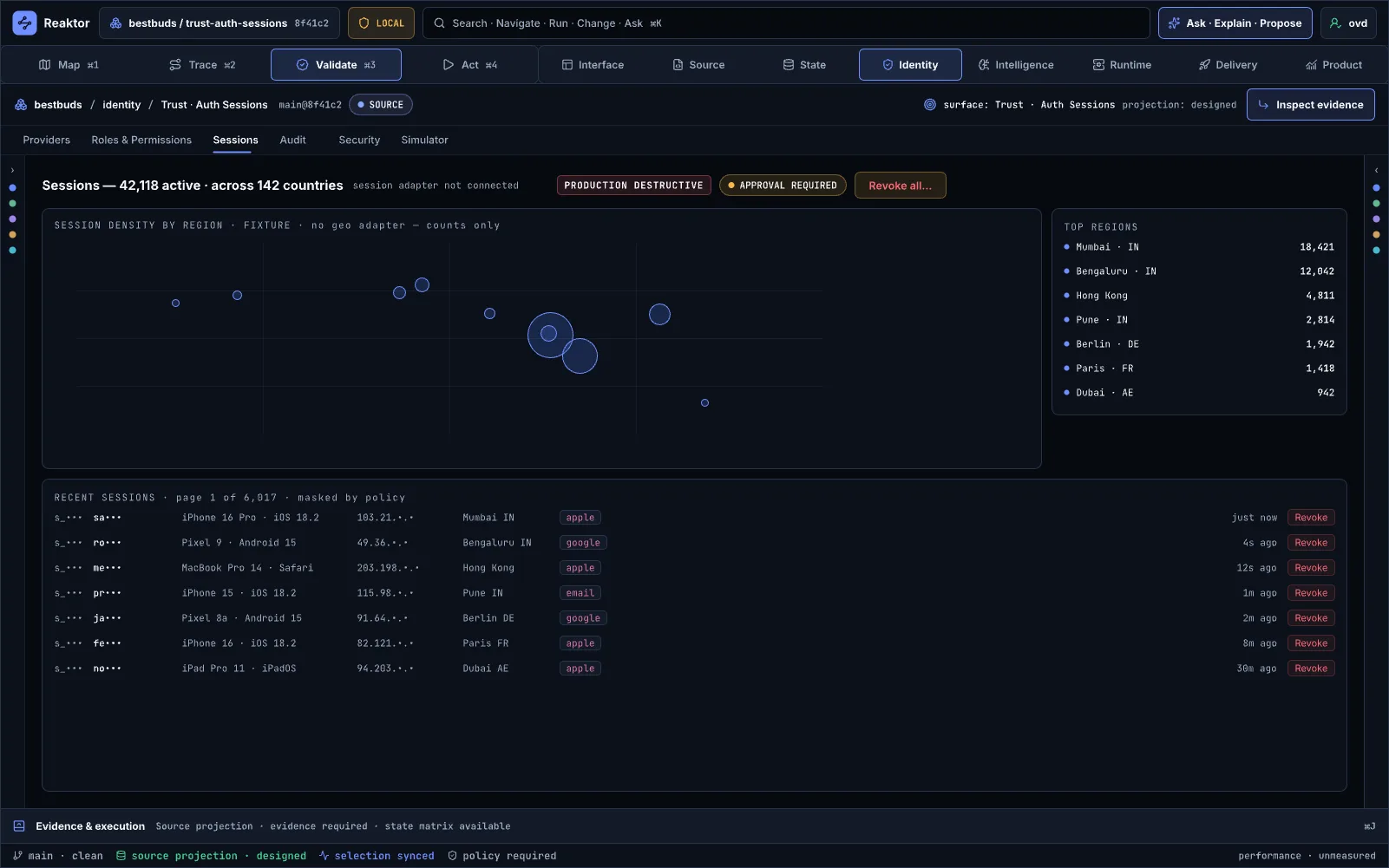
On the board. The Sessions tab of the identity surface. A header reads Sessions — 42,118 active · across 142 countries immediately followed by session adapter not connected, and a
PRODUCTION DESTRUCTIVE / APPROVAL REQUIRED / Revoke all… cluster. Then SESSION DENSITY BY REGION · FIXTURE · no geo adapter — counts only over a TOP REGIONS list (Mumbai · IN 18,421, Bengaluru · IN 12,042, Hong Kong 4,811, Pune · IN 2,814, Berlin · DE 1,942, Paris · FR 1,418, Dubai · AE 942), and RECENT SESSIONS · page 1 of 6,017 · masked by policy listing seven rows of masked
session id, masked handle, device string, partially masked IP, city, provider, age and a Revoke
control.
Vision tie. None, and the omission is precise. §1 says evidence is the load-bearing idea and that every datum carries a truth class. This board carries truth classes in prose but its subject matter — a session — is exactly the object that should link authentication to authorization, and it does not. Every column describes the provenance of the session (device, IP, provider, age). No column describes what the session may do.
Workflow tie. Opened during an incident: an account is compromised, someone needs to see live
sessions and kill them. That is a real and valuable five-minute task, and the board supports it. It
is opened at no other time. Today this is the Auth0 session list or a delete from auth.sessions.
Agentic tie. An agent can read a session inventory and propose revocations, governed by the
APPROVAL REQUIRED chip on Revoke all…, which is correctly placed. It cannot answer any question
about entitlement, and the geographic leaderboard is the least agent-useful shape the data could
take: seven cities ranked by count supports no decision an agent could make.
Blueprint tie. Unreal's network connection list in the session frontend — connected clients with address, ping and platform. The analogy holds completely, including its limitation: the connection list tells you a client is attached, never what it is replicating or authorized to replicate.
Replaces / augments. Auth0 session management, the Okta System Log, Stripe's device list pattern,
and the Supabase auth.users table view.
Improvements.
- Add an
Entitlementscolumn: per session, the count of resource instances that session can currently reach, linking to the Decision Record pane proposed below. This converts a session inventory into an authorization instrument and is the change that would make the board matter. - Delete the
TOP REGIONSleaderboard. Replace it withSESSIONS BY ENTITLEMENT— grouped by role and by scope breadth, with anover-scopedbucket at the top. - Mark the header.
42,118 active · across 142 countriessits directly abovesession adapter not connected; with no adapter, that is not a stale number but an invented one. The honest header isSessions — UNKNOWN · session adapter not connectedwith the fixture count demoted into the band. - Bind the four prose marks (
session adapter not connected,FIXTURE,masked by policy,no geo adapter) toTruthMarkandEmptyReasoncomponents rather than typed band labels, so an atlas-wide query can see them. - Add a
Last decisioncolumn showing the most recent authorization decision made for that session, which turns the row into an entry point rather than a terminus.
On the twenty numbers, and the V2 grammar. These two facts reconcile cleanly, and the received
framing of the board is wrong in a way worth correcting. 09.02 is not an unmarked board. It carries
four separate provenance strings and is one of the more heavily marked boards in the atlas. It
belongs to the thirty-five boards that §3 describes as marking provenance "with hand-typed prose
rather than components", not the forty-nine with no marker at all. The atlas-wide scan reports it as
unmarked because the marks are typed into V2 band labels instead of instantiated as TruthMark,
FreshnessStamp or EmptyReason components — so they are legible to a human and invisible to a
query. That is precisely what one expects of the V2 grammar proof-of-concept board: the V2 band
grammar puts provenance in the band label, the PoC proved the band grammar works, and nobody has yet
made the band label a slot that renders a truth component. Making it one is a single change to the
band primitive that would move all thirty-five prose-marked boards into the queryable set without
redesigning any of them. It is the highest-leverage change available in the atlas, and this board is
where to prove it. The residual honesty problem is narrower than "twenty unmarked numbers": it is
that the header total and the fixture mark contradict each other on the same screen.
Verdict. Merge into 09.01 as the Sessions tab of one Identity surface, and rebuild its body
around entitlement rather than geography.
09.03 · Trust · Security Simulator
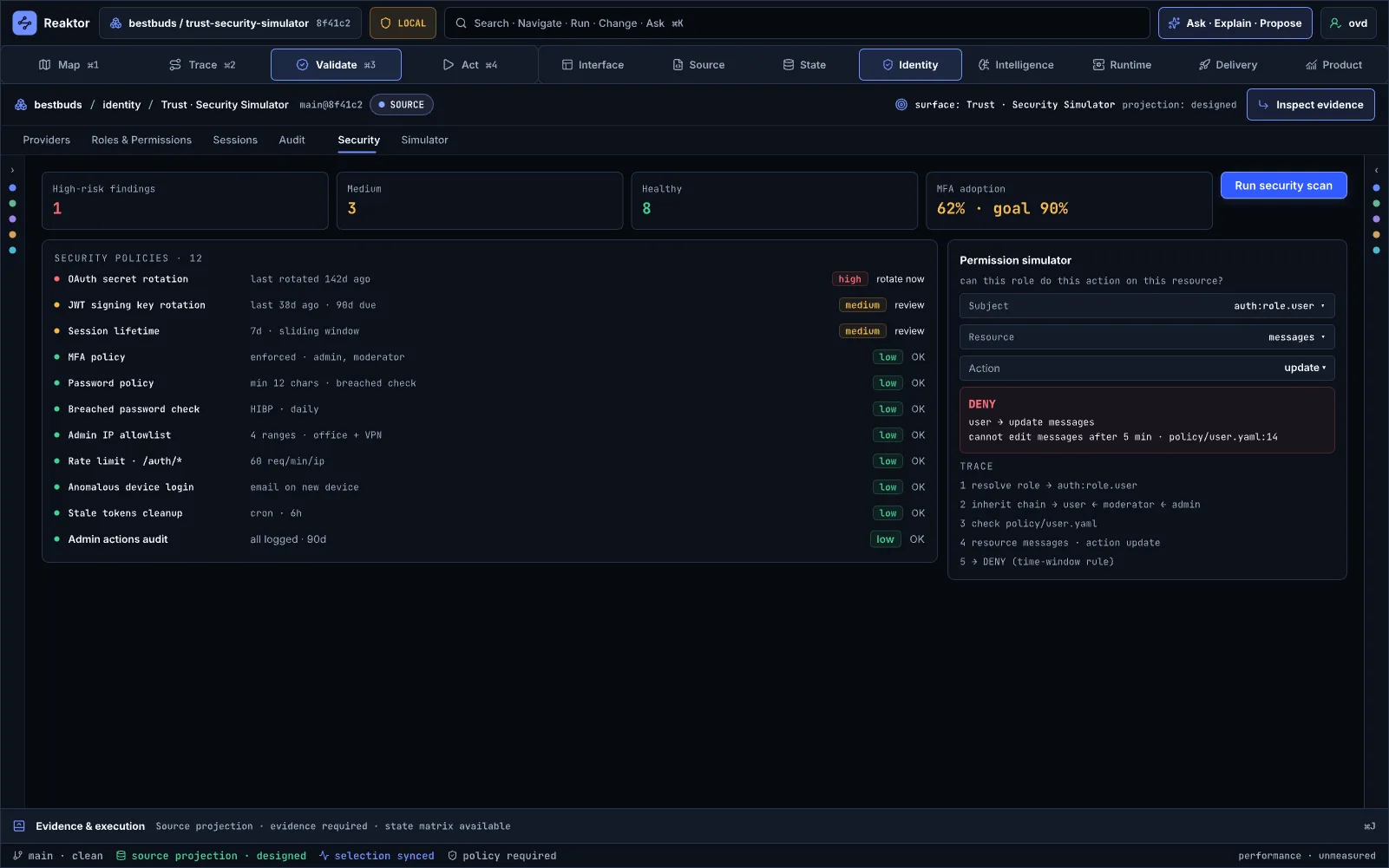
On the board. Two tabs of the identity strip on one board. A posture header reads High-risk findings 1, Medium 3, Healthy 8, MFA adoption 62% · goal 90%, with a Run security scan
control. Below it SECURITY POLICIES · 12 lists eleven rows with a severity and an action — OAuth secret rotation / last rotated 142d ago / high / rotate now, JWT signing key rotation / last 38d ago · 90d due / medium / review, Session lifetime / 7d · sliding window / medium / review, then
eight low / OK rows. The lower half is the Permission simulator, captioned "can this role do this
action on this resource?", with three selectors (Subject auth:role.user, Resource messages,
Action update), a DENY verdict reading user → update messages · cannot edit messages after 5 min · policy/user.yaml:14, and a five-step TRACE: 1 resolve role → auth:role.user, 2 inherit chain → user ← moderator ← admin, 3 check policy/user.yaml, 4 resource messages · action update,
5 → DENY (time-window rule).
Vision tie. The TRACE block is the best thing in this cluster and the only place in it where
the vision genuinely lands. A decision decomposed into ordered, individually inspectable steps with a
source citation is what "the diagram and the system are the same object" looks like applied to
policy. It is also the only pane in sixteen boards that explains why rather than what.
Workflow tie. Opened when a support ticket says "this user says they can't edit". An engineer reproduces the denial in the simulator instead of reading YAML. That is a genuinely good five-minute loop and it is the one loop in this cluster that would get daily use.
Agentic tie. The strongest agentic surface here. A structured subject/resource/action query with
a structured trace is directly machine-composable: an agent can enumerate the cross product, diff
verdicts across a proposed policy change, and cite policy/user.yaml:14 in a PR. What governs it is
weak — the board shows no approval requirement on the simulator, correctly, since simulation is pure,
but it also offers no way for an agent to record a simulation as evidence attached to a change.
Blueprint tie. The Blueprint Debugger: a breakpoint hit with a call stack and the ability to
inspect each frame. The five-step TRACE is a call stack. The analogy breaks in one place and it is
the important place — Unreal's debugger traces an execution that actually happened, whereas this
traces a hypothesis the user typed in. Nothing here is bound to a real request.
Replaces / augments. The AWS IAM Policy Simulator, the OPA/Rego playground, Cedar's CLI evaluator, and — for the posture list — Vanta or Drata.
Improvements.
- Change
Subjectfrom a role to a principal.auth:role.usermust becomeu_9c2ewith the role shown as a resolved attribute. Every instance-scoped bug lives in the gap between a role and a principal. - Add a fourth selector,
Resource instance, besideResource.messagesmust becomemessages in room r_8f41. Without an instance field the simulator cannot expressS-1. - Add a worked
PERMITexample beside theDENY. Every explanation on this board and on09.01explains a denial; the security-relevant failure is always a wrongful permit, and no board in the atlas explains one. - Add a
Checks not performedcolumn to theTRACE, populated from the graph by callsite census. - Reconcile the posture header with reality or mark it.
High-risk findings 1 / Healthy 8is asserted against a code audit that found twelve security findings with a critical authorization bypass among them;01.02in this same atlas says12 findings · 3 blocking. Two boards, same subject, different counts, neither marked. - Make
Run security scanstate what scanner runs. There is no CI in this repository, so the control currently promises an execution with nothing behind it.
Verdict. Strengthen. This is the anchor board of the identity surface and the right home for the Decision Record pane described below.
Would 09.01 or 09.02 have surfaced S-1? No — and the reason is structural, not accidental
S-1 is that any authenticated user can join any chat room: a realtime token is minted after
authenticating the caller and validating the room's shape, but membership is never checked, and the
membership function that exists is called from only two other places. Four separate properties of
this cluster guarantee it is invisible.
The matrix has no instance axis. 09.01's permission matrix is 5 roles × 6 resources where the
six resources are classes: USERS · SESSIONS · ROLES · MESSAGES · CAMPAIGNS · MEDIA. A function from
(role, class) to CRUD cannot express "principal u may read room r but not room r′", because
there is no place in its domain for r. S-1 lives entirely in that gap.
The matrix actively certifies the bug as correct. The user × MESSAGES row reads C R · · —
create and read messages. The deployed behaviour, in which any authenticated user reads any room's
messages, satisfies that cell exactly. A reviewer checking the running system against this board
finds conformance. The board does not merely miss the bug; it ratifies it.
Every explanation is a denial. 09.03's only worked example is DENY, and 09.01's hierarchy
is captioned EXPLAINABLE but explains nothing beyond inheritance. A system that can justify
refusals and cannot justify permissions can never find over-permission, and over-permission is the
whole of the security-relevant failure class.
Sessions are authentication inventory. 09.02 shows that a session exists and offers to revoke
it. Authentication is exactly what worked correctly in S-1. The bug is a resource-authorization
failure downstream of a successful authentication, and there is no column on 09.02 in which it
could appear.
There is a fifth fact, and it changes the recommendation. The atlas already contains the right
concept, on the wrong board. 01.02 · North Star · Auth System Slice carries a RESOURCE POLICY
node reading chat membership · profile views · tenant boundaries; a SELECTED PATH reading
Principal → token → resource decision → repository → audit evidence; a coverage line reading
Source finding · negative authorization tests required; an EVIDENCE & FINDINGS block reading
12 findings · 3 blocking; and a selection inspector reading Finding / chat.membership — Source-proven authorization gap · production mutation blocked, with Truth FAILED · run_7f2a. That
is S-1, named, counted alongside its eleven siblings, and correctly classified. It sits on the
aspirational North Star board and appears nowhere on the three boards a developer actually opens to
ask who can do what. The word membership occurs in four boards atlas-wide and in none of mine.
So the fix is not greenfield. It is to promote 01.02's model into the working surface.
The pane to build: Decision Record, on 09.03. Its subject is one real request, not a
hypothesis, headed POST /realtime/token · room r_8f41 · principal u_9c2e · 15:04:02.118 · run_7f2a. Its anatomy:
- A verdict chip that distinguishes
PERMITTED BY RULEfromPERMITTED BY DEFAULT. This single distinction is the pane's reason to exist.S-1is a permit-by-default: the request succeeded because nothing denied it, which no existing board can represent. - Rules evaluated — an ordered list of every predicate the request passed, each with its verdict
and source location:
authenticate(caller) → PASS · auth/token.kt,validateRoomShape(room) → PASS · realtime/room.kt. This is09.03'sTRACE, rebased onto a real request. - Checks not performed — the column that finds the bug.
isMember(principal, room) → NEVER CALLED, annotated with a callsite census drawn from the live graph:defined · called from 2 sites · not on this path. A predicate that exists, is called elsewhere, and is absent from a path that reaches a protected resource is a computable, high-precision signal. This is exactly the reasoning the human audit performed, and on a live typed graph it is a traversal, not an insight. - Counterfactual — a one-click re-evaluation reporting
if isMember returned false, this request would still be PERMITTED. It converts "the check is missing" from a claim into a demonstration, and it is the control that would survive an argument with a sceptical engineer. - Blast radius —
142k principals × N rooms, cashing out the promise09.01already makes in prose. - Reachability — how many public routes reach this decision path.
- Truth, Effect and Permission fields plus the
Origin / Observed / Confidence / Revision / Ownerevidence block, per the13.03model board; and when the decision log is unwired, an explicitOBSERVED · not wired · decision log adapter absentrather than an empty pane.
The delta from what 09.03 already draws is small: a principal instead of a role, an instance
instead of a class, a permit instead of a denial, and one new column. That is the most valuable
design change available in this cluster.
09.04 · Map + State · Data Studio — Query, Schema & Lineage
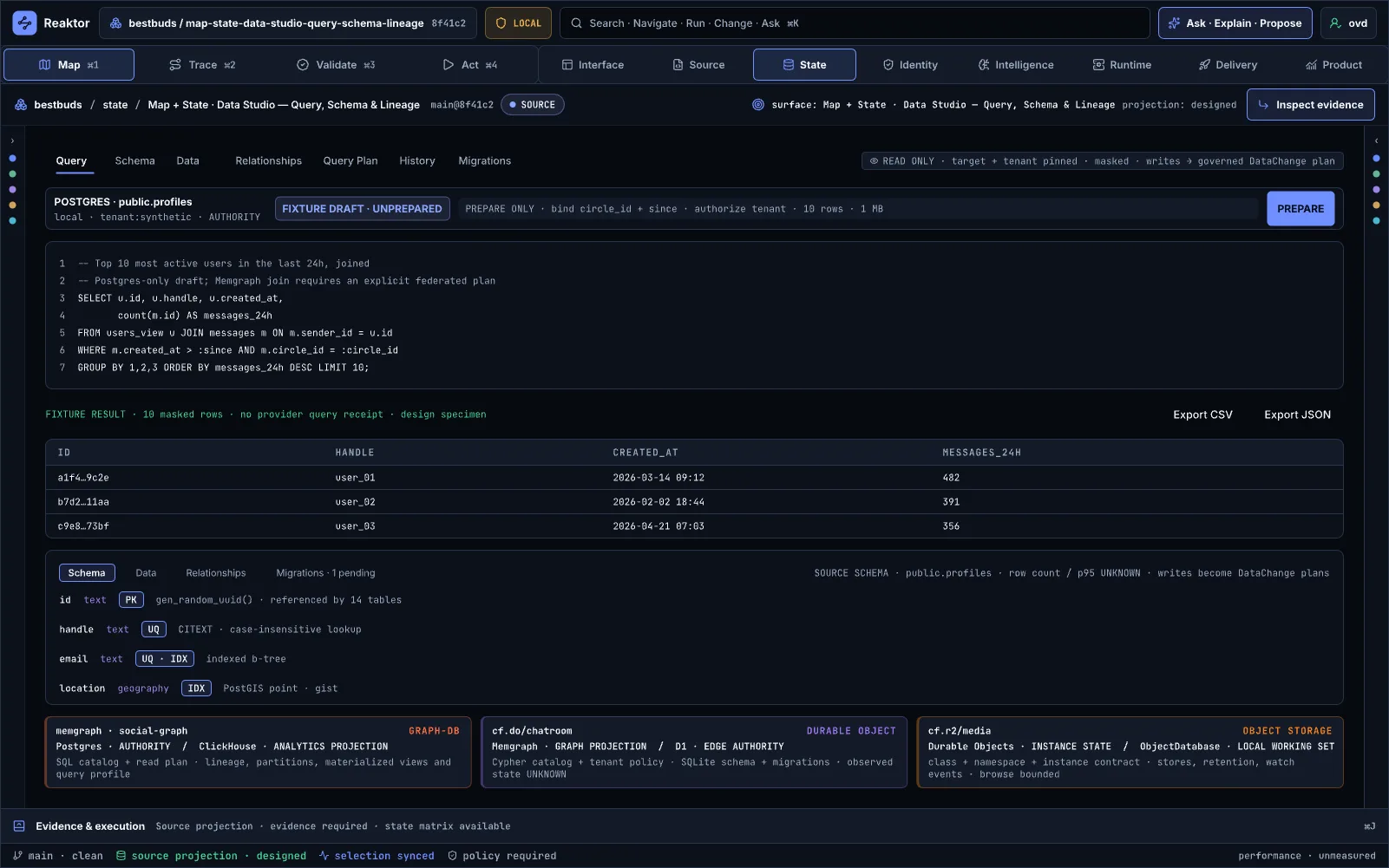
On the board. A seven-tab strip Query · Schema · Data · Relationships · Query Plan · History · Migrations over a governed SQL console. The console is banded READ ONLY · target + tenant pinned · masked · writes → governed DataChange plan, targeted at POSTGRES · public.profiles marked local · tenant:synthetic · AUTHORITY, and the query itself is FIXTURE DRAFT · UNPREPARED with a
PREPARE ONLY · bind circle_id + since · authorize tenant · 10 rows · 1 MB budget and a PREPARE
control. The seven-line SQL includes the comment "Postgres-only draft; Memgraph join requires an
explicit federated plan". Results are banded FIXTURE RESULT · 10 masked rows · no provider query receipt · design specimen over three rows. Below, a SOURCE SCHEMA · public.profiles · row count / p95 UNKNOWN column list (id text PK, handle text UQ CITEXT, email text UQ · IDX, location geography IDX PostGIS point · gist), and a store-card grid pairing each engine with its role:
Postgres · AUTHORITY / ClickHouse · ANALYTICS PROJECTION, Memgraph · GRAPH PROJECTION / D1 · EDGE AUTHORITY, Durable Objects · INSTANCE STATE / ObjectDatabase · LOCAL WORKING SET, with observed state UNKNOWN and browse bounded.
Vision tie. This is the best board in the cluster and one of the better boards in the atlas. It
embodies polyglot on one data plane and evidence together and without cheating. The store
cards make authority a first-class visual property, and the SQL comment "Memgraph join requires an
explicit federated plan" is the polyglot seam shown honestly rather than papered over. Every number
on the board is either marked fixture or marked UNKNOWN.
Workflow tie. Opened several times a week by anyone answering a data question — the "top 10 most active users" query in the console is exactly the ad-hoc ask. Today that is TablePlus pointed at production with no tenant pin, no masking and no budget, which is the practice this board is designed to end.
Agentic tie. Excellent. An agent reads store authority, column types, index coverage and the
budget envelope, and can compose a query it knows must be PREPAREd before running. writes → governed DataChange plan is the governing rule and it is stated on the band rather than implied. The
no provider query receipt mark is precisely the signal an agent needs to avoid reporting fixture
rows as findings.
Blueprint tie. The Content Browser plus the Reference Viewer — assets with their types,
and what references what. referenced by 14 tables on the id column is literally a reference-count
badge. The analogy is strong and the board should lean into it further.
Replaces / augments. TablePlus, DataGrip, pgAdmin, the Supabase SQL editor, dbt docs for lineage, and the ad-hoc half of Metabase or Hex.
Improvements.
- Move
AUTHORITYfrom the store card to the datum. The audit's finding is about which store is authoritative for what, and a per-store badge cannot express that identity is authoritative in Postgres while presence is authoritative in the Durable Object. Add anAuthoritycolumn to the schema list, valued per column or per table. - Resolve the two-authority conflict the board creates.
Postgres · AUTHORITYandD1 · EDGE AUTHORITYboth appear with no rule for disagreement. Add aConflictfinding component —13.03already defines one — that fires when two stores claim authority for the same datum. - Add a
Stalenessfield to each projection card.ClickHouse · ANALYTICS PROJECTIONandMemgraph · GRAPH PROJECTIONare read models, and their lag is the single most consequential fact a developer needs;eventually consistentappears zero times in the entire atlas. - Restore the
Querytab on09.05and09.06, which drop it — the same surface currently has two different tab strips. - Depict the
Datatab. It is listed here and on both sibling boards and no board shows it. - Make
referenced by 14 tablesclickable into the graph; it is the one lineage affordance already present and it currently goes nowhere.
Verdict. Strengthen. This board should be the template the identity cluster is rebuilt against.
09.05 · State · Query Plan & Governed Migrations
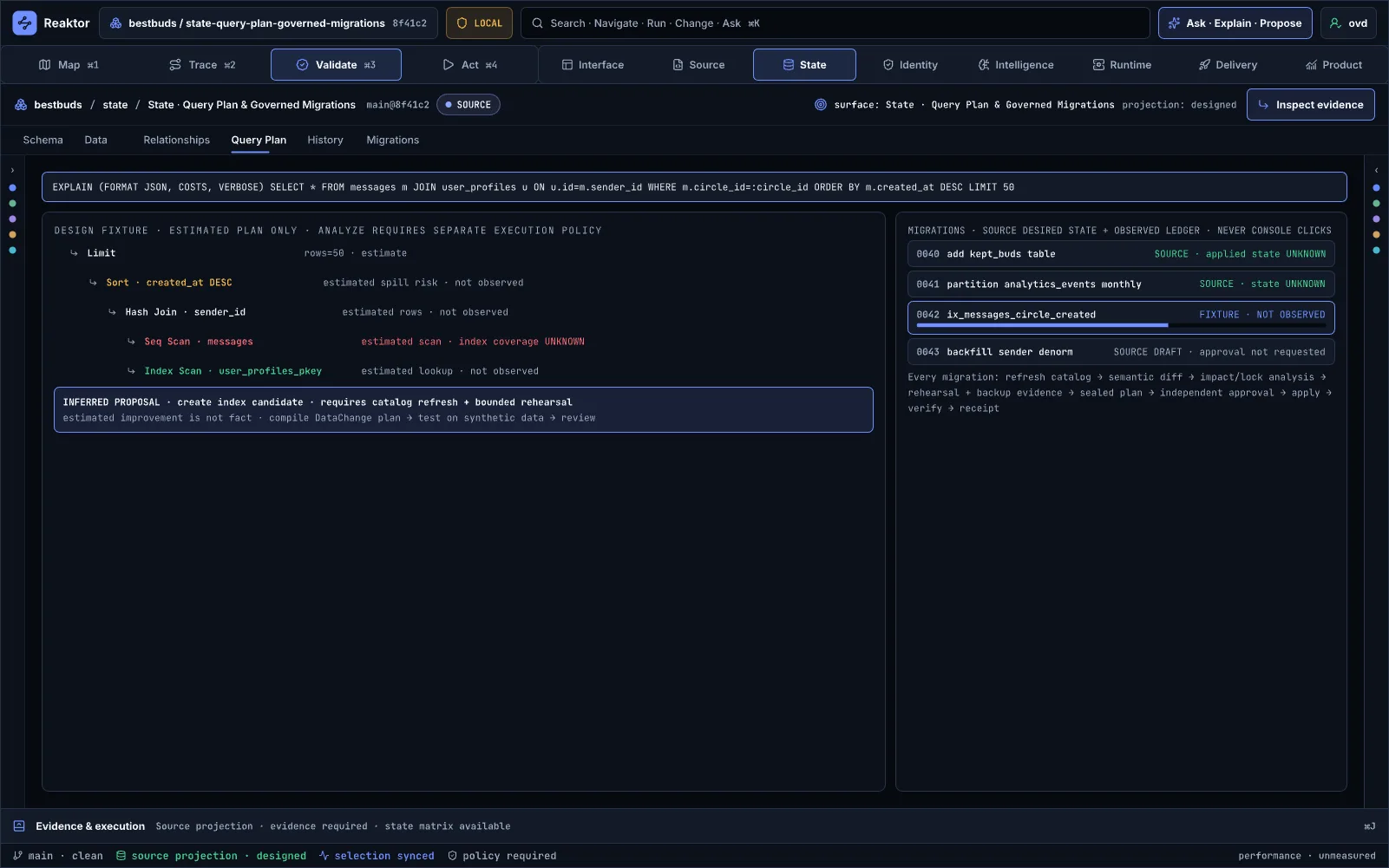
On the board. A six-tab strip without Query. The upper pane shows an EXPLAIN (FORMAT JSON, COSTS, VERBOSE) statement over messages JOIN user_profiles, banded DESIGN FIXTURE · ESTIMATED PLAN ONLY · ANALYZE REQUIRES SEPARATE EXECUTION POLICY, with a five-node plan tree where every node
carries its own hedge: Limit rows=50 · estimate, Sort · created_at DESC / estimated spill risk · not observed, Hash Join · sender_id / estimated rows · not observed, Seq Scan · messages / estimated scan · index coverage UNKNOWN, Index Scan · user_profiles_pkey / estimated lookup · not observed. Beneath it an INFERRED PROPOSAL · create index candidate · requires catalog refresh + bounded rehearsal, qualified "estimated improvement is not fact · compile DataChange plan → test on
synthetic data → review". The lower pane is MIGRATIONS · SOURCE DESIRED STATE + OBSERVED LEDGER · NEVER CONSOLE CLICKS with four rows — 0040 add kept_buds table / SOURCE · applied state UNKNOWN,
0041 partition analytics_events monthly / SOURCE · state UNKNOWN, 0042 ix_messages_circle_created / FIXTURE · NOT OBSERVED, 0043 backfill sender denorm / SOURCE DRAFT · approval not requested —
over an eight-stage contract from refresh catalog to receipt.
Vision tie. Strong on evidence and it is the clearest application in the cluster of the
DESIRED + OBSERVED dual plane that 13.03 establishes. The header literally names both planes and
then admits the observed plane is empty for all four rows. NEVER CONSOLE CLICKS is a real
architectural commitment stated as a design constraint.
Workflow tie. Opened on the day a migration ships and during the postmortem of a slow query. The
audience is one senior engineer and whoever must approve. Today this is Flyway plus a pganalyze
tab plus a Slack thread asking whether 0041 actually ran in production.
Agentic tie. Well-governed. INFERRED PROPOSAL is the correct truth class for an agent
suggestion, and "estimated improvement is not fact" is an instruction to the agent as much as to the
human. An agent can propose the index and cannot apply it; the eight-stage contract names
independent approval explicitly. The gap is that there is no place for the agent to attach the
rehearsal result once obtained.
Blueprint tie. The cook and package pipeline with the asset validator attached —
migrations as ordered cook steps, each gated by a validator, none of which may be skipped by hand.
The NEVER CONSOLE CLICKS rule is the direct analogue of forbidding hand-edited cooked content.
Replaces / augments. Flyway, Liquibase, Atlas, gh-ost and pt-online-schema-change,
PlanetScale deploy requests, and pganalyze for the plan half.
Improvements.
- Split the migration row's single state chip into two columns,
DesiredandObserved. The header promises both planes; the rows collapse them into one string, which is why0042readsFIXTURE · NOT OBSERVEDwhile0040readsSOURCE · applied state UNKNOWNfor what is the same underlying condition. - Add a
Lock analysiscolumn with an estimated lock duration and blocked-query class per row. The eight-stage contract names "impact/lock analysis" and no column shows it. - Add an
Applied atandApplied bypair, empty with a reason, so the ledger has a shape to fill rather than a proseUNKNOWN. - Make
0043 backfill sender denormshow its row estimate and its resumability, since a backfill is the migration class that most needs both and the one whereapproval not requestedmatters most. - Add a
Rehearsalslot on theINFERRED PROPOSALcard that holds the synthetic-data result, so the proposal accumulates evidence rather than staying an estimate.
Verdict. Strengthen.
09.06 · State · Data Evidence & History
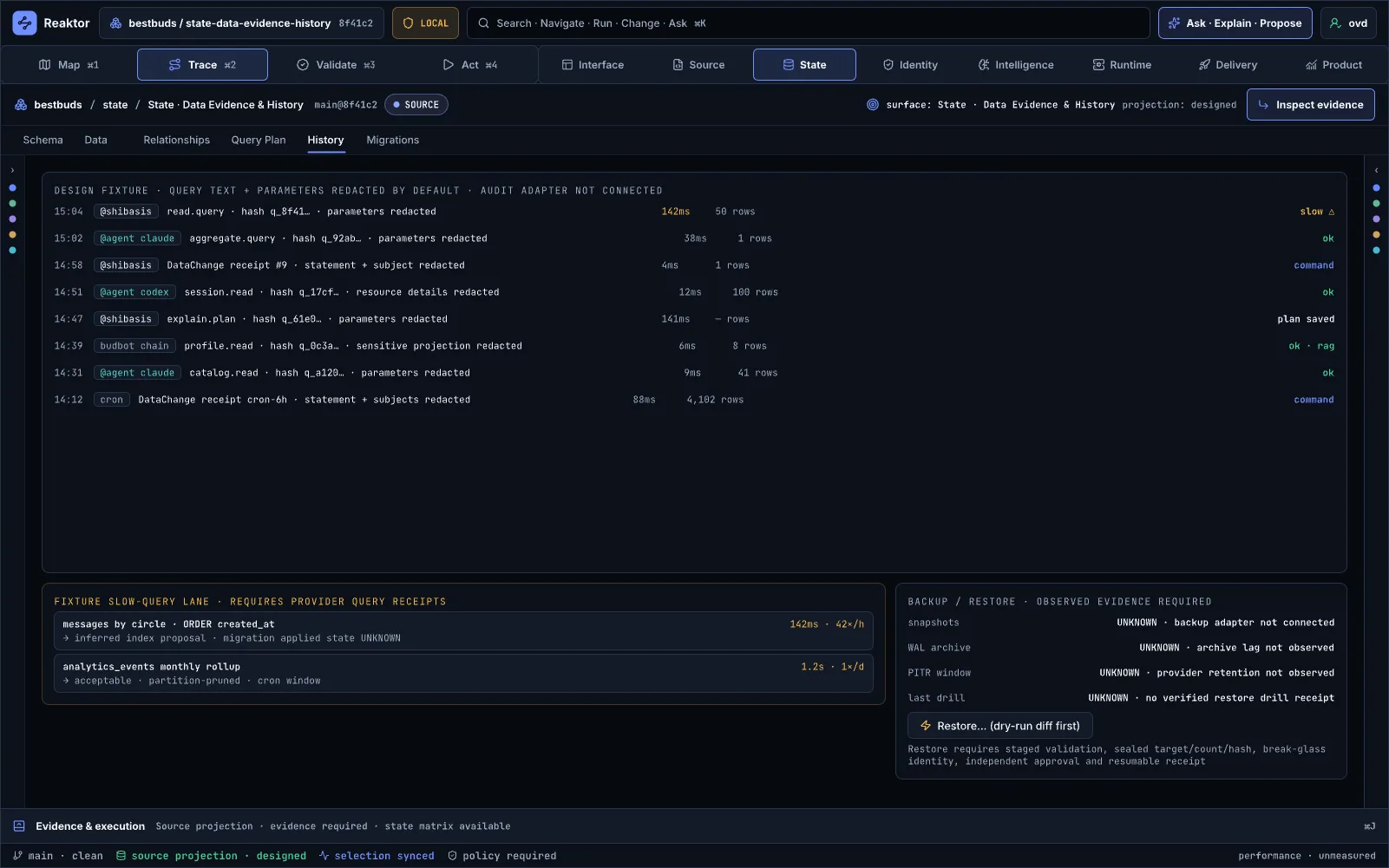
On the board. Three stacked panes on the same six-tab strip. First, a query history banded
DESIGN FIXTURE · QUERY TEXT + PARAMETERS REDACTED BY DEFAULT · AUDIT ADAPTER NOT CONNECTED, listing
eight timestamped entries with a mixed principal column — @shibasis, @agent claude, @agent codex, budbot chain, cron — each with an operation and hash (read.query · hash q_8f41…,
DataChange receipt #9 · statement + subject redacted, profile.read · hash q_0c3a… · sensitive projection redacted), a duration, a row count and a status (slow ⚠, ok, command, plan saved,
ok · rag). Second, FIXTURE SLOW-QUERY LANE · REQUIRES PROVIDER QUERY RECEIPTS with two entries,
one pointing to inferred index proposal · migration applied state UNKNOWN. Third, BACKUP / RESTORE · OBSERVED EVIDENCE REQUIRED with four fields all UNKNOWN, each carrying its own reason:
snapshots UNKNOWN · backup adapter not connected, WAL archive UNKNOWN · archive lag not observed,
PITR window UNKNOWN · provider retention not observed, last drill UNKNOWN · no verified restore drill receipt; and a Restore… (dry-run diff first) control gated by "staged validation, sealed
target/count/hash, break-glass identity, independent approval and resumable receipt".
Vision tie. This is the atlas's honesty high-water mark and the clearest realisation anywhere of
§1's closing principle that a NotWiredYet stating what is missing beats an invented number. Four
consecutive UNKNOWNs, each naming the specific adapter or receipt whose absence causes it, is
EmptyReason used correctly — in prose rather than as a component, but used correctly. last drill UNKNOWN · no verified restore drill receipt is a better answer than any number a competitor's
dashboard would print there.
Workflow tie. Two distinct moments. The slow-query lane is opened weekly by whoever owns performance. The backup block is opened once a quarter under duress, when someone asks whether the restore path has ever been tested — and this board's answer, "no verified restore drill receipt", is the answer most organisations discover only during the incident.
Agentic tie. The strongest agentic surface in the cluster, because the history pane treats
@agent claude, @agent codex and budbot chain as first-class principals alongside humans and
cron. That is §1's "agents as first-class operators" rendered concretely: agent activity is audited
in the same ledger as human activity, with the same redaction policy. An agent reading this board
sees its own footprint.
Blueprint tie. Unreal Insights plus the autosave and backup recovery panel — a trace store of what ran, joined to a recovery surface. The analogy is apt including the fact that in Unreal, too, the backup panel is the one nobody exercises until the day it matters.
Replaces / augments. pganalyze, pgBadger, Datadog Database Monitoring, the AWS Backup and RDS PITR consoles, and the query-audit half of a SIEM.
Improvements.
- Add a
Principal classfilter (human · agent · service · cron) to the history pane. The board already carries the distinction in its data and offers no way to slice by it. - Give the four backup fields a target column beside the
UNKNOWN, so the pane states the intended RPO and RTO next to the unobserved actual. An unknown against a stated target is actionable; an unknown alone is only honest. - Add an
Authoritybadge to each history row naming which store served it, connecting this board to09.04's authority model. - Escalate
last drill UNKNOWNinto a finding with an owner rather than a field. It is the highest- severity fact on the board and it renders identically to the other three. - Add a
Reads served from projectionmarker on rows whose data came from ClickHouse or Memgraph, since a slow query against a read model has a different remedy from one against the authority.
Verdict. Keep. This board is doing its job and should be cited as the standard for the rest of the atlas.
STATE · Composer · 1 of 5 · Product Intent
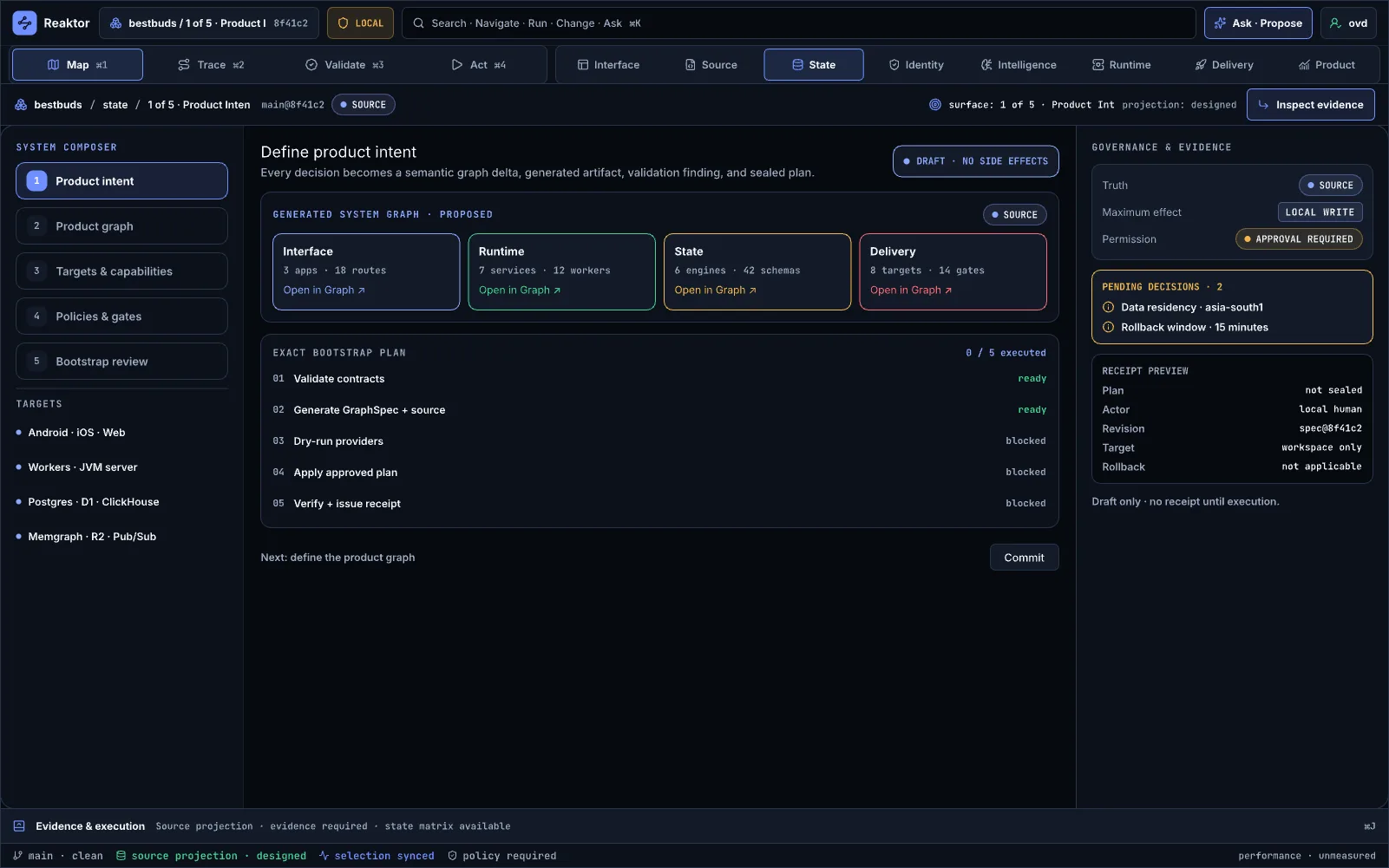
On the board. A left SYSTEM COMPOSER stepper (1 Product intent … 5 Bootstrap review) over a
static TARGETS rail reading Android · iOS · Web / Workers · JVM server / Postgres · D1 · ClickHouse / Memgraph · R2 · Pub/Sub. The centre is headed "Define product intent" with the contract
"Every decision becomes a semantic graph delta, generated artifact, validation finding, and sealed
plan", chipped DRAFT · NO SIDE EFFECTS, above GENERATED SYSTEM GRAPH · PROPOSED marked SOURCE
with four cards — Interface 3 apps · 18 routes, Runtime 7 services · 12 workers, State 6 engines · 42 schemas, Delivery 8 targets · 14 gates, each with Open in Graph ↗ — and EXACT BOOTSTRAP PLAN 0 / 5 executed listing 01 Validate contracts ready, 02 Generate GraphSpec + source ready,
03 Dry-run providers blocked, 04 Apply approved plan blocked, 05 Verify + issue receipt blocked. A right rail holds GOVERNANCE & EVIDENCE (Truth SOURCE, Maximum effect LOCAL WRITE,
Permission APPROVAL REQUIRED), PENDING DECISIONS · 2 (Data residency · asia-south1, Rollback window · 15 minutes) and a RECEIPT PREVIEW reading Plan not sealed, Actor local human,
Revision spec@8f41c2, Target workspace only, Rollback not applicable.
Vision tie. The framing sentence is the vision stated well — a decision becoming a graph delta
and a sealed plan is exactly the thesis. The board then contradicts it. This is step one, "Product
intent", before any input has been given, and it already asserts 3 apps · 18 routes, 7 services · 12 workers, 6 engines · 42 schemas and 8 targets · 14 gates, marked SOURCE. The output is
fully specified before the first input exists. If the diagram and the system are the same object, a
diagram of a system nobody has yet described is the one thing the thesis forbids.
Workflow tie. Opened once, ever, per product. That is the honest weight of a "new system" screen,
and it argues against spending five boards on it. Today this is rails new, create-next-app, or a
Backstage software template.
Agentic tie. Hostile in an interesting way. There is no visible input control anywhere on the
board — no text field, no picker, nothing that accepts intent. An agent reading it cannot determine
what it is being asked to supply. Commit is the only action, and PENDING DECISIONS · 2 names two
decisions with no control to decide them.
Blueprint tie. Unreal's new project wizard with its template gallery. The comparison is unflattering: Unreal's wizard is one screen with thumbnails, a blueprint-or-C++ toggle and a target platform picker, and it produces a running project. This is five screens that produce a summary.
Replaces / augments. create-next-app and rails new, Terraform and Pulumi init, Backstage
software templates, the Firebase and Amplify project-creation flows.
Improvements.
- Put an input on the input step. A product-intent step needs a name, a one-line description, a domain and a template picker, and none of the four exists.
- Empty the
GENERATED SYSTEM GRAPHcards until something generates them. At step one every card should read— · awaiting intent, not a specific count markedSOURCE. - Change the four cards' truth chip from
SOURCEtoPROPOSED · derived from templateonce a template is chosen.SOURCEasserts these counts came from real source, which is a stronger and falser claim than fixture. - Turn
PENDING DECISIONS · 2into two controls with defaults and an owner, since a decision the user cannot make is a label. - Collapse the stepper into a progress control on a single Composer board — see the verdict.
Verdict. Merge into a single STATE · Composer board with the stepper as a control.
STATE · Composer · 2 of 5 · Product Graph
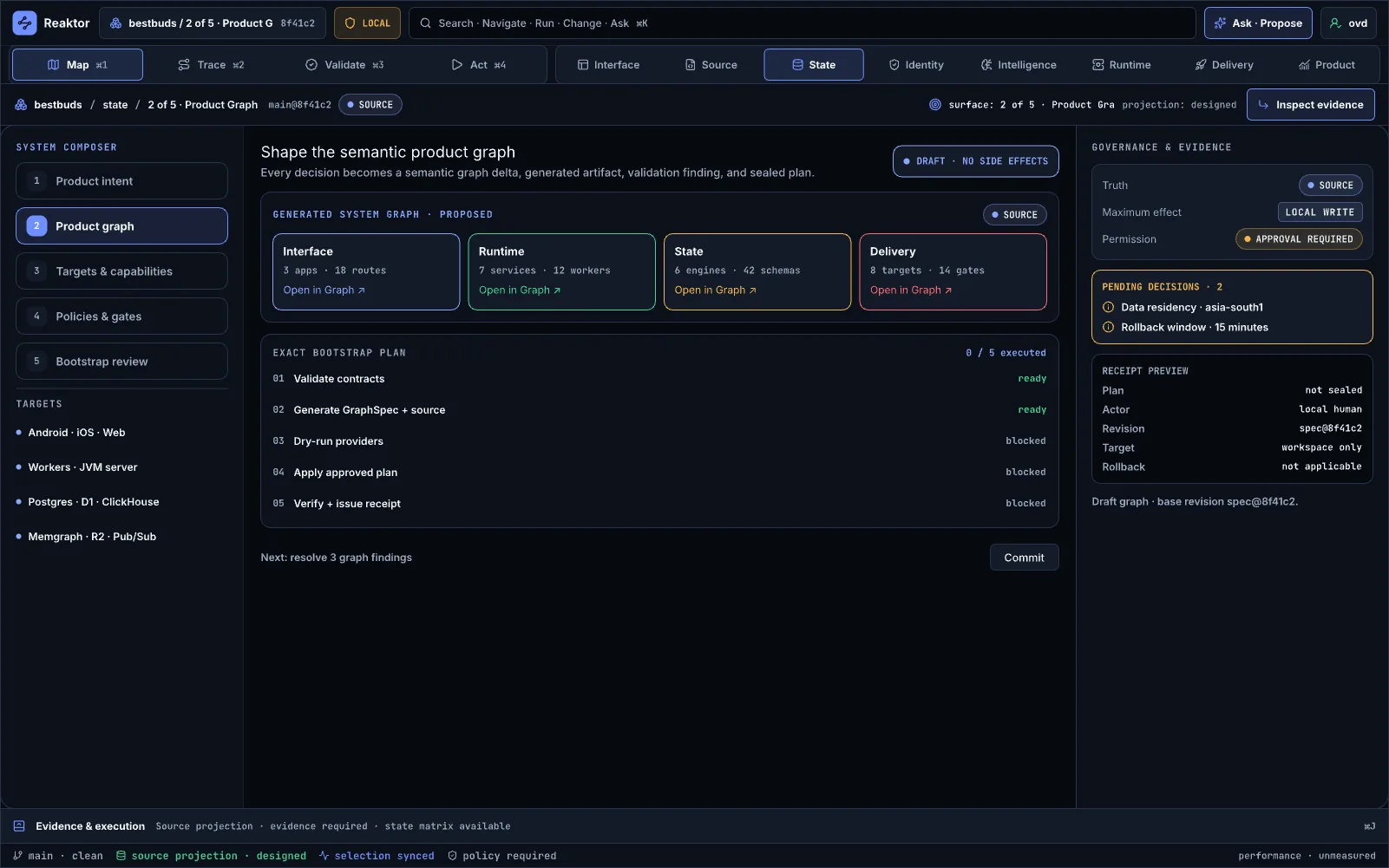
On the board. Byte-identical to step 1 except for six lines: the title, three breadcrumb echoes,
the headline "Shape the semantic product graph", the Next: resolve 3 graph findings line, and the
footnote "Draft graph · base revision spec@8f41c2". The stepper, targets rail, generated-graph cards,
bootstrap ledger, governance rail and receipt preview are unchanged.
Vision tie. This is the step that should carry the entire weight of §1 — the semantic product graph is the framework's central object — and it shows no graph. The pane where a user would shape nodes and ports is occupied by the same four summary cards shown on every other step. The board names the vision and depicts none of it.
Workflow tie. The one step in the wizard that would genuinely take an afternoon, given eight
lines of screen. Today this is a whiteboard photo, and the honest observation is that 04.02 · Map · Semantic Graph Editor already exists in this atlas and is where this work belongs.
Agentic tie. Next: resolve 3 graph findings is the most agent-relevant string on any Composer
board — three specific findings an agent could triage — and the findings are never listed. An agent
gets a count and no payload.
Blueprint tie. This should be the Blueprint graph editor itself and instead it is the project-settings summary page. That is the sharpest instance in the cluster of the Blueprint analogy being invoked and not honoured.
Replaces / augments. Nothing, as drawn. As intended, it overlaps 04.02 and the schema-design
half of Terraform module authoring.
Improvements.
- Embed the graph canvas from
04.02as this step's body rather than repeating the summary cards. TheOpen in Graph ↗controls already point at it; the step should host it. - List the three findings with severity, node and a resolve control. A count with no list is the board's central failure.
- Show a node and port inventory that changes as the graph is edited, replacing the frozen
3 apps · 18 routes. - Add a
Port type identityvalidation row to the findings list. DefectD-6— string-built ports carrying a null class and connecting to anything — is a graph-authoring defect that this step is the natural place to catch, and it is exactly the class of finding the composer should refuse to proceed past.
Verdict. Merge into 04.02 · Map · Semantic Graph Editor, which already does this properly.
STATE · Composer · 3 of 5 · Targets & Capabilities
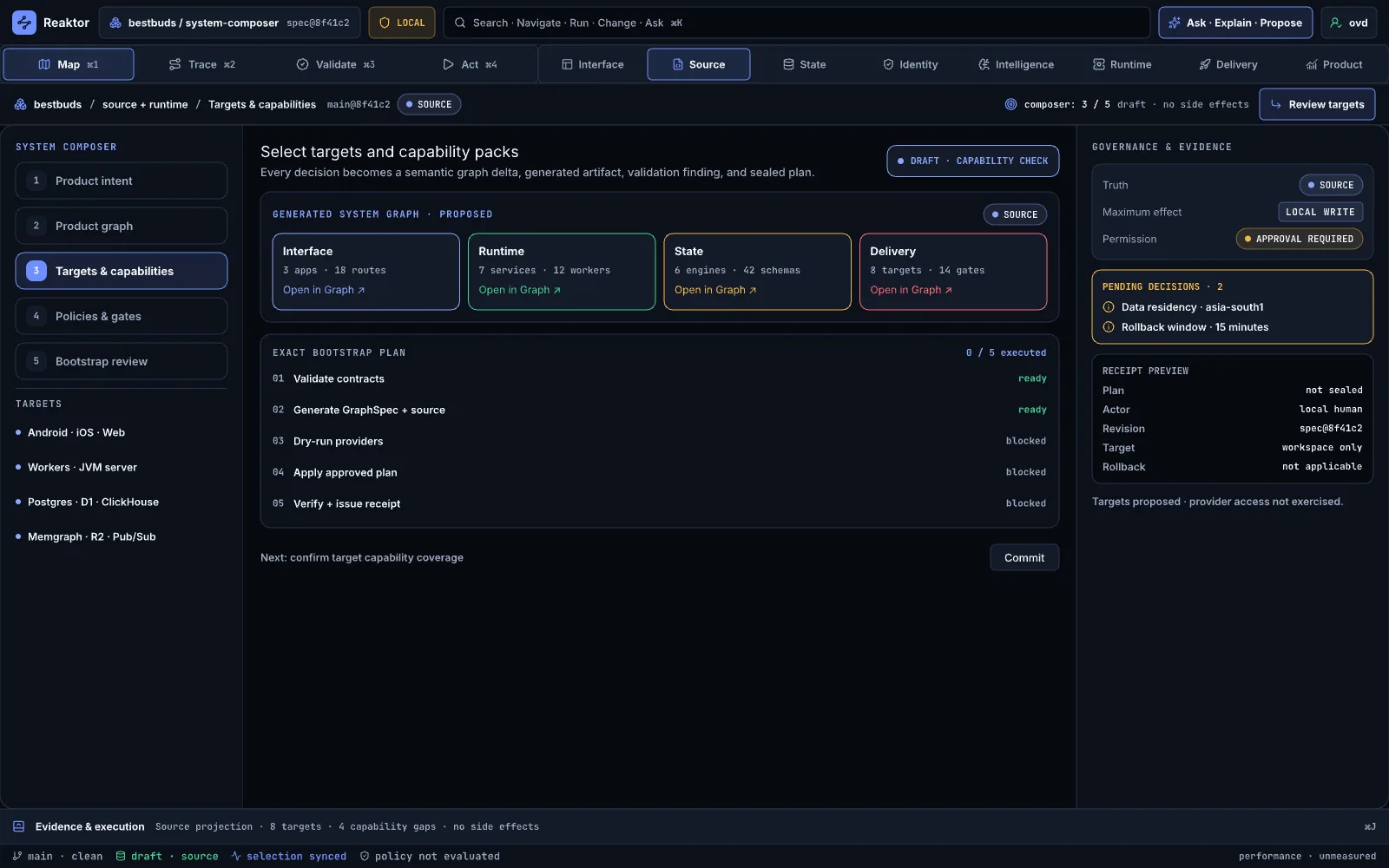
On the board. The most-diverged of the five steps, and the only one re-authored in the V2
chrome — its header reads composer: 3 / 5 and draft · no side effects where the others read
surface: and projection: designed, its revision chip reads spec@8f41c2 rather than 8f41c2,
and its footer reads policy not evaluated rather than policy required. Its capability content in
full is four strings: the headline "Select targets and capability packs", the chip DRAFT · CAPABILITY CHECK, the line Next: confirm target capability coverage, and a footer reading Source projection · 8 targets · 4 capability gaps · no side effects. Its footnote is "Targets proposed ·
provider access not exercised." The body is the same generated-graph cards and bootstrap ledger as
every other step.
Vision tie. This is where §1's adapter-and-capability model must live, and it is absent. Four
capability gaps are asserted and not one is enumerated. The word tier does not appear on this board;
across the whole atlas it appears on three boards, none of them this one. The word degradation, in
any form, appears zero times in all 104 boards — so the vision's sentence "degradation is
designed, not discovered" has no representation anywhere in the product atlas, and this is the board
whose title promises it. There is also a category error in the TARGETS rail, which mixes platforms
(Android · iOS · Web) with services (Postgres · R2 · Pub/Sub) on one list; a platform lacks
biometric auth, a datastore lacks transactions, and one axis cannot tier both.
Workflow tie. This is the step that determines what the product can never do on one of its targets, which makes it the highest-consequence screen in the wizard and the one most likely to be clicked past. Today the answer is discovered six months later when a feature ships broken on web.
Agentic tie. The most valuable possible agentic surface in this cluster and currently the
emptiest. A capability matrix is a machine-checkable contract: an agent could verify that no node
branches on platform, propose a degradation route for an absent cell, and refuse a plan whose target
set has an undesigned gap. As drawn, an agent reads the number 4 and nothing else.
Blueprint tie. Unreal's platform settings and device profiles — per-platform feature support with scalability tiers and explicit fallbacks. Unreal's version is a real matrix with real tiers, and this board is the label of that matrix without the matrix.
Replaces / augments. Unreal device profiles, caniuse and browser support matrices, Expo's
config plugins, LaunchDarkly when it is misused as a platform-capability switch.
The pane to build: Capability Matrix. Platforms down one axis, capabilities across, a tier in
each cell.
- Rows split into two blocks, because they tier differently: Devices (
Android,iOS,Web,Desktop) and Services (Workers,JVM server,Postgres,D1,ClickHouse,Memgraph,R2,Pub/Sub). - Columns are capabilities declared by the graph's adapters, not invented for the board:
biometric-auth,background-push,secure-enclave,filesystem,websocket,transactions,full-text-search,geo-query,blob-range-read,cron. - Cells carry one of five tiers:
FULL,PARTIAL,EMULATED,ABSENT, and — the honest default given §2 —UNKNOWN · adapter not probed. Most cells in this product areUNKNOWNtoday and the matrix should say so rather than fill itself in. - The empty cell is the point. Every
ABSENTorPARTIALcell must name its degradation route and its owner:Web × background-push = PARTIAL · service worker only · degrades to in-app banner · owner @platform. A cell with no route renders as a finding,UNDESIGNED DEGRADATION · product code will branch on platform. That single cell state turns the vision's sentence into an enforceable lint, and the count of such cells is the honest replacement for the bare4 capability gaps, which should read4 gaps · 2 undesigned. - Column footer carries
consumers · N nodes branch on this capabilityand abranches on platform · N violationscounter, each violation opening the offending node via theOpen in Graph ↗control the board already has. This is the direct, computable check that product code branches on capability and never on platform — the rule §1 states and no board enforces. - Row footer carries the target's coverage and whether any capability it lacks is required by a committed feature, which is the fact that should block the bootstrap plan.
Improvements. Build the matrix above as the step's body; split the TARGETS rail into devices and
services; make the rail a selector rather than a caption, since the headline says "Select" and no
control selects; replace 4 capability gaps with the gap list; and re-author steps 1, 2, 4 and 5 into
this board's V2 chrome so the wizard speaks one grammar.
Verdict. Rebuild. This is the one Composer step that earns its own board, and it is currently the emptiest.
STATE · Composer · 4 of 5 · Policies
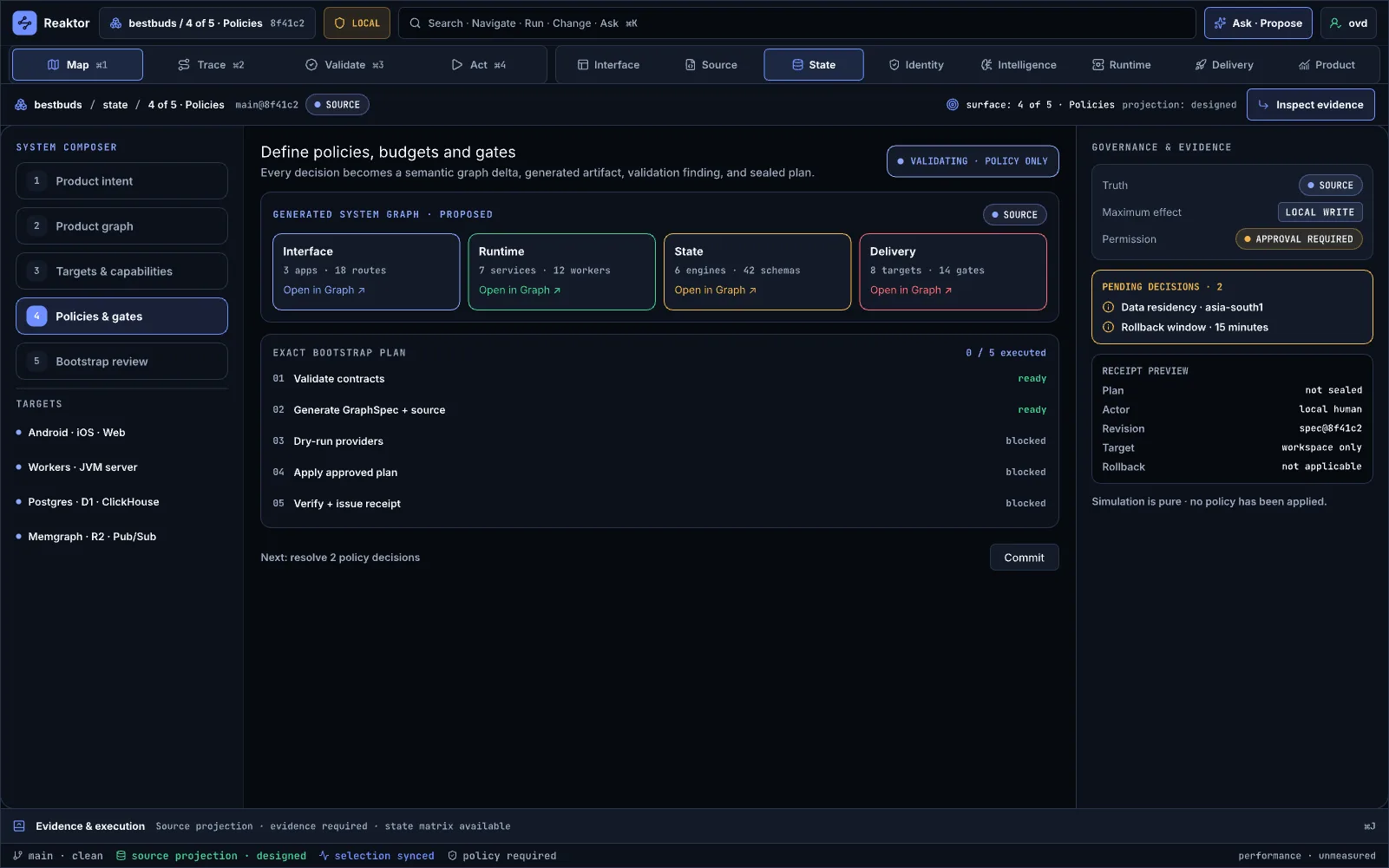
On the board. Six lines different from step 1: the headline "Define policies, budgets and gates",
the chip VALIDATING · POLICY ONLY, the line Next: resolve 2 policy decisions, and the footnote
"Simulation is pure · no policy has been applied." No policy, budget or gate is shown anywhere on the
board; the body remains the generated-graph cards and the bootstrap ledger.
Vision tie. None as drawn. The footnote "Simulation is pure · no policy has been applied" is a
genuinely correct and well-stated position — it is the same claim 09.03 earns with its simulator —
but here it describes a simulation that has no visible subject.
Workflow tie. This is where residency, retention, budget ceilings and approval gates are set for the life of the system, which in practice happens in a Terraform variables file six weeks later.
Agentic tie. Next: resolve 2 policy decisions refers to the same PENDING DECISIONS · 2 shown
on all ten Composer boards — Data residency · asia-south1 and Rollback window · 15 minutes. Those
two decisions never resolve; they persist unchanged into Provisioning · Complete. An agent tracking
them would observe a system reach verified completion with its policy decisions still pending.
Blueprint tie. Unreal's project settings tree. The analogy is fine and the board does not honour it: project settings has hundreds of leaves and this has none.
Replaces / augments. Terraform variable files, OPA bundle authoring, LaunchDarkly's approval settings, cloud organisation policy consoles.
Improvements.
- Show the policy list.
09.01already draws exactly the right component —Policies · 7with a name, a value and an+ Add policycontrol — and this step should reuse it rather than show nothing. - Add a budget block with concrete ceilings per target, since the headline promises budgets and nothing on the board mentions cost.
- Make the two pending decisions resolvable here and have them disappear from the governance rail once resolved, which is the only way the rail's count becomes meaningful.
- Add a gate list mapping each gate to the bootstrap step it blocks, connecting this step to the
blockedstates in the ledger that no board explains.
Verdict. Merge into STATE · Composer, reusing 09.01's policy list component as its body.
STATE · Composer · 5 of 5 · Bootstrap Ready
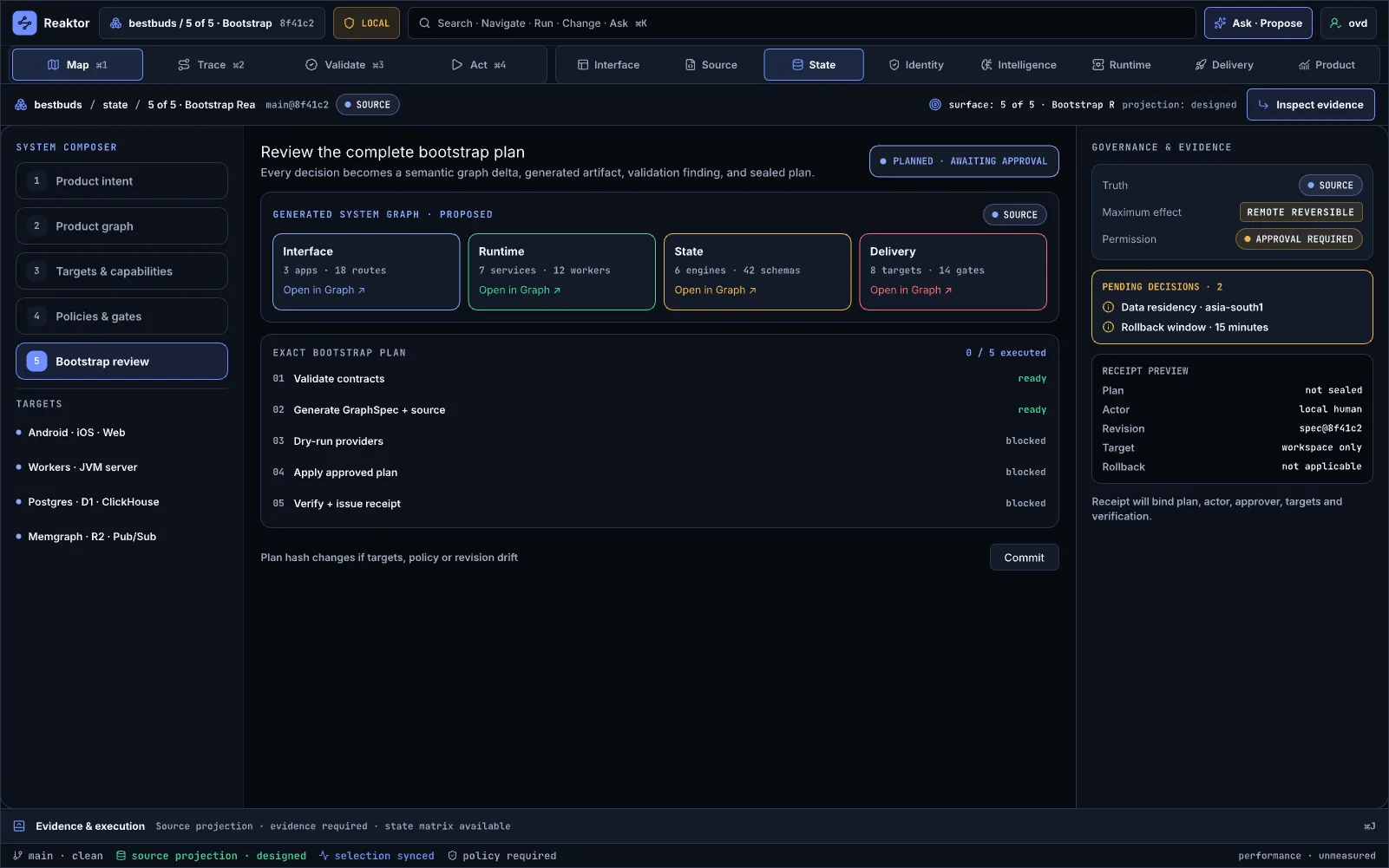
On the board. Six lines different from step 1: the headline "Review the complete bootstrap plan",
the chip PLANNED · AWAITING APPROVAL, the line "Plan hash changes if targets, policy or revision
drift", the footnote "Receipt will bind plan, actor, approver, targets and verification", and one
substantive change in the governance rail — Maximum effect escalates from LOCAL WRITE to REMOTE REVERSIBLE.
Vision tie. Two genuinely excellent lines. "Plan hash changes if targets, policy or revision
drift" is the fingerprint idea from §2's verification program applied correctly to a plan, and it is
one of only two places in the atlas where fingerprinting appears at all. "Receipt will bind plan,
actor, approver, targets and verification" is a precise statement of what a receipt is for. The
escalation of Maximum effect at the moment of approval is the right control at the right step.
Workflow tie. The approval moment: two people at one screen, one of whom is accountable. This is the step that most deserves to exist as its own board.
Agentic tie. Well-governed in principle. A plan hash that changes on drift is exactly what
prevents an agent replaying a stale approval, and the board says so. What is missing is the hash
itself — no plan hash is shown on this board, though Provisioning · Running displays plan 05e2…a91f, so the artefact exists one board later and not on the board that reviews it.
Blueprint tie. The package and cook confirmation dialog before a build is submitted. Apt.
Replaces / augments. terraform plan output, Pulumi preview, PlanetScale deploy requests,
GitHub environment protection rules.
Improvements.
- Show the plan hash. The board's entire argument rests on it and it is not displayed.
- Show the full ordered plan with per-step effect class, not the same five-line summary as step 1. A review step must render the thing being reviewed.
- Fix
RECEIPT PREVIEW, which still readsTarget workspace onlyandRollback not applicablewhileMaximum effecton the same rail now readsREMOTE REVERSIBLE. Those cannot both be true. - Add an
Approverfield distinct fromActor local human; the footnote promises the receipt binds an approver and the preview has no slot for one. - Add a diff against the previous plan hash, so re-approval after drift shows what drifted.
Verdict. Strengthen. This is the one wizard step that should survive as its own board.
STATE · Composer · Provisioning · Running
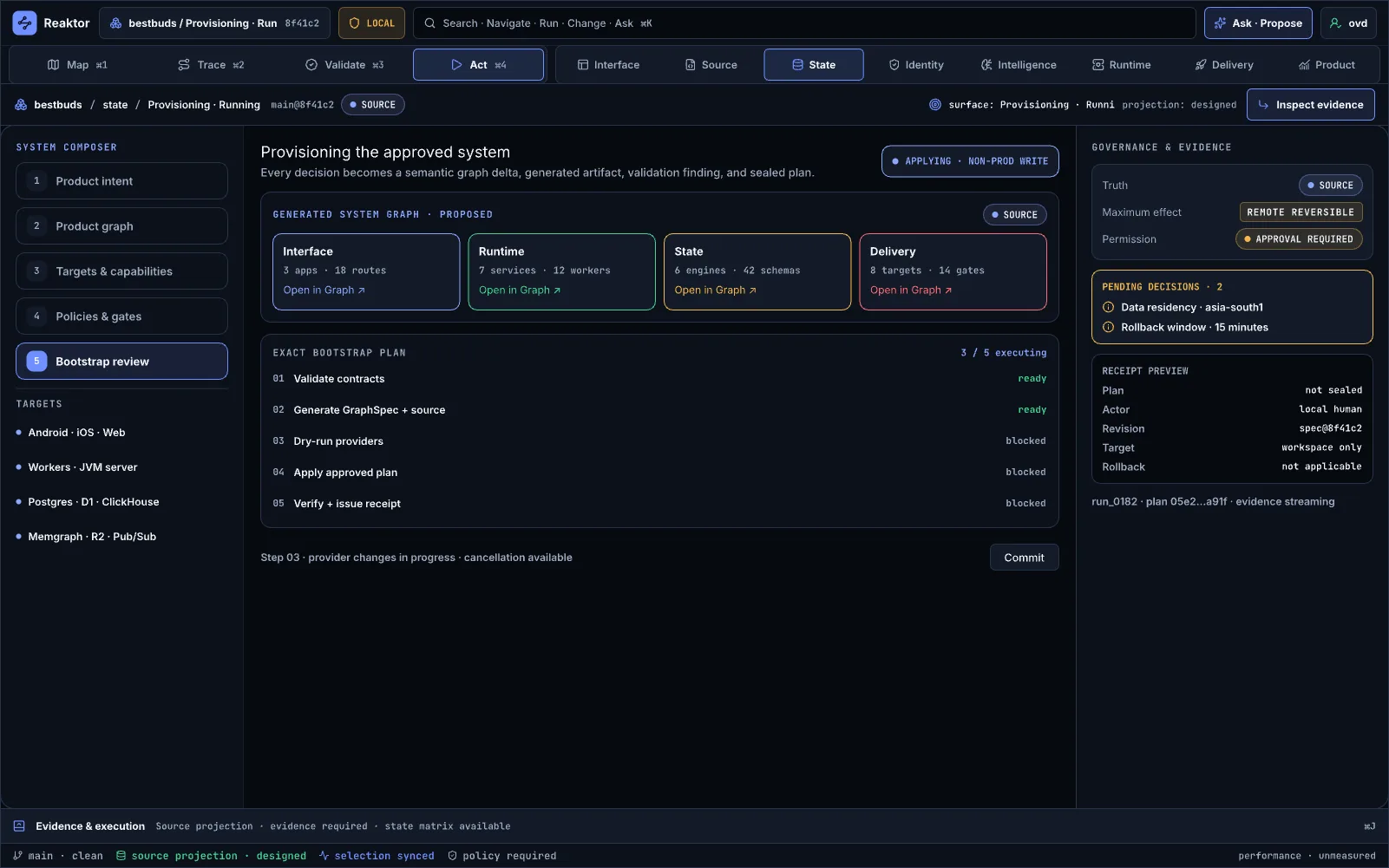
On the board. The headline is "Provisioning the approved system", chipped APPLYING · NON-PROD WRITE, with Maximum effect REMOTE REVERSIBLE, a ledger header reading 3 / 5 executing, a status
line "Step 03 · provider changes in progress · cancellation available", and a footnote run_0182 · plan 05e2…a91f · evidence streaming. The five ledger rows themselves read 01 Validate contracts ready, 02 Generate GraphSpec + source ready, 03 Dry-run providers blocked, 04 Apply approved plan blocked, 05 Verify + issue receipt blocked.
Vision tie. "Evidence streaming" attached to a named run with a plan hash is the right idea. It
is contradicted immediately below by a ledger in which step 03 — the step the status line says is in
progress — is marked blocked, and steps 01 and 02, which must have completed for 03 to be running,
are marked ready. The one widget that could show live state shows the pre-execution state.
Workflow tie. The screen someone stares at for four minutes while infrastructure changes. Its entire value is per-step progress, and per-step progress is the one thing it does not have.
Agentic tie. An agent watching this cannot determine which step is executing except by parsing
the prose status line, because the structured ledger disagrees with it. cancellation available is
stated with no cancel control shown.
Blueprint tie. The cook progress dialog and its message log. The comparison is precise and damning: Unreal's cook log is a live per-asset ledger with a result on each line, which is exactly the component this board needs and lacks.
Replaces / augments. terraform apply output, Pulumi's update view, an Argo rollout view, a
GitHub Actions run page.
Improvements.
- Make the ledger live. Per-row states must include
done,running,blocked,failed,skippedandrolled back; today all five rows are frozen atready/blockedin every one of the five provisioning states. - Add per-row elapsed time and a provider name, since a provisioning run's cost is concentrated in one or two steps and the board cannot show which.
- Add the cancel control the status line promises, with its own effect class and confirmation.
- Change
TruthfromSOURCEtoOBSERVEDon all provisioning boards. A run in progress is observation;SOURCEis the truth class of the plan, not of its execution. - Attach the streaming evidence to a visible target — a log pane or an evidence count — so "evidence streaming" is a state rather than a claim.
Verdict. Strengthen into the single canonical provisioning board, parameterised by run state.
STATE · Composer · Provisioning · Complete
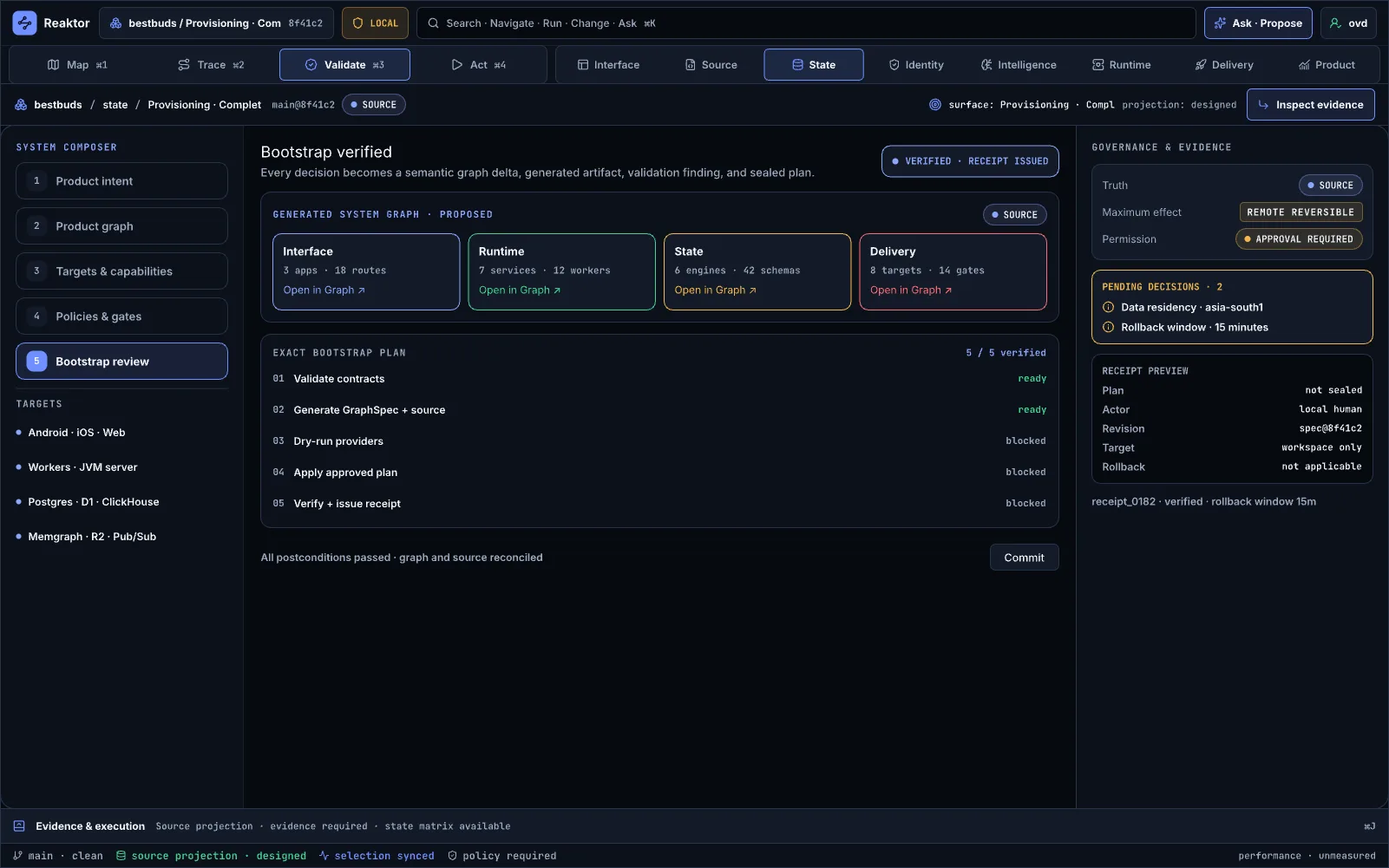
On the board. Eight lines different from Running: the headline "Bootstrap verified", the chip
VERIFIED · RECEIPT ISSUED, the ledger header 5 / 5 verified, the status line "All postconditions
passed · graph and source reconciled", and the footnote receipt_0182 · verified · rollback window 15m.
Vision tie. "Graph and source reconciled" is the thesis stated as a postcondition, and it is the
correct thing to verify. The board then fails to show a single reconciliation. Worse, 5 / 5 verified sits directly above three rows marked blocked and two marked ready — not one row says
done. And the right rail, unchanged from step 1 of the wizard, still reads Plan not sealed,
Target workspace only, Rollback not applicable and PENDING DECISIONS · 2, on a board whose
footnote says a receipt was issued with a fifteen-minute rollback window. The screen contradicts
itself in four places simultaneously.
Workflow tie. The screenshot pasted into Slack. That is its real function, which raises the stakes on its accuracy rather than lowering them.
Agentic tie. Actively dangerous for an agent. An agent parsing this board for completion state
finds 5 / 5 verified in the header, blocked in three ledger rows, not sealed in the receipt,
and verified in the footnote. Any automation built on it would key off whichever field its author
happened to read.
Blueprint tie. The cook-succeeded dialog. Unreal's version reports assets cooked, warnings and errors as counts; this reports a summary with no counts behind it.
Replaces / augments. The tail of terraform apply, a green Actions checkmark.
Improvements.
- Mark all five ledger rows
donewith timestamps, which is the minimum for the header claim to be true. - Fill the receipt:
Plan sealed 05e2…a91f,Targetnaming the real provider set, andRollback available until Twith a live countdown against the fifteen-minute window. - Clear
PENDING DECISIONS · 2or explain why a verified system still has pending decisions. - Show the postcondition list. "All postconditions passed" is a claim with no enumerable subject; each postcondition should be a row with its check and its evidence.
- Add a
Verifyre-run control, since verification of a live system is repeatable and its result ages.
Verdict. Merge into Provisioning · Running as its terminal state.
STATE · Composer · Provisioning · Failed
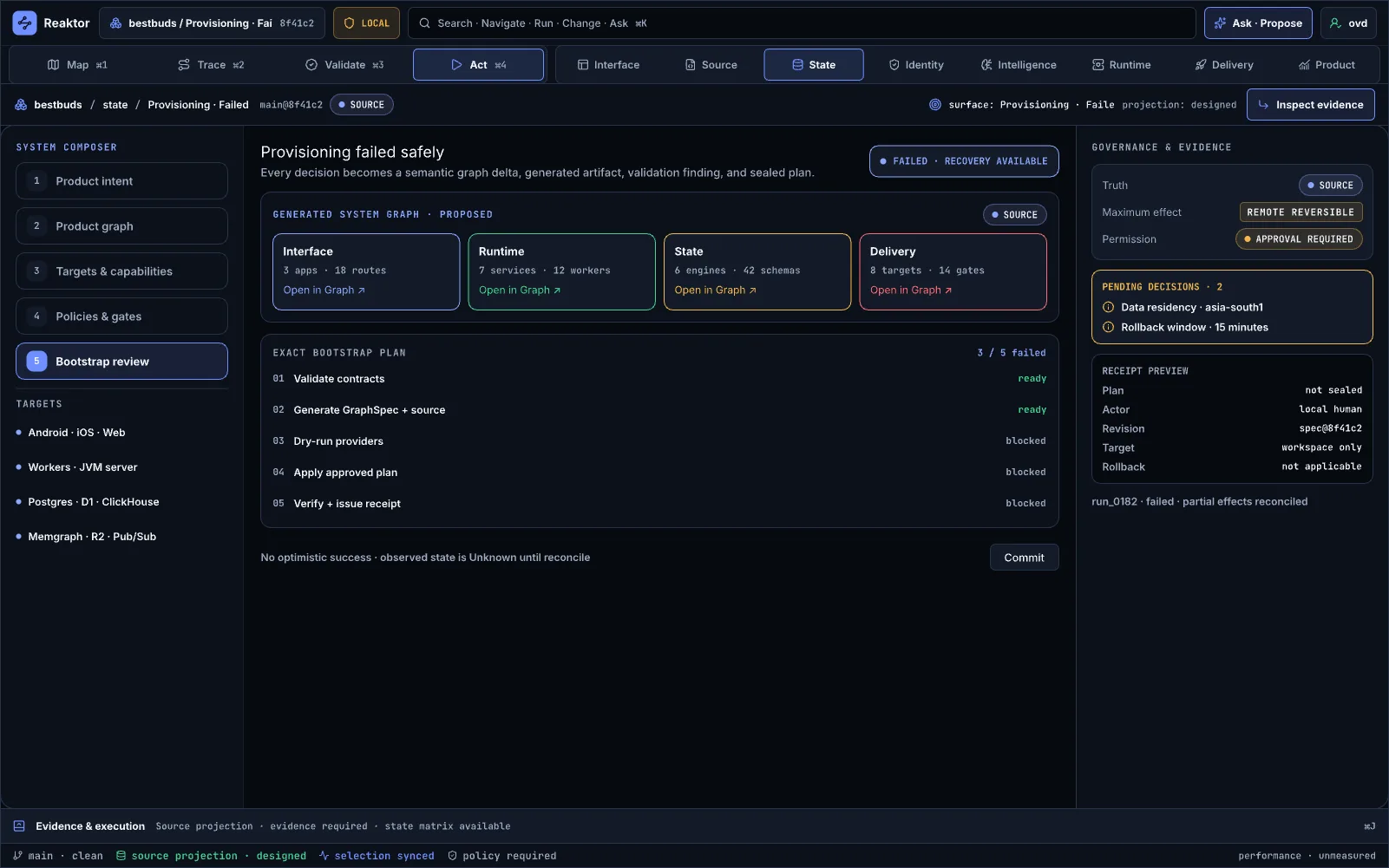
On the board. Eight lines different from Running: the headline "Provisioning failed safely",
the chip FAILED · RECOVERY AVAILABLE, the ledger header 3 / 5 failed, the status line "No
optimistic success · observed state is Unknown until reconcile", and the footnote run_0182 · failed · partial effects reconciled.
Vision tie. "No optimistic success · observed state is Unknown until reconcile" is the single
best sentence on any Composer board and one of the best in the atlas. It is the correct
distributed-systems position, stated more precisely than most production tools state it, and it is
exactly §1's evidence principle applied to a failure. Everything below it then betrays it: no ledger
row is marked failed, the header says three of five failed while rows 01 and 02 read ready and 03
through 05 read blocked, and "partial effects reconciled" in the footnote directly contradicts
"observed state is Unknown until reconcile" in the status line — one says reconciliation has
happened, the other says it has not.
Workflow tie. The most important board of the ten. A half-provisioned system across Cloudflare, GCP, Postgres, ClickHouse and Memgraph is the genuinely hard operational state, and it is the state this board is named for.
Agentic tie. An agent's correct behaviour on partial failure is to reconcile before acting, and the status line tells it so. It then has nothing to reconcile against, because no per-resource state is shown anywhere.
Blueprint tie. A cook failure with its message log. Unreal's message log names the asset, the error and the file; this names none of the three.
Replaces / augments. A terraform apply failure with a partial state file, which is precisely
the situation this board should be better at than Terraform.
Improvements.
- Add the pane the board exists for: a partial-effects table with one row per provider resource,
each carrying
created,not created,orphanedorunknown, its provider, and its reconciliation action. Without it "failed safely" is an assertion. - Mark row 03
failedwith its error and provider, and rows 04 and 05skipped, notblocked. - Resolve the reconciliation contradiction: either the footnote reads
partial effects NOT yet reconciledor the status line drops "until reconcile". As drawn the same screen makes both claims. - Add a
Reconcilecontrol as a first-class action beside recovery, since the status line makes it the precondition for everything else. - Name what the failure blocks downstream — which of the eight targets are now unusable — since that is the decision the operator must make in the next minute.
Verdict. Strengthen. This board needs the most work and would deliver the most value.
STATE · Composer · Provisioning · Retry
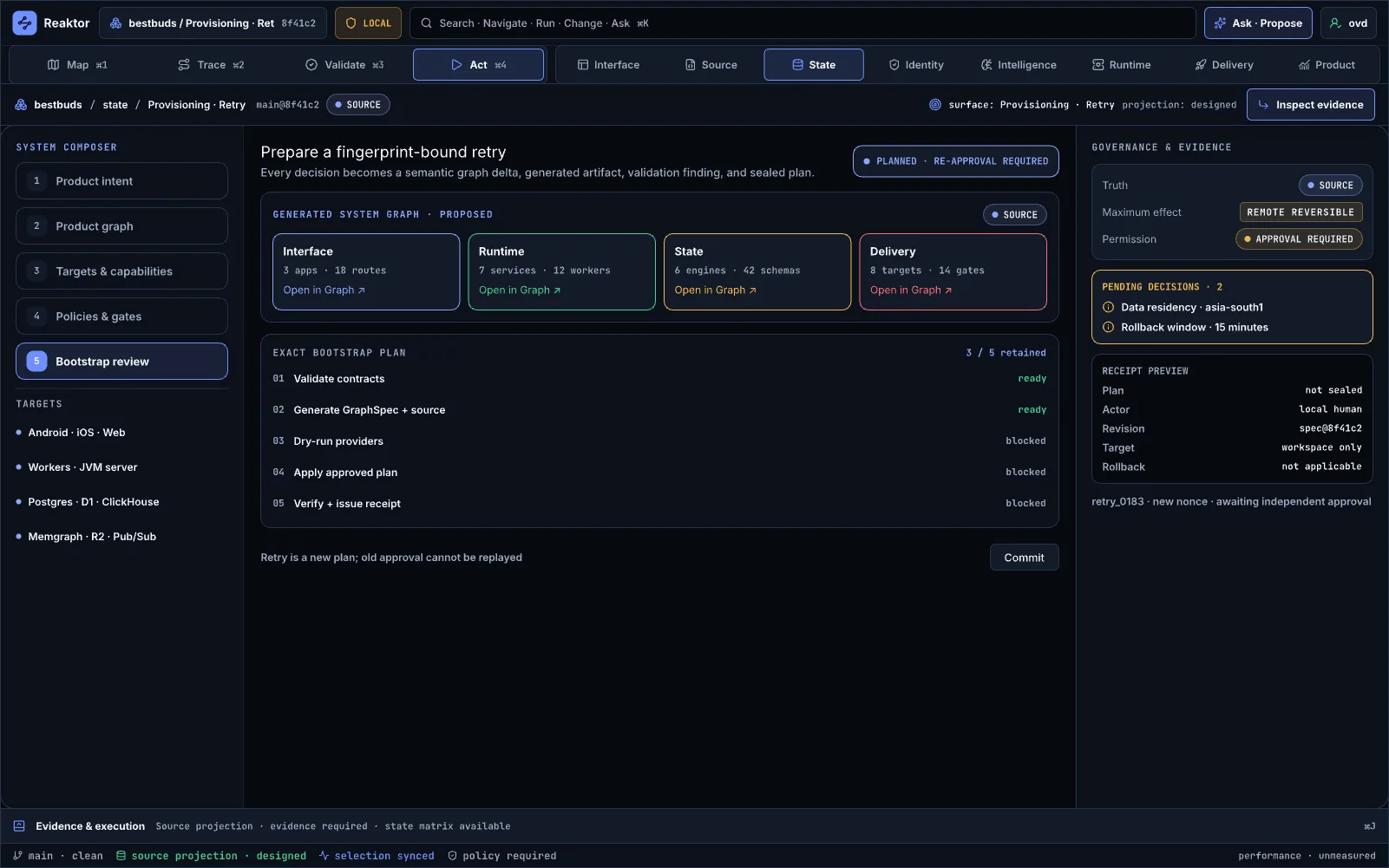
On the board. Eight lines different from Running: the headline "Prepare a fingerprint-bound
retry", the chip PLANNED · RE-APPROVAL REQUIRED, the ledger header 3 / 5 retained, the status
line "Retry is a new plan; old approval cannot be replayed", and the footnote retry_0183 · new nonce · awaiting independent approval.
Vision tie. "Retry is a new plan; old approval cannot be replayed", together with new nonce and
fingerprint-bound, is the correct and non-obvious security position on retry, and fingerprint is
one of only two occurrences of that word in the entire atlas — the keystone primitive of §2's
verification program, appearing here almost by accident. The ledger header 3 / 5 retained implies a
resumability model that no row expresses, since all five rows are identical to every other
provisioning board.
Workflow tie. Five minutes after the failure, with someone else needed for the second approval.
Agentic tie. The strongest governance statement in the cluster: an agent explicitly cannot replay an approval, and the retry requires an independent approver. This is what §1 means by governed, permissioned interfaces. There is no visible control by which an agent or human requests that approval.
Blueprint tie. Re-cooking only failed assets. Unreal shows which assets are being retried; this shows a count.
Replaces / augments. terraform apply after a failure, a GitHub Actions re-run-failed-jobs
button — and the board is right that both of those are unsafe by comparison, because both replay an
old approval.
Improvements.
- Show which three steps are retained and which two re-execute, per row, since
3 / 5 retainedis the board's core claim. - Show the old and new fingerprints side by side with the drift that forced a new plan. A fingerprint-bound retry should display both fingerprints.
- Add the approval request control and an approver field, since
awaiting independent approvalcurrently has no path to being satisfied. - Show what changed between
run_0182andretry_0183beyond the nonce.
Verdict. Merge into Provisioning · Failed as its recovery pane.
STATE · Composer · Provisioning · Rollback
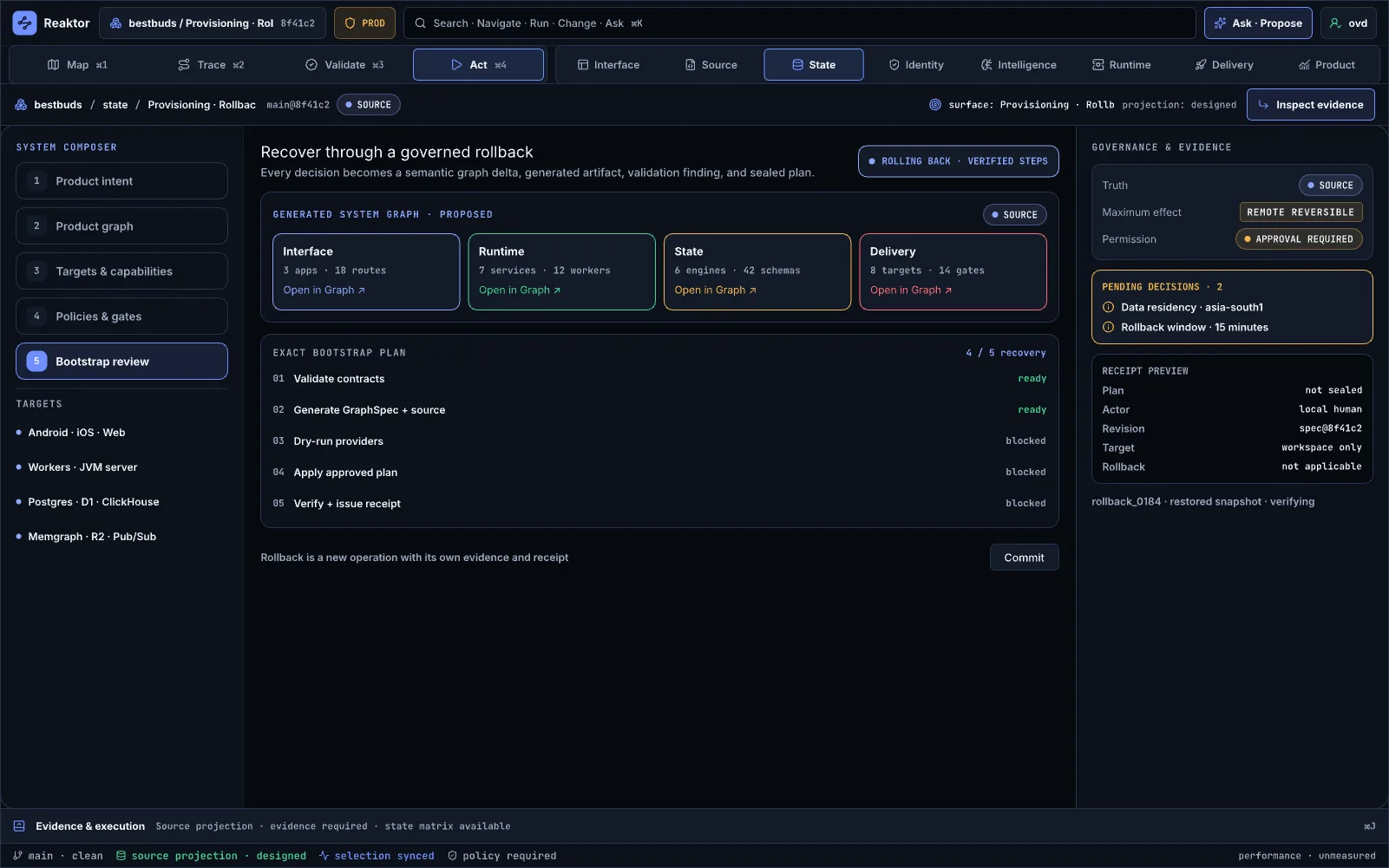
On the board. Nine lines different from Running, and the only Composer board whose environment
chip reads PROD rather than LOCAL. The headline is "Recover through a governed rollback", chipped
ROLLING BACK · VERIFIED STEPS, ledger header 4 / 5 recovery, status line "Rollback is a new
operation with its own evidence and receipt", footnote rollback_0184 · restored snapshot · verifying.
Vision tie. "Rollback is a new operation with its own evidence and receipt" is correct and
important — it refuses the common fiction that rollback returns a system to a previous state for free.
Against that, this board is marked PROD while its receipt preview, unchanged from every other
Composer board, reads Target workspace only and Rollback not applicable. A production rollback
board asserting that rollback is not applicable is the sharpest single contradiction in the cluster.
Workflow tie. The worst hour of someone's quarter, in production, probably at night.
Agentic tie. Correctly framed — a rollback as a new governed operation is something an agent can
be permitted to propose and forbidden to execute — but the board carries Permission APPROVAL REQUIRED identically to the draft steps, so the permission model does not escalate for a production
recovery.
Blueprint tie. Restoring from a backup and re-cooking. restored snapshot · verifying is the
right shape; the verification has no visible subject.
Replaces / augments. terraform state surgery, a Pulumi refresh-and-destroy, a database PITR
console — and it connects naturally to 09.06's backup block, which is where the snapshot's
provenance lives.
Improvements.
- Fix the receipt rail for
PROD: real target,Rollback applicable, sealed plan, and a break-glass identity field matching the one09.06requires for restore. - Show which steps are being rolled back and in what order, since rollback order is the substance of
the operation and
4 / 5 recoveryconveys none of it. - Link the restored snapshot to its record in
09.06, where snapshot provenance currently readsUNKNOWN · backup adapter not connected— the two boards must agree on whether a snapshot exists. - Escalate the permission chip beyond
APPROVAL REQUIREDfor a production recovery, and show the break-glass path. - Show what remains un-rolled-back — the effects that cannot be undone — which is the one fact an operator most needs and no board in the atlas states.
Verdict. Strengthen. Rollback is legitimately a distinct operation with its own plan and receipt, and the board is right to exist.
On the Composer as onboarding
Five steps plus five states is the wrong weight, and the boards prove it themselves. Nine of my
sixteen boards are one wizard; a tenth, 02.01 · Create · New System Composer, is a duplicate of step
3, carrying the identical strings "Select targets and capability packs", DRAFT · CAPABILITY CHECK,
"Next: confirm target capability coverage" and "Targets proposed · provider access not exercised."
Eleven boards, roughly a tenth of the atlas, are spent on a screen a user visits once per product.
The variation across them is six to nine lines out of 119. Four of the five wizard steps have no
step-specific body content of any kind — the same four summary cards and the same five-row ledger
appear on all of them. The correct shape is one STATE · Composer board with the stepper as a
control, plus one genuinely distinct step (Targets & Capabilities, rebuilt around the matrix above),
plus the approval review, plus one run board parameterised by state.
The provisioning states are honest in prose and dishonest in structure. Their captions are
excellent, and better than most shipping tools manage: "No optimistic success · observed state is
Unknown until reconcile", "Retry is a new plan; old approval cannot be replayed", "Rollback is a new
operation with its own evidence and receipt". Somebody with real distributed-systems judgment wrote
those sentences. But the five-row bootstrap ledger beneath them is byte-identical in all five states
— 01 ready, 02 ready, 03 blocked, 04 blocked, 05 blocked — so Complete claims 5 / 5 verified above three blocked steps, Failed claims 3 / 5 failed with no failed row, and
Rollback claims 4 / 5 recovery with nothing rolled back. The one widget capable of expressing
partial failure never changes. The claims about partial failure are made in captions and refuted by
the only structure on the screen. The same is true of the receipt rail, which is identical across all
ten boards including Complete and Rollback, producing the not sealed / receipt issued and
PROD / workspace only contradictions noted above.
The output is not credible given the audit, and the boards never say so. The plan promises
Dry-run providers then Apply approved plan across Cloudflare, GCP, Postgres, D1, ClickHouse,
Memgraph, R2 and Pub/Sub, with fingerprint-bound retry, nonce replay protection and governed
rollback. The audit says there is no CI, that the distributed plane has no queues at all and every
pipeline is waitUntil fire-and-forget, and that notifications have no idempotency. A provisioning
engine with exactly-once retry and rollback semantics across eight providers is strictly harder than
an idempotent notification send, and the notification send does not exist. Nothing on any of the ten
boards marks the provisioner as unbuilt. Truth: SOURCE is doing that work implicitly, but SOURCE
means "this is the designed state", which reads as a statement about the system rather than about the
board. Compare 09.06, two clusters away, which simply writes backup adapter not connected and is
immediately understood. The Composer needs the same sentence: provisioning adapter not connected · no provider access exercised. Its step-3 footnote already says "provider access not exercised", so
the vocabulary exists on the board and is applied to targets rather than to the engine.
On data authority
09.04 makes authority legible and is close to the only board in the atlas that does. A developer
can read directly off it that Postgres is AUTHORITY, ClickHouse is an ANALYTICS PROJECTION,
Memgraph is a GRAPH PROJECTION, D1 is EDGE AUTHORITY, Durable Objects hold INSTANCE STATE and
ObjectDatabase is a LOCAL WORKING SET. That vocabulary is consistent, it is placed on the store
card where it is unmissable, and the SQL comment "Postgres-only draft; Memgraph join requires an
explicit federated plan" shows the seam between two of them rather than hiding it. 09.05 extends
this correctly into time with SOURCE DESIRED STATE + OBSERVED LEDGER, and 09.06 extends it into
evidence with four honest UNKNOWNs.
Three things a developer still cannot determine. First, authority is marked per store, not per
datum, so the board cannot express that user identity is authoritative in Postgres while presence
is authoritative in the Durable Object and a friendship edge is authoritative in Memgraph — which is
exactly the granularity at which the audit established authority. Second, two stores carry an
authority badge (Postgres · AUTHORITY and D1 · EDGE AUTHORITY) with no stated rule for
disagreement and no Conflict finding, though the atlas defines that component on 13.03. Third,
and most consequentially, the read model's lag is invisible: the phrase eventually consistent
appears zero times across all 104 boards, and neither projection card carries a staleness figure. A
developer reading 09.04 learns that ClickHouse is a projection and learns nothing about how far
behind it is, which is the only fact that determines whether they may use it for the question they
are asking. That is the gap between marking authority and making authority usable.
Cluster findings
Missing panes.
09.07 · Decision Record— the reference monitor. One real request, its verdict, the rules that fired, and aChecks not performedcolumn with a callsite census. Nothing in the atlas explains a permit;S-1is a permit-by-default and is therefore unrepresentable today. (§2,S-1.)09.08 · Resource Graph & Membership. Principals and resource instances with the relationship edges between them — who is in which room, who owns which profile. RBAC by resource class cannot hold instance-scoped rules, andmembershipappears on four boards atlas-wide, none of them in the identity cluster. (§1 typed port graph; §2S-1.)Identity · Providers. The identity tab strip promises it on three boards and no board builds it. It is also the only placeS-4's shape — FCM endpoints stolen by re-registering a token — could live, since token registration is provider configuration and nothing else in the atlas owns it. (§2.)Identity · Audit. Promised by the same tab strip, never built.09.06audits data access; identity events — grants, role changes, revocations, break-glass — have no home. (§1 evidence.)Capability Matrix. Platform by capability by tier, with a degradation route in every non-full cell.degradationappears zero times in 104 boards andtieron three, none of them the board titledTargets & Capabilities. (§1 adapter + capability.)Read-Model Freshness. Projection lag per store, with the staleness budget each consumer tolerates.eventually consistentappears zero times atlas-wide while the audit establishes the read model is eventually consistent. (§2.)Negative Authorization Tests.01.02statesSource finding · negative authorization tests requiredand09.01promises "run negative tests" in prose; no board shows the suite, its coverage, or which resources have zero negative tests. This is theL1/L2rung of the verification program applied to authorization. (§2.)Composer · Provider Preflight. Credentials, quotas and permissions checked per provider before03 Dry-run providers— the step whose absence explains why03isblockedon every board and which the audit implies has no implementation. (§2.)
Seams.
- The identity tab strip promises six destinations and the atlas builds four.
ProvidersandAuditare dead links on09.01,09.02and09.03alike, whileSecurityandSimulatorshare one board. - The state tab strip differs between siblings.
09.04has seven tabs beginning withQuery;09.05and09.06have six and dropQuery, so navigating from the console to the plan loses the console. TheDatatab is listed on all three and depicted on none. 01.02is ahead of the boards it should feed. Thechat.membershipauthorization gap, thePrincipal → token → resource decision → repository → audit evidencepath,12 findings · 3 blockingandnegative authorization tests requiredall live on the North Star board. The three working identity boards carry none of them, and09.03contradicts the finding count outright withHigh-risk findings 1.02.01andSTATE · Composer · 3 of 5are the same screen, string for string. The atlas contains eleven Composer boards for a once-per-product flow.- The Composer speaks two grammars. Step 3 alone carries V2 chrome (
composer: 3 / 5,draft · source,policy not evaluated, revisionspec@8f41c2) while steps 1, 2, 4, 5 and all five provisioning boards carry V1 chrome (surface:,projection: designed,policy required, revision8f41c2). One wizard, two design systems. - Revision does not survive.
09.xboards readmain@8f41c2; Composer boards readmain@8f41c2in the breadcrumb andspec@8f41c2in the receipt, and step 3 readsspec@8f41c2in the header while its own breadcrumb still readsmain@8f41c2. The Symphony Contract promises revision survives every movement. - Chrome does not respond to state. Every one of the sixteen boards ends
policy requiredandperformance · unmeasured, includingProvisioning · Complete, which claims a verified system with an issued receipt, and including09.03, whose subject is policy.Inspect evidenceandEvidence & execution ⌘Jappear on all sixteen and no board shows what either yields. - The Composer never links to the identity cluster. A wizard that provisions Postgres, sets a
data-residency policy and issues receipts has no path to
09.01's policy list,09.04's store authority or09.06's backup evidence, though it creates the subjects of all three.
Honesty audit.
09.01is the cluster's worst offender and one of the atlas's worst. Roughly twenty numbers —89k,41k,11k,4,22,184,142k,31k,42 perms,36,24,14,10/min,30/min,4 ranges,24h,4h,12 char,90d,Policies · 7— with no fixture mark, no adapter note and no truth component anywhere on 268 lines.Last change 3m ago by @shibasisis a freshness claim with noFreshnessStamp. Unlike its two siblings it does not even mark in prose, which places it in §3's forty-nine. The honest version marks the wholeIDENTITY PLANErailFIXTURE · identity adapter not connected, and replaces the permission matrix's confidentC R U Dgrid with a grid that distinguishes granted from enforced.09.03asserts a security posture that contradicts known ground truth.High-risk findings 1,Medium 3,Healthy 8,MFA adoption 62% · goal 90%,SECURITY POLICIES · 12,last rotated 142d ago,last 38d ago, all unmarked. The audit found twelve security findings including a critical authorization bypass;01.02in the same atlas says12 findings · 3 blocking. The board reports one high-risk finding and eight healthy policies. This is not merely unmarked data — it is data that is wrong by an order of magnitude against a known figure that another board in the same file states correctly. The honest version reads12 findings · 3 blocking · S-1 criticaland marks the posture blockno scanner wired.Run security scanshould likewise name the scanner or be disabled, since no CI exists.09.02marks in prose and then contradicts its own mark.Sessions — 42,118 active · across 142 countriessits one line abovesession adapter not connected. Four provenance strings on the board make it one of the better-marked boards in the atlas and none of them covers the header. The honest version readsSessions — UNKNOWN · session adapter not connected, demotes42,118into the fixture band with the region counts, and binds all four marks to components so the atlas query can see them.- The ten Composer boards assert a generated system before anything generates it.
3 apps · 18 routes,7 services · 12 workers,6 engines · 42 schemas,8 targets · 14 gatesappear identically on all ten, chippedSOURCE, including on step 1 before any input exists.SOURCEis a stronger and falser claim thanFIXTUREwould be.4 capability gapsis asserted and never enumerated.PENDING DECISIONS · 2persists intoProvisioning · Complete. The honest version empties the cards until a template or an intent populates them, and marks the provisioning engineprovisioning adapter not connected · no provider access exercised, reusing the sentence pattern that09.06already uses well. - The five provisioning states assert run outcomes over a frozen ledger.
5 / 5 verified,3 / 5 failed,3 / 5 retainedand4 / 5 recoveryall sit above the same five rows readingready,ready,blocked,blocked,blocked.Completeclaimsreceipt_0182 · verifiedbesidePlan not sealedandRollback not applicable;Rollbackis chippedPRODbesideTarget workspace only. The honest version drives every ledger row and every receipt field from the run state, so the four headline fractions are computed from the rows rather than typed above them. 09.04,09.05and09.06are the model and should be cited as such.FIXTURE DRAFT · UNPREPARED,no provider query receipt · design specimen,row count / p95 UNKNOWN,estimated spill risk · not observed,SOURCE · applied state UNKNOWN,AUDIT ADAPTER NOT CONNECTED, andlast drill UNKNOWN · no verified restore drill receiptare what §1's evidence principle looks like when someone actually applies it. Every board in the identity cluster should be re-authored against the standard these three already meet — and they sit in the same cluster, under the same shell, three boards away.
Part 11 · Section 10–11 — Observe, Learn and Optimize
Ten boards: 10.01–10.05, 11.01–11.05.
Before the board entries, one measurement that frames everything below. I grepped all ten board texts for the vocabulary of §1. The word capability appears zero times. adapter appears zero times. visitor appears zero times. subgraph appears zero times. fingerprint, invariant and provenance each appear zero times. The word port appears exactly twice, both on 10.03, both as the identifier GraphDiff.diffPorts inside a flame graph — that is a Kotlin function name, not a measurement key.
So across ten boards whose entire job is to observe a running system, the atlas never once measures a port. It measures by (le, service), chat-service, pod chat-7f2, ChatActor.kt:142. Those are Datadog's key, Grafana's key and Sentry's key. Meanwhile 06.04, one section away, already has a pane literally headed PORT INVOCATIONS · WATERFALL. The idea exists in the atlas. It did not reach Section 10. That single fact is the cluster's central defect and most of what follows is a consequence of it.
10.01 · Trace + Runtime · Spans, eBPF & Evidence
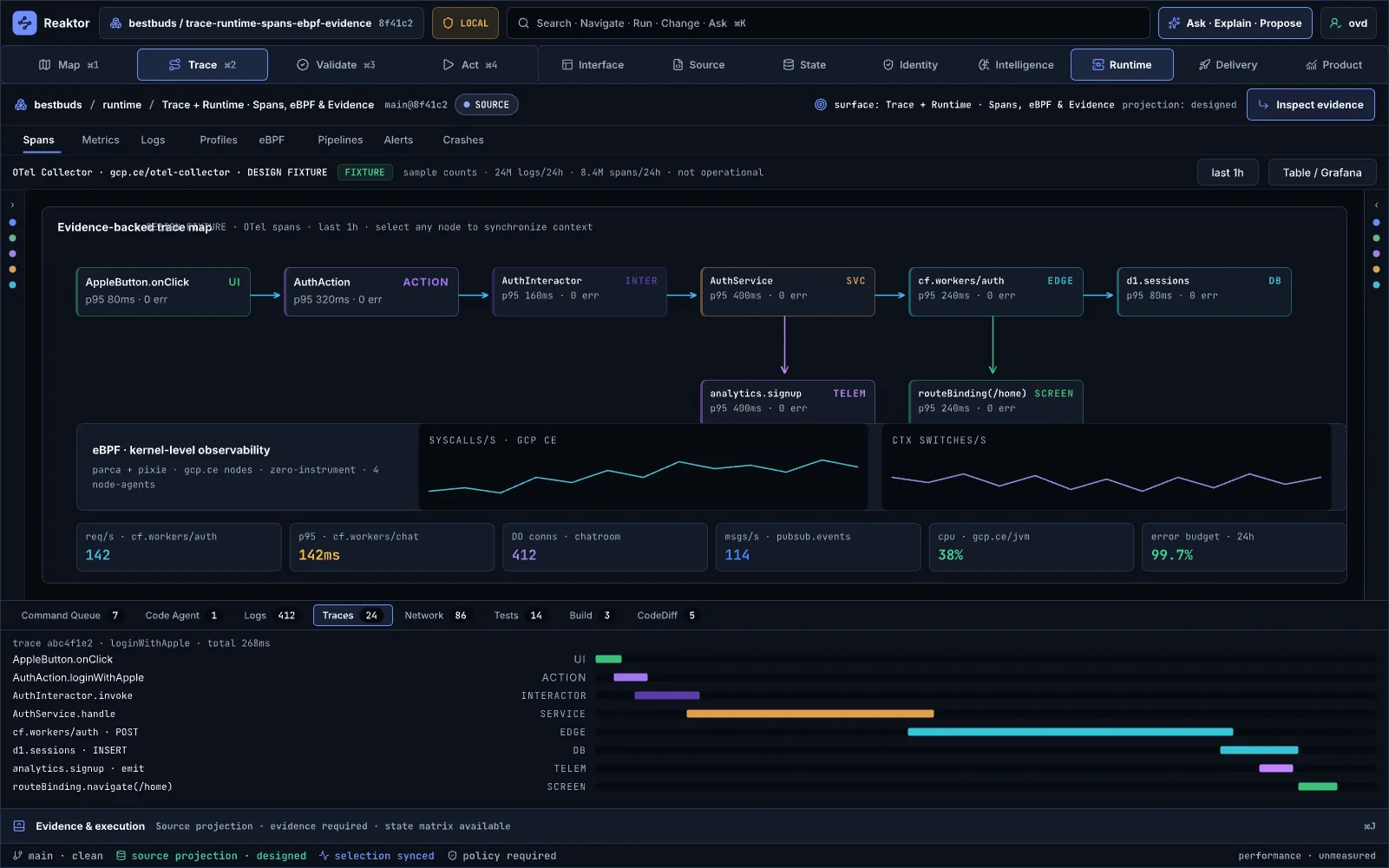
On the board. Four panes under a nine-tab runtime bar (Spans, Metrics, Logs, Profiles, eBPF, Pipelines, Alerts, Crashes). A collector header row reads OTel Collector · gcp.ce/otel-collector · DESIGN FIXTURE with FIXTURE and sample counts · 24M logs/24h · 8.4M spans/24h · not operational. Below it an Evidence-backed trace map labelled DESIGN FIXTURE · OTel spans · last 1h · select any node to synchronize context shows eight nodes typed UI, ACTION, INTER, SVC, EDGE, DB, TELEM, SCREEN, each carrying a p95 and 0 err. Then an eBPF · kernel-level observability strip (parca + pixie · gcp.ce nodes · zero-instrument · 4 node-agents) with six unmarked tiles, a command-queue counter row (Logs 412, Traces 24, Network 86, Tests 14, Build 3, CodeDiff 5), and a single-trace list for trace abc4f1e2 · loginWithApple · total 268ms.
Vision tie. This is the board that should embody visitors — "telemetry instruments a subtree" is the canonical visitor example in §1 — and it does not mention traversal, subtree or visitor anywhere. What it does embody, and this is real, is evidence: it is the only board in my cluster that stamps DESIGN FIXTURE and says not operational out loud. It also embodies the eight-node typed spine (UI → ACTION → INTER → SVC → EDGE → DB) which is genuinely the graph's shape and not a service list.
Workflow tie. Opened at the start of an incident, or on the Monday after a release, by whoever is on call. Today that person opens Datadog APM's service map, then a Grafana dashboard, then Sentry, and reconciles three different naming schemes by hand. The pitch here is that the service map is not derived from traffic heuristics — it is the graph, so it is complete before the first request.
Agentic tie. An agent reads a typed node list with latency and error counts attached, which is more useful than a service map because the types are real. It can propose "instrument this subtree" or "this edge is uninstrumented". What governs it: nothing on this board. There is no effect mark, no permission field, no Propose affordance beyond the global Ask · Explain · Propose in the chrome. The board is read-only by omission rather than by declaration.
Blueprint tie. Unreal Insights plus the Blueprint debugger's execution-flow highlight, where the wire that just fired glows. The analogy holds unusually well for the trace map. It breaks on scope: Insights traces one process on one machine, while this traces a device, an edge worker and a database in one path.
Replaces / augments. Datadog APM service map, Honeycomb, Jaeger, Grafana Tempo, Pixie, Parca. It should absorb the collector and the storage and replace only the map.
Improvements.
- Add a
COVERAGEpane next to the trace map with the columnsports total,ports instrumented,ports never observed,ports observed but not in graph. This is the one number Datadog structurally cannot produce, because it has no list of spans that ought to exist. It is also the honest version of this board: on today's code every row would read0 / n. - Key the trace map on
(node id, port id, revision)and show the port name on the edge, not the service name in the node. Then add aD-6 collisionstate to any edge whose port was built from a string and therefore carries a null class — the audit says everyServiceNodeendpoint and every JS caller is in that state, so the tracing key is currently ambiguous and the board should say so. - Fix the p95 values. Every one of them is an exact multiple of 80ms — 80, 160, 240, 320, 400 — which is a five-step design grid read off bar widths, not a latency distribution. Replace them with a
NotWiredYetdash and anEmptyReasonofno collector deployed. - Extend the
DESIGN FIXTUREmarker to the eBPF strip. Right now the fixture stamp sits on the collector row and the trace map, and the six eBPF tiles (142 req/s,142ms,412,114,38%,99.7%) are unmarked, so a reader reasonably concludes those are live. - Move the single-trace list off this board entirely — see the trace-continuum section below.
Verdict. Strengthen. Keep it as the aggregate span-and-coverage surface, hand the single-trace detail to 06.04, and make coverage the headline.
10.02 · Observe · Metrics
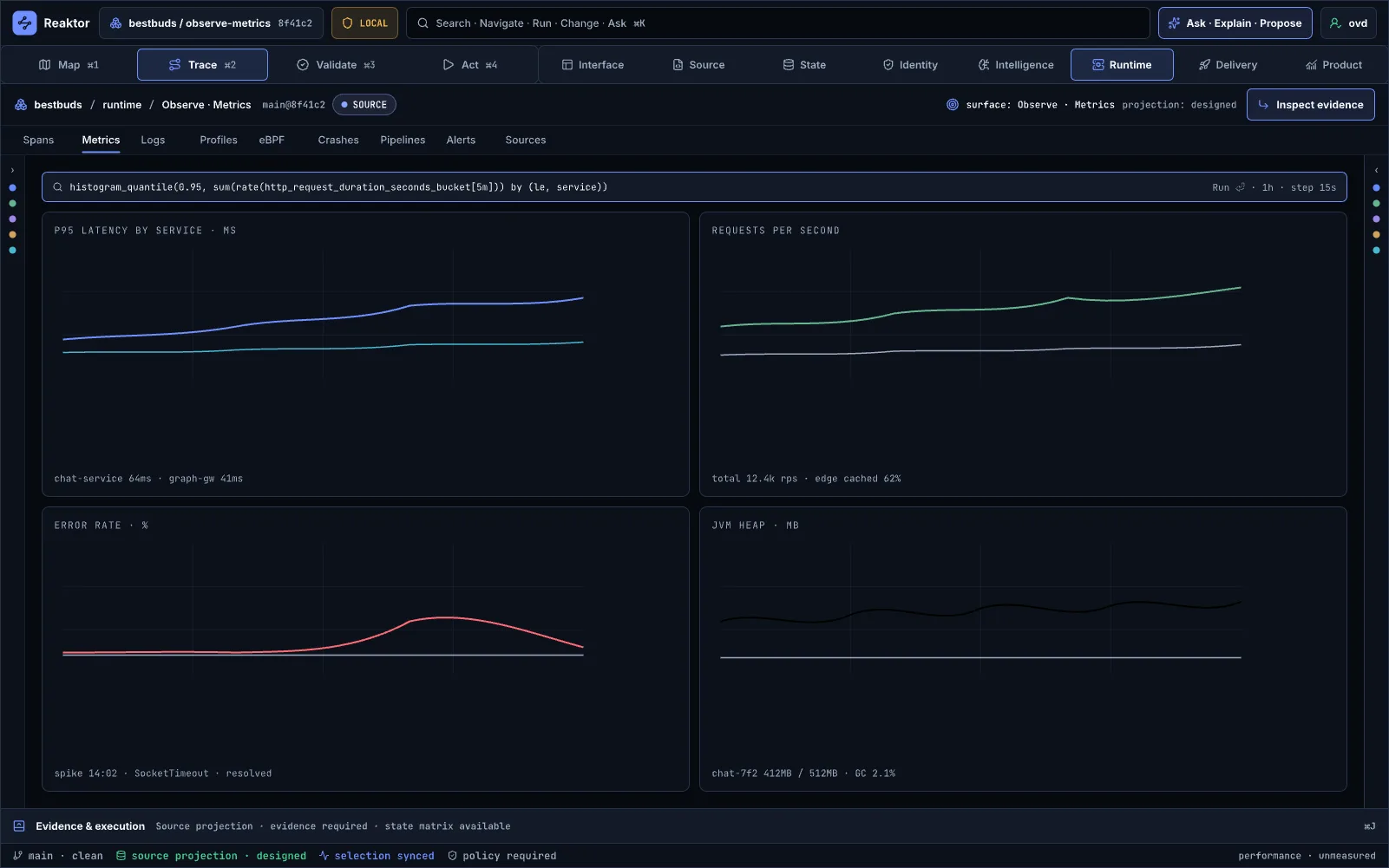
On the board. The thinnest board in the cluster, and one of the thinnest in the atlas at 1,048 bytes. One PromQL editor containing histogram_quantile(0.95, sum(rate(http_request_duration_seconds_bucket[5m])) by (le, service)) with a Run ⏎ · 1h · step 15s control, and four chart tiles: P95 LATENCY BY SERVICE · MS (chat-service 64ms · graph-gw 41ms), REQUESTS PER SECOND (total 12.4k rps · edge cached 62%), ERROR RATE · % (spike 14:02 · SocketTimeout · resolved), JVM HEAP · MB (chat-7f2 412MB / 512MB · GC 2.1%). No sub-panes beyond that.
Vision tie. None. This board embodies no load-bearing idea from §1. Its query groups by (le, service), which is the exact opposite of the graph thesis — it asserts that the unit of measurement is a service name string, resolved by convention, which is precisely the thing Reaktor exists to abolish. It is a Grafana screenshot with Reaktor chrome around it.
Workflow tie. A platform engineer glances at it during a deploy or when an alert fires. They do this today in Grafana, and Grafana is better at it: annotations, ad-hoc filters, exemplars, alert previews, transformations, a decade of panel types. There is no moment in a team's week where someone would open this instead.
Agentic tie. Agent-hostile. An agent given a PromQL box and four static captions can do nothing that Grafana's own MCP integration does not do better. The captions (spike 14:02 · SocketTimeout · resolved) are prose findings baked into chart titles, so they are not machine-readable and not linked to 10.04, where the same SocketTimeout is described as an active spike affecting 112 users.
Blueprint tie. Unreal's stat unit HUD and the Session Frontend's stat charts. The weakest analogy in the cluster; a stats HUD is a debugging aid, not a product surface.
Replaces / augments. It should replace nothing. Grafana, Prometheus and Datadog all win. Absorb, do not rebuild.
Improvements.
- Delete the four generic chart tiles and embed Grafana. Keep only one Reaktor-native pane on this board.
- That pane is metric definitions as graph nodes. A metric is a node with a typed input port; renaming or moving the node rewrites every dashboard, report block and alert that consumes it, because they all reference the node id, not a label string. Grafana's dashboards break silently when a label is renamed and there is no way to find out except by looking. That is a real, common, expensive failure and it is structurally unfixable in Grafana. Give the pane the columns
metric node,consumers(dashboards, alerts, report blocks),last definition change,breaking?. - Add a
Rename impactcontrol on any metric node that runs the same blast-radius query06.04already has and lists every consumer that would break. - Change the query grouping from
by (le, service)toby (le, node, port)and show, next to the editor, the graph selection the query resolves to. If the selection is empty, sayno ports matchrather than rendering an empty chart. - Replace the four caption-findings with links.
spike 14:02 · SocketTimeoutmust be a control that lands on theSocketTimeoutgroup in10.04.
Verdict. Rebuild as Metric Definitions, or Merge into 10.05 as a "sources and definitions" pane and drop the chart surface entirely. Do not ship a competent metrics dashboard; there is no version of it that is worth a user's attention over Grafana.
10.03 · Observe · Profiles
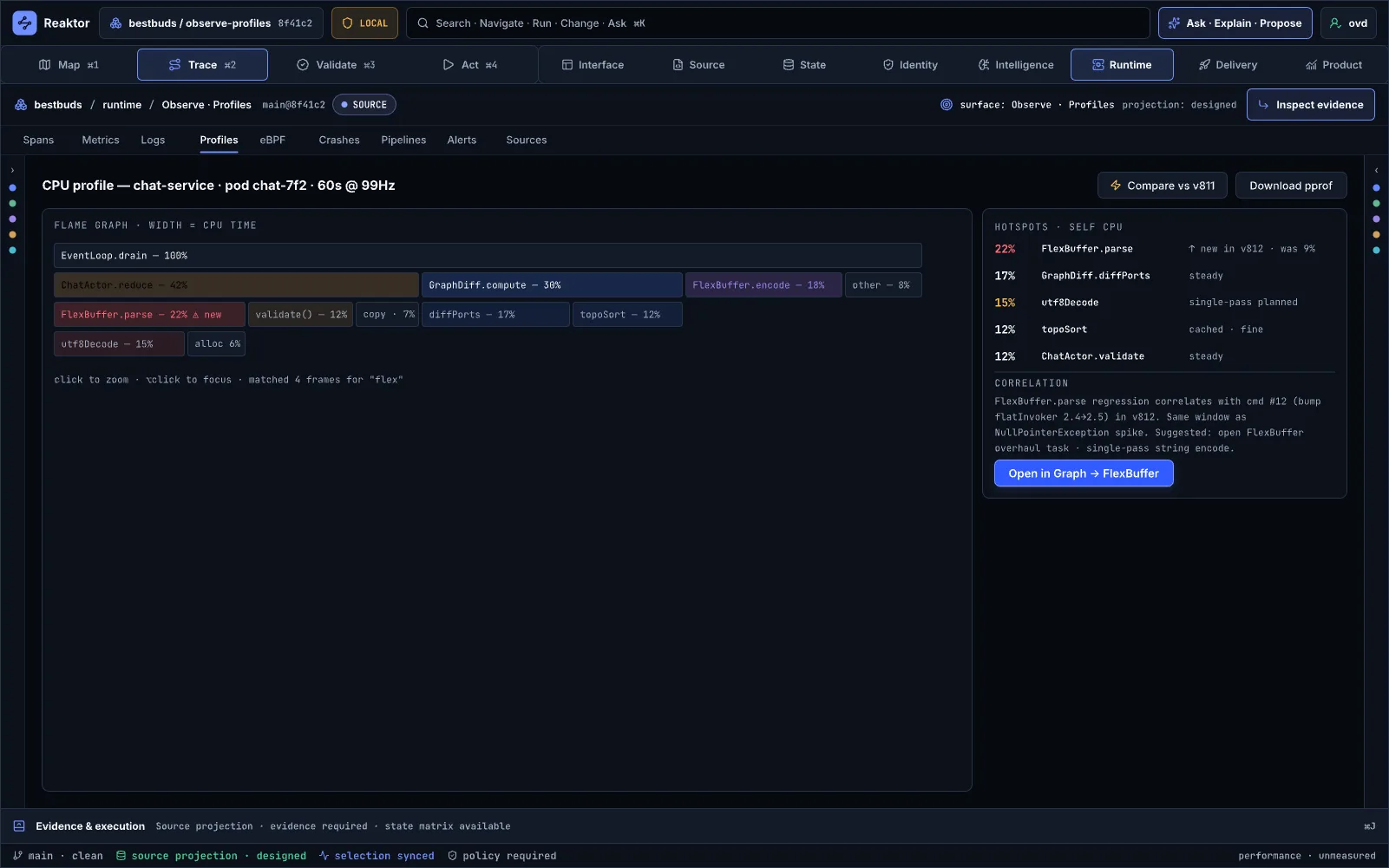
On the board. A CPU profile header CPU profile — chat-service · pod chat-7f2 · 60s @ 99Hz with two controls, Compare vs v811 and Download pprof. A FLAME GRAPH · WIDTH = CPU TIME pane with a root EventLoop.drain — 100% and named children ChatActor.reduce — 42%, GraphDiff.compute — 30%, FlexBuffer.encode — 18%, other — 8%, plus a second level (FlexBuffer.parse — 22% ⚠ new, validate() — 12%, copy · 7%, diffPorts — 17%, topoSort — 12%, utf8Decode — 15%, alloc 6%), an interaction hint click to zoom · ⌥click to focus · matched 4 frames for "flex", a HOTSPOTS · SELF CPU list of five frames with trend notes (↑ new in v812 · was 9%, single-pass planned, cached · fine), and a CORRELATION block ending in Open in Graph → FlexBuffer.
Vision tie. Partially, and by accident. The CORRELATION block ties a profile regression to a specific change (cmd #12 (bump flatInvoker 2.4→2.5)) and offers Open in Graph → FlexBuffer — that is the graph doing work. The flame graph itself embodies nothing: it folds on call stacks, exactly like pprof, and a call stack is the representation Reaktor claims to have replaced.
Workflow tie. Opened after a latency alert or a release, by whoever owns the service. Today they run pprof, or Parca, or Xcode Instruments on device, or Android Studio Profiler, and none of those three tools' outputs can be compared to each other. That cross-runtime incomparability is the real opening here.
Agentic tie. Good, and the best-designed correlation in my cluster. An agent reads a hotspot list with deltas and a named suspect change, and the board already writes the proposal for it: Suggested: open FlexBuffer overhaul task · single-pass string encode. What governs it is unstated — there is no effect mark on Open in Graph, and no permission on the implied task creation.
Blueprint tie. Unreal Insights' CPU timeline. The analogy is exact and that is the problem: Insights also folds on stacks, so a stack-folded flame graph is table stakes.
Replaces / augments. pprof, Parca, Pyroscope, Xcode Instruments, Android Studio Profiler, JFR.
What the incumbent structurally cannot do. Two things, and both are genuinely novel. First, fold the profile onto graph topology instead of call stacks: self-CPU per node, per port, per subgraph, per capability tier, so the answer to "where does the time go" is "in the AuthInteractor subtree, 62% of it crossing the chat.realtime boundary" rather than "in EventLoop.drain". Second, one flame graph across runtimes. A Kotlin frame, a C++ frame reached through reaktor-ffi and a TypeScript frame in a Worker are three profilers' worth of work today and cannot be placed on one axis, because no profiler follows a JSI or C-ABI boundary. Reaktor can, because the frame carries a node id on both sides. Neither is on the board, and the second depends on reaktor-ffi, which the audit says is a skeleton whose Transport is four TODO()s.
Improvements.
- Add a
Fold bycontrol with optionsstack,node,port,subgraph,boundary. Default it tonode. This is one control and it is the whole differentiator. - Add a
boundarylane to the flame graph that shows time spent insidereaktor-ffiframes, markedUNMEASURED · ffi transport not implementeduntil it is. That is the honest state and it makes the gap visible rather than absent. - Fix the arithmetic. The first level sums to 98% (
42 + 30 + 18 + 8). A flame graph cannot lose 2% of its root's time; these numbers were typed, not sampled. Either make them sum or replace them. - Repoint the profiled subject. There is no profiled
pod chat-7f2. There is a real measurement source in this codebase: the FlexBuffers device runs (the S23 bulk A/B, the adversarial suite, the iPhoneFlexBenchrunner). Make the board's default subject a realRunRefto one of those runs, withCompare vsselecting another run. The board's narrative — FlexBuffer parse cost,utf8Decode · single-pass planned— is already anchored in that real programme; only the subject is invented. - Delete
matched 4 frames for "flex". Two flex frames are visible; the search state has nothing behind it.
Verdict. Strengthen, on condition the fold-by control lands. As drawn it is a pprof clone with an invented subject; with graph folding it is the most defensible board in Section 10 after 10.04.
10.04 · Observe · Errors
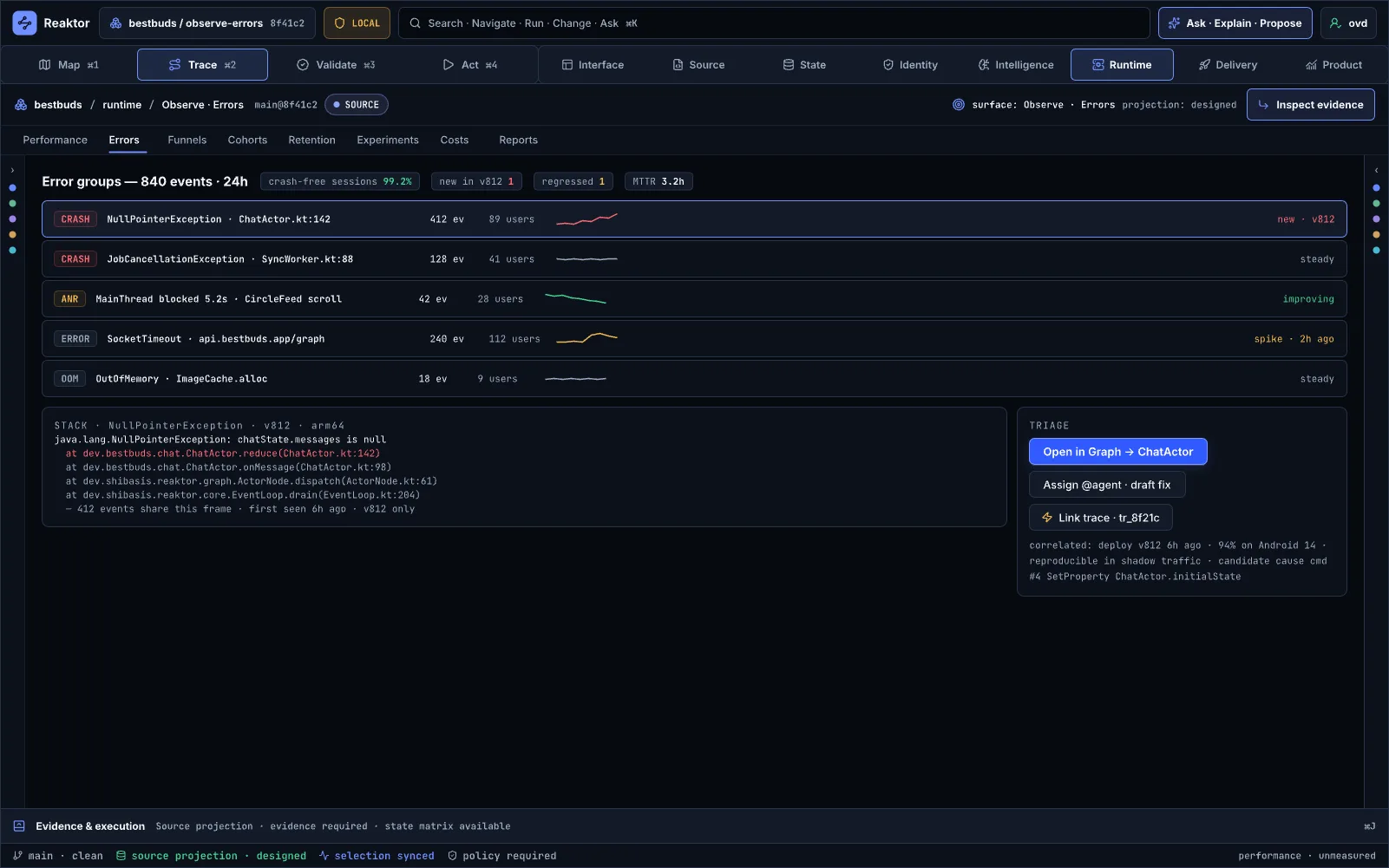
On the board. A summary row (Error groups — 840 events · 24h, crash-free sessions 99.2%, new in v812 1, regressed 1, MTTR 3.2h), a five-row group list typed CRASH / CRASH / ANR / ERROR / OOM with event and user counts and trend words (new · v812, steady, improving, spike · 2h ago), a STACK · NullPointerException · v812 · arm64 pane with four real-looking frames ending dev.shibasis.reaktor.core.EventLoop.drain(EventLoop.kt:204) and the line — 412 events share this frame · first seen 6h ago · v812 only, and a TRIAGE block with three controls: Open in Graph → ChatActor, Assign @agent · draft fix, Link trace · tr_8f21c, plus a correlation line naming candidate cause cmd #4 SetProperty ChatActor.initialState.
Vision tie. The strongest in Section 10. Open in Graph → ChatActor is the diagram-and-system-are-one-object thesis made into a button, and Assign @agent · draft fix is agents-as-first-class-operators. The grouping key, however, is still a stack frame (ChatActor.kt:142), which is Sentry's model.
Workflow tie. Opened every morning by the mobile lead and during any incident. Today: Sentry or Crashlytics for the group list, then a manual hunt through git blame for the cause, then a Linear ticket. The TRIAGE row collapses all three into one place, and that is a genuinely good product idea independent of the graph.
Agentic tie. The best agentic surface in my cluster. An agent reads a grouped error with a stack, a release, a device distribution (94% on Android 14), a shadow-traffic reproduction claim and a candidate causal command, and Assign @agent · draft fix gives it a governed entry point. What is missing is the governance itself: there is no EffectMark on draft fix, no permission tier, and no statement of what subgraph the agent is allowed to touch.
Blueprint tie. Unreal's Crash Reporter fused with the Message Log, where a Blueprint runtime error highlights the offending node in the graph. Open in Graph → ChatActor is literally that behaviour. The closest true analogy in the cluster.
Replaces / augments. Sentry, Firebase Crashlytics, Bugsnag, Rollbar, and the Linear ticket that usually follows.
What the incumbent structurally cannot do. Three things.
- Attribute an error to a pushed subgraph revision. Sentry's unit of blame is a release build. Reaktor's graph code push rewires a marked subgraph at runtime, so two devices on the same build can be running different graphs. Sentry cannot express that; it has no field for it. Reaktor can group by
(subgraph, revision)and answer "this NPE only appears on devices that received bundleb_4f12", which is a different and far more actionable statement than "v812". - Group by capability tier. The same exception on a device where the adapter is present is a different defect from the same exception where the adapter is absent — one is a bug, the other is missing degradation. Sentry has no capability model and cannot split the group. This is the single most valuable unbuilt idea on the board, and the word
capabilitydoes not appear on it. - Compute blast radius from the error.
06.04already hasBLAST RADIUS · Affected nodes 14 · across 5 modules. An error group should carry the same, so triage starts from "what else touches this port" rather than from a stack.
Improvements.
- Add
subgraphandrevisioncolumns to the group list, and aGroup bycontrol offeringstack frame,port,subgraph + revision,capability tier. - Add a
BLAST RADIUSstrip to theSTACKpane reusing06.04's query, withAffected nodes,Tests impacted,Deploy targets. - Put an
EffectMarkand a permission tier onAssign @agent · draft fix, and state the writable scope, e.g.may edit: chat subgraph · may not edit: auth, ledger. - Replace the invented top group. The audit names real defect classes in exactly this code path — lifecycle fires effects on rejected transitions, and actors can double-start, both in
ActorNodeand the lifecycle, which is where this board's fake stack already points (ActorNode.dispatch(ActorNode.kt:61)). The honest board shows the realD-*defects withSourceRefto the audit, not a fabricatedNullPointerException. - Fix the sub-nav. This board carries Section 11's tab bar (
Performance,Errors,Funnels,Cohorts,Retention,Experiments,Costs,Reports) while its breadcrumb saysbestbuds / runtime / Observe · Errorsand every other Observe board carries the runtime bar. From10.04you cannot reach10.01,10.02,10.03or10.05. This is a navigational dead end, not a styling nit. - Reconcile the causal claim with
07.03. This board sayscandidate cause cmd #4 SetProperty ChatActor.initialState;07.03 Ship · Releasessays the same NPE group isregression linked: cmd #12 flatInvoker bump;10.03sayscmd #12caused aFlexBuffer.parseregression. Two boards blame two different commands for one error group.
Verdict. Keep, and make it the section's flagship. It is the only board in Section 10 where the graph does visible work.
10.05 · Observe · Alerts & Pipelines
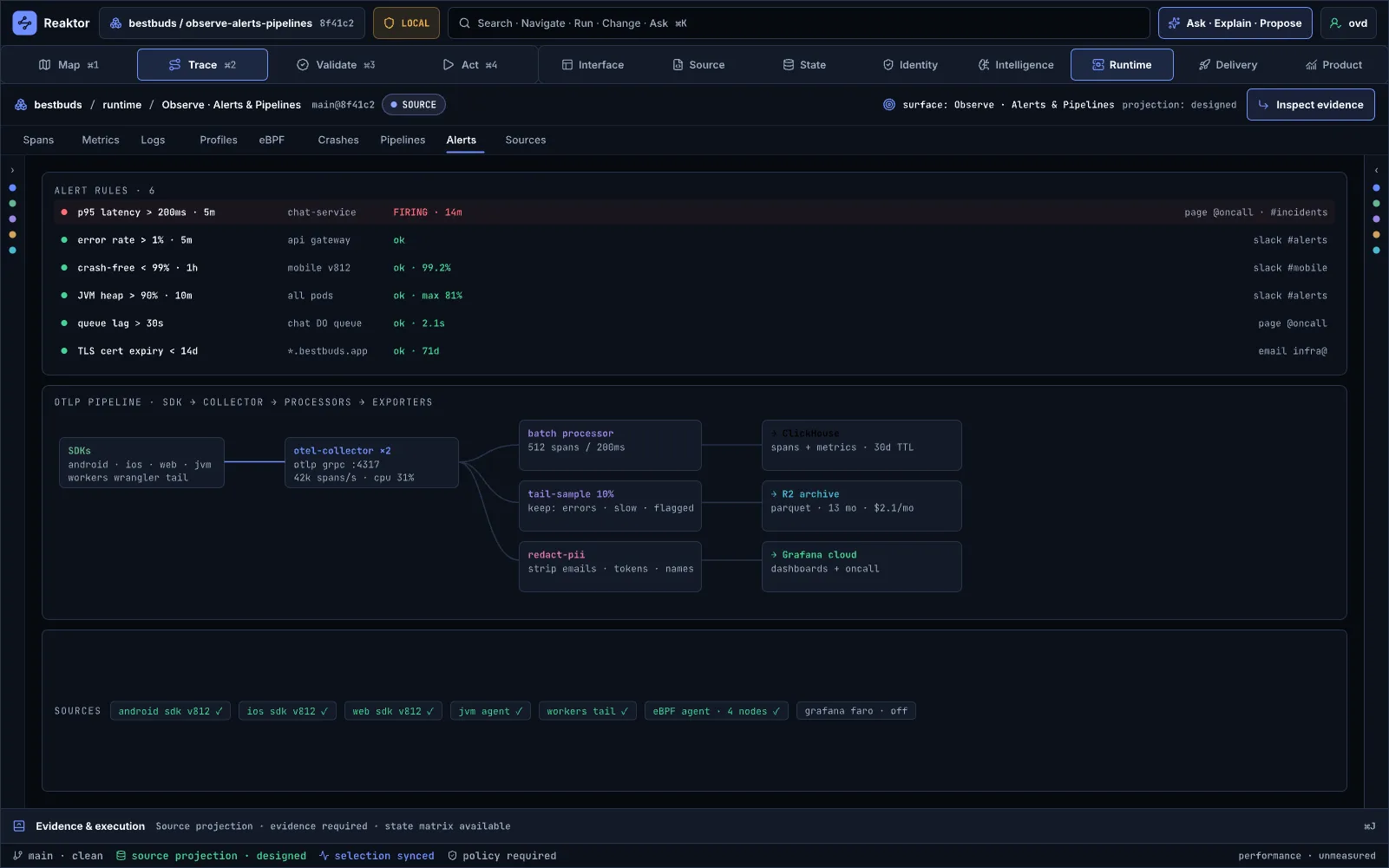
On the board. Three panes. ALERT RULES · 6 lists six rules with target, state and route: p95 latency > 200ms · 5m on chat-service is FIRING · 14m routed to page @oncall · #incidents; then error rate > 1%, crash-free < 99%, JVM heap > 90%, queue lag > 30s · chat DO queue · ok · 2.1s, TLS cert expiry < 14d · ok · 71d. OTLP PIPELINE · SDK → COLLECTOR → PROCESSORS → EXPORTERS diagrams SDKs, otel-collector ×2 · otlp grpc :4317 · 42k spans/s · cpu 31%, batch processor 512 spans / 200ms, tail-sample 10% · keep: errors · slow · flagged, redact-pii · strip emails · tokens · names, and three exporters (→ ClickHouse spans + metrics · 30d TTL, → R2 archive parquet · 13 mo · $2.1/mo, → Grafana cloud dashboards + oncall). SOURCES lists seven inputs, six with green ticks: android sdk v812 ✓, ios sdk v812 ✓, web sdk v812 ✓, jvm agent ✓, workers tail ✓, eBPF agent · 4 nodes ✓, grafana faro · off.
Vision tie. The pipeline pane embodies the opinionated stack honestly — ClickHouse, R2, Cloudflare tail, GCP nodes are all real choices in this system, and redact-pii is a genuine design position. The alert pane embodies nothing; alert rules are strings against service names.
Workflow tie. Opened when an alert misfires, when someone is added to on-call, or when a new service ships and needs coverage. Today: a Grafana alerting page, a PagerDuty schedule, a otel-collector-config.yaml in a repo nobody wants to touch, and a Slack channel. Consolidating the collector topology with the rules that consume it is a good idea and no incumbent does it in one view.
Agentic tie. An agent could read the source list and the rule list and answer "which services have no alert" — but it cannot, because there is no service inventory on the board, only six rules. Give it the graph and the question becomes answerable.
Blueprint tie. Unreal's build-and-cook farm monitoring plus the Session Frontend's device routing. The analogy breaks quickly: Unreal has no alerting concept at all, so this is Grafana Alerting and PagerDuty with a collector diagram attached.
Replaces / augments. Grafana Alerting, PagerDuty, Opsgenie, the OTel Collector config file, Datadog Monitors, Sentry alerts.
What the incumbent structurally cannot do. One thing, and it is worth building: alert routing derived from the graph rather than from a hand-maintained mapping. page @oncall · #incidents and slack #alerts are static strings, and static ownership mappings drift the moment a team reorganises or a module moves — this is the single most common alerting failure in real teams. With a live typed graph, the route is a query: page the owner of the subgraph containing the port that breached, and if the breach's blast radius crosses two owners, page both. Second-order: alert coverage as a graph query — "every port with an EDGE or DB type and no alert" is computable, and no incumbent can compute it because no incumbent has the denominator.
Improvements.
- Replace the route column with
Owner (derived)and show the query that derived it, with aRoute driftedstate when the graph's owner and the configured route disagree. - Add a
COVERAGEpane:ports with alerts,ports without,alerts pointing at ports that no longer exist. The third state is the one that catches real rot. - Delete the
queue lag > 30s · chat DO queue · ok · 2.1srule or mark itNotWiredYet. The audit is unambiguous that the distributed plane has no queues at all and every pipeline iswaitUntilfire-and-forget. This rule monitors a queue that does not exist, and the2.1sreading is an assertion about nothing. - Add the alerts this system actually needs, given the audit: a moderation fail-open rate alert (moderation fails open, and
11.04bills41k moderation calls/dagainst it), a duplicate-notification rate alert (notifications have no idempotency), and a chat-room authorization alert (any authenticated user can join any room). Section 10 currently has six alerts and not one of them watches the security plane, even though the atlas ships a saved query namedSecurity findingson11.01's scopes rail. - Downgrade the six
✓ticks. A tick is a status claim, and there are no OTel SDKs for android, ios, web or jvm in this codebase. This is the most misleading control in my cluster precisely because it is not a number and so escapes the "unmarked numeric assertion" count. Replace withDESIGNED · not deployedper source, and reserve✓for the two that could plausibly be true today (workers tailand the ClickHouse exporter, since a Worker-to-ClickHouse path is proven live).
Verdict. Strengthen. The pipeline pane is worth keeping and is largely honest about its own topology; the alert pane needs graph-derived routing or it is Grafana with fewer features.
11.01 · Trace + Product · Outcomes & Regressions
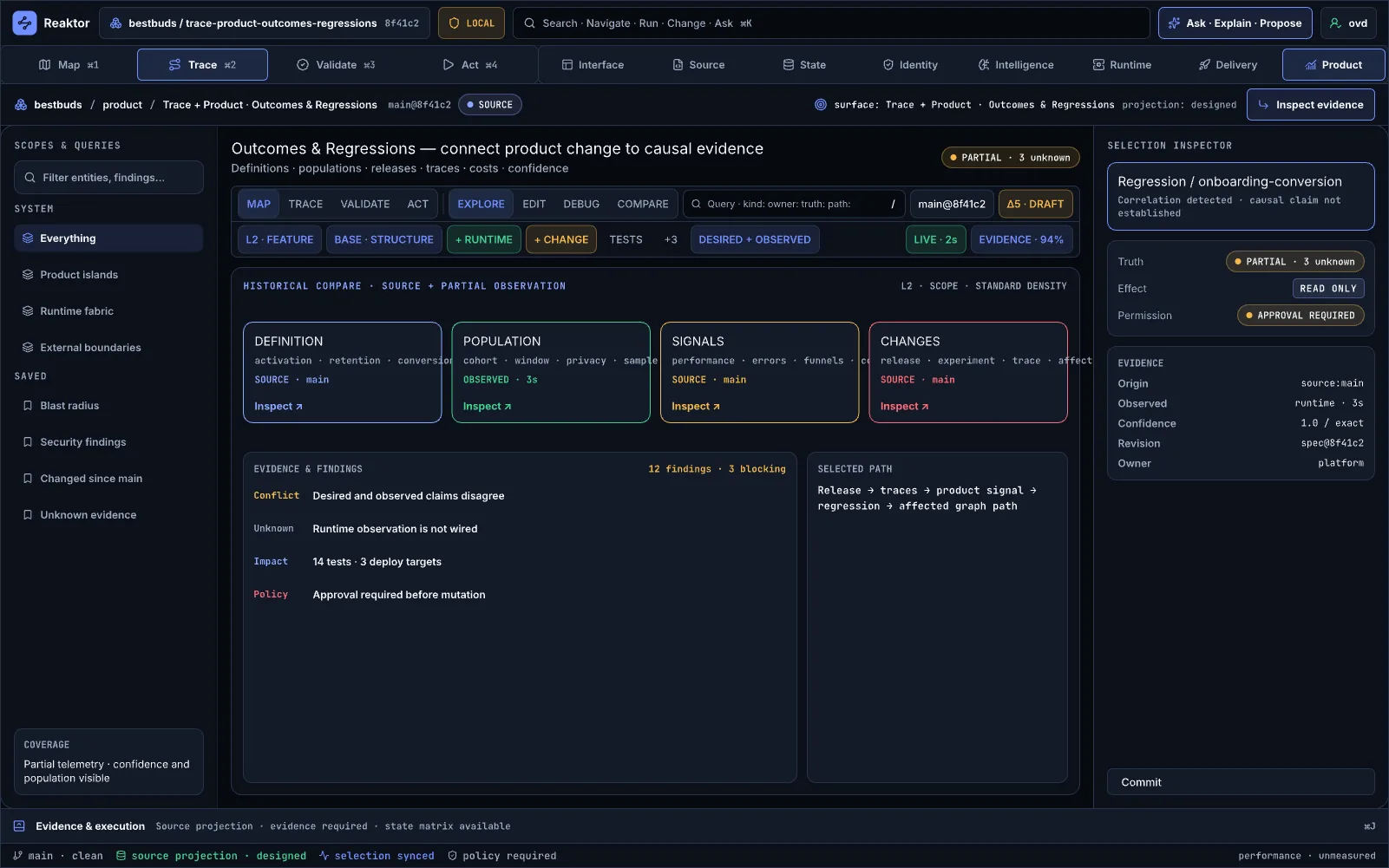
On the board. The full atlas scaffold rather than a bespoke layout: a SCOPES & QUERIES rail (Everything, Product islands, Runtime fabric, External boundaries, and saved queries Blast radius, Security findings, Changed since main, Unknown evidence), a COVERAGE line reading Partial telemetry · confidence and population visible, a header Outcomes & Regressions — connect product change to causal evidence subtitled Definitions · populations · releases · traces · costs · confidence, a PARTIAL · 3 unknown truth chip, a mode row (MAP TRACE VALIDATE ACT EXPLORE EDIT DEBUG COMPARE), and four content cards: DEFINITION (activation · retention · conversion · guardrail, SOURCE · main), POPULATION (cohort · window · privacy · sample size, OBSERVED · 3s), SIGNALS (performance · errors · funnels · costs · incidents), CHANGES (release · experiment · trace · affected graph nodes). Then EVIDENCE & FINDINGS · 12 findings · 3 blocking with Conflict / Desired and observed claims disagree and Unknown / Runtime observation is not wired, a SELECTED PATH of Release → traces → product signal → regression → affected graph path, and a SELECTION INSPECTOR on Regression / onboarding-conversion marked Correlation detected · causal claim not established.
Vision tie. The best in the cluster and one of the better in the atlas. It carries the truth vocabulary as components rather than prose: Truth PARTIAL · 3 unknown, Effect READ ONLY, Permission APPROVAL REQUIRED, and an evidence block with Origin / Observed / Confidence / Revision / Owner. Correlation detected · causal claim not established is exactly the discipline §1 asks for, stated as a first-class finding rather than a caveat. CHANGES including affected graph nodes is the graph doing product work.
Workflow tie. Opened at a weekly product review, or the day a metric moves and nobody knows why. Today this is four tools and a person: Amplitude for the metric, Sentry for the errors, the release dashboard for what shipped, and a senior engineer's memory for what connects them. There is no product on the market that does this join, because doing it requires knowing which code the release changed and which product events that code emits — which requires the graph.
Agentic tie. The board exposes a governed finding path. An agent reads a typed finding list with blocking counts, a truth chip, an effect mark and an approval requirement, and the SELECTED PATH gives it an explicit chain to walk. It can propose a regression hypothesis and is blocked from acting by APPROVAL REQUIRED. This is what the other nine boards should look like.
Blueprint tie. Closest to Unreal's Automation results correlated with a build, but the honest answer is that the analogy breaks. Unreal has no notion of a product outcome; the nearest thing is telemetry-driven design in Epic Online Services, which is a separate product bolted on. This board is Reaktor-specific and that is a point in its favour.
Replaces / augments. Amplitude, Mixpanel, PostHog, Statsig's metrics layer, and the "why did this drop" Slack thread. Also, partly, dbt's semantic layer, since DEFINITION is a metric-definition surface.
Improvements.
- Fix the self-contradiction in the evidence block. It reads
Confidence 1.0 / exactwhile the truth chip readsPARTIAL · 3 unknownand a finding saysRuntime observation is not wired. Confidence cannot be exactly 1.0 on a surface with unwired observation. Make confidence a function of the population and coverage, and show the two inputs. - De-boilerplate the numbers.
12 findings · 3 blockingandImpact 14 tests · 3 deploy targetsappear verbatim on12.07and13.03too, so they are chrome, not evidence. Derive them from the selection or blank them. - Give
DEFINITIONa real body: one column per metric withdefined at(aSourceRefto the graph node),last changed,consumers,disagrees with. Todayactivation · retention · conversion · guardrailis a word list. - Give
POPULATIONits own numbers:n,window,excluded,consent basis. This is the only board in my cluster that says the wordprivacyand it says it once, as a label. - Add a
PROMOTEcontrol that turns aCorrelation detectedfinding into aCausal claimonly when an experiment or holdout is attached, and refuses otherwise. That single interaction would enforce, at the level of the UI, the discipline that11.02violates.
Verdict. Keep, and promote it to the spine of Section 11. Every other board in the section should be a lens on this one.
11.02 · Learn · Cohorts & Retention
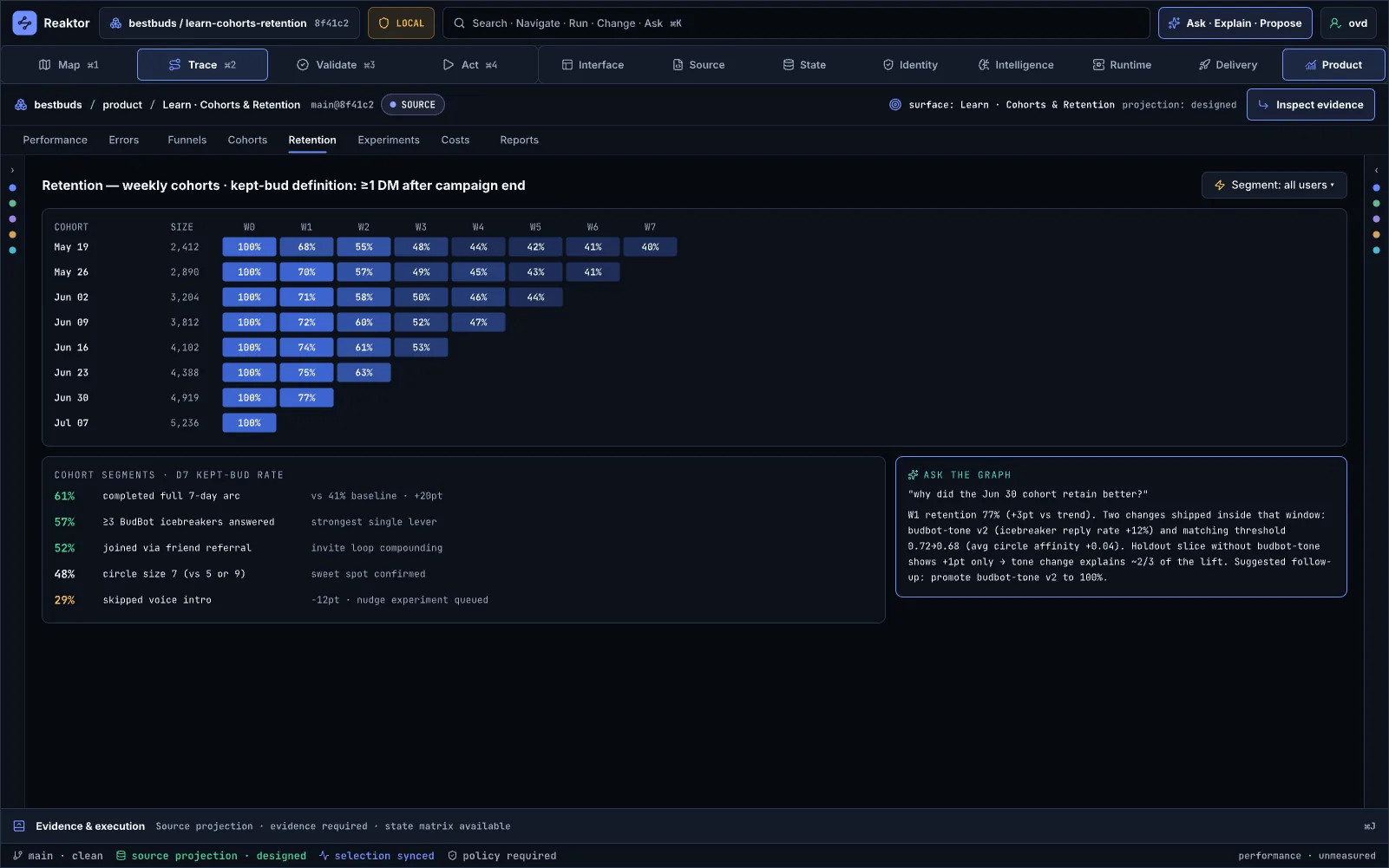
On the board. Three panes. A weekly retention triangle headed Retention — weekly cohorts · kept-bud definition: ≥1 DM after campaign end with a Segment: all users ▾ control, eight cohorts from May 19 to Jul 07 with sizes 2,412 through 5,236 and 36 retention percentages across W0–W7. A COHORT SEGMENTS · D7 KEPT-BUD RATE pane with five rows: 61% completed full 7-day arc · vs 41% baseline · +20pt, 57% ≥3 BudBot icebreakers answered · strongest single lever, 52% joined via friend referral, 48% circle size 7 (vs 5 or 9) · sweet spot confirmed, 29% skipped voice intro · −12pt · nudge experiment queued. An ASK THE GRAPH pane answering "why did the Jun 30 cohort retain better?" with a four-line narrative naming budbot-tone v2, matching threshold 0.72→0.68, a holdout slice, and Suggested follow-up: promote budbot-tone v2 to 100%.
Vision tie. None. No graph, no ports, no types, no evidence marks. ASK THE GRAPH is the only gesture at the vision and its answer is a paragraph of prose with no citation, no RunRef, and no link to the query that produced it.
Workflow tie. Opened by a founder or PM on Monday. Today: Amplitude, Mixpanel or PostHog, all of which do this better — segment builders, breakdowns, significance on the triangle, cohort export, session replay linkage.
Agentic tie. Actively agent-hostile despite the pane called ASK THE GRAPH. An agent cannot verify the answer, cannot re-run it, cannot see the definition of kept-bud beyond the one-line prose, and cannot tell which of the five segments are conditioned on the outcome. The narrative is a confident conclusion with the derivation deleted, which is the worst possible input to an agent.
Blueprint tie. There is no Unreal analogy. This is a games-analytics dashboard, and the Blueprint frame does not extend to it. Say so plainly rather than inventing one.
Replaces / augments. Amplitude, Mixpanel, PostHog, Heap. It replaces none of them.
What the incumbent structurally cannot do. Honestly: almost nothing, as drawn. The one defensible sliver is that a cohort definition could be a graph node, versioned with the code, so that changing what kept-bud means shows up as a graph diff with a blast radius over every dashboard and report that consumes it. Amplitude's definitions live in Amplitude and drift silently from the code that emits the events. That is a real problem and a real fix, but it is one pane, not a board — and it belongs on 11.01's DEFINITION card.
The honesty problem, specifically. This is the worst board in the atlas on evidence and the numbers are internally checkable, so here is the check.
- The retention triangle alone is 44 assertions: eight cohort sizes and 36 percentages. Not one carries a provenance marker.
- Every column is monotone non-decreasing.
W1runs 68, 70, 71, 72, 74, 75, 77.W2runs 55, 57, 58, 60, 61, 63.W3runs 48, 49, 50, 52, 53.W4runs 44, 45, 46, 47. Cohort sizes run 2,412 up to 5,236 without a single dip. Real retention triangles are noisy and reverse constantly. A triangle with zero reversals in 36 cells is authored, not measured. - The board's own AI answer contradicts the board's own table.
ASK THE GRAPHclaims the Jun 30 cohort'sW1 retention 77% (+3pt vs trend). The previous cohort's W1 is 75%, so the step is +2pt; fitted against the six prior cohorts the deviation is roughly +0.6pt. There is no reading of the table that yields +3pt. And because the table has no noise at all, no cohort could ever be flagged as an outlier — the question the pane answers is unaskable of the data above it. - It contradicts
11.03.48% circle size 7 (vs 5 or 9) · sweet spot confirmedasserts a settled finding, while11.03showscircle-size-9 · killed · day 4on a guardrail breach atp=0.002on the primary. An experiment killed on day 4 of 14 never reached power on the secondary; "sweet spot confirmed" is not something that experiment established. - Three of the five segments are conditioned on the outcome.
completed full 7-day arc,≥3 BudBot icebreakers answeredandskipped voice introare all engagement measures, so the comparison to a41% baselineis survivorship, not a lever. Calling the second onestrongest single leveris the exact error11.01names asCorrelation detected · causal claim not established. The section's own honest board defines the discipline and this board breaks it on the next screen. - The substrate is not nothing, but it is not this. There is an
analytics_eventstable with monthly range partitions in Postgres and a ClickHouse binding from an analytics worker, and Worker-to-ClickHouse has been proven live from the edge. So event ingest is plausible. Cohort modelling, retention definitions, holdout slices and the causal narrative are entirely absent from code.
What it should show instead. The retention triangle with every cell blank and one EmptyReason reading no cohort model · analytics_events ingested, not modelled, above a single honest pane: the analytics_events schema, the partitions that exist, the row counts that are actually there, and the list of definitions that would have to be written to fill the triangle. That is a more useful board than a fabricated triangle because it tells a builder what to build.
Improvements.
- Replace the triangle body with
NotWiredYetcells plus theEmptyReasonabove, and keep the row and column headers so the shape of the missing thing is visible. - Add a
DEFINITIONheader row to the triangle:kept-budmust be a link to the graph node that defines it, withlast changedandconsumers, not prose in a title. - Split the segment pane into two labelled groups,
AssignableandOutcome-conditioned, and refuse the word "lever" on anything in the second group. - Make
ASK THE GRAPHcite. Every claim in the narrative needs aRunRefto the query that produced it and aRe-runcontrol.explains ~2/3 of the liftwith no derivation is worse than no answer. - Remove
Suggested follow-up: promote budbot-tone v2 to 100%from this board. Promotion is11.03's effect, it has a guardrail model, and a retention board proposing a 100% rollout from an uncontrolled comparison is the failure mode this section exists to prevent.
Verdict. Demote to Vision, or Merge into 11.01 as the POPULATION card's detail view. As a product surface it is a worse Amplitude built on data that does not exist.
11.03 · Learn · Experiments
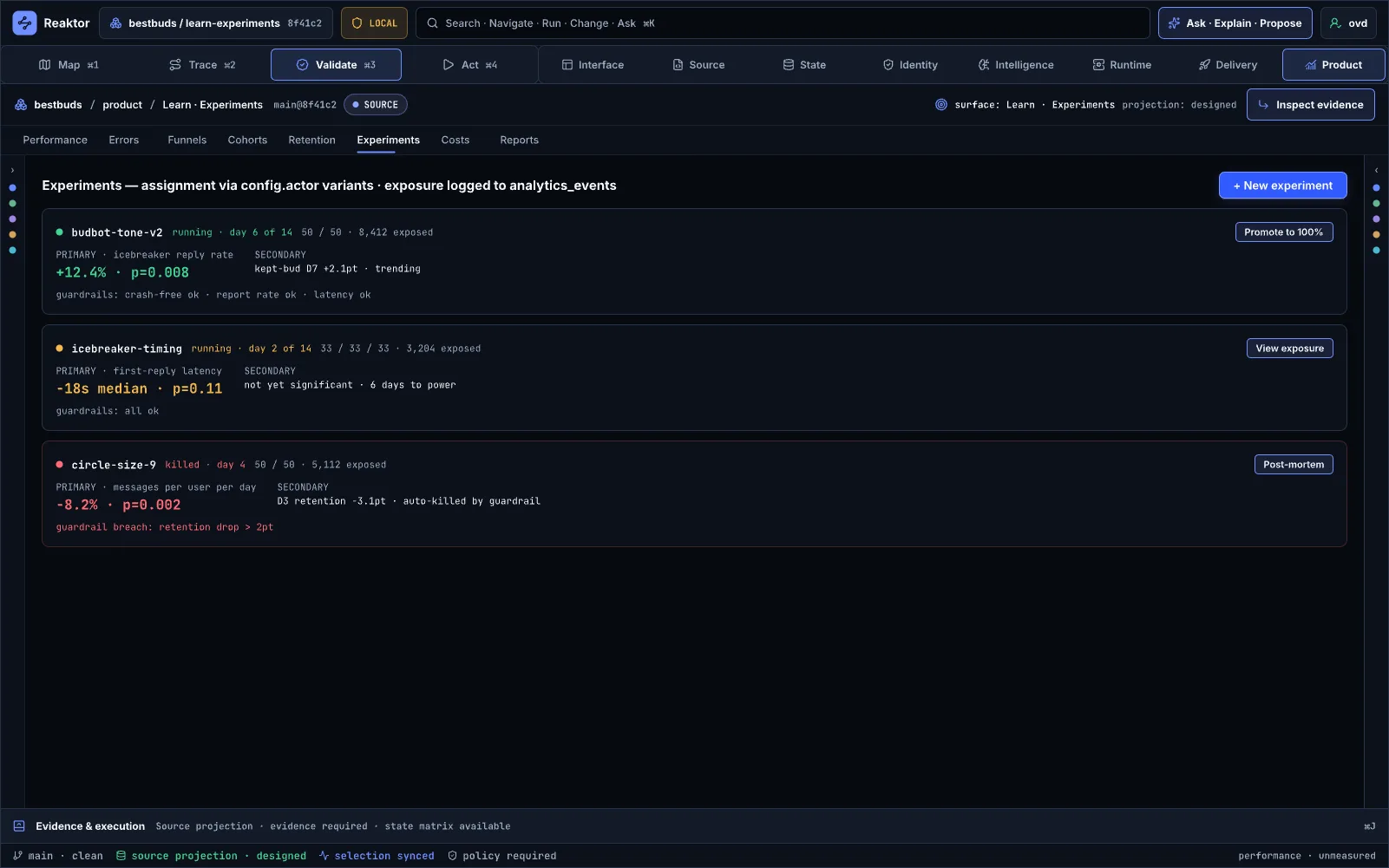
On the board. One pane, three experiment cards, plus + New experiment. The header states the mechanism: Experiments — assignment via config.actor variants · exposure logged to analytics_events. budbot-tone-v2 is running · day 6 of 14, 50 / 50 · 8,412 exposed, with Promote to 100%, PRIMARY · icebreaker reply rate +12.4% · p=0.008, SECONDARY kept-bud D7 +2.1pt · trending, guardrails: crash-free ok · report rate ok · latency ok. icebreaker-timing is day 2 of 14, 33 / 33 / 33, −18s median · p=0.11, not yet significant · 6 days to power, with View exposure. circle-size-9 is killed · day 4 with −8.2% · p=0.002, D3 retention −3.1pt · auto-killed by guardrail, guardrail breach: retention drop > 2pt, and a Post-mortem control.
Vision tie. More than 11.02 and less than it appears. assignment via config.actor variants names a real node type, and if assignment happens at a node in the live graph then exposure is provably logged at the port where assignment occurred, which is a genuine claim. But the board never shows that node, never shows the port, and never shows the exposure log. The config worker is, per prior audit notes, a dead duplicate.
Workflow tie. Opened by a PM daily during a test and by an engineer when a guardrail fires. Today: Statsig, LaunchDarkly, GrowthBook, Optimizely, or an in-house flag table plus a notebook.
Agentic tie. Reasonable. An agent reads state, day count, exposure, primary and secondary effects, and guardrail status, and could propose promote, extend or kill. Promote to 100% is the one high-effect control in the cluster and it carries no effect mark, no approval requirement and no confirmation state, on a board whose sibling 11.01 marks everything APPROVAL REQUIRED.
Blueprint tie. Unreal's data-driven config — device profiles and console variables varied per cohort — plus the live-ops A/B in Epic Online Services. Weak analogy; experimentation is not a Blueprint concept.
Replaces / augments. Statsig, LaunchDarkly, GrowthBook, Optimizely, Eppo, and Firebase Remote Config.
What the incumbent structurally cannot do. One real thing: compute an experiment's blast radius. Statsig knows which users saw a variant; it does not know which code the variant changed. Reaktor does, because the variant is a node and the graph tells you what it reaches. That turns a guardrail from a list of metrics somebody remembered to add into a derived set — "these are the ports downstream of this variant, watch all of them" — which is precisely how guardrails are missed in practice. Second: experiment and code push are the same mechanism. A variant is a subgraph swap and so is a code push, so a single surface can express "5% of devices are running this subgraph" whether the reason is a canary or an experiment. Statsig and LaunchDarkly cannot express the canary; the release tool cannot express the experiment. This board and 07.03 are already showing the same flags to two different audiences.
Improvements.
- Add a
Derived guardrailsrow per experiment listing the downstream ports the variant reaches and the current status of each, with a count of guardrails that were derived versus hand-added. - Put an effect mark, an approval requirement and a confirm state on
Promote to 100%, and disable it whileday n of 14is less than the pre-registered horizon unless a sequential test is declared. Promotingbudbot-tone-v2onp=0.008atday 6 of 14is peeking, and the board's most prominent button invites it. - Show the assignment node. One row: the
config.actornode id, its port, the exposure event name, and aVerify exposurecontrol that samples the log and reports assignment balance.8,412 exposedon a50 / 50split should show 4,206 versus 4,206 or the imbalance. - Replace bare p-values with effect size and interval.
+12.4% · p=0.008should read+12.4% [4.1%, 20.7%] · n=8,412. This costs one column and removes the single most common misreading. - Reconcile with
07.03. Both boards showbudbot-tone-v2,circle-size-9andvoice-intro-nudge;07.03calls themFEATURE FLAGS · CONFIG ACTOR · RUNTIME, NO REDEPLOY. Same objects, two boards, no link between them.
Verdict. Merge into 07.03 Ship · Releases as an "Experiments" lens, or keep only if the derived-guardrail pane lands. Flags, canaries and experiments are one mechanism in this architecture and splitting them across two sections is the atlas contradicting its own thesis.
11.04 · Optimize · Costs
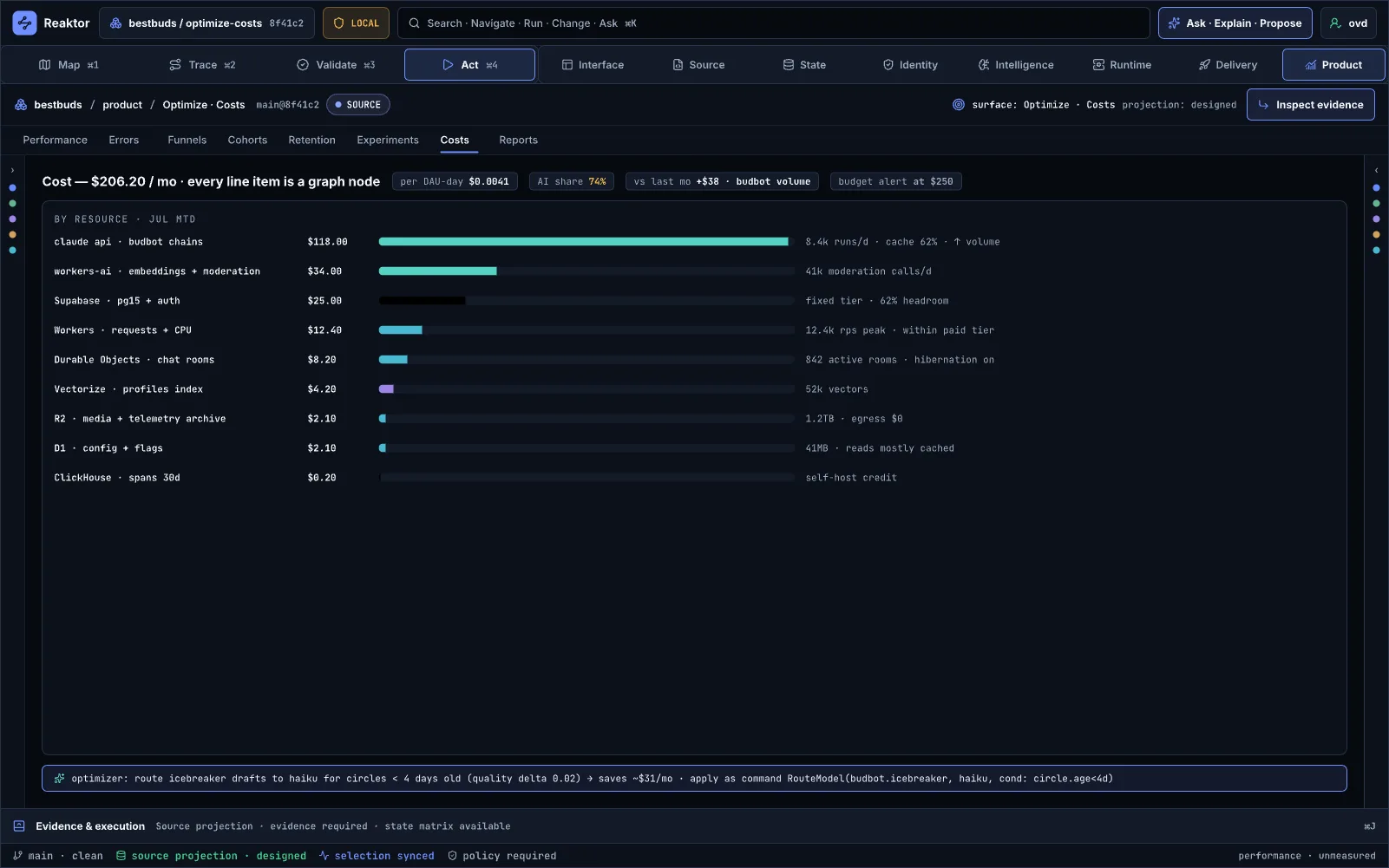
On the board. A header Cost — $206.20 / mo · every line item is a graph node, four summary tiles (per DAU-day $0.0041, AI share 74%, vs last mo +$38 · budbot volume, budget alert at $250), a BY RESOURCE · JUL MTD table of nine rows from claude api · budbot chains $118.00 · 8.4k runs/d · cache 62% down to ClickHouse · spans 30d $0.20 · self-host credit, and an optimizer line proposing route icebreaker drafts to haiku for circles < 4 days old (quality delta 0.02) → saves ~$31/mo expressed as a command, RouteModel(budbot.icebreaker, haiku, cond: circle.age<4d).
Vision tie. The header asserts the vision — every line item is a graph node — and the table then does not deliver it. Nine rows keyed by vendor SKU (Workers, Durable Objects, Vectorize, R2, D1, Supabase, ClickHouse) is exactly the Cloudflare billing page. A vendor SKU is not a graph node. The optimizer line is the one place the vision lands: a saving expressed as a graph command with a condition, which is executable rather than advisory.
Workflow tie. Opened at month end, or when a bill jumps. Today: five separate billing consoles that cannot be added together, exported to a spreadsheet, plus an Anthropic usage page. The consolidation alone is worth something; the graph attribution is worth much more.
Agentic tie. The best-shaped proposal in my cluster. RouteModel(budbot.icebreaker, haiku, cond: circle.age<4d) is a governable, typed, reversible command with a stated quality cost — that is what an agent proposal should look like everywhere in this atlas. It has no effect mark or approval gate, which it badly needs given that it silently degrades output quality for a cohort of users.
Blueprint tie. The strongest analogy in the cluster, and it is not the profiler. It is Unreal's Size Map and Asset Audit — the tools that attribute shipped bytes to individual assets and let you click through the reference chain to see who pulled in the 400MB texture. Reaktor's version attributes dollars to nodes and lets you click through the port chain to see which call path pulled in the Sonnet request. Same tool, different currency. That framing should drive the redesign.
Replaces / augments. Cloudflare and GCP billing consoles, Vantage, CloudZero, Infracost, Anthropic's usage dashboard, and the FinOps spreadsheet.
Does the board attempt per-node cost? No. It claims it in the header and ships a vendor table. This is the largest gap between claim and content in my cluster.
The graph-native cost model, designed. This is the one genuinely novel thing in Section 11 and it is worth specifying properly.
- Unit of attribution is the port invocation, not the resource. Every span already carries
(node, port, revision). Attach a cost vector to the span: tokens for a model port, CPU-milliseconds and requests for a Worker port, row-reads for a D1 or Postgres port, connection-seconds for a Durable Object port, byte-months for R2. Cost then rolls up the graph exactly as latency does, because it is carried on the same edges. - Three views fall out for free. Per node: what does
budbot.icebreakercost per month. Per port: what does one invocation of that port cost, so you get a unit price, not a total. Per path: what does one signup cost, decomposed along the exact causal path06.04already draws —AppleButton → AuthAction → AuthInteractor → AuthService → cf.workers/auth → d1.sessions, with a dollar figure on each hop. No billing console can produce that number, because no billing console knows the path exists. - Amortisation is where it gets hard and interesting. Fixed costs (
Supabase · fixed tier,ClickHouse · self-host credit) do not attribute to invocations. Show them in a separateUnattributedband with an explicit allocation policy control (by invocation,by bytes,by headroom,unallocated) rather than pretending they divide. - Cost regression as a first-class finding. Because cost is carried on spans keyed by revision,
cost per signup rose 18% at revision r_812is derivable and belongs on11.01alongside latency and error regressions. This is the join no FinOps tool can make, since none of them know what a release changed. - Budget as a graph constraint.
budget alert at $250should be a per-subgraph budget attached to a node, so an agent proposing a change can be told at proposal time that it exceeds thebudbotsubgraph's monthly ceiling — a compile-time cost check rather than an end-of-month surprise.
The arithmetic problem. The table is internally consistent — the nine rows sum to exactly $206.20 and $152 / $206.20 is the claimed 74% AI share — which makes the cross-board contradictions more striking, not less.
11.04listsclaude api $118.00as aJUL MTDtotal.11.05listsAI cost/day $118 · +9%.12.02listscost / day $118 · trending +9%. The same figure is a monthly total on one board and a daily total on two others. At$118/daythe AI line alone is roughly$3,540/monthand the$206.20/mototal is impossible.12.02independently breaks it:token spend 41.2M in · 8.1M outper day against$3 / $15 per Mtokmeans the output tokens alone cost$121.50a day, more than the claimed total, before a single input token is counted.per DAU-day $0.0041does not divide out. At theDAU 5,236that11.05reports,$206.20over 30 days is$0.0013, and over the 13-day month-to-date implied bylast Jul 13it is$0.0030. No plausible window yields$0.0041.13.02already shows the honest version of this board. Its cost pane readsCOST · ADAPTER NOT CONNECTED — source, currency, window and allocation UNKNOWN. Two boards in one atlas depict the same subject; one says the adapter is not connected, the other publishes nine line items to the cent.
Improvements.
- Re-key the table from resource to node. Columns:
node,port,invocations,unit cost,total,share,Δ vs prior revision. Keep the vendor breakdown as a secondaryBy providertoggle for reconciliation against the actual bill. - Add a
Cost per pathpane driven by the same trace selection as06.04, with a dollar figure on each hop ofloginWithAppleand a headlinecost per signup. - Add an
Unattributedband with an allocation-policy control, so fixed tiers stop being silently spread. - Put an effect mark, an approval requirement and a quality-impact statement on the
optimizercommand, and add aRevertthat is itself a command. Routing a cohort's drafts to a cheaper model is a user-visible product change wearing a cost-saving label. - Until the adapter exists, adopt
13.02's language verbatim. OneEmptyReasonreadingcost adapter not connected · source, currency, window and allocation UNKNOWN, with the nine resource rows present but valueless so the shape of the model is still legible.
Verdict. Rebuild as a per-node, per-port cost model, and move it out of Section 11 into Section 13 next to 13.02, which already owns the resource inventory and already has the empty cost slot waiting for it. Cost is a runtime-fabric concern, not a product-learning concern.
11.05 · Learn · Reports
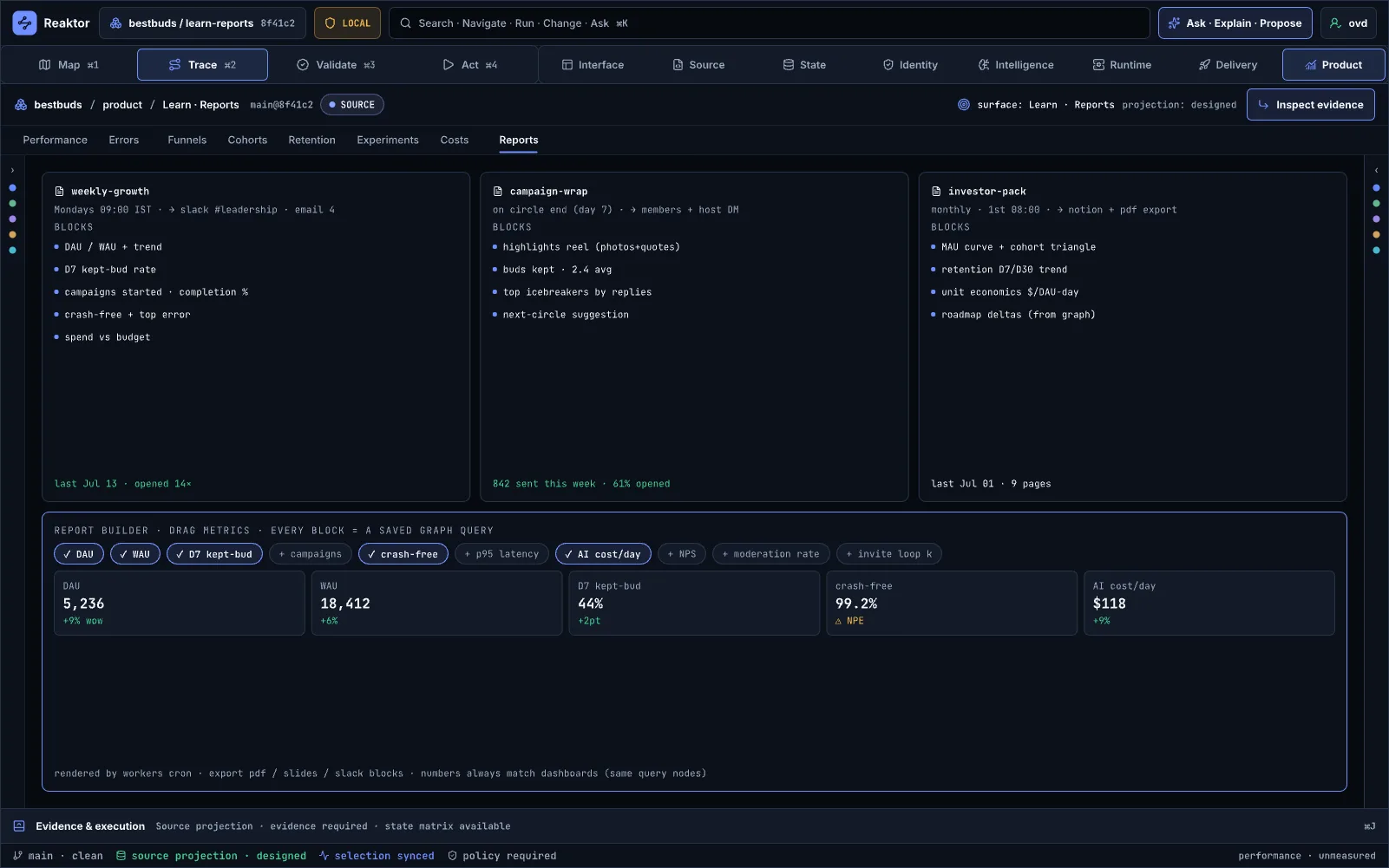
On the board. Three saved reports and a builder. weekly-growth runs Mondays 09:00 IST · → slack #leadership · email 4 with five blocks and last Jul 13 · opened 14×. campaign-wrap fires on circle end (day 7) · → members + host DM with four blocks including highlights reel (photos+quotes) and 842 sent this week · 61% opened. investor-pack is monthly · 1st 08:00 · → notion + pdf export with MAU curve + cohort triangle, unit economics $/DAU-day, roadmap deltas (from graph) and last Jul 01 · 9 pages. Then REPORT BUILDER · DRAG METRICS · EVERY BLOCK = A SAVED GRAPH QUERY with ten chips split between checked and unchecked, a five-tile preview (DAU 5,236, WAU 18,412, D7 kept-bud 44%, crash-free 99.2% ⚠ NPE, AI cost/day $118), and a footer: rendered by workers cron · export pdf / slides / slack blocks · numbers always match dashboards (same query nodes).
Vision tie. One sentence carries it: numbers always match dashboards (same query nodes). That is a semantic-layer claim, and it is the correct one — a single definition store consumed by dashboard, scheduled report and investor pack. roadmap deltas (from graph) is the other genuine tie, since a roadmap delta derived from the graph rather than from a Notion page is something no BI tool can produce.
Workflow tie. Opened once when set up and then never — which is the point; the output arrives in Slack. The person who opens it is whoever is asked "where did this number come from" in a leadership meeting. Today: a Metabase or Looker dashboard, a Notion page updated by hand, a Zapier job, and three versions of DAU that disagree.
Agentic tie. Good in shape, unbuilt in substance. If every block is a saved graph query then an agent can compose a report, and campaign-wrap firing on circle end (day 7) is an event-triggered report, which is a genuinely agentic pattern. But the board shows no query for any block, so an agent has nothing to read.
Blueprint tie. Unreal's Automation report and Insights export. Weak; this is a BI scheduling tool and the frame does not stretch to it.
Replaces / augments. Metabase, Looker, Mode, Hex, the Notion investor update, and Zapier or n8n for the scheduling.
What the incumbent structurally cannot do. The definitional join. Looker's LookML and dbt's semantic layer are the closest competitors and both sit beside the code, so a metric definition drifts from the events that feed it and nobody finds out. If the query is a node in the same graph as the emitting code, a rename propagates and a broken block is a compile error rather than a wrong number in an investor deck. That is the one claim on this board worth building the board for.
Improvements.
- Make each block show its query node id and
last changed, and add aDefinition driftstate when a block's query node changed since the report last rendered. This operationalisesnumbers always match dashboardsinstead of asserting it. - Add a
Provenancefooter to every rendered report — revision, window, population, and which blocks wereNotWiredYetat render time. A report that ships to#leadershipand to investors must carry its own evidence, and this is the highest-stakes distribution surface in the atlas. - Add an
UNAVAILABLEblock state and render it in the output rather than omitting it. A weekly report that silently drops the D7 block because the cohort model is missing is worse than one that printsD7 kept-bud — not wired. - Reconcile the preview tiles.
DAU 5,236is the same figure as11.02'sJul 07cohort size, andAI cost/day $118contradicts11.04's monthly$118. If the blocks really were the same query nodes these two could not disagree, so the preview is the proof that they are not. - Gate
investor-pack. A monthly PDF export to external parties is the one place in this atlas where an unmarked number becomes a legal artifact. It needs an explicit approval step and a rule that noPARTIALorUNKNOWNblock renders into it without a visible caveat.
Verdict. Strengthen, then merge the builder into 11.01 once DEFINITION is real. The scheduling and distribution half is worth keeping as its own board; the metric-definition half belongs on 11.01.
Cross-cutting
1. The differentiation ledger
For each board, what the incumbent structurally cannot do, and the verdict on building versus absorbing.
| Board | Structural advantage from the live typed graph | Build or absorb |
|---|---|---|
10.01 Spans | Span coverage has a denominator. The graph enumerates every port that should emit a span, so "which ports are uninstrumented" is answerable before traffic. Datadog and Honeycomb can only show spans that arrived. | Build the map and the coverage pane. Absorb the collector, storage and waterfall. |
10.02 Metrics | Metric definitions as nodes, so a rename has a blast radius instead of a silent break. | Absorb Grafana entirely. Build only the definition pane. |
10.03 Profiles | Fold on graph topology, not call stacks. One flame graph across Kotlin, C++ and TypeScript because frames carry node ids across the FFI boundary — no profiler follows a JSI or C-ABI hop. | Build the fold. Absorb pprof, Parca and the platform profilers as sample sources. |
10.04 Errors | Group by pushed subgraph revision and by capability tier. Sentry's unit of blame is a build; Reaktor's is a live subgraph, and two devices on one build can run different graphs. | Build. Strongest case in the cluster. |
10.05 Alerts | Routing derived from graph ownership rather than a static mapping, and alert coverage as a query over ports. | Build the routing and coverage. Absorb Grafana Alerting and PagerDuty as the delivery layer. |
11.01 Outcomes | Joins product regression to the affected graph nodes and the revision that changed them. Amplitude has no model of code. | Build. The section's only irreplaceable board. |
11.02 Cohorts | Nothing, beyond definitions-as-nodes, which is one pane. | Absorb PostHog or Amplitude. |
11.03 Experiments | Guardrails derived from the variant's downstream ports; experiment and canary unified because both are subgraph swaps. | Build the derivation. Absorb Statsig for statistics. |
11.04 Costs | Cost carried on spans keyed by (node, port, revision), giving unit cost per port and cost per causal path. No billing console knows the path exists. | Build. The most novel unbuilt idea in the cluster. |
11.05 Reports | One definition store shared by dashboard, scheduled report and investor pack, living in the same graph as the emitting code. | Build the definition binding. Absorb Metabase for rendering. |
Four boards are honest absorb-not-rebuild cases in whole or in large part: 10.02, 11.02, and the statistical engine of 11.03, and the rendering half of 11.05. That is a legitimate outcome and the atlas should say it on the boards themselves — an embedded Grafana panel with a Reaktor definition rail around it is a more credible product than a home-grown chart.
2. What graph-native observability actually looks like
The design, concretely, in one place. Every signal in this cluster is currently keyed by a string that a human chose — a service name, a pod name, a stack frame, a vendor SKU. Replace that key with (node id, port id, revision, capability tier) and each surface changes shape.
- The span. Emitted at a port, not in a function. Its parent is determined by the graph edge, not by a propagated header, so the trace tree is correct even across a code push that rewired the middle of it. Latency becomes per-port:
AuthService.loginWithApplehas a p95 per inbound port, and a slow port is attributable to the caller that used it that way, not to the service as a whole. - Coverage. The denominator exists.
ports total,ports instrumented,ports never observed, and — the one that catches rot —spans arriving for ports not in the graph, which is the signature of stale deployed code. This single number is the cluster's clearest "Datadog cannot do this". - Blast radius as an observability primitive.
06.04already computesAffected nodes 14 · across 5 modulesfor a trace. The same query should hang off an error group, an alert, a cost regression and an experiment variant. It is one query reused five times and it currently appears on exactly one board outside my cluster. - The error. Grouped by
(port, capability tier, subgraph revision). The same exception where the adapter is present is a bug; where the adapter is absent it is missing degradation; those are two defects and Sentry cannot separate them because it has no capability model. And because graph code push rewires marked subgraphs at runtime, the release field must be a bundle revision, so an error can be attributed to the exact pushed subgraph that introduced it. Sentry has no field for that and cannot acquire one. - The profile. Samples fold onto topology. Self-CPU per node, per port, per subgraph, and a boundary lane showing time inside
reaktor-ffiframes. Crossing runtimes is the part no incumbent can match, and it is also the part that does not exist yet, so it must be marked as vision. - The cost. A vector on the span, rolled up the same edges as latency. Per node, per port, per path. Detailed in the
11.04entry above. - The prerequisite nobody has written down. All of this keys on port identity, and the audit's
D-6says port type identity is unsound:Typeis(String, KClass?), reified ports carry a real class, and everyServiceNodeendpoint and every JS caller carriesnull. Same-named ports on different paths refuse to connect; different classes on the string path connect happily. A telemetry key built on that identity will merge unrelated ports and split identical ones. The keystone fingerprint system named in §2 is not just a verification concern — it is the precondition for this entire section, and no board in Section 10 mentions it. That is the most important structural link between the audit and my cluster and it should appear as a blocking finding on10.01.
3. The trace continuum: one surface or three?
There are three trace surfaces in the atlas: 10.01 (span map, eBPF, evidence), 06.04 (causal trace), 12.07 (AI traces). They should be one surface with three lenses, and the boards already prove it.
10.01 and 06.04 are showing the same trace. Both name trace abc4f1e2, both walk the identical seven hops from AppleButton.onClick through AuthAction.loginWithApple, AuthInteractor.invoke, AuthService.handle, cf.workers/auth, d1.sessions to routeBinding.navigate(/home). They disagree on its duration: 06.04 says 142 ms and its waterfall sums to 142ms, while 10.01 says total 268ms. One trace, two boards, two durations, no link between them. That is not two surfaces that happen to overlap; it is one surface duplicated and then allowed to drift.
12.07 is a different case. It is not a different viewer — it is the same scaffold as 11.01 and 13.03 down to the identical 12 findings · 3 blocking and Impact 14 tests · 3 deploy targets — applied to spans whose kind is model or tool. Request → prompt → model → tool → guardrail → eval → product signal is a filtered path through the same span tree, with extra columns for tokens, cost and guardrail outcome. That is a lens, not a viewer.
The recommendation:
- One trace surface with an explicit
Lenscontrol offeringSystem(the aggregate map and coverage,10.01's job),Causal(one path with the port waterfall and blast radius,06.04's job), andModel(spans filtered to model and tool kinds with token, cost and guardrail columns,12.07's job). 10.01keeps the aggregate map and gains the coverage pane; it loses the single-trace list to the Causal lens.12.07becomes the Model lens and stops being a board.- The justification is the Symphony Contract itself: it promises selection survives every movement. Three trace viewers with three chrome sets and three sub-nav bars guarantee that selecting a span on one and moving to another loses it — which is exactly what the duration disagreement above demonstrates has already happened at authoring time.
4. Should Section 11 be demoted?
Yes, as drawn — but the right move is a restructure, not a blanket demotion, because two of its five boards carry the only genuinely novel ideas in my cluster.
11.01 Outcomes & Regressionsis the section's spine and should stay a product surface. It is the only board that carries the truth vocabulary as components and the only one whose central claim — joining a product regression to affected graph nodes — is unavailable in any incumbent.11.02 Cohorts & Retentionshould be demoted to vision and replaced by an integration surface that embeds PostHog or Amplitude, with Reaktor owning only the definition store.11.03 Experimentsshould be merged into07.03 Ship · Releases. Flags, canaries and experiments are one mechanism — a subgraph swap on a fraction of traffic — and the two boards already show the same three flags.11.04 Costsshould be rebuilt and moved to Section 13, next to13.02, which already owns the resource inventory and already has an empty, honestly-labelled cost slot.11.05 Reportsshould keep its scheduling and distribution half and hand its builder to11.01.
Section 11 therefore shrinks from five product surfaces to two, one of which is an integration surface. That is a smaller and much more defensible section, and it stops the atlas from claiming an analytics product it has no code for and no reason to build.
Cluster findings
Missing panes
Span coverage. No board answers "which ports emit no telemetry". This is the single clearest structural advantage the live graph confers on observability — a denominator that Datadog, Honeycomb and Grafana cannot construct — and Section 10 does not have it. Belongs on 10.01.
Logs. Section 10's own tab bar lists Logs on four of five boards, and there is no logs board. 10.01 even shows a Logs 412 counter. Given the audit's twelve security findings, a log surface keyed by principal and port is not optional.
Crashes. The same tab bar lists Crashes, and the errors board is filed under Section 11's tab bar instead, so the destination is unreachable from within Section 10.
Sources. Listed as a tab on 10.02, 10.03 and 10.05; implemented as a pane inside 10.05. Either promote it or remove the tab.
Security observability. Six alert rules and not one watches the security plane, on a system where the audit records S-1…S-12 including any authenticated user joining any chat room, stealable FCM endpoints, and moderation that fails open. The atlas already ships a saved query named Security findings on 11.01's rail; Section 10 never uses it. A 10.06 · Observe · Security Signals board with fail-open rate, authorization-denial rate and anomalous-principal detection is the highest-value missing surface in my cluster.
Queue and delivery health. 10.05 asserts a chat DO queue alert; the audit says there are no queues at all and every pipeline is waitUntil fire-and-forget, with no idempotency in notifications. A pane showing fire-and-forget completion rate, dropped-effect count and duplicate-notification rate would make the atlas's most serious architectural gap visible rather than papered over with a green tick.
Capability and degradation observability. The word capability does not appear once across ten boards. §1 says degradation is designed, not discovered — but nothing observes it. A pane showing, per adapter, the population on each capability tier and the error and success rates within each tier is what makes designed degradation checkable in production.
Telemetry instrumentation as a visitor. §1's canonical visitor example is "telemetry instruments a subtree", and no board shows the visitor, its scope, its overhead, or which subtrees it is attached to. The 03.01 Visitor Lab board exists elsewhere in the atlas; Section 10 never connects to it.
Cost per path. Covered above under 11.04. No board answers "what does one signup cost".
Definition store. 11.01 has a DEFINITION card with four words in it and 11.05 claims every block = a saved graph query. Neither shows the store. The metric-definition surface is the load-bearing pane behind 10.02, 11.02, 11.05 and half of 11.03, and it exists nowhere.
Seams
The two tab bars bleed into each other. Section 10's boards carry Spans · Metrics · Logs · Profiles · eBPF · Crashes · Pipelines · Alerts · Sources — nine destinations for five boards, four of them dead. Section 11's boards carry Performance · Errors · Funnels · Cohorts · Retention · Experiments · Costs · Reports — eight destinations for five boards, with Performance and Funnels dead and Cohorts/Retention pointing at one board. And 10.04 Observe · Errors carries the Section 11 bar while its breadcrumb reads bestbuds / runtime / Observe · Errors, so the section's best board is navigationally orphaned from its own section.
The same trace has two durations. 06.04 says 142 ms for trace abc4f1e2; 10.01 says total 268ms for the same id and the same hops.
The same error has two causes. 10.04 blames the NPE on cmd #4 SetProperty ChatActor.initialState; 07.03 says the same group is regression linked: cmd #12 flatInvoker bump; 10.03 attributes cmd #12 to a FlexBuffer.parse regression instead.
The same signal has two states. 10.02's error-rate caption reads spike 14:02 · SocketTimeout · resolved; 10.04 lists SocketTimeout · api.bestbuds.app/graph · 240 ev · 112 users · spike · 2h ago. Resolved on one board, active on the other, with no link either way.
The same figure is monthly and daily. $118 is a JUL MTD line item on 11.04 and a daily cost on both 11.05 and 12.02.
Cost is depicted twice with opposite honesty. 13.02 reads COST · ADAPTER NOT CONNECTED — source, currency, window and allocation UNKNOWN; 11.04 publishes nine line items to the cent.
Two boards own the same flags. budbot-tone-v2, circle-size-9 and voice-intro-nudge appear on both 11.03 and 07.03, with no cross-link and different framings (experiment versus FEATURE FLAGS · CONFIG ACTOR).
The metrics board queries a backend the pipeline board does not provision. 10.02 runs PromQL against Prometheus; 10.05's pipeline exports to ClickHouse, R2 and Grafana Cloud, and never mentions Prometheus. 10.01's toggle offers Table / Grafana.
The scaffold boards are indistinguishable. 11.01, 12.07 and 13.03 share the same rail, the same mode row, the same EVIDENCE & FINDINGS · 12 findings · 3 blocking, the same Impact 14 tests · 3 deploy targets and the same Origin / Observed / Confidence / Revision / Owner block. Those counts are chrome, not evidence, which quietly devalues the truth vocabulary everywhere it appears.
The chrome promises evidence that the panes do not carry. All ten boards end with Evidence & execution · Source projection · evidence required · state matrix available and ⌘J, and Inspect evidence sits in the header of every one. On eight of ten, no pane offers a per-datum evidence affordance, so the promise is decorative.
Repeated magic numbers give the fixture away. 142 is a request rate, a p95 in milliseconds, a total trace duration and a slow-query time. 412 is a Durable Object connection count, a log count, an error event count and a JVM heap figure in megabytes. 4,102 is a cohort size and a row count. 8,412 is an exposure count and 8.4k is a daily run count. These are one author's sample values reused, and a reader who notices stops trusting every number on every board.
Honesty audit
11.02 Cohorts & Retention — worst in the cluster and, per the atlas-wide count, worst in the atlas. 44 unmarked assertions in the triangle alone, every column monotone with zero reversals, an AI narrative claiming +3pt vs trend that the table cannot produce, a sweet spot confirmed that 11.03 shows was never established, and three of five "levers" conditioned on the outcome they claim to explain. Honest version: blank cells with EmptyReason · no cohort model · analytics_events ingested, not modelled, plus the real analytics_events schema and partition state, and the list of definitions still to be written.
11.04 Optimize · Costs — a confident invoice for a bill nobody has fetched. Nine line items to the cent, a per DAU-day figure that does not divide out, and $118 that contradicts two other boards by a factor of thirty. Its own sibling 13.02 already carries the correct language. Honest version: adopt 13.02's COST · ADAPTER NOT CONNECTED verbatim, keep the nine rows valueless so the model's shape stays legible, and keep the RouteModel(...) command, which is a genuine design artifact rather than a measurement.
10.05 Alerts & Pipelines — the most misleading control in the cluster is not a number. Six green ✓ marks assert deployed OTel SDKs on android, ios, web, jvm, workers and four eBPF nodes. None exists. Because they are ticks rather than figures they escape the atlas's "unmarked numeric assertion" audit entirely, while making a stronger claim than any number would. The queue lag · 2.1s reading monitors a queue the audit says does not exist. Honest version: DESIGNED · not deployed on every source except the Worker tail and ClickHouse export, and the queue rule replaced with a fire-and-forget completion-rate pane.
10.03 Observe · Profiles — named hot frames from an unprofiled pod. ChatActor.reduce — 42%, GraphDiff.compute — 30%, FlexBuffer.parse — 22% ⚠ new and was 9% are asserted for pod chat-7f2 at 60s @ 99Hz, and the first level sums to 98%, so a flame graph loses 2% of its root's time — a physical impossibility that proves the numbers were typed. Honest version: repoint the subject at the FlexBuffers device runs, which are real, with a RunRef and a real Compare vs between two of them.
10.02 Observe · Metrics — four unmarked chart captions and one PromQL query against a backend nothing provisions. chat-service 64ms, 12.4k rps · edge cached 62%, 412MB / 512MB · GC 2.1%. Honest version: an embedded Grafana panel labelled as such, or an empty state.
10.04 Observe · Errors — fabricated where it could have been devastating. A convincing stack trace ending in dev.shibasis.reaktor.core.EventLoop.drain(EventLoop.kt:204), an invented 840 events · 24h, MTTR 3.2h, 94% on Android 14, and reproducible in shadow traffic when no shadow-traffic system exists. The frustrating part is that the audit hands this board a better top group for free: lifecycle fires effects on rejected transitions and actors can double-start, both in exactly the ActorNode and lifecycle path the fake stack already points at. Real defects with SourceRef to the audit would make the same design point and be true.
11.03 Learn · Experiments — plausible numbers, missing method. Effect sizes and p-values with no intervals, no pre-registration, no sequential correction, and a Promote to 100% button offered on day 6 of a 14-day test at p=0.008. The config.actor assignment mechanism it names is, per prior audit notes, a dead duplicate worker.
11.05 Learn · Reports — the distribution risk. Its preview tiles disagree with 11.04 and reuse 11.02's numbers, which disproves its own claim that numbers always match dashboards (same query nodes). This is the one board whose output leaves the building, into #leadership and an investor-pack, so it is the one place an unmarked number becomes an external commitment. It needs a provenance footer and a render-time gate before it needs anything else.
10.01 Trace, eBPF & Evidence — partially honest, and the partial part is the problem. DESIGN FIXTURE, not operational and performance · unmeasured are exactly right. But the marker covers the collector row and the trace map while the six eBPF tiles below it are unmarked, so a reader takes those as live. And every p95 on the map is a multiple of 80ms, which is a design grid read off bar widths. Extend the marker downward and blank the grid values.
11.01 Outcomes & Regressions — honest in vocabulary, decorative in use. It is the only board carrying Truth, Effect, Permission and an evidence block, and it undermines them by asserting Confidence 1.0 / exact next to Truth PARTIAL · 3 unknown and a finding that says Runtime observation is not wired. Confidence of exactly 1.0 on an unwired surface is the truth vocabulary being used as ornament, which is more corrosive than not using it at all.
Part 12 · Section 13 — Runtime and Extensibility
Boards covered: four — 13.01 Map + Runtime · System Fabric & Operations, 13.02 Trace + Runtime · System Fabric Resource Explorer, 13.03 Extend · FFI Switchboard, 13.04 Extend · Graph Projections.
Ground truth used beyond the board text: the FFI specification at /Users/ovd/dev/bestbuds/targets/reaktorWeb/docusaurus/docs/reaktor-ffi.md (579 lines), and the actual module at /Users/ovd/dev/reaktor/reaktor-ffi/, read to check the depiction against the code.
The evidence template
13.03 · Extend · FFI Switchboard is not a better-looking board than the other 103. It is a board that has a grammar, and the grammar is what should be lifted. What follows is that grammar written as a specification a designer can apply to any board tomorrow.
The template exists to satisfy one promise the atlas already makes on 00 · START HERE: "Map the whole system, trace any consequence, validate every claim, and act through governed plans — without losing workspace, revision, environment, selection, time, principal, or evidence." Those seven carriers are the template's reason to exist. Every region below either carries one of them or renders the object under study. Nothing else is allowed in.
The regions
R1 — Identity strip (mandatory). The top line carries five of the seven carriers at once: workspace and product path (bestbuds / extend-ffi-switchboard), revision (8f41c2), environment (LOCAL), principal (ovd), and two entry points — the command palette (⌘K, labelled Search · Navigate · Run · Change · Ask) and the agent (Ask · Explain · Propose). This strip must be byte-identical across all 104 boards. Its job is to prove that moving between boards did not silently change who you are, which revision you are reading, or which environment you would write to.
R2 — Movement and instrument selector (mandatory). Map ⌘1 · Trace ⌘2 · Validate ⌘3 · Act ⌘4 and the eight instruments Interface · Source · State · Identity · Intelligence · Runtime · Delivery · Product. Every board is one (movement × instrument) cell and must show which cell it is by selection state, not by its title. A board whose content does not match its declared movement is a defect the selector makes visible — this is exactly how 13.02 fails, below.
R3 — Scope rail (mandatory for any board whose subject is a set; optional for a single-object board). Three stacked parts. A free filter (Filter entities, findings…), a SYSTEM group of structural scopes (Everything · Product islands · Runtime fabric · External boundaries), and a SAVED group of stored queries (Blast radius · Security findings · Changed since main · Unknown evidence). The rail closes with R4.
R4 — Coverage declaration (mandatory, one per board, no exceptions). One sentence, two halves, separated by a middle dot: what is real, then what is not. Kotlin source · foreign targets designed. Desktop source · MCP parity proof pending. This is the single most valuable component on the model board and the one most obviously missing from 13.01 and 13.02.
The rule that makes it honest: it is a bound component, not a text field. The first half must resolve to a module path plus a revision. The second half must resolve to a document anchor. A board that cannot fill both halves from real references may not render the component — it must instead render COVERAGE · UNDECLARED, which is a visible defect, not a blank.
R5 — Board thesis (mandatory). Two lines. A title that names the object in the system's own vocabulary (FFI Switchboard — explicit contracts across runtime boundaries) and a dimension line (ABI · schemas · ownership · cancellation · streaming · conformance). The dimension line is a contract with the reader: every dimension named must resolve to a region on the board or to an explicit gap marker. 13.03 names six dimensions and delivers on roughly one and a half, which is the board's central failure.
R6 — Mode strip (mandatory). SOURCE · MAP · TRACE · VALIDATE · ACT · EXPLORE · EDIT · DEBUG · COMPARE. Nine modes, exactly one active. The rule: a mode must either produce a materially different rendering of the same selection, or render disabled with a one-line reason. Nine always-enabled modes that all show the same plane is worse than three modes that work.
R7 — Query bar (mandatory). Query · kind: owner: truth: path: with / as the focus key. The four typed facets are what turn the truth vocabulary from decoration into an index. truth:unknown must be a runnable query — that single capability is what would let a reviewer find the atlas's own 49 unmarked boards. Facets are extensible per section; kind, owner, truth, path are the floor.
R8 — Revision and layer strip (mandatory). main@8f41c2 (base), Δ5 · DRAFT (uncommitted delta count and draft state), L2 · FEATURE (semantic level), then layer toggles BASE · STRUCTURE / + RUNTIME / + CHANGE / TESTS / +3. Two things are separated here and must stay separated: semantic level (how much of the graph you resolve, L0 to L4) and overlay layers (which evidence planes are composited on top). Boards routinely conflate them.
R9 — Plane header (mandatory). Three bound values: the dual-plane declaration (DESIRED + OBSERVED), liveness (LIVE · 2s), and evidence coverage (EVIDENCE · 94%). All three are computed. The dual-plane declaration is a state, not a label: legal values are DESIRED ONLY, OBSERVED ONLY, DESIRED + OBSERVED, and DESIRED + OBSERVED · CONFLICT. If a board renders DESIRED + OBSERVED while its findings ledger says Runtime observation is not wired, the header must fall back to DESIRED ONLY automatically. 13.03 violates this today.
R10 — The plane (mandatory). Named for what it renders and how it was derived: BOUNDARY PLANE · SOURCE-DERIVED, PROJECTION PLANE · IDENTICAL SNAPSHOT HASH. Immediately below sits the density control, L2 · SCOPE · STANDARD DENSITY, which is three independent settings — level, grouping, density — and should read as three controls, not one string.
The plane holds entity cards. Every card carries exactly four things: a name in system vocabulary (TYPESCRIPT GUEST), a role line naming its concerns (Workers · events · promises · streams), a truth stamp (SOURCE · main, OBSERVED · 3s, UNKNOWN), and an Inspect ↗ affordance that navigates without losing selection. A card with no truth stamp is invalid.
R11 — Findings ledger (mandatory). A counter (12 findings · 3 blocking) and a typed list. 13.03 shows four classes; the full set should be six: Conflict (two claims disagree), Unknown (a claim cannot be made because something is not wired), Stale (an observation exists but is older than its freshness horizon), Impact (what a change here would touch — 14 tests · 3 deploy targets), Policy (what governs a mutation — Approval required before mutation), and Defect (a known D-* or S-* finding scoped to this object). The atlas has no Defect class today, which is why the twelve security findings and the port-identity defect appear nowhere.
Two binding rules. A Conflict must name both operands — Desired and observed claims disagree is a class label masquerading as a finding; the real finding reads desired: TS guest present in HELLO capability table · observed: no HELLO ever exchanged. And the counter must be the length of the list; if the list is truncated, the truncation is shown.
R12 — Selected path (mandatory). The causal chain this board exists to let you walk: Contract → generated boundary → runtime call → trace → conformance receipt. Each hop is a navigation target, and each hop carries its own truth stamp, so a chain that goes dark halfway is visible as such. This is the region that makes selection survival concrete rather than promised.
R13 — Selection inspector (mandatory). Four stacked parts.
- Subject line, typed:
Boundary / chat.realtime. Kind first, then identity. - Qualifier line, one sentence of honest nuance:
Source contract · native parity not yet proven. - The three independent axes, each in its own slot and never merged into a single badge: Truth (
UNKNOWN · not wired), Effect (READ ONLY), Permission (APPROVAL REQUIRED). The Symphony Contract names a fourth — Lifecycle — which13.03omits and which the template must add, because a boundary that isDraft,Active,DeprecatedorRemovedbehaves differently under every other axis. - The evidence block, R14.
R14 — Evidence block (mandatory, five fields on the model board, seven in the template). Origin (source:main), Observed (runtime · 3s), Confidence (1.0 / exact), Revision (spec@8f41c2), Owner (platform). Two fields must be added.
Method — how the observation was made: read, sampled, replayed, computed, asserted. Without it, Confidence 1.0 / exact is unfalsifiable. And Horizon — the age at which this observation becomes Stale, which is what converts Observed · 3s from a timestamp into a judgement.
Field-level rule: Observed and Confidence render as — when Truth is UNKNOWN. It is not possible to have observed something at exact confidence three seconds ago that is simultaneously not wired. This one rule would have caught the model board's own contradiction.
R15 — Commit affordance (mandatory when Effect is not READ ONLY; hidden otherwise). One button, Commit, and it must be the only write path on the board. Every mutation on every board therefore travels the same patch → plan → receipt route the Symphony Contract promises.
R16 — Footer status ledger (mandatory). Five self-reports: working-tree state (main · clean), projection provenance (source projection · designed), selection state (selection synced), governance state (policy required), and measurement state (performance · unmeasured). The last one is the atlas's best habit and should never be dropped: a board that has not measured itself says so in its own footer.
Mandatory versus optional
Mandatory on every board: R1, R2, R4, R5, R6, R7, R8, R9, R10, R11, R13, R14, R16. That is thirteen of sixteen regions.
Conditional: R3 (scope rail) only when the subject is a set; R12 (selected path) only when the board has a causal chain to offer, which for a Map-movement board it may not; R15 (commit) only when effect is not read-only.
Optional and section-specific: extra planes below R10 — 13.01's operations catalog and run ledger, 13.02's inventory table. These are free-form but inherit the card rules from R10: name, role, truth stamp, inspect.
The four validity rules
V1 — Independence. Truth, Effect, Permission and Lifecycle occupy four separate slots and never collapse into one status chip. This is a direct restatement of the Symphony Contract's second clause and it is the rule the atlas breaks most often, because a single coloured badge is easier to draw.
V2 — No orphan numerals. No numeral may render without a truth stamp inside the same component. 12 findings, 94%, 14 tests, 3 deploy targets, Δ5 are all currently orphans. The honest alternatives are a stamped number, or the number's absence with a stated reason. Section 1 of the brief already gives the doctrine: "NotWiredYet that states what is missing is a better answer than an invented number."
V3 — Conflicts name operands. See R11.
V4 — Coverage bounds the plane. No card may claim a truth class stronger than the board's coverage line permits. If coverage says Kotlin source · foreign targets designed, then the C++ GUEST card cannot read SOURCE · main; the strongest legal stamp for it is DESIGNED. This one rule, mechanically enforced, would remove most of the atlas's dishonesty in a single pass.
How a board declares its coverage honestly
Four steps, in order.
- Name the artefact that makes the real half true — a module path, a test name, a run id. If you cannot name one, the real half is empty and the coverage line reads
NOTHING WIRED · <subject> designed. - Name the anchor that makes the designed half true — a spec section, a roadmap phase.
13.03's designed half should readforeign targets designed · spec §8 trunk matrix · P2–P4. - Set the plane header (R9) from the coverage line, not by hand. Designed-only coverage forces
DESIRED ONLY. - Push the coverage class down to every card via V4, and let the cards that fall back to
DESIGNEDbe visibly different from the ones that do not. A board where three of four cards readDESIGNEDis not an embarrassing board; it is an accurate one, and it tells a planner exactly where the work is.
Applying the template to a new board tomorrow
Take the target board. Write its coverage line first, before drawing anything — it decides the ceiling for everything else. Write the thesis dimension line second, and treat it as a checklist of regions you now owe. Draw R1, R2, R6, R7, R8, R16 as fixed chrome copied verbatim. Choose the plane's derivation label and put every entity on a card with the four required parts. Enumerate findings by class and let the counter compute itself. Write the selected path as the chain a reader actually needs to walk, and mark the hop where it currently goes dark. Then fill one selection inspector for the most interesting entity, with all four axes and all seven evidence fields, and delete any field you cannot source rather than inventing it.
The finished board is correct when a stranger can answer three questions from it without asking: what part of this is real, what would happen if I changed it, and who has to say yes.
Board entries
13.01 · Map + Runtime · System Fabric & Operations
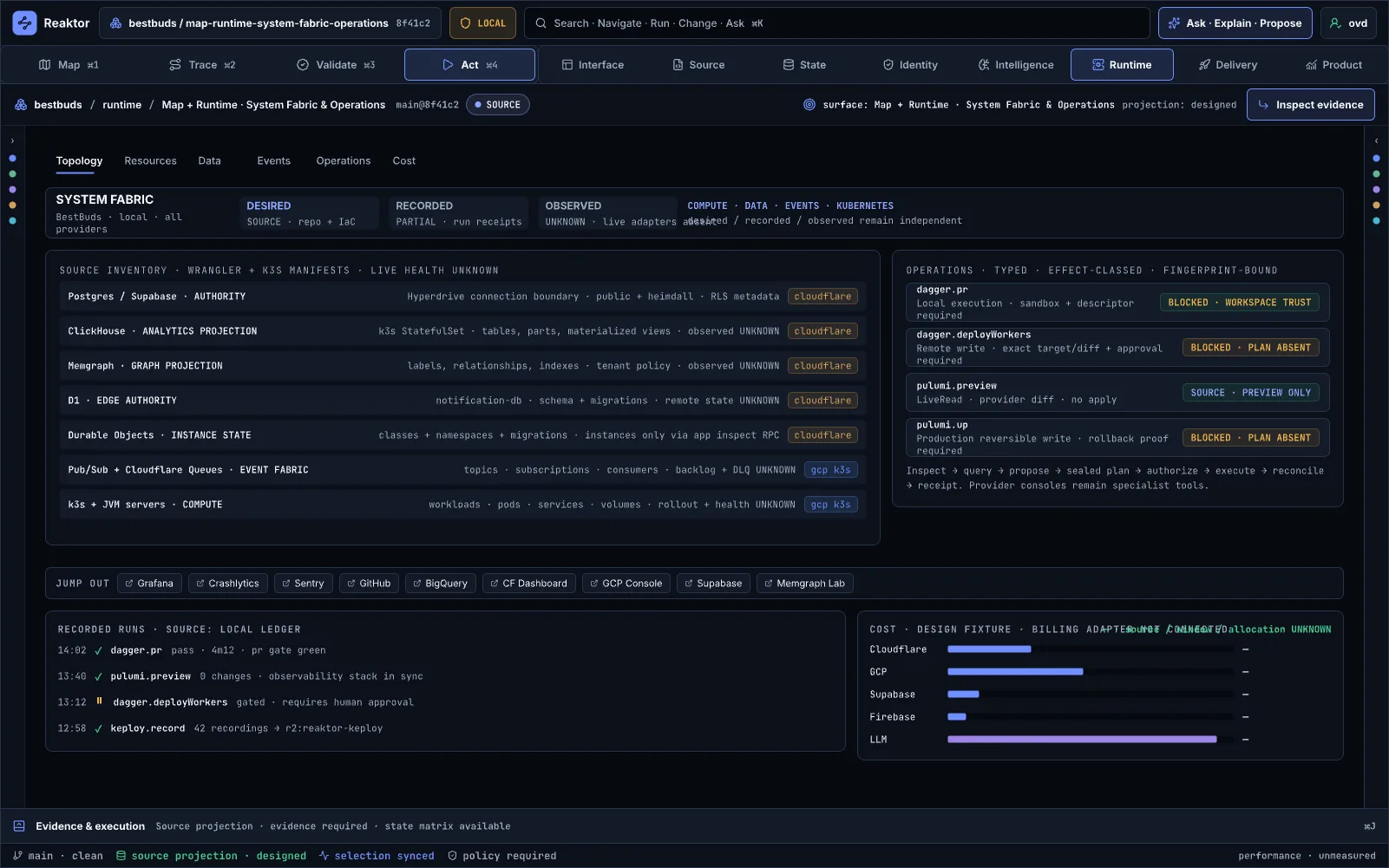
On the board. Six tabs — Topology, Resources, Data, Events, Operations, Cost — over a SYSTEM FABRIC pane scoped BestBuds · local · all providers. The pane's header is the cluster's best idea: three independent truth columns, DESIRED · SOURCE · repo + IaC, RECORDED · PARTIAL · run receipts, OBSERVED · UNKNOWN · live adapters absent, under the caption desired / recorded / observed remain independent, banding COMPUTE · DATA · EVENTS · KUBERNETES. Seven resource rows follow, each with a role in small caps and an honesty clause: Postgres / Supabase · AUTHORITY, ClickHouse · ANALYTICS PROJECTION (observed UNKNOWN), Memgraph · GRAPH PROJECTION, D1 · EDGE AUTHORITY (remote state UNKNOWN), Durable Objects · INSTANCE STATE (instances only via app inspect RPC), Pub/Sub + Cloudflare Queues · EVENT FABRIC (backlog + DLQ UNKNOWN), k3s + JVM servers · COMPUTE (rollout + health UNKNOWN). Below that an OPERATIONS · TYPED · EFFECT-CLASSED · FINGERPRINT-BOUND catalog of four operations — dagger.pr (BLOCKED · WORKSPACE TRUST), dagger.deployWorkers (BLOCKED · PLAN ABSENT), pulumi.preview (SOURCE · PREVIEW ONLY), pulumi.up (BLOCKED · PLAN ABSENT) — captioned Inspect → query → propose → sealed plan → authorize → execute → reconcile → receipt. Provider consoles remain specialist tools. Then a nine-chip JUMP OUT row (Grafana, Crashlytics, Sentry, GitHub, BigQuery, CF Dashboard, GCP Console, Supabase, Memgraph Lab), a four-row RECORDED RUNS · SOURCE: LOCAL LEDGER, and a COST · DESIGN FIXTURE · BILLING ADAPTER NOT CONNECTED pane whose five provider rows are all em-dashes.
Vision tie. This is the opinionated-stack idea made visible — Cloudflare, GCP, Postgres, ClickHouse, Memgraph, k3s all on one surface with their roles typed rather than their vendors listed. It also carries the evidence idea unusually well in the header and the cost pane. It does not carry the graph idea at all: nothing here is a node, nothing has ports, and the "fabric" is a list of vendors rather than a projection of the live graph onto deployment targets. For a board in the Runtime instrument of a framework whose thesis is that the graph is alive at runtime, that is a real miss.
Workflow tie. This is the Monday-morning and the incident board. Someone opens it after a deploy or during a page, to answer "what is out there and is any of it different from what we intended". Today that is four browser tabs — Cloudflare dashboard, GCP console, Supabase, and a terminal running kubectl — plus a Slack scroll to find who ran what. The board's real contribution is putting desired, recorded and observed side by side, which no console does.
Agentic tie. An agent reads a clean typed inventory with roles and an operations catalog that is already effect-classed and permission-gated — this is close to an ideal agent surface. Governance is stated: three of four operations are BLOCKED with a named reason, and the caption pins the sequence an agent must follow through a sealed plan. What an agent cannot do is verify anything, because OBSERVED is UNKNOWN across the board; so an agent here can propose and can never confirm. The JUMP OUT chips are agent-hostile: they are the one-way exits the Symphony Contract says should be GraphLink round trips.
Blueprint tie. This is the World Outliner over a level that will not load. You see every actor placed in the world, with its class and its intended properties, and none of them tick. Unreal's analogue for the operations catalog is closer to the editor's console-command allowlist than to anything in the graph editor. The analogy breaks in the direction that matters: Unreal's world is one process it owns, so the outliner is authoritative by construction; here the world is six providers Reaktor does not own, and the entire design problem is reconciling intent against a world that changes without asking.
Replaces / augments. Backstage's software catalog, the Cloudflare and GCP consoles, Pulumi Cloud and Terraform Cloud stack views, k9s and Lens, and the infrastructure half of Datadog or Grafana. It augments rather than replaces the observability tools, which is what the JUMP OUT row admits.
Improvements.
- Add the coverage declaration (R4) to the fabric header:
Wrangler + k3s manifests, main@8f41c2 · live adapters designed, none connected. Today the same information is scattered across four different prose fragments (SOURCE INVENTORY · WRANGLER + K3S MANIFESTS · LIVE HEALTH UNKNOWN, plus three per-rowUNKNOWNs). - Replace the
RECORDED RUNStimestamps with stamped rows. Each run row getsOrigin,RunRefandMethod; a run that has never happened rendersNEVER RUNwith anEmptyReason.dagger.pr · pass · 4m12 · pr gate greenmust becomedagger.pr · NEVER RUN ON A PR · no CI workflow exists. - Add a fourth truth column,
RECONCILED, next to desired/recorded/observed, showing per resource whether a drift assessment has ever been performed. Every row today implies drift is unknown; none says whether anyone has looked. - Turn
JUMP OUTchips intoGraphLinkround trips: each chip carries the current selection out and declares what it will bring back (Grafana → dashboard for selected resource → returns span set). A chip that cannot round-trip is labelledONE WAY. - Give each of the seven resource rows a port-facing sub-line naming which graph nodes bind to it —
Postgres / Supabase · bound by 14 nodes · 3 unreachable. That is the one change that would make this a Reaktor board rather than a vendor list. - Add a
Queuesrow honesty fix: per audit ground truth the distributed plane has no queues, soPub/Sub + Cloudflare Queues · EVENT FABRICshould readNO QUEUE IN CODE · every pipeline is waitUntil fire-and-forget · backlog undefined.
Verdict. Strengthen. It is the stronger of the two fabric boards and should absorb 13.02's inventory table.
13.02 · Trace + Runtime · System Fabric Resource Explorer
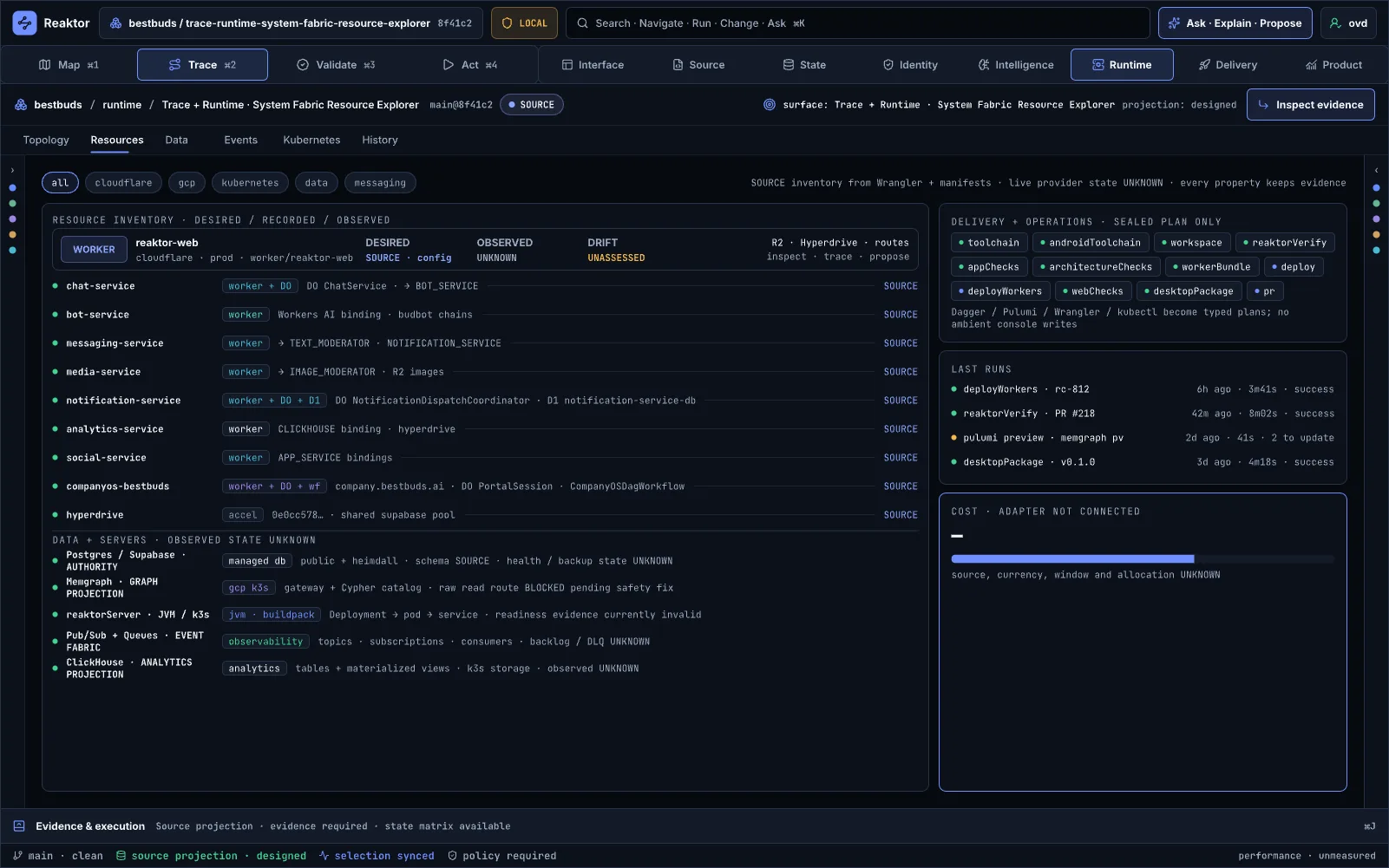
On the board. Six tabs — Topology, Resources, Data, Events, Kubernetes, History — plus a provider filter row (all · cloudflare · gcp · kubernetes · data · messaging) and the header SOURCE inventory from Wrangler + manifests · live provider state UNKNOWN · every property keeps evidence. The main pane, RESOURCE INVENTORY · DESIRED / RECORDED / OBSERVED, expands one row — WORKER reaktor-web, cloudflare · prod · worker/reaktor-web, with DESIRED · SOURCE · config, OBSERVED · UNKNOWN, DRIFT · UNASSESSED, bindings R2 · Hyperdrive · routes, and actions inspect · trace · propose. Nine rows stay collapsed: chat-service (worker + DO, DO ChatService · → BOT_SERVICE), bot-service (Workers AI binding · budbot chains), messaging-service (→ TEXT_MODERATOR · NOTIFICATION_SERVICE), media-service (→ IMAGE_MODERATOR · R2 images), notification-service (worker + DO + D1), analytics-service (CLICKHOUSE binding · hyperdrive), social-service, companyos-bestbuds (worker + DO + wf, DO PortalSession · CompanyOSDagWorkflow), and hyperdrive accel (0e0cc578… · shared supabase pool). Below sit DATA + SERVERS · OBSERVED STATE UNKNOWN (five entries, including Memgraph with raw read route BLOCKED pending safety fix and reaktorServer · JVM / k3s with readiness evidence currently invalid), a DELIVERY + OPERATIONS · SEALED PLAN ONLY chip catalog of nine Dagger tasks grouped toolchain / workspace / deploy, a four-row LAST RUNS ledger, and the same COST · ADAPTER NOT CONNECTED stub.
Vision tie. Same as 13.01 — the opinionated stack and the evidence discipline — but weaker, because it adds a Trace promise it never keeps. 00 · START HERE defines the Trace movement as "Trace UI → port → service → state", "Align time, release, evidence and cost", "Replay safely from recorded boundaries", with output "Causal path · evidence bundle · explanation". This board contains no causal path, no time alignment, no replay, and no explanation. It is a Map board wearing a Trace label. The → BOT_SERVICE and → TEXT_MODERATOR · NOTIFICATION_SERVICE fragments on the collapsed rows are the only causality present, and they are static text, not traversable edges.
Workflow tie. A platform engineer opens this when onboarding, or when asking "which worker owns this binding". Today that is wrangler.toml files plus grep. The genuinely useful thing here that no existing tool gives is the binding column — seeing at a glance that notification-service is worker + DO + D1 with a named coordinator and a named database.
Agentic tie. Reasonably good input: an agent gets a typed inventory with binding edges, and the inspect · trace · propose triple on the expanded row is a correctly shaped action vocabulary. What is missing is the thing the movement promises — an agent asked "why did this notification not send" gets a resource list, not a path. The DELIVERY + OPERATIONS · SEALED PLAN ONLY catalog with its caption Dagger / Pulumi / Wrangler / kubectl become typed plans; no ambient console writes is the correct governance frame and should be lifted verbatim into any board that lets an agent act.
Blueprint tie. The Content Browser with the type filter engaged. Provider chips are asset-type filters, rows are assets, the expanded row is the asset details panel. The analogy breaks at double-click: in Unreal every asset opens into an editor that can change it, and here inspect leads to a surface where OBSERVED is UNKNOWN, so the browser has no editor behind it.
Replaces / augments. Backstage's catalog, Steampipe and CloudQuery, the Cloudflare resource list, wrangler CLI listings, ArgoCD's application view. It does not replace ArgoCD's sync status because it has none.
Improvements.
- Make
DRIFT · UNASSESSEDa live column with three states —UNASSESSED,IN SYNC,DRIFTED— and a per-rowAssessaction that names which adapter would perform the check. A column that is permanently one value is a label. - Rename the tabs so they match
13.01. Today13.01offersOperationsandCostwhere13.02offersKubernetesandHistory, over the same subject; a reader moving between the two loses their place for no reason. - Replace the
LAST RUNSledger entirely.reaktorVerify · PR #218 · 42m ago · 8m02s · successasserts a PR-triggered verification run, and no CI exists — the only framework workflow file is commented out and the Dagger pipeline isworkflow_dispatch-only. The honest pane shows nine task chips withLAST RUN · NEVERand one line:no CI; tasks are locally invocable only. - Build the actual Trace pane this board is named for: pick a request, show
UI → port → service → binding → store, with a truth stamp per hop and the hops that go dark rendered dark. Without it, merge the inventory into13.01and free the cell. - Add an
unreachablefilter next to the provider chips. The vision's visitor idea says unreachable routes are found by query; a resource explorer that cannot answer "which of these is bound by nothing" is not using the graph. - Expand more than one row by default, or make the collapsed rows carry their truth stamps. Nine of ten rows currently show
SOURCEand nothing else, so the desired/recorded/observed header describes a table that only has one column filled.
Verdict. Rebuild as a real causal-trace board; its inventory content merges into 13.01.
13.03 · Extend · FFI Switchboard
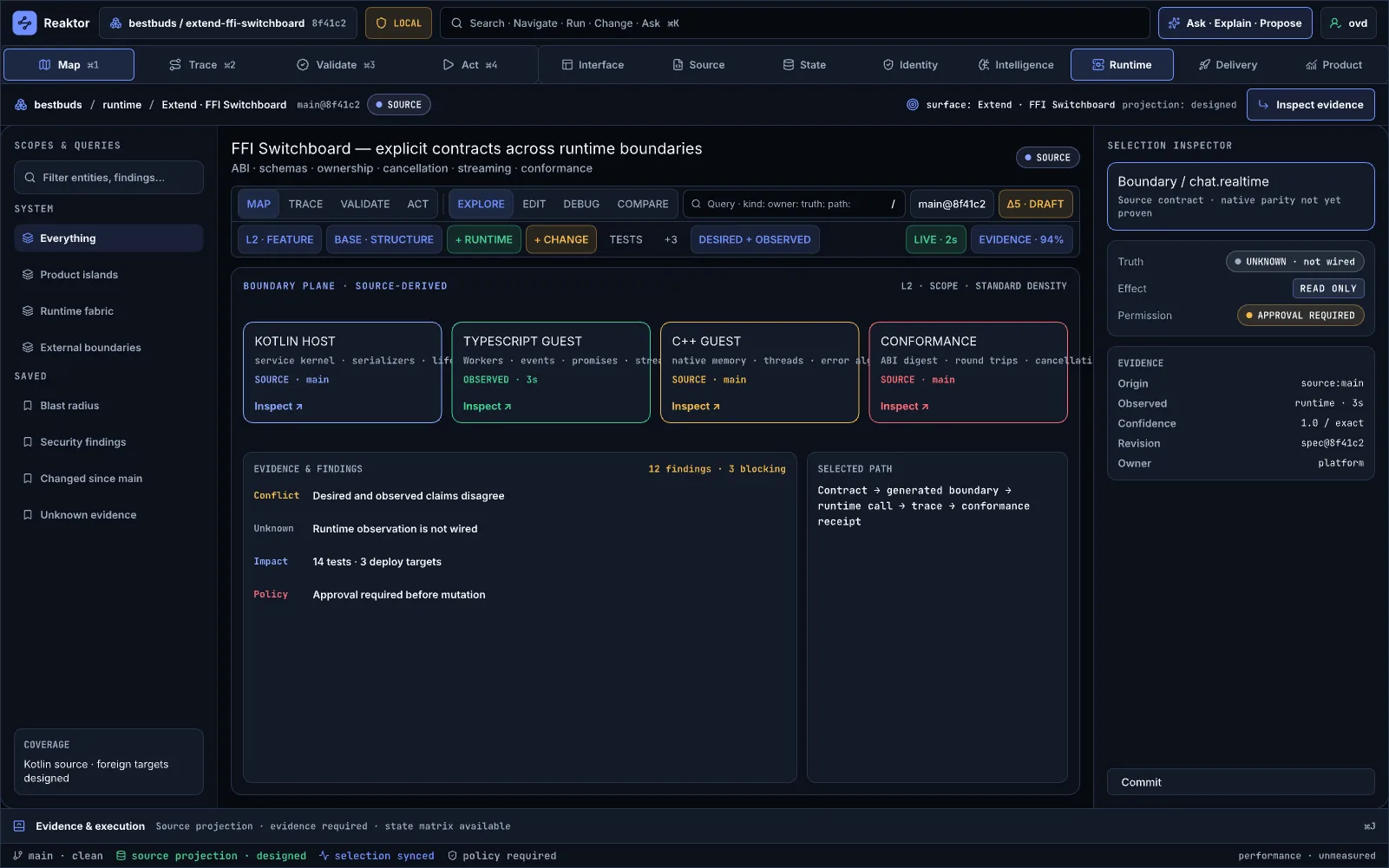
On the board. The full template described above: scope rail with SYSTEM and SAVED query groups and the coverage line Kotlin source · foreign targets designed; thesis FFI Switchboard — explicit contracts across runtime boundaries over ABI · schemas · ownership · cancellation · streaming · conformance; nine-mode strip; typed query bar kind: owner: truth: path:; revision strip main@8f41c2 · Δ5 · DRAFT · L2 · FEATURE with layers BASE · STRUCTURE / + RUNTIME / + CHANGE / TESTS / +3; plane header DESIRED + OBSERVED · LIVE · 2s · EVIDENCE · 94%; and BOUNDARY PLANE · SOURCE-DERIVED at L2 · SCOPE · STANDARD DENSITY holding four cards — KOTLIN HOST (service kernel · serializers · lifecycle, SOURCE · main), TYPESCRIPT GUEST (Workers · events · promises · streams, OBSERVED · 3s), C++ GUEST (native memory · threads · error algebra, SOURCE · main), and CONFORMANCE (ABI digest · round trips · cancellation · backpressure, SOURCE · main). Right of that: EVIDENCE & FINDINGS · 12 findings · 3 blocking with Conflict · Desired and observed claims disagree, Unknown · Runtime observation is not wired, Impact · 14 tests · 3 deploy targets, Policy · Approval required before mutation; SELECTED PATH · Contract → generated boundary → runtime call → trace → conformance receipt; and a selection inspector on Boundary / chat.realtime reading Source contract · native parity not yet proven, Truth UNKNOWN · not wired, Effect READ ONLY, Permission APPROVAL REQUIRED, with evidence Origin source:main, Observed runtime · 3s, Confidence 1.0 / exact, Revision spec@8f41c2, Owner platform, and a Commit button.
Vision tie. This is the polyglot-on-one-data-plane idea, and it is the atlas's best attempt at the evidence idea. The three-runtime framing is exactly right and matches the spec's own table of primary Kotlin, performance C++, dynamic TypeScript. But the board embodies the idea of the boundary without any of its mechanism. The full detailed judgement is in the FFI section below.
Workflow tie. This is opened the day someone needs a hot path in C++ or wants to ship a screen through Hermes without an app release, and again every time a cross-language call misbehaves. Today the alternative is four separate crafts with no shared surface: writing a JNI shim by hand, reading Flow.ts to guess the async contract, adding printf logging on the C++ side, and reasoning about ownership from memory. Nothing in the current toolchain lets one person see all three sides of a boundary at once — that absence is exactly why this board should be the most important one in the atlas.
Agentic tie. As designed, extremely strong: an agent gets typed contracts, an owner, a permission gate that says APPROVAL REQUIRED, and a Commit that is the single write path. An agent could propose a @FfiService interface, see the fingerprint consequences, and never be able to apply it without a human. As built, weak in one specific way: an agent reading Truth UNKNOWN · not wired next to Confidence 1.0 / exact and Observed runtime · 3s has been handed contradictory evidence, and an agent that trusts evidence blocks will act on the wrong half.
Blueprint tie. This is the Blueprint-to-C++ boundary — UFUNCTION(BlueprintCallable), the module dependency rules, and the hot-reload consistency check — with the CONFORMANCE card standing in for the asset validator. The analogy breaks in the direction that makes Reaktor's problem harder: Unreal compiles that boundary at build time inside one binary, so a mismatch is a compile error. Reaktor's boundary spans independently deployed runtimes, including a Hermes bundle pushed after the app shipped, so the boundary must be negotiated at run time — which is precisely what HELLO, DESCRIBE and fingerprints exist for, and precisely what the board does not draw.
Replaces / augments. Postman and grpcurl for calling a boundary, the Buf Schema Registry and buf breaking for schema identity and compatibility, Wireshark or Charles at the frame level, Flipper and the Hermes debugger for the JS side, Instruments and Valgrind for ownership and leaks, and the hand-rolled JNI/JSI scaffolding that has no tool at all. No single existing product covers this set, which is the strongest argument for the board's existence.
Improvements. These are the six panes specified in the FFI section below: FRAME INSPECTOR, CREDIT LEDGER, OWNERSHIP & LIFETIME, CANCELLATION PROPAGATION, CONFORMANCE MATRIX, and WIRE & CELL LIFECYCLE. Two template-level fixes belong here too. First, apply the R14 field rule so Observed and Confidence render — whenever Truth is UNKNOWN. Second, apply V4 so CONFORMANCE cannot read SOURCE · main under a coverage line that says foreign targets are only designed.
Verdict. Split into three: 13.03 · Extend · FFI Contracts (the template plus the frame, ownership and lifecycle panes), 13.05 · Trace · Wire Debugger (credits, cancellation, per-wire timeline), and 13.06 · Validate · Boundary Conformance (the matrix and the fingerprint gate). The template itself is promoted atlas-wide.
13.04 · Extend · Graph Projections
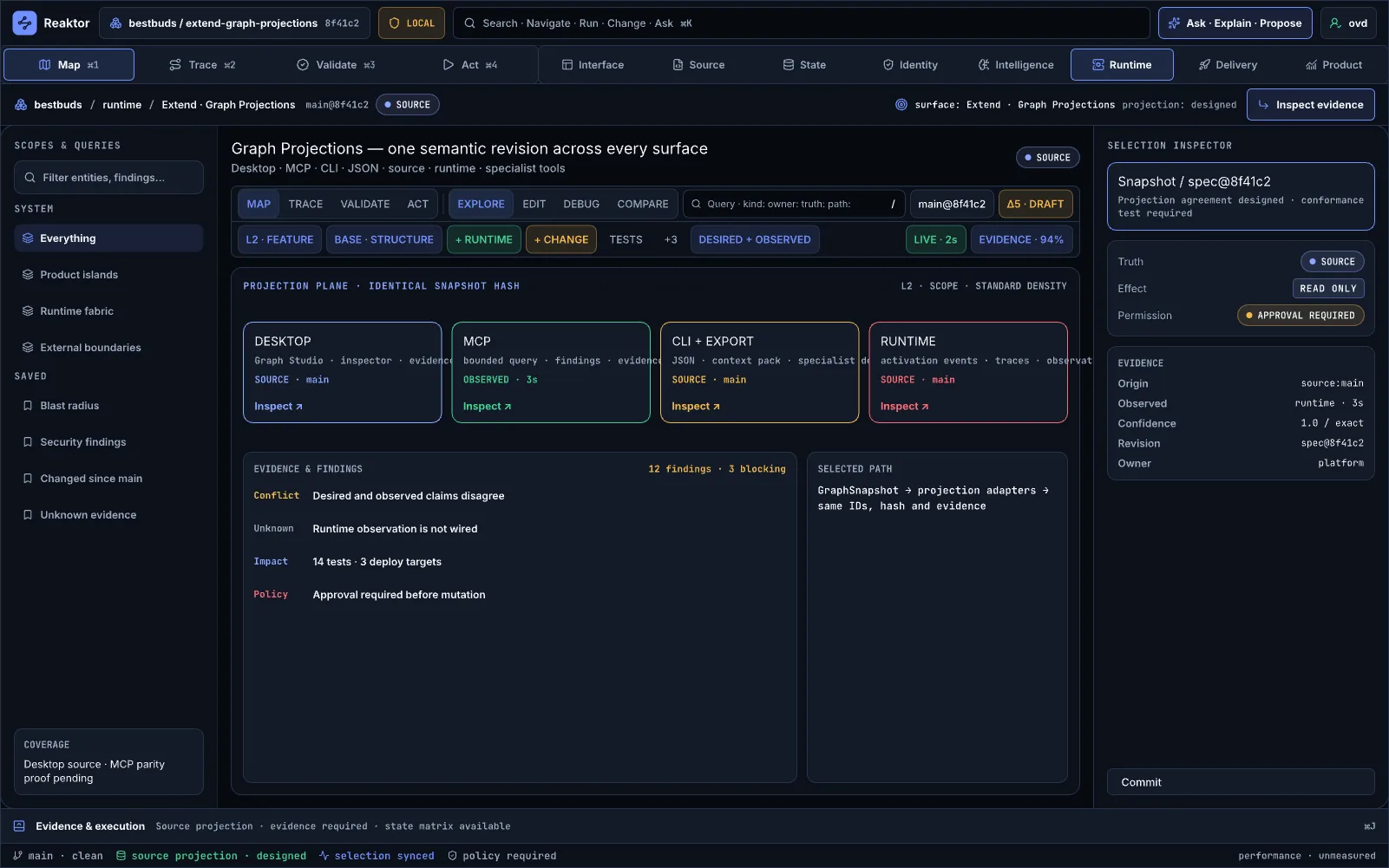
On the board. The same template, chrome-identical to 13.03 — same scope rail with the same four SYSTEM scopes and the same four SAVED queries, same nine-mode strip, same query bar, same main@8f41c2 · Δ5 · DRAFT · L2 · FEATURE strip, same DESIRED + OBSERVED · LIVE · 2s · EVIDENCE · 94% header, same 12 findings · 3 blocking with the four identical findings, same 14 tests · 3 deploy targets, and a selection inspector whose evidence block is value-for-value identical (source:main, runtime · 3s, 1.0 / exact, spec@8f41c2, platform). What differs: the coverage line Desktop source · MCP parity proof pending; the thesis Graph Projections — one semantic revision across every surface over Desktop · MCP · CLI · JSON · source · runtime · specialist tools; the plane label PROJECTION PLANE · IDENTICAL SNAPSHOT HASH; four cards DESKTOP (Graph Studio · inspector · evidence drawer), MCP (bounded query · findings · evidence · deltas, OBSERVED · 3s), CLI + EXPORT (JSON · context pack · specialist deep links), RUNTIME (activation events · traces · observations · receipts); the path GraphSnapshot → projection adapters → same IDs, hash and evidence; and a subject of Snapshot / spec@8f41c2 qualified Projection agreement designed · conformance test required, with Truth SOURCE.
Vision tie. It reaches for two vision capabilities and lands on neither, which the Part 3 section below works through in detail. In short: it treats "projection" as the same graph serialized to four transports, when the vision means one graph rendered as many different views. And graph code push, the vision's boldest runtime claim, does not appear anywhere on this board or in this section.
Workflow tie. This is opened when someone asks why the desktop workbench and the MCP server disagree, or when preparing a context pack for an agent. That is a real and recurring problem — the moment two consumers of one model diverge, every conversation about the system forks. But it is a platform-team correctness board, not something a product engineer opens in a normal week, which is a reasonable thing for a board to be as long as it is honest about it.
Agentic tie. Structurally this is the agent's own board — the MCP card is the agent's doorway, and bounded query · findings · evidence · deltas is exactly the right shape for what an agent should be able to ask. It is undermined by the depiction: reaktor-mcp is a single file, McpProtocol.kt, a JSON-RPC shell with no graph tools registered, so MCP · OBSERVED · 3s asserts a live agent-facing observation that does not exist. The board that most needs to be true about agent access is the one making the least supportable claim.
Blueprint tie. Unreal's several simultaneous views of one world — Outliner, Details, World Partition minimap, and especially Data Layers, which is the closest real analogue to a projection lens. The analogy breaks because Unreal's views all live in one editor process reading one in-memory world, so agreement is free. Reaktor's views live in a desktop app, an MCP server, a CLI, and the running system, so agreement is a distributed-consistency property that has to be proved — which is what conformance test required correctly admits and what the plane label IDENTICAL SNAPSHOT HASH incorrectly asserts as already true.
Replaces / augments. Structurizr and the C4 tooling for scope views, Backstage TechDocs and its system model, Neo4j Bloom and Memgraph Lab for graph exploration, Sourcegraph's code graph, and the MCP inspector. It also displaces the practice of maintaining architecture diagrams by hand, which is the vision's actual claim: the diagram and the system are one object.
Improvements. These are specified in Part 3 below: a LENS LIBRARY replacing the four transport cards, a LENS AGREEMENT pane replacing the asserted identical hash with a per-surface hash comparison, and a code-push board split out. Two immediate fixes: change Truth SOURCE on the snapshot subject to DESIGNED, since no GraphSnapshot type exists anywhere in reaktor; and stop reusing 13.03's evidence values, which currently prove the block is a static component rather than a binding.
Verdict. Rebuild as 13.04 · Extend · Projection Lenses, splitting the runtime-update material into a new 13.07 · Extend · Graph Code Push.
Part 2 — FFI: what the board shows against what the protocol is
How well 13.03 depicts the real protocol
The specification pins a great deal. A seven-slot FlexBuffer frame — protocol, verb, callId, targetId, methodId, payload, meta. Nine verbs — HELLO, DESCRIBE, CALL, RESULT, ERROR, EMIT, COMPLETE, CANCEL, CREDIT. A five-category error model — app, codec, route, cancelled, deadline — with the commitment that exceptions never unwind across a boundary but arrive as values. Credit-based backpressure with request(n) semantics and a per-cell buffering policy of suspend, drop-oldest, or error. A seven-row memory contract covering request buffers, response buffers, shared reads, batch arenas, streams, threading and exceptions. And a six-function C ABI — reaktor_abi_version, reaktor_attach, reaktor_send, reaktor_invoke, reaktor_release, reaktor_detach.
Not one of those forty-odd named things appears on the board. The board's entire depiction of the protocol is four card subtitles. ABI digest · round trips · cancellation · backpressure is the only place any protocol concept surfaces, and ABI digest is not even the spec's word — the spec says fingerprint, and it says the fingerprint is the keystone primitive that unifies port type identity, codec layout identity and FFI method identity. Renaming the keystone on the one board that owns it is how a vocabulary fragments.
Meanwhile the code side is worse than the board suggests and better than nothing. reaktor-ffi does contain a Switch with a ModuleMap, a FlexPayload typealias with moduleName, functionName and sequenceNumber extension properties, a Target.kt sketch, and a working Hermes boot in Engine.cpp. What it does not contain is any of the protocol: ByteBufferTransport's four methods are each TODO("Not yet implemented"), and FlexPayload.argument<T> is itself a TODO with the comment decodeFromFlexBuffer is currently missing. The three-field envelope in the source comment — moduleName, functionName, sequenceNumber — is the thing the seven-slot frame replaces, and it is still what the code has.
So the board's coverage line, Kotlin source · foreign targets designed, is generous in the wrong place. The Kotlin side is not source-complete either; it is a registry and a sketch. The accurate line is Kotlin registry + Hermes boot proven · frame protocol, credits, C ABI all designed only.
Three specific dishonesty points. The CONFORMANCE card carries SOURCE · main for round trips · cancellation · backpressure, none of which exist in any language. The TYPESCRIPT GUEST card carries OBSERVED · 3s on a board whose own findings ledger says Runtime observation is not wired. And Impact · 14 tests names a test count for a module with exactly one test file, KotlinToCppTest.kt, in androidInstrumentedTest.
Against that, the board's honesty is real where it appears and should be preserved verbatim: native parity not yet proven, foreign targets designed, performance · unmeasured, and Truth UNKNOWN · not wired are all correct, unusual for this atlas, and load-bearing.
The three genuinely undefined things, and how to draw them
The spec leaves three questions open, and an honest board treats an open decision differently from an unbuilt one. An unbuilt thing gets DESIGNED; an undecided thing gets UNDECIDED with the options and the deciding criterion visible.
The cell and wire lifecycles exist only as prose — "a cell that throws answers the open wire with an ERROR frame and per policy restarts clean or unregisters" is a sentence, not a state machine. The fingerprint algorithm is named as a "sorted-signature hash, build time" and never specified, despite being the keystone. And the credit unit is explicitly open: the spec's own open-decisions list asks whether byte-credits are needed for large-blob streams or whether item-credits plus a max frame size suffice, with an initial window of 16 items as the v1 position.
Each of these gets a first-class treatment in the panes below rather than being quietly filled in.
The six panes a developer needs
Pane A — FRAME INSPECTOR. A frame table with exactly seven columns matching the seven slots, so the column headers teach the protocol: protocol, verb, callId, targetId, methodId, payload, meta. Above it, nine verb filter chips, one per verb, each showing its count and greying out when zero. targetId and methodId render as the interned number with the resolved name beside it, since names ride only in HELLO and DESCRIBE — showing both is how a reader learns that the number is the identity. Selecting a row opens a decoded payload tree with a raw-FlexBuffer toggle and a validator chip reading VALIDATED AT TRUNK, TRUSTED PATH, or UNVALIDATED, which matters because the audit found the FlexBuffer read path has no bounds checks and validation is opt-in. meta expands to its known keys — shape, deadlineMs, traceId, priority, byName. ERROR rows expand to the five-category model with the category chip coloured by whether it is caller-caused (app, codec) or transport-caused (route, cancelled, deadline).
Empty state, which is today's state: NO FRAME HAS EVER BEEN CAPTURED · Transport.sendSync and sendAsync are TODO() · the current envelope is [moduleName, functionName, sequenceNumber, args…], with a side-by-side of the three-slot envelope against the seven-slot frame so the pane doubles as the migration diagram.
Pane B — CREDIT LEDGER. One row per open wire, with a horizontal timeline whose lanes are CREDIT grants above the axis and EMIT consumptions below, and the running credit balance drawn as a filled band that visibly touches zero. Zero-credit stalls render as hatched bands with a duration, because a stalled emitter is the failure this pane exists to find. Per-cell policy is a chip on the left — suspend, drop-oldest, or error — taken from the service definition, and the pane sorts by longest stall.
The credit unit is the honest bit. A unit control sits in the pane header reading UNIT · ITEMS · UNDECIDED, with a hover that names the open question and both options, and the initial window shown as WINDOW · 16 items · v1 position. When a wire carries blobs, the row shows both an item count and a byte total side by side, so the pane is generating the evidence that will settle the decision rather than pretending it is settled.
Pane C — OWNERSHIP & LIFETIME. The spec's seven memory rules become seven row groups, in the spec's own order: request buffers (caller-owned, released after the trunk accepts), response buffers (callee-owned, returned as a handle, reaktor_release the single disposal path), shared reads (refcount across languages), batch arenas, streams, threading, exceptions. Columns: handle, owning runtime, refcount, arena membership, allocated at, released at, and a lifetime state of LIVE, RELEASED, LEAKED, or DOUBLE RELEASED. Batch arenas render as a container row whose children collapse into it, so the batch_arena_single_release property — one release frees everything — is visible as a shape rather than a claim. A Release path sub-view traces a single handle from allocation to its reaktor_release call, crossing runtime lanes.
The pane's real job is catching what the audit warns about generally: something allocated in one runtime and freed in another, or never freed. It should render a LEAKED row in red with the wire that created it, and it should refuse to render any of this as OBSERVED until a native run has actually produced it.
Pane D — CANCELLATION PROPAGATION. A directed time-ordered diagram, cancel origin on the left, one lane per runtime, one arrow per trunk hop. Each hop shows its acknowledgement and its latency. Below the diagram, a resource ledger listing what each side released in response, which is the cancel_stream_releases_native_state property drawn rather than asserted. Three failure states get explicit renderings: an orphaned wire where CANCEL was sent and never acknowledged, a late EMIT arriving after CANCEL (legal in flight, illegal after acknowledgement — the pane must distinguish these), and native state still held after the wire closed. Caller death is a first-class origin, since the spec makes trunk liveness cancel all of a dead caller's wires; a SIMULATE CALLER DEATH control belongs here and is the kind of thing no existing tool offers.
Pane E — CONFORMANCE MATRIX. Rows are the spec's eleven acceptance tests, named exactly as the spec names them — jni_typed_unary_round_trip, missing_cell_is_error_frame, abi_version_mismatch_blocks_call, fingerprint_mismatch_downgrades_to_keyed, stream_sequence_order, stream_credit_backpressure, cancel_stream_releases_native_state, batch_arena_single_release, hermes_bundle_cell_invoke, python_async_iterator_collects_kotlin_flow, ffi_span_has_graph_ids. Columns are the runtimes: Kotlin/JVM, Kotlin/Native, C++, TypeScript on Hermes, TypeScript on Workers, Python. Each cell is one of PASS, FAIL, NOT IMPLEMENTED, NOT APPLICABLE, and a passing or failing cell carries a RunRef — device, revision, timestamp — because the audit's whole lesson is that a green cell without a run reference is decoration. Today every cell reads NOT IMPLEMENTED, and that matrix is worth more than the current CONFORMANCE · SOURCE · main card, because it converts a vague claim into eleven named pieces of work.
Two row groups sit above the tests. A trunk row group mirroring the spec's copy ledger — loopback, JNI, JSI, cinterop, C ABI, gRPC, kotlinx.rpc — with today's copy count against the target, which is the only place in the atlas where a performance budget could be stated with provenance. And an ABI row showing the six C functions with their present/absent state, since three of the eleven tests depend on functions that do not exist.
Pane F — WIRE & CELL LIFECYCLE. Two state machines drawn as editable graphs, not as illustrations, because this is the part the spec has not written and the atlas is the right place to write it.
The wire machine: Idle → Open on CALL; Open → Complete on RESULT for the unary shape; Open → Streaming on first EMIT; Streaming → Streaming on EMIT and on CREDIT; Streaming → Draining when credit reaches zero; Streaming → Complete on COMPLETE; any state to Errored on ERROR; any state to Cancelled on CANCEL. Four transitions are genuinely unpinned and must render with an UNDEFINED badge rather than a guessed edge: what happens to buffered items when CANCEL arrives mid-drain, whether a deadline expiry produces ERROR(deadline) or CANCEL, whether EMIT after acknowledged CANCEL is a protocol violation or a discard, and what a CREDIT frame on a closed wire means. Each undefined edge carries a Decide action that opens a decision record.
The cell machine: Registered → Running, Running → Suspended under a supervision policy, Running → Failed on an unhandled throw, Failed → Restarted or Failed → Unregistered by policy, with supervision events flowing to the switch's event stream. The pane should show, per cell, which policy is configured, and mark cells with no policy as UNSUPERVISED.
Both machines connect to the audit's lifecycle defect — effects fire on rejected transitions and actors can double-start — by rendering rejected transitions as a distinct edge class with a counter, so the defect is observable rather than remembered.
A seventh pane, named here and promoted to a missing board below. FINGERPRINT REGISTRY. Per method: the normalized signature, the computed fingerprint, the peers that agree, the peers that disagree, and the resulting codec tier — positional, keyed-compat, or refused. It belongs in section 13 because the FFI is the forcing function for it, but it serves port type identity and codec layout identity too, and those are the atlas's two most consequential defects.
Part 3 — Graph projections and code push
Does 13.04 serve projection?
Not in the sense the vision means. The vision's projection idea is one graph rendered as many different views: a C4-style scope projection that collapses child boundaries, a deployment topology that groups by target, an agent-facing projection that shows only governed interfaces. Those are semantic transformations — different node sets, different collapse rules, different facets — over one model.
13.04's four cards are DESKTOP, MCP, CLI + EXPORT, and RUNTIME. Those are not views; they are transports. The board is asking whether the same data survives four serializations, which is a real and worthwhile question — it is a conformance question — but it is not the projection question, and calling it Graph Projections occupies the name that the actual capability needs.
The gap is more pointed because the real capability partly exists. reaktor-flow contains ReaktorFlowScopeView and buildReaktorFlowGraph(scopeView), which is the scope-local C4-style projection with collapsed child boundaries and inline expand, default-on in the desktop GraphPane. That is a shipped, tested projection with a test file beside it, and the board that owns projections does not mention it. Meanwhile the board's SELECTED PATH reads GraphSnapshot → projection adapters → same IDs, hash and evidence, and no GraphSnapshot type exists in reaktor at all — the name appears only in FlexBuffer benchmark models. The board names a type that does not exist and omits the type that does.
Does 13.04 serve code push?
Not at all, and neither does any other board in the section. Graph code push — marked subgraphs updating and rewiring at runtime, delivered as Kotlin/JS through Hermes, with typed boundaries governing what a pushed bundle may touch — is one of the vision's boldest claims and the one most likely to be the thing a stranger remembers. Section 13 is Runtime and Extend. If code push does not live here it lives nowhere, and it currently lives nowhere.
The reality to be honest about: Engine.cpp boots Hermes and evaluates an embedded bundle, exercising a JS StateFlow from C++ over JSI. That is a genuine proof and it is hello-world shaped — Reaktor_HermesHello() still returns a static char[256]. There is no bundle signing, no namespace grant, no fingerprint gate, and no rewire of anything. A board depicting code push today would be almost entirely DESIGNED, and that is fine; the value of drawing it is that it forces the four hard questions into view.
What to build
Rebuild 13.04 as Projection Lenses. Replace the four transport cards with a LENS LIBRARY. A lens is a saved tuple of scope root, depth, collapse rule, facet filter and layout policy — which is close to what ReaktorFlowScopeView already carries. Ship five named lenses so the concept is concrete: C4 Scope (collapsed child boundaries, inline expand — the one that already works, stamped SOURCE), Deployment Topology (nodes grouped by target and provider, which is the lens that would make 13.01 and 13.02 projections of the graph rather than vendor lists), Agent View (only nodes exposing governed interfaces, annotated with their permission and effect class), Blast Radius (transitive dependents of the selection, which already exists as a saved query in the rail and deserves to be a lens), and Capability Map (adapters by capability tier, showing where degradation is designed). Each lens card carries its own truth stamp; four of the five are DESIGNED today and the board is better for saying so.
Add a LENS AGREEMENT pane in place of the asserted IDENTICAL SNAPSHOT HASH. One row per consuming surface — desktop, MCP, CLI export, runtime — with the snapshot id it read, the hash it computed, its node and edge counts, and an agreement verdict. Disagreement is the interesting state and must be renderable: two hashes side by side with a structural diff of what each surface saw. The current plane label asserts the happy path as a fact; the pane makes it a test. This is also where MCP parity proof pending becomes actionable rather than decorative.
Add 13.07 · Extend · Graph Code Push, with four panes.
A MARKED SUBGRAPH pane: which nodes are pushable, shown as a highlighted region of the live graph, with the typed boundary drawn explicitly — the exact set of ports a pushed bundle may read and write. Nodes outside the mark render dimmed and unreachable, which is the governance story drawn rather than described.
A BUNDLE pane: bundle id, signature and signer, the namespace it registers cells under, the namespace grants its trunk was given in HELLO, size, and build revision. The spec's own rule belongs on the face of it — a code-pushed bundle cannot call payments/* unless granted — as a visible grant list with denied namespaces shown struck through.
A FINGERPRINT GATE pane: per method exported by the bundle, the fingerprint against the host's, and the resulting tier of positional, keyed-compat, or refused. This is the mechanism that makes a stale bundle degrade instead of misreading bytes, and it is the single most important safety property of the whole feature.
A REWIRE PREVIEW pane: the marked subgraph before and after, with added, removed and rewired edges classed distinctly, an effect summary of what would change for live sessions, and an explicit rollback with a receipt. The lifecycle states across the top — Staged, Signed, Granted, Fingerprint matched, Rewired, Rolled back — with the board's honest position that only Staged has ever happened.
Cluster findings
Missing panes
13.05 · Trace · Wire Debugger. Section 13 has a Trace board for infrastructure and none for the boundary that the vision says is the polyglot data plane. Frames, credits and cancellation are per-wire causal events and belong in the Trace movement, not folded into an Extend board.
13.06 · Validate · Boundary Conformance. The verification program's L2 tier is differential conformance testing, and the atlas contains the words differential, property test and model check zero times. The eleven acceptance tests crossed with six runtimes is the most concrete verification artefact the framework has, and it is currently one card subtitle.
13.07 · Extend · Graph Code Push. Named in the vision as a load-bearing capability, present in the code as a Hermes hello-world, absent from all 104 boards. It is the section's job.
13.08 · Validate · Fingerprint Registry. The audit names one fingerprint system unifying port type identity, codec layout identity and FFI method identity as the keystone primitive of the entire verification program. The word appears twice in the whole atlas. The unsound port type identity defect — Type as (String, KClass?), where string-built ports carry null and connect regardless of class — has no board anywhere, and it is the defect most likely to produce a silent wrong-type connection in production.
13.09 · Trace · Event Fabric & Backlog. Both fabric boards list Pub/Sub + Cloudflare Queues · EVENT FABRIC with backlog + DLQ UNKNOWN, implying a queue whose depth simply has not been read. The audit says the distributed plane has no queues at all and every pipeline is waitUntil fire-and-forget with no idempotency in notifications. That is a different and more serious statement, and it deserves a board that says it.
13.10 · Validate · Fabric Drift & Reconcile. 13.02 carries a DRIFT · UNASSESSED column that no board ever moves off UNASSESSED, and 13.01 names reconcile in its operations sentence with nothing behind it. Reconciliation is the entire point of holding desired and observed independently; without it the three-column header is a filing system rather than a check.
Seams
The section is two halves that share no grammar. 13.03 and 13.04 carry a scope rail, a typed query bar, a mode strip, a semantic-level control, a findings ledger, a selected path and a selection inspector with an evidence block. 13.01 and 13.02 carry none of those seven regions. They are four boards in one section built to two different specifications, and a reader crossing from 13.02 to 13.03 loses their query, their saved scopes and their selection inspector without being told.
13.01 and 13.02 are the same board. Both inventory the same fabric — Postgres/Supabase, ClickHouse, Memgraph, Durable Objects, Pub/Sub and Queues, k3s and JVM servers — both end with a run ledger, and both end with an identically stubbed cost pane. The declared difference is movement, Map against Trace, and 13.02 does nothing a Trace board does. The honest resolution is one fabric board plus one genuine causal-trace board.
Tab vocabularies diverge across the pair. 13.01 offers Topology · Resources · Data · Events · Operations · Cost; 13.02 offers Topology · Resources · Data · Events · Kubernetes · History. Four shared, two different, over the same subject, which means tab position is not stable across the two boards a reader will move between most often.
13.03 and 13.04 are the same board with four cards swapped. Same rail, same modes, same query bar, same revision strip, same LIVE · 2s, same EVIDENCE · 94%, same 12 findings · 3 blocking, same four findings word for word, same 14 tests · 3 deploy targets, and an evidence block identical in all five fields. Two unrelated subsystems reporting identical evidence is proof that the evidence block is a static component rather than a binding, and that is the single most damaging fact about the atlas's best board.
Vocabulary drift on the keystone. The spec calls it a fingerprint and makes it the keystone; 13.03 calls it ABI digest. The spec calls the units cells, switches, trunks and wires; the boards call them hosts, guests and boundaries. A board that renames the primitives it exists to teach undoes the eigenvector-primitive argument.
Dead ends where the contract promises round trips. 13.01's nine JUMP OUT chips are one-way exits, while 00 · START HERE promises that specialist tools round-trip through a GraphLink. 13.02's inspect · trace · propose actions have no destination board in this section. 13.03's four Inspect ↗ affordances and its five-hop SELECTED PATH have nowhere in the atlas to land, because the panes that would receive them are the missing boards above.
Findings are counted but never listed. Every templated board shows 12 findings · 3 blocking and then shows four finding classes. No board in this cluster shows the twelve. There is no findings list surface anywhere, which means the counter is the only representation of the atlas's most important content.
Honesty audit
13.01. The RECORDED RUNS ledger is the problem: 14:02 ✓ dagger.pr · pass · 4m12 · pr gate green asserts a passing PR gate, and no CI exists — the only framework workflow file is fully commented out and the Dagger pipeline is workflow_dispatch-only. 13:40 ✓ pulumi.preview · 0 changes · observability stack in sync asserts provider agreement on a board whose own header says OBSERVED · UNKNOWN · live adapters absent, which is a self-contradiction inside one pane. 12:58 ✓ keploy.record · 42 recordings → r2:reaktor-keploy asserts a specific count against nothing but SOURCE: LOCAL LEDGER. The honest version renders the four operations with LAST RUN · NEVER and one sentence: no CI exists; these tasks are locally invocable only, and no run receipt has been recorded. Against that, the cost pane is exemplary — DESIGN FIXTURE · BILLING ADAPTER NOT CONNECTED, five providers, five em-dashes, and source / window / allocation UNKNOWN. That pane is how the run ledger should look.
13.02. Four LAST RUNS rows carry twelve unprovenanced numerals. reaktorVerify · PR #218 · 42m ago · 8m02s · success is the worst single assertion in the cluster, because it invents a pull-request-triggered verification run in a repository with no CI at all. deployWorkers · rc-812 · 6h ago · 3m41s · success invents a release candidate. The honest version is nine task chips reading NEVER RUN under the true caption the board already has — Dagger / Pulumi / Wrangler / kubectl become typed plans; no ambient console writes — which describes an intention and is fine as one. Genuinely good on this board and worth preserving: DRIFT · UNASSESSED, raw read route BLOCKED pending safety fix, and readiness evidence currently invalid.
13.03. 12 findings · 3 blocking, 14 tests · 3 deploy targets, EVIDENCE · 94%, LIVE · 2s, OBSERVED · 3s, Confidence 1.0 / exact and Δ5 are seven unmarked numerals, and 13.04 carrying every one of them identically proves they are decoration. CONFORMANCE · ABI digest · round trips · cancellation · backpressure · SOURCE · main claims source truth for four things that exist in no language — Transport's four methods are TODO() and FlexPayload.argument<T> is a TODO noting that decodeFromFlexBuffer is missing. TYPESCRIPT GUEST · OBSERVED · 3s directly contradicts the board's own Unknown · Runtime observation is not wired. The honest version keeps Truth UNKNOWN · not wired, renders Observed and Confidence as —, drops the plane header to DESIRED ONLY, sets three of four cards to DESIGNED, replaces 14 tests with 1 test file · androidInstrumentedTest/KotlinToCppTest.kt, and states coverage as Kotlin registry + Hermes boot proven · frame protocol, credits and C ABI designed only. Preserve exactly as written: native parity not yet proven, foreign targets designed, performance · unmeasured.
13.04. PROJECTION PLANE · IDENTICAL SNAPSHOT HASH asserts an agreement no code computes, and the path it rests on, GraphSnapshot → projection adapters, names a type that does not exist in reaktor. MCP · bounded query · findings · evidence · deltas · OBSERVED · 3s asserts a live agent-facing observation, and reaktor-mcp is one JSON-RPC protocol file with no graph tools registered. Truth SOURCE on the snapshot subject is the cluster's sharpest single dishonesty — stronger than 13.03's UNKNOWN, on a weaker foundation. The honest version sets the subject to Truth DESIGNED, renames the plane PROJECTION PLANE · AGREEMENT UNPROVEN, stamps DESKTOP as SOURCE (the scope projection in reaktor-flow is real and tested) and the other three as DESIGNED, and keeps its two good lines unchanged: Desktop source · MCP parity proof pending and Projection agreement designed · conformance test required.
Part 13 · The panes the atlas needs
Nine analysts proposed missing boards independently. Where several arrived at the same pane from different sections, that convergence is itself evidence. Below, deduplicated and ranked by what each unblocks.
Tier 1 — Proposed independently by three or more analysts
| Pane | Proposed by | Why it must exist |
|---|---|---|
| Assurance section (L0–L5) | A, B, E, and implied by C, I | The verification programme is agreed and the atlas depicts none of it. lincheck, property test, model check, fuzz, differential, counterexample and defect are each at zero across 104 boards. |
| Fingerprint Registry | A, B, C, F, I | The keystone primitive that unifies port type identity, codec layout identity and FFI method identity, and the home for defect D-6. The word appears twice in the atlas and neither instance means this. |
| Graph Code Push | A, B, C, E, I | A load-bearing vision capability depicted on zero boards, while STATE · Deploy · Recovery Complete implicitly depends on it to claim a twenty-one-minute recovery. |
| Capability and Degradation Matrix | A, B, G, H | Targets down one axis, capabilities across, tier per cell, and the designed degradation route in every non-full cell. degradation appears zero times in 104 boards; tier appears three times, none on the board titled Targets & Capabilities. |
| Queue, Backpressure and Delivery Health | A, C, H, I | The audit's largest runtime gap — no queues exist, every pipeline is fire-and-forget, notifications have no idempotency. backpressure and credit appear on three boards. |
Tier 2 — Proposed by two analysts, or by one with a strong case
| Pane | Proposed by | Purpose |
|---|---|---|
| Decision Record (reference monitor) | G | One request, its verdict, the rule that fired, and — critically — a Checks not performed column with a callsite census. The single highest-value new pane in the atlas: it is the board that would have caught S-1. |
| Visitor Author and Run | B, H | Write, scope, dry-run and read a traversal. Visitors are one of four pillars and appear on four boards; the board named Visitor Lab shows an access-control card instead. |
| Choreography / Saga | A, B | Cross-system flows as saga graphs executed by visitors. saga, choreograph and session-typ are all zero. |
| Command Catalog / verb registry | F | AddChainNode, ConnectPorts, SetProperty, PromoteChain, RouteModel, DropIndex, DataChange and ExtractScope are invented across nine boards with no arity, inverse or required evidence. |
| Boundary Conformance Runs | B, E, I | Both 03.02 and 13.03 carry a CONFORMANCE card and neither shows a run — while the differential C++ oracle and adversarial suite, the project's genuinely strongest evidence, appear on no board. |
| Span Coverage | H | Instrumented versus uninstrumented ports, and spans arriving for ports not in the graph. The denominator no incumbent observability tool can construct. |
| Metric Definition Store | H | The load-bearing pane behind 10.02, 11.02, 11.05 and half of 11.03, which exists nowhere — which is why $118 can be daily on two boards and monthly on a third. |
| Truth Rendering Conformance | D | Every data component × every mark × three themes, in greyscale. The board that would have caught the four-way colour collision. |
| Empty, Denied and NotWired States | D | With roughly 30 of 74 panes wired, this is the product's most common state and EmptyReason has one instance atlas-wide. |
| Agent Fleet, Budget and Capability Grant | F | Per-principal capability, spend, concurrency and kill switch, plus the escalation path. 08.03 raises "agent asked for pen-test scope" and no board in 104 can answer it. |
| Deploy · Partially Applied / Outcome Unknown / Rollback Not Possible | E | Five targets deploy independently with no queues, so partial application is the default outcome and is drawn nowhere. Every existing deploy state resolves cleanly. |
| Atlas Self-Map | A | An index of every surface with its section, movement, instrument, wiring state and freshness. Section 04's banner claims six surfaces and holds ten, which proves the index is needed. |
Tier 3 — Dead tabs that promise boards which do not exist
These are not proposals so much as debts the atlas has already incurred. Each is advertised in a tab strip on multiple boards and leads nowhere: Logs (nine boards advertise it), Crashes, Sources, Identity · Providers (three boards), Identity · Audit, Tools and Function Registry, AI Releases, Agent Chat / Delegation, and the drawer's Traces and Tests panes — the latter two being precisely the panes the verification programme depends on.
A tab that leads nowhere is worse than an absent tab, because it asserts a capability the product does not have.
Part 14 · The taxonomy after revamp
The atlas currently runs two organising principles that do not reconcile. The movement × instrument matrix is stated as the constitution and followed by 22 of 69 numbered boards, populating 10 of 32 cells. The thirteen thematic sections are the real structure and use a different vocabulary entirely.
The matrix should be kept as a lens, not a filing system. Movements are genuine verbs and the four are well chosen. The instruments are not a partition and cannot be one: Identity is a visitor over the other seven, Intelligence is a technology class, and Product is an audience. A non-orthogonal axis cannot index anything, which is exactly why twenty-two cells are empty.
The proposed structure is eleven numbered sections plus two appendices:
| # | Section | Change from today |
|---|---|---|
| 01 | Understand | Keeps North Star; gains an Assurance North Star. The four near-identical quadrant boards collapse to two. |
| 02 | Compose | Keeps Create. Absorbs the eleven Composer boards as states of one surface. Primitive Atlas rebuilt as a coverage-and-redundancy argument. |
| 03 | Graph | Today's Section 04, consolidated from ten boards to six as its own banner already claims. Gains revision diff, subgraph library, attach-to-live-graph. |
| 04 | Extend | Merges today's 03.02 Polyglot Boundary Studio into 13.03 FFI Switchboard; gains the wire debugger, conformance runs, code push and the fingerprint registry. |
| 05 | Govern | Visitors, capabilities, policy, the decision record, the command catalog. Absorbs the good half of 03.01. |
| 06 | Build | Today's Inner Loop plus Device Lab, which ships nothing and does not belong in Ship. |
| 07 | Assurance | New. L0 CI and hygiene, L1 invariants and defects, L2 property/lincheck/differential, L3 model checking, L4 proofs, L5 deterministic simulation. |
| 08 | Ship | Release, pipeline, gates, code push rollout, store channels, and the three missing deploy states. |
| 09 | Trust | Identity, policy, data authority, migrations, evidence and history. Re-authored against 09.06, the cluster's honesty high-water mark. |
| 10 | Operate | Observe and Learn merged and shrunk from ten boards to roughly four, with the rest explicitly delegated to incumbents. |
| 11 | Agents and AI | Sections 08 and 12 merged, with the agent plane and the in-product AI plane clearly separated inside it. |
| A | Interface System | Demoted from a numbered section to an appendix. It is a reference library, not a product surface. |
| B | Atlas Self-Map | New. The index of the atlas, generated rather than drawn. |
Two structural rules go with this. The twenty orphan STATE boards dock under their parent surfaces rather than floating unsectioned. And every board declares its (movement × instrument) cell in the selector, so a board whose content does not match its declared cell becomes a visible defect rather than an invisible one.
Part 15 · The seamlessness programme
Seamlessness in this atlas is not a visual problem. The chrome is already consistent to a degree most design systems never reach — 84 of 89 boards carry the full identity chain. The seams are semantic: the same subject described differently in different places, and the carriers that are promised but not actually carried.
Seam 1 — One subject, many truths. The same release is healthy on one board and rolled back on five. The same trace has two durations. The same cost is daily and monthly. The same subsystem routes to four different models. The same release candidate has three test denominators. The fix is not proofreading; it is that sample data must come from one fixture set, authored once and referenced, so that changing rc-812's Maestro count changes it in eleven places. A design file that hand-copies its own facts will drift exactly as code does.
Seam 2 — Evidence that does not bind. Seventeen boards carry an identical evidence block. Until those fields are bound to the subject, moving between boards carries the chrome and loses the meaning — the precise inverse of the Symphony Contract. The template's rule V4, that coverage bounds the plane, is the mechanism.
Seam 3 — Time. At 23.6% coverage, freshness is the one carrier the contract names that the atlas does not carry. Every datum needs an as-of and a horizon, and Observed must render — when Truth is UNKNOWN.
Seam 4 — Navigation that lies. 10.04, the best board in the Observe cluster, carries Section 11's tab bar while its breadcrumb reads runtime, so it is unreachable from its own section. Nine boards advertise a Logs tab with no board behind it. Tabs must be generated from the board index, so an advertised destination that does not exist cannot be drawn.
Seam 5 — Governance forking. Four mutation paths where the contract promises one. Every write on every board routes through a single Commit affordance, and every board that mutates shows a plan id, a hash, an approver distinct from the requester, and an expiry.
Seam 6 — The design system and the atlas have separated. The documented palette is not the painted palette; the marks collide; the shell is 86 hand-copies whose layer names have drifted from their rendered text. Components must be instances, not copies, and the parity check must compare the pen file against the Kotlin implementation in both directions.
Seam 7 — Responsive contracts. The agent affordance degrades from Ask · Propose to Ask by screen width, and the truth mix silently drops a category at 768. Capability must not be a function of viewport; if a narrow shell cannot offer proposals, it must say so rather than quietly removing the control.
Part 16 · Sequencing
Six phases, each with a binary exit criterion, ordered so that each makes the next cheaper.
Phase 0 — Stop the contradictions (days). Build one fixture set: one release candidate with one set of test counts, one cost figure with one window, one trace with one duration, one moderation route. Fix the rollback dialog's restore point. Exit: no two boards state different values for the same subject, verified by a script over the exported text.
Phase 1 — Bind the evidence (1–2 weeks). Make the V2 band label a slot that renders a TruthMark, which promotes all thirty-five prose-marked boards into the queryable set without redesigning any of them. Apply rule V2 — no numeral without a truth stamp — and rule V4 — coverage bounds the plane. Exit: truth:unknown is a runnable query; no board renders Confidence beside not wired; every board has a coverage declaration or renders COVERAGE · UNDECLARED.
Phase 2 — Repair the design system (2–3 weeks). Reconcile the documented palette with the painted one, resolve the four-way mark collisions so truth, effect and permission are independently legible in greyscale, convert the 86 hand-copied shells into instances, and document the light and high-contrast token values. Exit: the Truth Rendering Conformance board passes in three themes and in greyscale; shell layer names and rendered text agree.
Phase 3 — Consolidate (2–3 weeks). Apply Part 14's taxonomy. Collapse Section 04 from ten boards to six, the Composer from eleven to one plus states, the North Star quadrants from four to two. Delete or fill every dead tab. Exit: no board pair shares more than 30% of unique content except declared state sets; every advertised tab resolves.
Phase 4 — Build the assurance section (3–4 weeks). The six L0–L5 boards, the defect and security registers, the fingerprint registry. Exit: every rung of the verification ladder has a surface, and the D-* and S-* registers are live rather than illustrative.
Phase 5 — Fill the vision gaps (ongoing). Graph code push, choreography and saga, the visitor author-and-run surface, capability and degradation, queue and backpressure, the decision record. Exit: every load-bearing idea in the Reaktor essays has at least one board, and no board depicts a subsystem more confidently than its coverage line permits.
The ordering matters for one reason above the others. Phase 0 and Phase 1 are cheap, and until they are done every other improvement is drawn on a surface no reader has cause to trust.
Appendix B · Method
Board text was obtained by exporting all 104 top-level nodes to HTML with layer names and ids preserved, then splitting on board boundaries and extracting text nodes in document order — 191,505 characters in total. Component instances were resolved where noted. The export drifts on layout, a known fill_container padding issue, but is exact for text, which is what every measurement here depends on. Colour analysis was performed on hex literals in the same export. Board images were exported separately at 1× as WebP.
Nine analysts worked in parallel from one shared brief containing the vision, the audit ground truth, and a fixed per-board output format. Each read its assigned boards in full. Every claim sharp enough to be damaging if wrong was independently re-verified against the file before publication; two claims were corrected in that pass and the corrections are stated in the text rather than silently applied.
Appendix A · Measurements
Every figure below was measured directly from /Users/ovd/dev/bestbuds/modules/reaktor.pen via the Pencil MCP, or from a full HTML export of all 104 top-level boards. Nothing here is estimated. The measurement basis excludes the stale pen-truth.json.
Scale
| Measure | Value |
|---|---|
| Top-level boards | 104 |
| Product boards (excluding section banners, reference library, START HERE) | 89 |
Component instances (ref nodes) across the file | 1,457 |
| Reusable components defined | 96 |
| Total visible text lines across product boards | 11,677 |
| Median unique content lines per board (chrome stripped) | 82 |
Finding 0 — The evidence block is a constant, and it contradicts itself
This is the most serious finding in the atlas, and it supersedes the softer framing in Finding 1.
The evidence grammar is not merely underused. On the boards where it is used, it is instantiated as copy-pasted chrome carrying identical values about entirely different subjects.
| String | Boards carrying it verbatim |
|---|---|
EVIDENCE · 94% | 20 |
12 findings · 3 blocking | 17 |
14 tests · 3 deploy targets | 17 |
Runtime observation is not wired | 17 |
Observed — runtime · 3s | 17 |
Confidence — 1.0 / exact | 17 |
Seventeen boards assert that they have exactly twelve findings of which three are blocking, exactly fourteen tests across three deploy targets, evidence coverage of exactly 94%, a runtime observation exactly three seconds old, and confidence of exactly 1.0. Those seventeen boards include the Machine Signal design system, an AI trace viewer, a knowledge atlas, a visitor lab, a primitive catalogue, and the FFI switchboard — subjects with nothing in common.
Worse, each of those seventeen boards contradicts itself. All seventeen state Runtime observation is not wired in the findings block and, eighteen lines below in the evidence block, Observed — runtime · 3s with Confidence — 1.0 / exact. 03.04 · Constraint Optimizer places Truth UNKNOWN · not wired nine lines above Confidence 1.0 / exact on the same card. 01.04 · Agent OS does the same.
This includes 13.03 · FFI Switchboard. Its structure — Truth / Effect / Permission, an evidence block, a desired-versus-observed plane, a conflict finding — remains the correct template and the best thing in the file. But its values are the same constant as everywhere else. The template is right; nothing has ever been filled in.
Two consequences follow. First, nothing about a board's subject survives moving between boards, which breaks the Symphony Contract precisely where it makes its strongest promise. Second, a reader who notices the contradiction once can no longer trust any evidence block anywhere in the atlas — which is the exact failure the repo's truth bar was written to prevent, reproduced as a design pattern rather than a code defect.
Finding 1 — The frame of evidence without the substance
The atlas says the word "evidence" almost everywhere and marks the provenance of almost nothing.
| Signal | Coverage |
|---|---|
| Boards whose chrome carries the word "evidence" | 86 / 89 — 96.6% |
| Truth-vocabulary component instances across the whole file | 36 / 1,457 refs — 2.5% |
| …of those 36, instances sitting in the design-system catalog board | 20 |
| Product boards carrying at least one truth mark | ~5 |
| Truth components defined and instantiated zero times | 4 (SourceRef/Runtime, EmptyReason/Unknown, RunRef/Correlated, PlanSummary/Sealed) |
Evidence is present as a label in the chrome, not as a property of each datum.
Finding 2 — Time is the broken invariant
The Symphony Contract promises that workspace, revision, environment, selection, time, principal, and evidence survive every movement. Six of those seven hold up remarkably well; one does not.
| Contract element | Boards carrying it |
|---|---|
| Environment | 87 / 89 — 97.8% |
| Evidence (as label) | 86 / 89 — 96.6% |
| Workspace | 85 / 89 — 95.5% |
| Revision | 85 / 89 — 95.5% |
| Selection | 85 / 89 — 95.5% |
Command palette (⌘K) | 85 / 89 — 95.5% |
| Principal | 84 / 89 — 94.4% |
Four movements (⌘1–⌘4) | 84 / 89 — 94.4% |
| Time / freshness | 21 / 89 — 23.6% |
84 of 89 boards carry the full workspace-revision-environment-principal-evidence chain. The V2 band grammar genuinely landed file-wide. But three quarters of the atlas shows data with no as-of, no TTL, and no freshness stamp — in a product whose entire proposition is knowing whether what you are looking at is still true.
Finding 3 — Confident fiction
| Signal | Value |
|---|---|
| Numeric assertions across product boards | 661 |
| Boards asserting five or more numbers with no provenance marker of any kind | 49 |
| Boards marking provenance with hand-typed prose rather than components | 35 |
| Worst offender | 11.02 · Learn · Cohorts & Retention — 60 unmarked numbers |
| Runners-up | 04.01 · Graph · System Graph (55), 05.04 · Interface · Drawer States (54) |
Where honesty does appear it is a string someone remembered to type — DESIGN FIXTURE, fixture, adapter not wired on 06.05. That cannot be counted, gated, or kept true.
Finding 4 — The assurance vocabulary is absent
Occurrences across all 104 boards, with component instances resolved:
| Term | Count |
|---|---|
lincheck, property test, model check, fuzz, differential, defect, counterexample | 0 each |
invariant | 2 |
fingerprint | 2 |
idempotent | 1 |
simulation | 2 |
determinism | 5 |
conformance | 8 (nearly all on 13.03) |
proof | 12 |
The atlas has thirteen sections for activities and none for correctness.
Finding 4b — Which of Reaktor's load-bearing ideas the atlas actually depicts
Every concept from the vision, counted across all 104 boards with component instances resolved. This is the clearest statement of what the atlas is about and what it silently omits.
| Vision concept | Boards | Reading |
|---|---|---|
| Ports and wires | 54 | Core structural vocabulary — well covered |
| Actors and mailboxes | 36 | Well covered |
| Nested scopes, L0–L4 | 31 | Well covered |
| Capability tiers | 19 | Present, though degradation itself never appears |
| Adapters | 14 | Present |
| MCP / agent protocol | 11 | Present |
| Determinism and replay | 11 | Present |
| Flows and streams | 7 | Thin |
| Fingerprint / contract identity | 6 | Thin — and this is the keystone primitive |
| Polyglot language names | 6 | Thin for a polyglot-first framework |
| Visitors and traversal | 4 | One of the four pillars, on four boards |
| Graph code push | 4 | Headline capability, barely present |
| Backpressure and credits | 3 | The FFI's core flow-control mechanism |
| Conformance / differential testing | 3 | Nearly absent |
| FlexBuffers and zero-copy | 2 | The data plane the entire polyglot story rests on |
| Invariants | 2 | Nearly absent |
| Idempotency / delivery semantics | 1 | Nearly absent |
| Choreography, saga, session types | 0 | A named vision pillar, entirely absent |
| Eigenvector basis, spanning, redundancy | 0 | The framework's own primitive-selection principle, entirely absent |
The pattern is consistent: the atlas depicts the framework's structure thoroughly — ports, wires, actors, scopes, capabilities — and its semantics and assurance almost not at all. A developer could learn the shape of a Reaktor system from this atlas and would learn nothing about what makes one correct.
Two omissions deserve particular attention. Visitors are one of the four load-bearing ideas — the mechanism by which telemetry, auth, and structural queries are added without editing every file — and appear on four boards, one of which is a dedicated Visitor Lab that does not actually depict authoring or running a visitor. FlexBuffers is the interchange format on which the entire polyglot claim rests, and appears on two.
Method note: an earlier automated pass reported "proof / formal methods" on 83 boards. That was a false positive — the substring lean matching the word clean in the status bar's main · clean. The true count for formal-method vocabulary is effectively zero, consistent with Finding 4.
Finding 5 — Redundancy
Boards were compared on unique content with shared chrome removed. Jaccard similarity above 0.30 counts as substantial overlap.
| Overlap | Boards |
|---|---|
| 1.00 — textually identical | STATE · Shell · Expanded 1600 Dark / Light / High Contrast (three boards differing only in colour) |
| 0.87 | 04.06A Connected ~ 04.06B Rerouted |
| 0.84 | 04.06 Editing Connections ~ both of its states |
| 0.84 | Composer 1 of 5 ~ Composer 2 of 5 |
| 0.82 | 02.01 New System Composer ~ Composer 3 of 5 |
| 0.79 | All five Composer · Provisioning states pairwise |
| — | 191 board pairs share more than 30% of their unique content |
Shared chrome accounts for 27.6% of all text, which is the shell working correctly. The redundancy above is on top of that.
Finding 6 — Thin boards
| Substance (unique content lines, chrome stripped) | Boards |
|---|---|
| Stub — under 40 | 3 |
| Thin — 40 to 59 | 13 |
| Moderate — 60 to 99 | 56 |
| Substantial — 100+ | 17 |
Sixteen boards are chrome with a label on top. Notable among them: 05.03 · Interface · Command Palette (48 unique lines) — the single most important shared surface between humans and agents — and 10.02 · Observe · Metrics (27), the thinnest product board in the atlas.
Method note
Board text was obtained by exporting all 104 top-level nodes to HTML with layer names and ids preserved, then splitting on top-level board boundaries and extracting text nodes in document order. Component instances were resolved where noted. The export drifts on layout (a known fill_container padding issue) but is exact for text content, which is all these measurements depend on.
Appendix B · Method
Board text was obtained by exporting all 104 top-level nodes to HTML with layer names and ids preserved, then splitting on board boundaries and extracting text nodes in document order — 191,505 characters in total. Component instances were resolved where noted. The export drifts on layout, a known fill_container padding issue, but is exact for text, which is what every measurement here depends on. Colour analysis was performed on hex literals in the same export. Board images were exported separately at 1× as WebP.
Nine analysts worked in parallel from one shared brief containing the vision, the audit ground truth, and a fixed per-board output format. Each read its assigned boards in full. Every claim sharp enough to be damaging if wrong was independently re-verified against the file before publication; two claims were corrected in that pass and the corrections are stated in the text rather than silently applied.