Impact, design obligations and qualification
Design synthesis, 7 October 2026. This chapter incorporates the supplied Astra report. Its models and acceptance tests describe intended architecture; they do not certify current implementation. The report inventoried 140 public routes and compared substantive sections of 51 documents. Repository source and current qualification receipts determine what ships.
Architecture thesis and invariants · Nodes, ports and hyperedge vocabulary · Composition and execution semantics · Compiler, source publication and consistency · Shadow, evidence and region releases · Authoring and industry precedents · Cross-runtime systems and worked scenarios · Impact, design obligations and qualification
15. Ecosystem impact and complexity frontier
Reaktor can potentially solve families of boundary problems: cross-runtime feature composition; native-resource access; durable command execution; offline state and synchronization contracts; live sessions; safe deployment; environment reproduction; cross-tool context drift; agent mutation safety; inspection and authorization; adaptive model placement; and multi-surface behavior reuse. A single feature may benefit from several, which is where the composition can be more valuable than isolated wrappers.
The nearest precedents should sharpen—not weaken—the differentiation. Ptolemy supplies heterogeneous execution semantics; MLIR supplies extensible compiler structure; databases supply atomic change; Kubernetes and Erlang supply realization and upgrades; FoundationDB supplies disciplined simulation. MPS’s experimental Projectional Agent Toolkit now gives agents structured model-editing and validation facilities. “Agents can edit a typed graph” alone is therefore not a defensible uniqueness claim. [Ptolemy II: hierarchy, ports and models of computation] [MLIR — Dialect conversion] [JetBrains MPS — Projectional Agent Toolkit (2026.1, experimental)] [Kubernetes — Controllers] [Erlang/OTP — Release handling] [FoundationDB — A Distributed Unbundled Transactional Key Value Store (SIGMOD 2021)]
The stronger hypothesis is that Reaktor lowers the total cost of accepted, cross-layer changes across mobile, browser, server, data, native and operational boundaries. That should be tested against the best ordinary stack, not a deliberately weak baseline.
Do not equate this with increasing computational power beyond a general programming language. The target is the feasible frontier at a fixed team, time, reliability, cost and performance budget. Domain understanding, algorithm design, product judgment and external failures remain essential difficulty. A broad framework can also impose modeling, dependency, adoption and lock-in costs.
An Amdahl-style fixed-work sensitivity model illustrates the fixed-work case. If 60% of work improves fourfold with no overhead, the overall factor is about 1.82, not four. That is an illustration, not a forecast. The model also misses a second benefit: teams may attempt larger or riskier designs because the cost of safe experimentation falls. [Amdahl — Validity of the single processor approach (1967)] [Reaktor plan and roadmap] [FoundationDB — A Distributed Unbundled Transactional Key Value Store (SIGMOD 2021)]
16. Design obligations and open findings
1. Capability tier versus constrained offer
Classification: Documentation conflict
Keep tier as presentation. Eligibility must satisfy schema, protocol, placement, privacy, lifetime and authority before preference ranking. Re-selection needs stability and session migration rules.
Acceptance test: A higher-quality remote model is rejected when private inputs cannot leave the device; fallback is observed and testable.
Sources: Capability selection, Reaktor plan and roadmap
2. Evidence kinds versus an ordinal ladder
Classification: Design correction
Replace minimum EvidenceLevel with a claim-indexed evidence requirement. Bounds, assumptions, checker trust and exact artifacts are part of the claim.
Acceptance test: A successful production trace cannot discharge a universal no-unauthorized-write claim; a proof of a model cannot discharge a measured latency SLO.
Sources: Formal methods and evidence, Shadow verification and capsules
3. Binary kernel examples versus n-ary relationships
Classification: Documentation reconciliation
Choose typed incidence records as the structural substrate. Binary invocation, ownership and hyperedge protocols are qualified relation schemas.
Acceptance test: A session has exactly one authority and many participants; this must not conflict with a unary consumer’s exclusive-binding rule.
Sources: Graph substrate redesign, Data graph, Formal methods and evidence
4. Protocol and completion semantics
Classification: Omission from design
Make admitted, persisted, processed, canceled and reconciled outcomes explicit per protocol. Require versioned behavioral compatibility, not only matching record layouts.
Acceptance test: Inject reply loss after commit. The caller reconciles the same command receipt instead of duplicating the logical effect.
Sources: Service contracts, Graph protocol, Data workflows, Surface contracts and interaction
5. Lifecycle, ownership and handover
Classification: Omission from design
Model host lifetime, component ownership, task scope and resource leases separately. Persist required work before acknowledging host-local completion.
Acceptance test: Destroy a browser/Worker host without cleanup callbacks; prove durable intent survives or declare a weaker profile.
Sources: Component lifecycle, Actor execution model, Durable work, FFI / Switchboard
6. Source-backed transaction publication
Classification: New boundary to make explicit
Source edits, graph revisions and built artifacts may have different authorities. Stage and pin a candidate; compare source revision; record recoverable publication phases.
Acceptance test: Crash after materializing source but before promoting the graph. Recovery must not publish a mixed source/artifact revision.
Sources: Source ownership, Visual language, DevOps integration
7. Incremental analysis is more than visitors
Classification: Sharper mechanism
Use a dependency-tracked query/analysis service for positive and negative facts. Run generic visitors as one client, not the only execution model.
Acceptance test: Insert a new provider that invalidates a previous absence result; its query, binding and verification evidence all become stale.
Sources: Module execution plan, Graph visitors, McSherry et al. — Differential Dataflow, Mokhov, Mitchell & Peyton Jones — Build Systems à la Carte
8. Time scales and specialized execution
Classification: Omission from design
Separate definition revisions, activation roots, reactive values, durable workflow events and native frame/tick state. Bind observations back by identity.
Acceptance test: Animate at the host frame rate without committing architecture revisions; replace a UI region without discarding an active IME draft.
Sources: Surface contracts and interaction, Dynamic UI and verification, Surface performance and assets, Operational graph evidence
9. Coordination and collaboration boundaries
Classification: Sharper invariant policy
Use serialized authority commits first. Permit coordination-free merges only for operations proven safe under the required merge/invariant model.
Acceptance test: Two private branches add different providers to one exclusive port. Individually valid does not mean jointly valid.
Sources: Stable foundations, Data transactions, PostgreSQL — Transaction isolation, Bailis et al. — Coordination Avoidance in Database Systems
10. Evidence capture and privacy
Classification: Omission from design
Keep trace sampling separate from replay completeness. Exactly one substitution owner per effect; mark loss and unavailable joins. Retention and suppression apply to every derived workspace.
Acceptance test: Deleted source data does not reappear after Shadow base reconstruction; duplicated collectors do not replay one effect twice.
Sources: Operational graph evidence, Capture fabric, Capture and replay, Shadow workspaces, Shadow verification and capsules
11. Meta-schema and qualification evolution
Classification: New explicit obligation
Version module semantics, contracts and checker implementations. Unknown required semantics block activation; evidence binds the interpreter/checker versions.
Acceptance test: An upgraded dialect changes cancellation semantics without changing payloads. Old compatibility and evidence must not silently survive.
Sources: Formal methods and evidence, Module execution plan, MLIR — Dialect conversion, Surface contracts and interaction
12. Storage engine ambition
Classification: Implementation simplification
Define graph storage semantics independently of physical layout. Start with a qualified existing transactional authority plus immutable graph indexes; custom WAL/GC only when measured needs justify it.
Acceptance test: Crash-recovery and snapshot-lifetime tests pass before any performance claim; old snapshots retain their own resolution directory.
Sources: Stable foundations, Mutable memory and publication, SQLite — Isolation
13. Product intent and reusable feature boundaries
Classification: Omission from design
Connect changes to acceptance contracts and user journeys, not only types. Reusable regions carry assumptions, effects, migrations and operational tests.
Acceptance test: The feature compiles and deploys, but loses a user draft or breaks accessibility; its acceptance gate still rejects it.
Sources: Reaktor plan and roadmap, Surface contracts and interaction, Dynamic UI and verification
14. Design truth versus implementation truth
Classification: Documentation hygiene
Every normative claim gets status, owner, source revision, implementation pointers and qualifying tests. Separate historical criticism from active contract.
Acceptance test: No generated compliance view may show a design-only streaming guarantee as implemented merely because a document describes it.
Sources: FFI / Switchboard, Formal methods and evidence, Workbench layers, Shadow workspaces
15. Graph integration without dependency cycles
Classification: Sharper architectural rule
Low-level reaktor-core and graph-free policy/storage primitives need not import the graph. Higher-level module contributions expose their identities, capabilities and effects to the graph.
Acceptance test: The foundational libraries remain usable headlessly while every admitted operational boundary is registered and inspectable.
Sources: Core dependency boundary, Module execution plan, Build control-plane responsibilities
16. External harness authority is not graph authority
Classification: New trust-boundary finding
Model provider configuration, raw harness arguments, subprocess/network access and inherited tools as effective execution authority. Isolate untrusted runs or mark the governance claim incomplete.
Acceptance test: A denied graph mutation must not become authorized merely by asking an inherited harness tool to perform the same external action.
Sources: Conductor harness boundaries, Workbench layers, Formal methods and evidence, Shadow verification and capsules
17. Implementation and validation sequence
Start with descriptor-driven palette/source mapping and one qualified behavior profile. Add release manifests and activation images before promising arbitrary node hot-swap. Then prove a single end-to-end update through Service, FFI, Work, Data and Shadow, reusing existing graph/storage authorities rather than creating another IR or ownership universe.
Acceptance tests: preserve the semantic digest after layout-only edits; reject a missing native descriptor; detect a stale-evidence candidate; widen an update when a shared state schema changes; preserve old calls under the old image; survive a lost activation reply; reject stale callbacks after resource disposal; refuse an unauthorized capability escalation; and recover from a partially rolled-out fleet.
Benchmark node-by-node interpreter overhead against compiled region execution, physical bytes transmitted versus semantic change size, time to compile/invalidate, retained-generation memory, and hot-path FFI copies. More granular updates can reduce change scope, but they can also prevent inlining and increase dispatch cost; make the tradeoff selectable per region.
Product thesis: Stately-like precision for behavior, Unreal-like engine composition, Cursor-like expert editing, FlutterFlow-like product iteration and Expo-like runtime-aware delivery—all expressed through Reaktor’s governed distributed-system model. The value must be demonstrated by a difficult full-stack change that remains typed, authorized, testable and recoverable.
First: settle the common contract vocabulary—identity, typed incidences, region/source ownership, protocols, effect/authority separation, lifetime and claim-indexed evidence. Preserve compatibility façades while this becomes the source of truth.
Second: qualify one complete change loop on existing storage and runtime primitives. A stateful service/Work path should admit a command, commit an exact receipt, survive acknowledgement loss, run under current tenant authority, and remain inspectable across restart.
Third: add graph-aware incremental compilation and evidence invalidation. Begin conservatively; validate optimization against the reference semantics and failure corpus. Avoid implementing custom storage, distributed scheduling and a new compiler backend simultaneously.
Fourth: prove the cross-runtime composition on a difficult feature, such as a multiplayer or live-media workflow with native buffers, browser/mobile interaction, a model provider, durable results and mixed-version rollout. Inject disconnects, stale policies, failed migrations, duplicate delivery and host disappearance.
Finally: run external-team ablations: ordinary tooling; Reaktor libraries without global graph automation; graph-aware plans and typed agent operations; and the full Shadow/governance loop. Hold feature requirements and model/harness versions constant. Measure accepted-change lead time, regression escape rate, recovery, unauthorized-action prevention, onboarding, memory/call overhead and ability to leave the platform.
The essential deliverable is not a larger picture. It is a small compositional core whose promises remain true while the surrounding system changes.
18. Documentation coverage
140 current navigation routes retrieved/inventoried; 51 targeted substantive section comparisons. The remaining routes were not fully substantively audited. Counts include the canonical FFI alias. Additional legacy and private-access failures are in the ledger. This is not an immutable snapshot of the site or a repository audit.
Complexity frontier and ecosystem impact
Measure the whole accepted change, including modeling, tests, adapters and operational recovery.
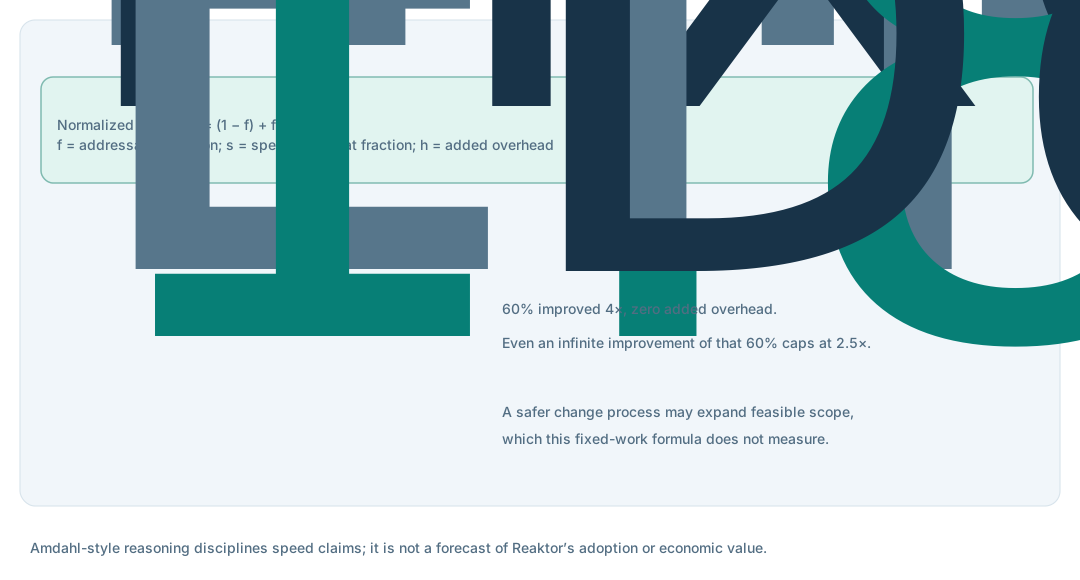
Law / model / proof obligation: S = 1 / [(1−f) + f/s + h], a hypothetical fixed-work sensitivity model.
Reaktor design decision
Reaktor could reduce cross-tool translation, duplicated configuration, agent context assembly and incident reproduction. More importantly, verified experimentation may make previously too-risky refactors affordable.
What this does not establish
Essential algorithms, product discovery and cross-system failure remain difficult. A new semantic platform can add lock-in, training, bottlenecks and maintenance cost. No market-size or productivity multiplier is measured here.
Falsifiable acceptance test. Use external-team ablations and count escaped defects, unsafe action attempts, onboarding, recovery, runtime overhead and accepted-change lead time—not generated lines of code.
Theory, precedent and Reaktor context: Amdahl — Validity of the single processor approach (1967) Reaktor plan and roadmap FoundationDB — A Distributed Unbundled Transactional Key Value Store (SIGMOD 2021)
Design obligations and open findings
Sixteen findings: existing concepts omitted from our synthesis, documentation inconsistencies, and proposed corrections. These are not a repository security or correctness audit.
Documentation conflict
01. Capability tier versus constrained offer
Keep tier as presentation. Eligibility must satisfy schema, protocol, placement, privacy, lifetime and authority before preference ranking. Re-selection needs stability and session migration rules.
Acceptance: A higher-quality remote model is rejected when private inputs cannot leave the device; fallback is observed and testable.
Capability selection Reaktor plan and roadmap
Design correction
02. Evidence kinds versus an ordinal ladder
Replace minimum EvidenceLevel with a claim-indexed evidence requirement. Bounds, assumptions, checker trust and exact artifacts are part of the claim.
Acceptance: A successful production trace cannot discharge a universal no-unauthorized-write claim; a proof of a model cannot discharge a measured latency SLO.
Formal methods and evidence Shadow verification and capsules
Documentation reconciliation
03. Binary kernel examples versus n-ary relationships
Choose typed incidence records as the structural substrate. Binary invocation, ownership and hyperedge protocols are qualified relation schemas.
Acceptance: A session has exactly one authority and many participants; this must not conflict with a unary consumer’s exclusive-binding rule.
Graph substrate redesign Data graph Formal methods and evidence
Design gap
04. Protocol and completion semantics
Make admitted, persisted, processed, canceled and reconciled outcomes explicit per protocol. Require versioned behavioral compatibility, not only matching record layouts.
Acceptance: Inject reply loss after commit. The caller reconciles the same command receipt instead of duplicating the logical effect.
Service contracts Graph protocol Data workflows Surface contracts and interaction
Design gap
05. Lifecycle, ownership and handover
Model host lifetime, component ownership, task scope and resource leases separately. Persist required work before acknowledging host-local completion.
Acceptance: Destroy a browser/Worker host without cleanup callbacks; prove durable intent survives or declare a weaker profile.
Component lifecycle Actor execution model Durable work FFI / Switchboard
Required boundary
06. Source-backed transaction publication
Source edits, graph revisions and built artifacts may have different authorities. Stage and pin a candidate; compare source revision; record recoverable publication phases.
Acceptance: Crash after materializing source but before promoting the graph. Recovery must not publish a mixed source/artifact revision.
Source ownership Visual language DevOps integration
Sharper mechanism
07. Incremental analysis is more than visitors
Use a dependency-tracked query/analysis service for positive and negative facts. Run generic visitors as one client, not the only execution model.
Acceptance: Insert a new provider that invalidates a previous absence result; its query, binding and verification evidence all become stale.
Module execution plan Graph visitors McSherry et al. — Differential Dataflow Mokhov, Mitchell & Peyton Jones — Build Systems à la Carte
Design gap
08. Time scales and specialized execution
Separate definition revisions, activation roots, reactive values, durable workflow events and native frame/tick state. Bind observations back by identity.
Acceptance: Animate at the host frame rate without committing architecture revisions; replace a UI region without discarding an active IME draft.
Surface contracts and interaction Dynamic UI and verification Surface performance and assets Operational graph evidence
Sharper invariant policy
09. Coordination and collaboration boundaries
Use serialized authority commits first. Permit coordination-free merges only for operations proven safe under the required merge/invariant model.
Acceptance: Two private branches add different providers to one exclusive port. Individually valid does not mean jointly valid.
Stable foundations Data transactions PostgreSQL — Transaction isolation Bailis et al. — Coordination Avoidance in Database Systems
Design gap
10. Evidence capture and privacy
Keep trace sampling separate from replay completeness. Exactly one substitution owner per effect; mark loss and unavailable joins. Retention and suppression apply to every derived workspace.
Acceptance: Deleted source data does not reappear after Shadow base reconstruction; duplicated collectors do not replay one effect twice.
Operational graph evidence Capture fabric Capture and replay Shadow workspaces Shadow verification and capsules
Required obligation
11. Meta-schema and qualification evolution
Version module semantics, contracts and checker implementations. Unknown required semantics block activation; evidence binds the interpreter/checker versions.
Acceptance: An upgraded dialect changes cancellation semantics without changing payloads. Old compatibility and evidence must not silently survive.
Formal methods and evidence Module execution plan MLIR — Dialect conversion Surface contracts and interaction
Implementation simplification
12. Storage engine ambition
Define graph storage semantics independently of physical layout. Start with a qualified existing transactional authority plus immutable graph indexes; custom WAL/GC only when measured needs justify it.
Acceptance: Crash-recovery and snapshot-lifetime tests pass before any performance claim; old snapshots retain their own resolution directory.
Stable foundations Mutable memory and publication SQLite — Isolation
Design gap
13. Product intent and reusable feature boundaries
Connect changes to acceptance contracts and user journeys, not only types. Reusable regions carry assumptions, effects, migrations and operational tests.
Acceptance: The feature compiles and deploys, but loses a user draft or breaks accessibility; its acceptance gate still rejects it.
Reaktor plan and roadmap Surface contracts and interaction Dynamic UI and verification
Documentation hygiene
14. Design truth versus implementation truth
Every normative claim gets status, owner, source revision, implementation pointers and qualifying tests. Separate historical criticism from active contract.
Acceptance: No generated compliance view may show a design-only streaming guarantee as implemented merely because a document describes it.
FFI / Switchboard Formal methods and evidence Workbench layers Shadow workspaces
Sharper architectural rule
15. Graph integration without dependency cycles
Low-level reaktor-core and graph-free policy/storage primitives need not import the graph. Higher-level module contributions expose their identities, capabilities and effects to the graph.
Acceptance: The foundational libraries remain usable headlessly while every admitted operational boundary is registered and inspectable.
Core dependency boundary Module execution plan Build control-plane responsibilities
Trust boundary
16. External harness authority is not graph authority
Model provider configuration, raw harness arguments, subprocess/network access and inherited tools as effective execution authority. Isolate untrusted runs or mark the governance claim incomplete.
Acceptance: A denied graph mutation must not become authorized merely by asking an inherited harness tool to perform the same external action.
Conductor harness boundaries Workbench layers Formal methods and evidence Shadow verification and capsules
Documentation coverage
140 navigation routes retrieved; 51 received targeted substantive section comparisons. The remainder were inventoried, not fully substantively audited. The count includes archives and the FFI design alias; it is not a count of unique implementations or 140 fully read documents. This is not an atomic snapshot of a changing site and is not a source-code audit.
Additional legacy routes and a private authentication boundary are listed below. No completeness claim is made about unlinked, private or unavailable material.
140 routes
| Document / family | Access | Review depth | Connected findings |
|---|---|---|---|
| reaktor-graph-substrate-redesign | |||
| Graph kernel and semantics | public route retrieved | targeted substantive sections compared | Binary kernel examples versus n-ary relationships; Binary kernel examples versus n-ary relationships |
| reaktor-unified-system-graph | |||
| Graph kernel and semantics | public route retrieved | targeted substantive sections compared | No per-document finding asserted. |
| reaktor_graph_visitors_design | |||
| Graph kernel and semantics | public route retrieved | retrieved and inventoried; not fully substantively audited | Incremental analysis is more than visitors; Incremental analysis is more than visitors |
| reaktor-component-lifecycle | |||
| Graph kernel and semantics | public route retrieved | targeted substantive sections compared | Lifecycle, ownership and handover; Lifecycle, ownership and handover |
| reaktor-graph-hierarchical-ui | |||
| Graph kernel and semantics | public route retrieved | retrieved and inventoried; not fully substantively audited | No per-document finding asserted. |
| graph-kernel-analysis | |||
| Graph kernel and semantics | public route retrieved | retrieved and inventoried; not fully substantively audited | No per-document finding asserted. |
| reaktor-actor-model | |||
| Graph kernel and semantics | public route retrieved | targeted substantive sections compared | Lifecycle, ownership and handover; Lifecycle, ownership and handover |
| reaktor-distributed-actors | |||
| Graph kernel and semantics | public route retrieved | targeted substantive sections compared | No per-document finding asserted. |
| reaktor-graph-protocol | |||
| Graph kernel and semantics | public route retrieved | targeted substantive sections compared | Protocol and completion semantics; Protocol and completion semantics |
| reaktor-graph-sources | |||
| Graph kernel and semantics | public route retrieved | targeted substantive sections compared | Source-backed transaction publication; Source-backed transaction publication |
| reaktor-service | |||
| Graph kernel and semantics | public route retrieved | targeted substantive sections compared | Protocol and completion semantics; Protocol and completion semantics |
| astra-reaktor-plan-and-roadmap | |||
| Vision, data and delivery | public route retrieved | targeted substantive sections compared | Capability tier versus constrained offer; Product intent and reusable feature boundaries; Capability tier versus constrained offer; Product intent and reusable feature boundaries |
| contributing | |||
| Vision, data and delivery | public route retrieved | retrieved and inventoried; not fully substantively audited | No per-document finding asserted. |
| reaktor-essays | |||
| Vision, data and delivery | public route retrieved | retrieved and inventoried; not fully substantively audited | No per-document finding asserted. |
| reaktor-framework-overview | |||
| Vision, data and delivery | public route retrieved | retrieved and inventoried; not fully substantively audited | No per-document finding asserted. |
| reaktor-db | |||
| Vision, data and delivery | public route retrieved | targeted substantive sections compared | No per-document finding asserted. |
| reaktor-data-graph | |||
| Vision, data and delivery | public route retrieved | targeted substantive sections compared | Binary kernel examples versus n-ary relationships; Binary kernel examples versus n-ary relationships |
| reaktor-data-storage | |||
| Vision, data and delivery | public route retrieved | targeted substantive sections compared | No per-document finding asserted. |
| reaktor-multitenancy | |||
| Vision, data and delivery | public route retrieved | targeted substantive sections compared | No per-document finding asserted. |
| reaktor-data-transactions | |||
| Vision, data and delivery | public route retrieved | targeted substantive sections compared | Coordination and collaboration boundaries; Coordination and collaboration boundaries |
| reaktor-bus-mesh | |||
| Vision, data and delivery | public route retrieved | targeted substantive sections compared | No per-document finding asserted. |
| reaktor-mesh | |||
| Vision, data and delivery | public route retrieved | targeted substantive sections compared | No per-document finding asserted. |
| reaktor-data-workflows | |||
| Vision, data and delivery | public route retrieved | targeted substantive sections compared | Protocol and completion semantics; Protocol and completion semantics |
| reaktor-work | |||
| Vision, data and delivery | public route retrieved | targeted substantive sections compared | Lifecycle, ownership and handover; Lifecycle, ownership and handover |
| reaktor-data-inspection | |||
| Vision, data and delivery | public route retrieved | targeted substantive sections compared | No per-document finding asserted. |
| reaktor-data-implementation | |||
| Vision, data and delivery | public route retrieved | targeted substantive sections compared | No per-document finding asserted. |
| bestbuds-schema-hardening | |||
| Vision, data and delivery | public route retrieved | retrieved and inventoried; not fully substantively audited | No per-document finding asserted. |
| reaktor-module-execution-plan | |||
| Modules, capabilities and Surface | public route retrieved | targeted substantive sections compared | Incremental analysis is more than visitors; Meta-schema and qualification evolution; Incremental analysis is more than visitors; Meta-schema and qualification evolution; Graph integration without dependency cycles |
| reaktor-module-review | |||
| Modules, capabilities and Surface | public route retrieved | retrieved and inventoried; not fully substantively audited | No per-document finding asserted. |
| reaktor-capability | |||
| Modules, capabilities and Surface | public route retrieved | targeted substantive sections compared | Capability tier versus constrained offer; Capability tier versus constrained offer |
| reaktor-core | |||
| Modules, capabilities and Surface | public route retrieved | targeted substantive sections compared | Graph integration without dependency cycles |
| reaktor-server | |||
| Modules, capabilities and Surface | public route retrieved | targeted substantive sections compared | No per-document finding asserted. |
| auth-analysis | |||
| Modules, capabilities and Surface | public route retrieved | targeted substantive sections compared | No per-document finding asserted. |
| reaktor-notifications-design | |||
| Modules, capabilities and Surface | public route retrieved | retrieved and inventoried; not fully substantively audited | No per-document finding asserted. |
| deep-link-integration | |||
| Modules, capabilities and Surface | public route retrieved | retrieved and inventoried; not fully substantively audited | No per-document finding asserted. |
| reaktor-koog-agents | |||
| Modules, capabilities and Surface | public route retrieved | targeted substantive sections compared | No per-document finding asserted. |
| reaktor-surface-desktop | |||
| Modules, capabilities and Surface | public route retrieved | retrieved and inventoried; not fully substantively audited | No per-document finding asserted. |
| reaktor-webview | |||
| Modules, capabilities and Surface | public route retrieved | retrieved and inventoried; not fully substantively audited | No per-document finding asserted. |
| reaktor-surface | |||
| Modules, capabilities and Surface | public route retrieved | retrieved and inventoried; not fully substantively audited | No per-document finding asserted. |
| reaktor-surface-application-extensions | |||
| Modules, capabilities and Surface | public route retrieved | retrieved and inventoried; not fully substantively audited | No per-document finding asserted. |
| reaktor-surface-application-patterns | |||
| Modules, capabilities and Surface | public route retrieved | retrieved and inventoried; not fully substantively audited | No per-document finding asserted. |
| reaktor-surface-contracts-and-interaction | |||
| Modules, capabilities and Surface | public route retrieved | targeted substantive sections compared | Protocol and completion semantics; Time scales and specialized execution; Meta-schema and qualification evolution; Product intent and reusable feature boundaries; Protocol and completion semantics; Time scales and specialized execution; Meta-schema and qualification evolution; Product intent and reusable feature boundaries |
| reaktor-surface-design-and-ownership | |||
| Modules, capabilities and Surface | public route retrieved | targeted substantive sections compared | No per-document finding asserted. |
| reaktor-surface-dynamic-ui-and-verification | |||
| Modules, capabilities and Surface | public route retrieved | targeted substantive sections compared | Time scales and specialized execution; Product intent and reusable feature boundaries; Time scales and specialized execution; Product intent and reusable feature boundaries |
| reaktor-surface-foundations | |||
| Modules, capabilities and Surface | public route retrieved | retrieved and inventoried; not fully substantively audited | No per-document finding asserted. |
| reaktor-surface-implementation-plan | |||
| Modules, capabilities and Surface | public route retrieved | retrieved and inventoried; not fully substantively audited | No per-document finding asserted. |
| reaktor-surface-motion-and-materials | |||
| Modules, capabilities and Surface | public route retrieved | retrieved and inventoried; not fully substantively audited | No per-document finding asserted. |
| reaktor-surface-performance-and-assets | |||
| Modules, capabilities and Surface | public route retrieved | targeted substantive sections compared | Time scales and specialized execution; Time scales and specialized execution |
| reaktor-surface-references | |||
| Modules, capabilities and Surface | public route retrieved | retrieved and inventoried; not fully substantively audited | No per-document finding asserted. |
| reaktor-surface-renderers | |||
| Modules, capabilities and Surface | public route retrieved | targeted substantive sections compared | No per-document finding asserted. |
| flatbuffers-flexbuffers-mutable-memory | |||
| Binary memory, FFI and verification | public route retrieved | targeted substantive sections compared | No per-document finding asserted. |
| flatbuffers-flexbuffers-mutable-memory-01-bytes-and-ownership | |||
| Binary memory, FFI and verification | public route retrieved | retrieved and inventoried; not fully substantively audited | No per-document finding asserted. |
| flatbuffers-flexbuffers-mutable-memory-02-flatbuffers | |||
| Binary memory, FFI and verification | public route retrieved | retrieved and inventoried; not fully substantively audited | No per-document finding asserted. |
| flatbuffers-flexbuffers-mutable-memory-03-flexbuffers | |||
| Binary memory, FFI and verification | public route retrieved | retrieved and inventoried; not fully substantively audited | No per-document finding asserted. |
| flatbuffers-flexbuffers-mutable-memory-04-quality-and-performance | |||
| Binary memory, FFI and verification | public route retrieved | retrieved and inventoried; not fully substantively audited | No per-document finding asserted. |
| flatbuffers-flexbuffers-mutable-memory-05-mutable-memory | |||
| Binary memory, FFI and verification | public route retrieved | targeted substantive sections compared | Storage engine ambition; Storage engine ambition |
| flatbuffers-flexbuffers-mutable-memory-06-appendix-a | |||
| Binary memory, FFI and verification | public route retrieved | retrieved and inventoried; not fully substantively audited | No per-document finding asserted. |
| flatbuffers-flexbuffers-mutable-memory-07-appendix-b | |||
| Binary memory, FFI and verification | public route retrieved | retrieved and inventoried; not fully substantively audited | No per-document finding asserted. |
| flatbuffers-flexbuffers-mutable-memory-08-appendix-c | |||
| Binary memory, FFI and verification | public route retrieved | retrieved and inventoried; not fully substantively audited | No per-document finding asserted. |
| flatbuffers-flexbuffers-mutable-memory-09-appendix-d | |||
| Binary memory, FFI and verification | public route retrieved | retrieved and inventoried; not fully substantively audited | No per-document finding asserted. |
| flatbuffers-flexbuffers-mutable-memory-10-appendix-e | |||
| Binary memory, FFI and verification | public route retrieved | retrieved and inventoried; not fully substantively audited | No per-document finding asserted. |
| flatbuffers-flexbuffers-mutable-memory-11-appendix-f | |||
| Binary memory, FFI and verification | public route retrieved | retrieved and inventoried; not fully substantively audited | No per-document finding asserted. |
| flatbuffers-flexbuffers-mutable-memory-12-appendix-g | |||
| Binary memory, FFI and verification | public route retrieved | retrieved and inventoried; not fully substantively audited | No per-document finding asserted. |
| flexbuffer-implementation | |||
| Binary memory, FFI and verification | public route retrieved | retrieved and inventoried; not fully substantively audited | No per-document finding asserted. |
| flexbuffer-improvement-plan | |||
| Binary memory, FFI and verification | public route retrieved | retrieved and inventoried; not fully substantively audited | No per-document finding asserted. |
| flexbuffer-performance-review | |||
| Binary memory, FFI and verification | public route retrieved | retrieved and inventoried; not fully substantively audited | No per-document finding asserted. |
| kotlin-clr | |||
| Binary memory, FFI and verification | public route retrieved | retrieved and inventoried; not fully substantively audited | No per-document finding asserted. |
| reaktor-ffi | |||
| Binary memory, FFI and verification | public route retrieved | targeted substantive sections compared | Lifecycle, ownership and handover; Design truth versus implementation truth; Lifecycle, ownership and handover; Design truth versus implementation truth |
| reaktor-ffi-design | |||
| Binary memory, FFI and verification | alias of canonical reaktor-ffi | redirect/duplicate; not a distinct document | No per-document finding asserted. |
| reaktor-formal-methods | |||
| Binary memory, FFI and verification | public route retrieved | targeted substantive sections compared | Evidence kinds versus an ordinal ladder; Binary kernel examples versus n-ary relationships; Meta-schema and qualification evolution; Design truth versus implementation truth; Evidence kinds versus an ordinal ladder; Binary kernel examples versus n-ary relationships; Meta-schema and qualification evolution; Design truth versus implementation truth; External harness authority is not graph authority |
| reaktor-verified-foundations-fable-5 | |||
| Binary memory, FFI and verification | public route retrieved | retrieved and inventoried; not fully substantively audited | No per-document finding asserted. |
| reaktor-stable-foundations-5.6-ultra | |||
| Binary memory, FFI and verification | public route retrieved | targeted substantive sections compared | Coordination and collaboration boundaries; Storage engine ambition; Coordination and collaboration boundaries; Storage engine ambition |
| reaktor-graph-refinement-plan | |||
| Binary memory, FFI and verification | public route retrieved | retrieved and inventoried; not fully substantively audited | No per-document finding asserted. |
| reaktor-devops | |||
| Operations, build and Shadow | public route retrieved | targeted substantive sections compared | Source-backed transaction publication; Source-backed transaction publication |
| reaktor-build-tools | |||
| Operations, build and Shadow | public route retrieved | targeted substantive sections compared | Graph integration without dependency cycles |
| reaktor-cli | |||
| Operations, build and Shadow | public route retrieved | targeted substantive sections compared | No per-document finding asserted. |
| reaktor-dependeasy | |||
| Operations, build and Shadow | public route retrieved | targeted substantive sections compared | No per-document finding asserted. |
| reaktor-cloud-pane | |||
| Operations, build and Shadow | public route retrieved | retrieved and inventoried; not fully substantively audited | No per-document finding asserted. |
| reaktor-megascale-strategy | |||
| Operations, build and Shadow | public route retrieved | retrieved and inventoried; not fully substantively audited | No per-document finding asserted. |
| secrets-management | |||
| Operations, build and Shadow | public route retrieved | retrieved and inventoried; not fully substantively audited | No per-document finding asserted. |
| security-plan | |||
| Operations, build and Shadow | public route retrieved | retrieved and inventoried; not fully substantively audited | No per-document finding asserted. |
| operations | |||
| Operations, build and Shadow | public route retrieved | retrieved and inventoried; not fully substantively audited | No per-document finding asserted. |
| operations-references | |||
| Operations, build and Shadow | public route retrieved | retrieved and inventoried; not fully substantively audited | No per-document finding asserted. |
| operations-graph-evidence | |||
| Operations, build and Shadow | public route retrieved | targeted substantive sections compared | Time scales and specialized execution; Evidence capture and privacy; Time scales and specialized execution; Evidence capture and privacy |
| performance-observability | |||
| Operations, build and Shadow | public route retrieved | retrieved and inventoried; not fully substantively audited | No per-document finding asserted. |
| operations-observability | |||
| Operations, build and Shadow | public route retrieved | retrieved and inventoried; not fully substantively audited | No per-document finding asserted. |
| reaktor-analytics-telemetry | |||
| Operations, build and Shadow | public route retrieved | retrieved and inventoried; not fully substantively audited | No per-document finding asserted. |
| operations-profiling | |||
| Operations, build and Shadow | public route retrieved | retrieved and inventoried; not fully substantively audited | No per-document finding asserted. |
| operations-instance-diagnostics | |||
| Operations, build and Shadow | public route retrieved | retrieved and inventoried; not fully substantively audited | No per-document finding asserted. |
| operations-load-resilience | |||
| Operations, build and Shadow | public route retrieved | retrieved and inventoried; not fully substantively audited | No per-document finding asserted. |
| reaktor-devtools | |||
| Operations, build and Shadow | public route retrieved | retrieved and inventoried; not fully substantively audited | No per-document finding asserted. |
| reaktor-tooling-layer | |||
| Operations, build and Shadow | public route retrieved | retrieved and inventoried; not fully substantively audited | No per-document finding asserted. |
| shadow-backends | |||
| Operations, build and Shadow | public route retrieved | retrieved and inventoried; not fully substantively audited | No per-document finding asserted. |
| shadow-capture-fabric | |||
| Operations, build and Shadow | public route retrieved | targeted substantive sections compared | Evidence capture and privacy; Evidence capture and privacy |
| shadow-capture-replay | |||
| Operations, build and Shadow | public route retrieved | targeted substantive sections compared | Evidence capture and privacy; Evidence capture and privacy |
| shadow-dev-environment | |||
| Operations, build and Shadow | public route retrieved | retrieved and inventoried; not fully substantively audited | No per-document finding asserted. |
| shadow-clients-agents | |||
| Operations, build and Shadow | public route retrieved | retrieved and inventoried; not fully substantively audited | No per-document finding asserted. |
| shadow-foundations | |||
| Operations, build and Shadow | public route retrieved | targeted substantive sections compared | No per-document finding asserted. |
| shadow-verification | |||
| Operations, build and Shadow | public route retrieved | targeted substantive sections compared | Evidence kinds versus an ordinal ladder; Evidence capture and privacy; Evidence kinds versus an ordinal ladder; Evidence capture and privacy; External harness authority is not graph authority |
| shadow-workspaces | |||
| Operations, build and Shadow | public route retrieved | targeted substantive sections compared | Evidence capture and privacy; Design truth versus implementation truth; Evidence capture and privacy; Design truth versus implementation truth |
| operations-delivery | |||
| Operations, build and Shadow | public route retrieved | retrieved and inventoried; not fully substantively audited | No per-document finding asserted. |
| reaktor-instrumentation-plan | |||
| Operations, build and Shadow | public route retrieved | retrieved and inventoried; not fully substantively audited | No per-document finding asserted. |
| reaktor-workbench-links | |||
| Operations, build and Shadow | public route retrieved | retrieved and inventoried; not fully substantively audited | No per-document finding asserted. |
| hangar | |||
| Workbench, agents and products | public route retrieved | targeted substantive sections compared | No per-document finding asserted. |
| reaktor-workbench-layers | |||
| Workbench, agents and products | public route retrieved | targeted substantive sections compared | Design truth versus implementation truth; Design truth versus implementation truth; External harness authority is not graph authority |
| reaktor-agent-workspace | |||
| Workbench, agents and products | public route retrieved | retrieved and inventoried; not fully substantively audited | No per-document finding asserted. |
| reaktor-cloud | |||
| Workbench, agents and products | public route retrieved | retrieved and inventoried; not fully substantively audited | No per-document finding asserted. |
| reaktor-graph-pane | |||
| Workbench, agents and products | public route retrieved | retrieved and inventoried; not fully substantively audited | No per-document finding asserted. |
| reaktor-agentic-tooling | |||
| Workbench, agents and products | public route retrieved | retrieved and inventoried; not fully substantively audited | No per-document finding asserted. |
| reaktor-conductor | |||
| Workbench, agents and products | public route retrieved | targeted substantive sections compared | External harness authority is not graph authority |
| reaktor-browser-local-ai | |||
| Workbench, agents and products | public route retrieved | targeted substantive sections compared | No per-document finding asserted. |
| reaktor-visual-language | |||
| Workbench, agents and products | public route retrieved | targeted substantive sections compared | Source-backed transaction publication; Source-backed transaction publication |
| reaktor-atlas-revamp-5.6-ultra | |||
| Workbench, agents and products | public route retrieved | retrieved and inventoried; not fully substantively audited | No per-document finding asserted. |
| reaktor-ui-ux-audit-2026-09-08 | |||
| Workbench, agents and products | public route retrieved | retrieved and inventoried; not fully substantively audited | No per-document finding asserted. |
| reaktor-desktop-master-plan | |||
| Workbench, agents and products | public route retrieved | retrieved and inventoried; not fully substantively audited | No per-document finding asserted. |
| reaktor-koog-workbench | |||
| Workbench, agents and products | public route retrieved | retrieved and inventoried; not fully substantively audited | No per-document finding asserted. |
| reaktor-arena | |||
| Workbench, agents and products | public route retrieved | retrieved and inventoried; not fully substantively audited | No per-document finding asserted. |
| companyos-migration-plan | |||
| Workbench, agents and products | public route retrieved | retrieved and inventoried; not fully substantively audited | No per-document finding asserted. |
| manna-functional-designs | |||
| Workbench, agents and products | public route retrieved | retrieved and inventoried; not fully substantively audited | No per-document finding asserted. |
| manna-hld | |||
| Workbench, agents and products | public route retrieved | retrieved and inventoried; not fully substantively audited | No per-document finding asserted. |
| claude-nexergy-appweb-analysis | |||
| Workbench, agents and products | public route retrieved | retrieved and inventoried; not fully substantively audited | No per-document finding asserted. |
| codex-nexergy-appweb-analysis | |||
| Workbench, agents and products | public route retrieved | retrieved and inventoried; not fully substantively audited | No per-document finding asserted. |
| manna-kotlin-surface-migration-plan | |||
| Workbench, agents and products | public route retrieved | retrieved and inventoried; not fully substantively audited | No per-document finding asserted. |
| claude-critic-review | |||
| Critique and historical designs | public route retrieved | retrieved and inventoried; not fully substantively audited | No per-document finding asserted. |
| codex-critic-review | |||
| Critique and historical designs | public route retrieved | retrieved and inventoried; not fully substantively audited | No per-document finding asserted. |
| reaktor-competitive-analysis | |||
| Critique and historical designs | public route retrieved | retrieved and inventoried; not fully substantively audited | No per-document finding asserted. |
| codex-roadmap | |||
| Critique and historical designs | public route retrieved | retrieved and inventoried; not fully substantively audited | No per-document finding asserted. |
| reaktor-implementation-plan | |||
| Critique and historical designs | public route retrieved | retrieved and inventoried; not fully substantively audited | No per-document finding asserted. |
| reaktor-workbench-roadmap | |||
| Critique and historical designs | public route retrieved | retrieved and inventoried; not fully substantively audited | No per-document finding asserted. |
| claude-dev-environment | |||
| Critique and historical designs | public route retrieved | retrieved and inventoried; not fully substantively audited | No per-document finding asserted. |
| codex-dev-environment | |||
| Critique and historical designs | public route retrieved | retrieved and inventoried; not fully substantively audited | No per-document finding asserted. |
| performance-observability-history | |||
| Critique and historical designs | public route retrieved | retrieved and inventoried; not fully substantively audited | No per-document finding asserted. |
| shadow-design-history | |||
| Critique and historical designs | public route retrieved | retrieved and inventoried; not fully substantively audited | No per-document finding asserted. |
| engine-website-implementation-report | |||
| Critique and historical designs | public route retrieved | retrieved and inventoried; not fully substantively audited | No per-document finding asserted. |
| flow-analysis | |||
| Critique and historical designs | public route retrieved | retrieved and inventoried; not fully substantively audited | No per-document finding asserted. |
| reaktor-architecture-analysis | |||
| Critique and historical designs | public route retrieved | retrieved and inventoried; not fully substantively audited | No per-document finding asserted. |
| reaktor-graph-migration-plan | |||
| Critique and historical designs | public route retrieved | retrieved and inventoried; not fully substantively audited | No per-document finding asserted. |
| reaktor-atlas-review-fable-5 | |||
| Critique and historical designs | public route retrieved | retrieved and inventoried; not fully substantively audited | No per-document finding asserted. |
| reaktor-desktop-v3 | |||
| Critique and historical designs | public route retrieved | retrieved and inventoried; not fully substantively audited | No per-document finding asserted. |
| reaktor-gemini-devops-agent | |||
| Critique and historical designs | public route retrieved | retrieved and inventoried; not fully substantively audited | No per-document finding asserted. |
Additional and inaccessible material
- codex-reaktor-notifications-design/ — additional legacy page retrieved. legacy design; not counted among 140 current navigation routes.
- multiplatform-analysis/ — search-index material only; direct retrieval failed. not fully reviewed.
- react-compose/ — search-index material only; direct retrieval failed. not fully reviewed.
- architecture-analysis/ — search-index material only; direct retrieval failed. not fully reviewed.
- https://reaktor.build/private/astra-analysis — authentication redirect. not accessible; not reviewed.
Route discovery used the current site navigation plus indexed legacy material. Proposed behavior, source presence, passing tests, deployed behavior and current operational qualification remain distinct statuses throughout this report.
Primary sources
A mechanism-by-mechanism reading map, not a novelty claim. Papers and official documentation establish their own guarantees, not those of an unqualified Reaktor implementation.
- The Living GraphReaktor document · living
- Graph substrate redesignReaktor document · substrate
- Reaktor plan and roadmapReaktor document · roadmap
- Formal methods and evidenceReaktor document · formal
- Stable foundationsReaktor document · stable
- Capability selectionReaktor document · cap
- Module execution planReaktor document · module
- Graph visitorsReaktor document · visitors
- Component lifecycleReaktor document · life
- Actor execution modelReaktor document · actors
- Distributed actorsReaktor document · dactors
- Graph protocolReaktor document · protocol
- Source ownershipReaktor document · sources
- Service contractsReaktor document · service
- Data graphReaktor document · data
- Data transactionsReaktor document · txn
- Durable workReaktor document · work
- Data workflowsReaktor document · workflows
- MultitenancyReaktor document · tenant
- Surface contracts and interactionReaktor document · surface
- Dynamic UI and verificationReaktor document · dynamic
- Surface performance and assetsReaktor document · surfaceperf
- Surface renderersReaktor document · renderer
- FFI / SwitchboardReaktor document · ffi
- Mutable memory and publicationReaktor document · liveflex
- Shadow foundationsReaktor document · shadow
- Shadow workspacesReaktor document · workspace
- Shadow verification and capsulesReaktor document · verify
- Capture and replayReaktor document · replay
- Capture fabricReaktor document · capture
- Operational graph evidenceReaktor document · ops
- DevOps integrationReaktor document · devops
- Workbench layersReaktor document · layers
- Visual languageReaktor document · visual
- HangarReaktor document · hangar
- Authentication moduleReaktor document · auth
- Ptolemy II: hierarchy, ports and models of computationPrimary precedent · ptolemy
- Lee & Parks — Dataflow Process Networks (1995)Primary precedent · processnets
- Compositionality of dataflow modelsPrimary precedent · compositiondataflow
- Fong — Decorated Cospans (2015)Primary precedent · cospan
- Fong & Spivak — Seven Sketches in CompositionalityPrimary precedent · sketches
- Patch Graph Rewriting: comparison with DPO rewritingPrimary precedent · rewrite
- Foster et al. — Combinators for Bidirectional Tree TransformationsPrimary precedent · lenses
- Honda, Yoshida & Carbone — Multiparty Asynchronous Session TypesPrimary precedent · mpst
- A Mechanised Theory of Multiparty Asynchronous Session Types (ECOOP 2025)Primary precedent · mpstproof
- van der Aalst et al. — Soundness of workflow netsPrimary precedent · petri
- Cozzo et al. — Structure of Triadic Relations in Multiplex NetworksPrimary precedent · multilayer
- MIT OpenCourseWare — Queueing theory and Little’s lawPrimary precedent · queues
- MLIR — Dialect conversionPrimary precedent · mlir
- MLIR — InterfacesPrimary precedent · interfaces
- Koka — Types and effect handlersPrimary precedent · effects
- WebAssembly Component Model — WITPrimary precedent · wit
- Apache Arrow — C data interfacePrimary precedent · arrow
- SQLite — IsolationPrimary precedent · sqlite
- PostgreSQL — Transaction isolationPrimary precedent · postgres
- Bailis et al. — Coordination Avoidance in Database SystemsPrimary precedent · iconfluence
- FoundationDB — A Distributed Unbundled Transactional Key Value Store (SIGMOD 2021)Primary precedent · fdb
- Lamport — Distributed clocks, snapshots and temporal specificationsPrimary precedent · lamport
- Lamport — A high-level view of TLA+Primary precedent · tla
- Kubernetes — ControllersPrimary precedent · k8s
- Temporal — Workflow executionPrimary precedent · temporal
- Erlang/OTP — Release handlingPrimary precedent · otp
- Mokhov, Mitchell & Peyton Jones — Build Systems à la CartePrimary precedent · build
- McSherry et al. — Differential DataflowPrimary precedent · differential
- Unison — Code as content-addressed definitionsPrimary precedent · unison
- JetBrains MPS — Projectional Agent Toolkit (2026.1, experimental)Primary precedent · mps
- Functional Mock-up Interface — Model exchange and co-simulationPrimary precedent · fmi
- Unreal Engine — Introduction to BlueprintsPrimary precedent · blueprint
- Jetpack Compose — Architecture and statePrimary precedent · compose
- Amdahl — Validity of the single processor approach (1967)Primary precedent · amdahl
- Core dependency boundaryReaktor document · core
- Conductor harness boundariesReaktor document · conductor
- Build control-plane responsibilitiesReaktor document · buildtools
- Dependeasy build factsReaktor document · dependeasy
- Bus versus live MeshReaktor document · bus
- Live session topologyReaktor document · mesh
- Tidemark data layerReaktor document · db