Authoring and industry precedents
Design synthesis, 7 October 2026. This chapter incorporates the supplied Astra report. Its models and acceptance tests describe intended architecture; they do not certify current implementation. The report inventoried 140 public routes and compared substantive sections of 51 documents. Repository source and current qualification receipts determine what ships.
Architecture thesis and invariants · Nodes, ports and hyperedge vocabulary · Composition and execution semantics · Compiler, source publication and consistency · Shadow, evidence and region releases · Authoring and industry precedents · Cross-runtime systems and worked scenarios · Impact, design obligations and qualification
13. Authoring workbench and product precedents
Use a context-sensitive palette derived from module descriptors, not a hard-coded menu of every possible node. Dragging from a port filters by schema, protocol role, required authority, lifetime and target availability. Pure conversions may be suggested; a conversion that adds effects, permissions, lossy semantics or a network boundary must remain explicit.
A selected entity should synchronize the product preview, region canvas, source editor, statechart, contract inspector and trace view. Each view carries the same region/revision/activation selection. The UI must clearly distinguish authored desired state from what is running on a particular device.
Take state and microstep inspection from Stately, instance-aware pin watches and play/debug from Unreal, code-and-agent collaboration from Cursor, and component/interaction authoring from FlutterFlow. Play-in-Shadow launches a scoped test environment; it is not permission to pause a shared production runtime. Stately inspection API Unreal Blueprint debugger Cursor Agent overview FlutterFlow Action Flow Editor
Keep named reusable regions, typed holes, undoable draft patches, semantic zoom, bounded graph queries and direct source escape hatches. Save incomplete drafts with findings; only activation requires a closed, executable contract. Automated edits land in a candidate workspace, not an auto-reloaded production authority.
Stately / XState
Behavior is executable, inspectable state—not a flowchart approximation.
Take: Hierarchical and parallel states, typed events, guards, actor ownership, snapshots and microstep inspection.
Extend: A qualified statechart dialect for UI, protocols, services and durable processes, with explicit persistence and cancellation profiles.
Avoid: Do not make all Reaktor computation finite-state or silently add durability to XState-style actor execution.
Stately and XState documentation State machines and statecharts XState actor semantics Stately inspection API
Unreal Engine / Blueprints
A powerful engine exposes curated primitives to a visual language.
Take: Reflected module palette, typed pins, pure/effectful split, reusable assets, compiler findings, instance-aware watches, content cooking and Play-In-Editor.
Extend: A system studio over apps, servers, data and infrastructure; Play-in-Shadow; target-specific region packaging and native C++/C# boundaries.
Avoid: Do not reproduce engine-specific object assumptions, treat every drawn wire as an exec pin, or require giant graphs instead of source.
Unreal Blueprint visual scripting Blueprint technical guide Unreal Blueprint debugger Unreal content cooking
Cursor
Source editing, agent context and review belong in the main workbench.
Take: Code-and-agent workflow, context/rules, checkpoints, tool integration and review UX.
Extend: One selected region drives graph, source, contract and trace views. Agents propose typed region patches with visible blast radius and independently enforced publication.
Avoid: Prompts/rules are not an authority boundary; a source checkpoint does not roll back databases or external effects.
Cursor Agent overview Cursor Agent security Cursor rules
FlutterFlow
Start from the product the user is building, then expose its behavior.
Take: Reusable UI components, forms, trigger-bound action flows, preview and custom code escape hatches.
Extend: A product-first Surface lens linked to statecharts, service/data interfaces, authorization, deployment and evidence. Runtime renderer choice stays explicit.
Avoid: Do not equate a widget tree with the entire system, or promise arbitrary generated-code round trips.
FlutterFlow Action Flow Editor FlutterFlow custom code FlutterFlow reusable components
Expo
Separate the installed native runtime from compatible updateable content.
Take: Development builds, runtime compatibility, signed updates, staged rollouts and artifact distribution.
Extend: A signed region release and dependency vector, with per-host admission and state-safe activation; use existing Expo mechanisms for suitable RN targets.
Avoid: EAS Update is not assumed to be arbitrary subgraph hot-swap. Native additions need new builds; policy compliance is independent of technical loadability.
Expo development builds Expo runtime versions and updates Expo end-to-end update signing Expo update rollouts
Stately, Unreal, Cursor, FlutterFlow and Expo
Each precedent contributes a distinct mode of building software; none should become the universal semantics.
Vector diagram · click a marked item to inspect
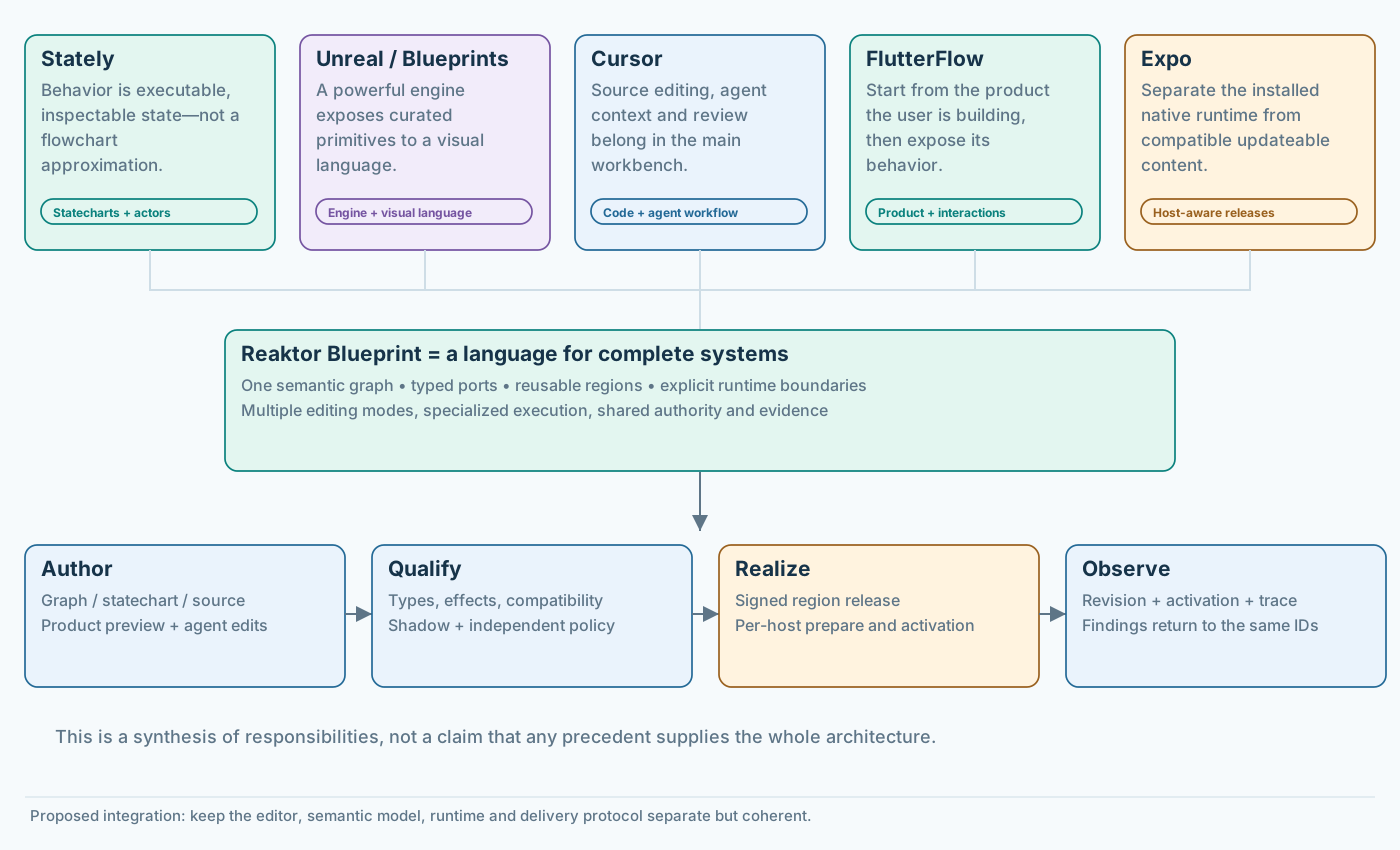
Reaktor design decision
Treat Reaktor as the engine, Blueprint as its higher-level system language, and the studio as synchronized product, behavior, code and operational views.
Boundary / caveat
This is neither a replacement renderer nor a merger of five products. Capability and authorization remain explicit at every execution boundary.
Qualification test. Select a UI element, jump to its statechart, service contract, implementation and deployment, then propose one linked change without recreating identities.
Stately / XState
Take: Hierarchical and parallel states, typed events, guards, actor ownership, snapshots and microstep inspection.
Extend for Reaktor: A qualified statechart dialect for UI, protocols, services and durable processes, with explicit persistence and cancellation profiles.
Do not inherit: Do not make all Reaktor computation finite-state or silently add durability to XState-style actor execution.
Stately and XState documentation State machines and statecharts XState actor semantics Stately inspection API
Unreal Engine / Blueprints
Take: Reflected module palette, typed pins, pure/effectful split, reusable assets, compiler findings, instance-aware watches, content cooking and Play-In-Editor.
Extend for Reaktor: A system studio over apps, servers, data and infrastructure; Play-in-Shadow; target-specific region packaging and native C++/C# boundaries.
Do not inherit: Do not reproduce engine-specific object assumptions, treat every drawn wire as an exec pin, or require giant graphs instead of source.
Unreal Blueprint visual scripting Blueprint technical guide Unreal Blueprint debugger Unreal content cooking
Cursor
Take: Code-and-agent workflow, context/rules, checkpoints, tool integration and review UX.
Extend for Reaktor: One selected region drives graph, source, contract and trace views. Agents propose typed region patches with visible blast radius and independently enforced publication.
Do not inherit: Prompts/rules are not an authority boundary; a source checkpoint does not roll back databases or external effects.
Cursor Agent overview Cursor Agent security Cursor rules
FlutterFlow
Take: Reusable UI components, forms, trigger-bound action flows, preview and custom code escape hatches.
Extend for Reaktor: A product-first Surface lens linked to statecharts, service/data interfaces, authorization, deployment and evidence. Runtime renderer choice stays explicit.
Do not inherit: Do not equate a widget tree with the entire system, or promise arbitrary generated-code round trips.
FlutterFlow Action Flow Editor FlutterFlow custom code FlutterFlow reusable components
Expo
Take: Development builds, runtime compatibility, signed updates, staged rollouts and artifact distribution.
Extend for Reaktor: A signed region release and dependency vector, with per-host admission and state-safe activation; use existing Expo mechanisms for suitable RN targets.
Do not inherit: EAS Update is not assumed to be arbitrary subgraph hot-swap. Native additions need new builds; policy compliance is independent of technical loadability.
Expo development builds Expo runtime versions and updates Expo end-to-end update signing Expo update rollouts
Official context and precedents: Stately and XState documentation Unreal Blueprint visual scripting Cursor Agent overview FlutterFlow Action Flow Editor Expo runtime versions and updates
Synchronized authoring and inspection views
Product preview, graph, statechart, source, traces and agent review retain the same region/revision context.
Vector diagram · click a marked item to inspect
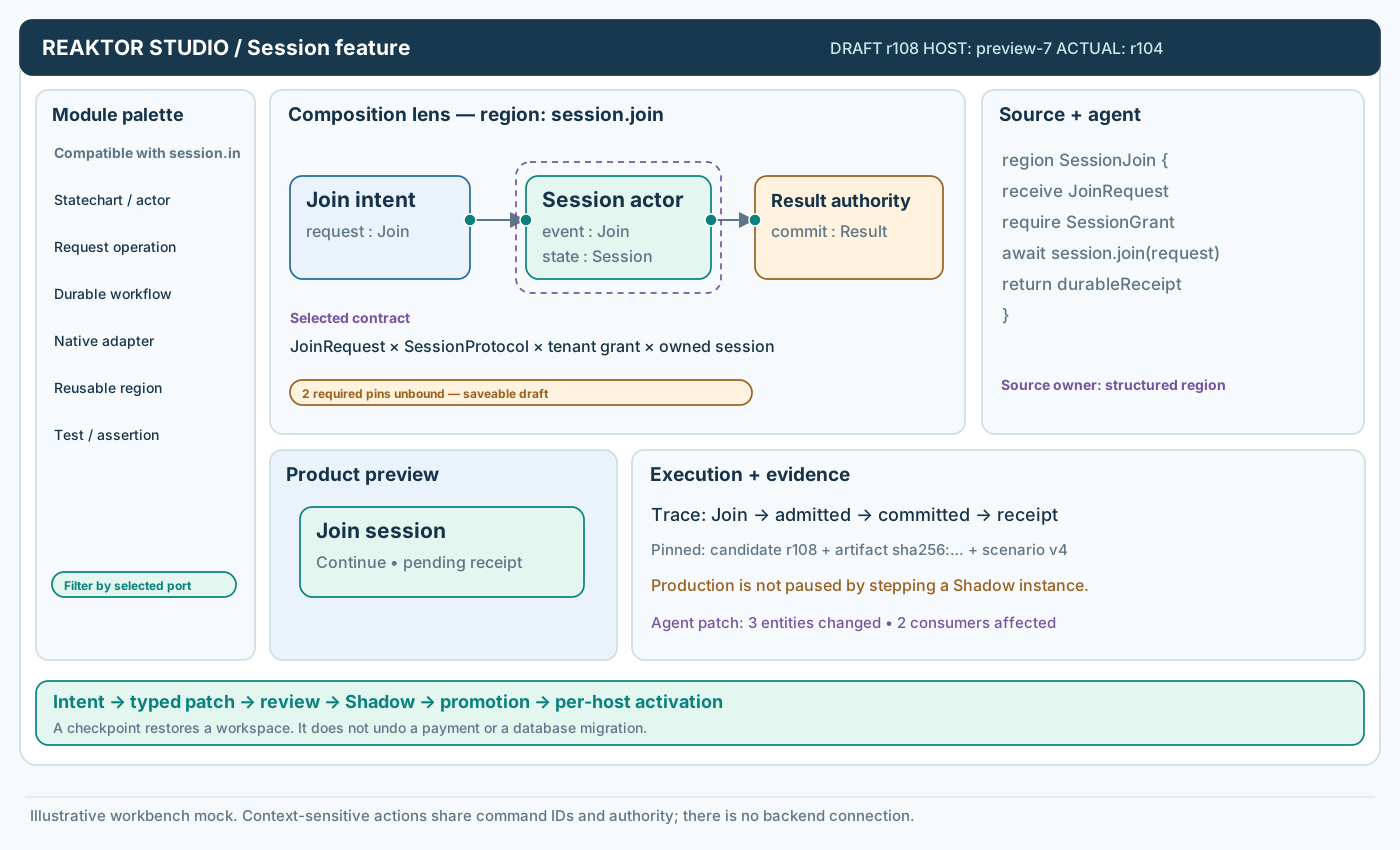
Reaktor design decision
Borrow the useful editing modes while maintaining one source owner per region. Display desired, candidate and observed revisions visibly. Palettes derive from module contracts.
Boundary / caveat
A pretty canvas is not a compiler. Source checkpoints and graph undo are not distributed rollback; production stepping requires explicit operational controls.
Qualification test. Rename or move a component. Stable identity survives, source links remain valid, and layout changes do not invalidate executable artifacts.
Official context and precedents: Unreal Blueprint debugger Stately inspection API Cursor Agent overview Cursor Agent security FlutterFlow Action Flow Editor Reaktor Visual Language / Blueprints
Do not base differentiation on a familiar primitive
Typed graphs, visual programming, structured agents and simulation each have substantial precedents.
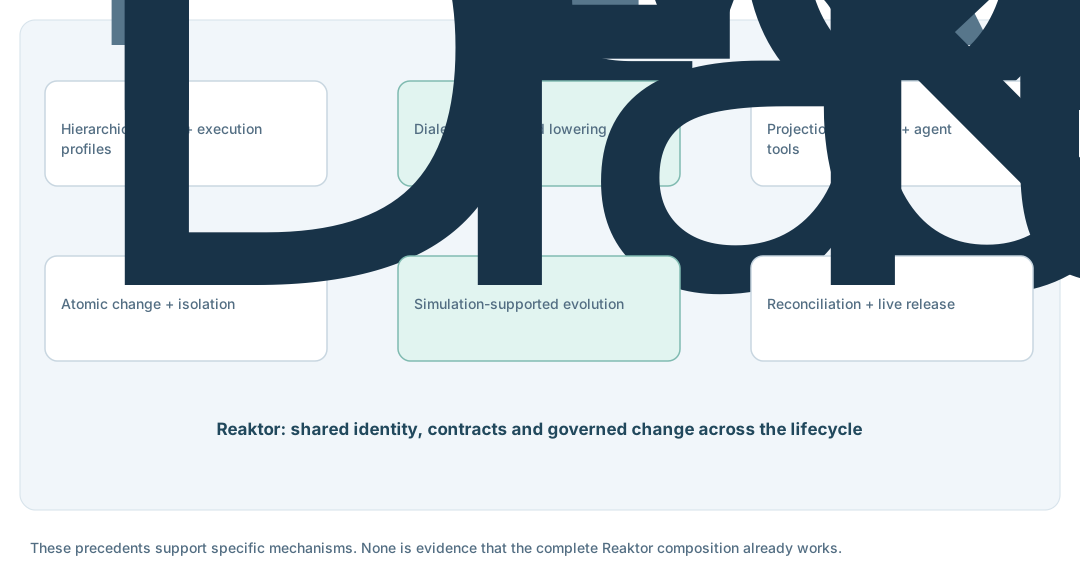
Law / model / proof obligation: Differentiation hypothesis: lower total cost of safe cross-layer change, not novelty of graph syntax.
Reaktor design decision
Ptolemy is especially close architecturally. MPS’s experimental 2026.1 Projectional Agent Toolkit already provides structural model edits and validation to agents. Reaktor should prove its value across runtime, state, authority, deployment and evidence boundaries.
What this does not establish
A catalog of precedents is not a feature-parity comparison or market survey. Integration can also multiply maintenance and semantic obligations if the boundaries are weak.
Falsifiable acceptance test. Compare the same nontrivial feature change with ordinary tooling, graph-aware tooling, and graph plus Shadow/governance. Keep the model and requirements fixed.
Theory, precedent and Reaktor context: Ptolemy II: hierarchy, ports and models of computation MLIR — Dialect conversion JetBrains MPS — Projectional Agent Toolkit (2026.1, experimental) FoundationDB — A Distributed Unbundled Transactional Key Value Store (SIGMOD 2021) Kubernetes — Controllers Erlang/OTP — Release handling