Nodes, ports and hyperedge vocabulary
Design synthesis, 7 October 2026. This chapter incorporates the supplied Astra report. Its models and acceptance tests describe intended architecture; they do not certify current implementation. The report inventoried 140 public routes and compared substantive sections of 51 documents. Repository source and current qualification receipts determine what ships.
Architecture thesis and invariants · Nodes, ports and hyperedge vocabulary · Composition and execution semantics · Compiler, source publication and consistency · Shadow, evidence and region releases · Authoring and industry precedents · Cross-runtime systems and worked scenarios · Impact, design obligations and qualification
4. Node families
N01 · Pure computation
Map, hash, score, validate
Contract: No hidden effects; cache only against declared inputs and semantic version.
N02 · Effectful operation
Send, reserve, write, invoke
Contract: Effects and required grants are explicit; timeout does not imply no effect.
N03 · Decision / pattern match
Guard, switch, eligibility
Contract: Define exhaustive cases and defaults; guards are pure in the selected profile.
N04 · Loop / recursive region
Fold, iterate, call itself
Contract: Specify continuation/state semantics and resource budgets; a cycle is not a schedule.
N05 · Actor / statechart
Session, cart, connection
Contract: Owns state and event ordering; hierarchy does not itself provide durability.
N06 · Workflow / saga
Checkout, onboarding, import
Contract: Version durable continuations; make retries, unknown results and compensation explicit.
N07 · Stream operator
Filter, window, resample
Contract: Specify demand, buffering, event-time policy, loss and cancellation.
N08 · Fork / join / scheduler
Parallel tasks, join, race
Contract: Choose all/any/quorum semantics, including failure and abandoned branches.
N09 · Timer / clock source
Deadline, interval, logical tick
Contract: Distinguish logical, event and wall clocks; inject clocks for replay.
N10 · Function / blueprint region
Reusable feature, generic subgraph
Contract: Stable exported interface; instantiate fresh owned state, not copied global identity.
N11 · Surface / view component
Screen, card, scene overlay
Contract: Interaction semantics are shared; native renderer behavior is qualified separately.
N12 · Route / navigation
Deep link, page, modal
Contract: Make route state, permissions and unsupported destinations explicit.
N13 · Input / interaction source
Gesture, keyboard, controller
Contract: Declare focus, sampling, ordering and host lifecycle behavior.
N14 · Form / validation region
Address form, editor inspector
Contract: Keep draft/invalid state saveable; effects require separately accepted values.
N15 · Device / platform adapter
Camera, GPS, clipboard
Contract: Native implementation is bounded by OS permissions, affinity and installed capabilities.
N16 · Native resource / engine
Map SDK, Unity, Unreal, codec
Contract: Resource owner and release callback survive async calls; opaque internals stay declared.
N17 · Media transform
Crop, encode, render, mix
Contract: Specify memory domain, mutability, format and synchronization; zero-copy is conditional.
N18 · Model inference
Ranker, speech, embedding
Contract: Pin model artifact and preprocessing; quality requires task-specific evidence.
N19 · Tool / external API adapter
Geocoder, payments, search
Contract: Treat credentials and external outcomes separately from local graph transactions.
N20 · Human decision / approval
Review, moderation, release signoff
Contract: Human identity, scope, policy version and expiry are part of the decision.
N21 · Database / state authority
Postgres, SQLite, KV authority
Contract: Actual store profile determines isolation and durability; rows are not architecture nodes.
N22 · Query / materialized view
Projection, lookup, aggregate
Contract: Declare source cut, freshness and dependency coverage; no unsound negative inference.
N23 · Transaction / unit of work
Graph commit, local outbox
Contract: Atomicity applies only to the named authority and enlisted qualified resources.
N24 · Queue / log / pubsub resource
Topic, task queue, event journal
Contract: Delivery, retention, offset, deduplication and redelivery laws belong to the provider.
N25 · Cache / replica / sync agent
Local-first replica, CDN cache
Contract: Specify merge/conflict policy and deletion semantics; not every invariant permits CRDT merge.
N26 · Blob / buffer / asset store
Images, model weights, snapshots
Contract: Graph stores descriptors and controlled references; large payloads remain in their owner.
N27 · Runtime host / executor
JVM, Hermes, browser, native
Contract: Expose an installed capability descriptor and lifetime; target name alone is insufficient.
N28 · Placement / resource pool
Worker fleet, GPU pool, region
Contract: Hard constraints precede optimization; placement is not proof of current availability.
N29 · Factory / dynamic instance
Match factory, tenant worker
Contract: Separate reusable definition from dynamic instance identity and bounded registry visibility.
N30 · External system boundary
Legacy service, PLC, SaaS
Contract: Expose integration coverage honestly; graph visibility does not sandbox external code.
N31 · Schema / contract definition
Record, protocol, resource ABI
Contract: Represent as a node when independently referenced; otherwise keep it a typed value/facet.
N32 · Capability offer / requirement
Offline ranker, GPU offer
Contract: Availability and suitability do not confer authority; selection is context-scoped.
N33 · Policy / principal boundary
Grant evaluator, tenant scope
Contract: Secrets stay out of graph payloads; current effect-time authority is rechecked.
N34 · Build / compiler pass
Typecheck, lower, package
Contract: Key caches by semantic inputs and toolchain; preserve source maps and qualification profile.
N35 · Artifact / release manifest
Signed region bundle, runtime image
Contract: Stable identity differs from content digest; exclude cosmetic layout from semantic identity.
N36 · Test / Shadow scenario
Fault replay, baseline/candidate
Contract: Record assumptions, capture gaps and runner; no generic green-check guarantee.
N37 · Claim / evidence record
Protocol claim, performance run
Contract: Evidence is claim-indexed, not a universal ordered strength score.
N38 · Observer / query / visitor
Inspector, trace lens, analysis
Contract: Inspection cannot mutate implicitly; coverage and authority limit conclusions.
N39 · Agent / change proposer
Planner, coding harness, reviewer
Contract: Drafts are not deployment; effective tool/OS authority must be controlled or disclosed.
N40 · Deployment / migration controller
Rollout, drain, state transfer
Contract: Durable reconciliation; monotonic fencing epochs and explicit mixed-version policy.
5. Port profiles
P01 · Value / immutable snapshot
Out → In
Contract: Schema, nullability, units and representation matter; value flow alone imposes no effect order.
P02 · Request / response
Require<I,O,E> ↔ Provide<I,O,E>
Contract: Direction is a role; sync/async, error and timeout outcomes are part of compatibility.
P03 · Durable command / receipt
Submit<I,CommandId> → Receipt
Contract: Receipt names the qualified completion stage, not simply receipt of bytes.
P04 · Push event
EventOut → EventIn
Contract: Declare ordering, overflow, replay and delivery guarantee; not implicitly durable.
P05 · Pull iterator / cursor
Next → Item|End
Contract: Cursor lifetime, backpressure, consistency cut and resume behavior are explicit.
P06 · Credit-controlled stream
Stream + Request(n)
Contract: Demand, buffer bounds, terminal events and cancellation must agree across the boundary.
P07 · Duplex session
Session<Role,Protocol>
Contract: Both endpoints follow the protocol; pin session version and handoff semantics.
P08 · Signal / reactive state
Signal<S,Version>
Contract: Distinguish latest-value conflation from delivery of every historical change.
P09 · Mutation / conditional update
Update<Patch,ExpectedVersion>
Contract: The authority checks predicates and authorization; local write locks are not distributed CAS.
P10 · Transaction participant
Participant<Authority,Profile>
Contract: Only qualified participants enlist; a transaction token is not universal ACID.
P11 · Execution / continuation
ExecIn → ExecOut
Contract: Defines effect order within one execution profile; not a generic network message.
P12 · Branch / guarded transition
Case / Event[Guard]
Contract: Exhaustiveness and guard purity are checked; branch choice is separate from data encoding.
P13 · Completion / join token
Done<BranchId,Outcome>
Contract: Join rule defines required contributors and treatment of failure/cancellation.
P14 · Cancellation / deadline
Cancel
Contract: Cancellation is cooperative unless stated otherwise; reconcile already-committed effects.
P15 · Clock / tick / timer
Tick<ClockId,Instant>
Contract: Specify event-time versus processing-time semantics; clocks are dependencies for replay.
P16 · Owned resource transfer
Owned
Contract: Exactly one accepted owner after transfer; reject duplication and invalid module epoch.
P17 · Borrowed buffer / view
Borrow<Buffer,Scope>
Contract: Cannot escape its declared scope; async and cross-address-space use require a qualified lease/copy.
P18 · Shared read lease
SharedRead<Buffer,Lease>
Contract: Reference counting alone does not make concurrent mutation safe; memory rules stay explicit.
P19 · Capability descriptor
Offer / Require
Contract: Metadata for selection, not an authorization bearer; no implied access to the capability.
P20 · Authorization request / grant
Authorize<Subject,Action,Scope>
Contract: Bind principal, scope, expiry and issuer; recheck at use and never serialize raw credentials.
P21 · Lifecycle management
Prepare / Activate / Drain / Release
Contract: Calls may fail or be skipped on host death; required persistence cannot rely on cleanup.
P22 · Checkpoint / migration
Snapshot → Restore
Contract: Migration is versioned and staged; rollback depends on state compatibility, not old code availability.
P23 · Artifact / schema reference
Ref<Kind,Digest,AccessPolicy>
Contract: A reference is not a raw pointer; loading verifies integrity, provenance and access.
P24 · Inspection / evidence
Observe<Selector,Cut> → Finding
Contract: Carries coverage and provenance; observational access does not confer mutation authority.
6. Hyperedge patterns
H01 · Exclusive binding
consumer:1, provider:1
Contract: Reject a second provider where exclusivity is required; dispatch can compile to a direct call.
H02 · Value flow
source:1, sink:1..N
Contract: Copy/fanout is legal only for the value ownership profile; units and schemas must match.
H03 · Control precedence
before:1..N, after:1..N
Contract: Defines ordering under a named profile; does not serialize unrelated graph layers.
H04 · Event subscription
publisher:1..N, subscriber:1..N
Contract: Subscriptions name filters, replay and delivery rules; broker resources remain separate nodes.
H05 · Request / reply binding
caller:1, callee:1, reply:0..1
Contract: Protocol includes correlation, failure and unknown outcomes; transport is chosen independently.
H06 · Multiparty session
authority:1, participant:1..N, observer:0..N
Contract: Single relation identity with role/cardinality checks; delivery comes from an explicit protocol.
H07 · Broadcast / fanout
producer:1, consumer:1..N
Contract: State whether delivery waits for all, any or no receivers; slow receivers need a policy.
H08 · Merge-any
producer:1..N, consumer:1
Contract: Specify interleaving, fairness and order; merging is not a join of corresponding values.
H09 · Join-all
input:2..N, result:1
Contract: Align values by invocation/key; define failure, timeout and missing-input treatment.
H10 · Race / select
contender:2..N, winner:1
Contract: Define first-completion versus first-success and cleanup/reconciliation of losing effects.
H11 · Keyed temporal join
left:1, right:1..N, result:1
Contract: State key, clock, lateness/watermark and window policy; topology alone cannot pair records.
H12 · Barrier / synchronization
member:2..N, continuation:1
Contract: Specify membership epoch, arrival condition and failure handling; no hidden global clock.
H13 · Quorum requirement
proposer:1, voter:1..N, result:1
Contract: Names a qualified protocol and membership; counting votes alone does not implement consensus.
H14 · Replica group
authority:0..1, replica:1..N
Contract: Replication/merge and fencing rules are explicit; schema does not create consistency.
H15 · Partition / route
router:1, shard:1..N
Contract: Specify key function, assignment epoch and resharding; preserve owner and replay semantics.
H16 · Atomic authority scope
authority:1, participant:1..N
Contract: ACID applies only where that authority/profile implements it; not across arbitrary stores.
H17 · Compensation relation
forward:1, compensator:1..N
Contract: Compensation is a new effect with its own failure modes, not automatic historical erasure.
H18 · Supervision
supervisor:1, child:1..N
Contract: Specify restart budget, state/ownership effects and host-death behavior.
H19 · Ownership / containment
owner:1, owned:1..N
Contract: Selected ownership relation is acyclic; visual grouping is not ownership.
H20 · Instantiation
definition:1, instance:1..N
Contract: Fresh activation identities and scopes; shared definitions are not shared mutable instance state.
H21 · Placement
component:1..N, host:1..N
Contract: A plan expresses intended placement; observations separately establish what actually runs.
H22 · Affinity / separation
member:2..N, constraint:1
Contract: Co-location, anti-affinity or memory-domain rule is a constraint, not an executable wire.
H23 · Scoped authorization
principal:1, resource:1..N, policy:1
Contract: Decision is tied to action/context; visual reachability neither proves nor grants access.
H24 · Capability resolution
requirement:1, offer:1..N, decision:1
Contract: Filter hard constraints and grants before preferences; pin or safely migrate running sessions.
H25 · Implements / source ownership
source:1, contract:1..N, region:1
Contract: Exactly one edit authority per region; generated projections are not independently editable truth.
H26 · Artifact dependency
consumer:1, dependency:1..N
Contract: Pin semantic/artifact revisions; cosmetic layout changes need not invalidate code.
H27 · Derivation / provenance
input:1..N, transform:1, output:1..N
Contract: Results carry input cut and transform version; unknown dependencies widen invalidation.
H28 · Evidence supports claim
claim:1, evidence:1..N, verifier:1..N
Contract: Scope assumptions and coverage; evidence does not promote or authorize itself.
H29 · Activation cohort
release:1, image:1..N, localRoot:1
Contract: Local root publication can be atomic; cross-host realization is recoverable coordination.
H30 · Boundary export / alias
internal:1..N, external:1..N
Contract: Preserve role, ownership and protocol when hiding/expanding a reusable region.
H31 · Clock / time alignment
clock:1..N, stream:1..N
Contract: Alignment needs a defined transform/uncertainty; timestamps do not establish causal order.
H32 · Tensor / algebraic operation
operand:1..N, operator:1, result:1..N
Contract: Validate axes, units and device layout; computation belongs to the qualified implementation.
H33 · Fallback / preference set
requirement:1, alternative:1..N
Contract: Fallbacks must remain eligible and authorized; never silently relax mandatory privacy or safety.
H34 · Data access / lineage
operation:1, store:1..N, schema:1..N
Contract: Records the modeled access scope; enforce at actual storage boundary and disclose opaque access.
H35 · State migration
oldState:1, migrator:1, newState:1
Contract: Version checkpoints, fence writers and validate postconditions; inverse may not exist.
H36 · Navigation / interaction route
origin:1, intent:1, destination:1..N
Contract: Choose destination with guards and grants; back-stack and cancellation semantics are explicit.
Node families · behavior
Ten representative module families: N01–N10. Full contracts are below the diagram.
Vector diagram · click a marked item to inspect
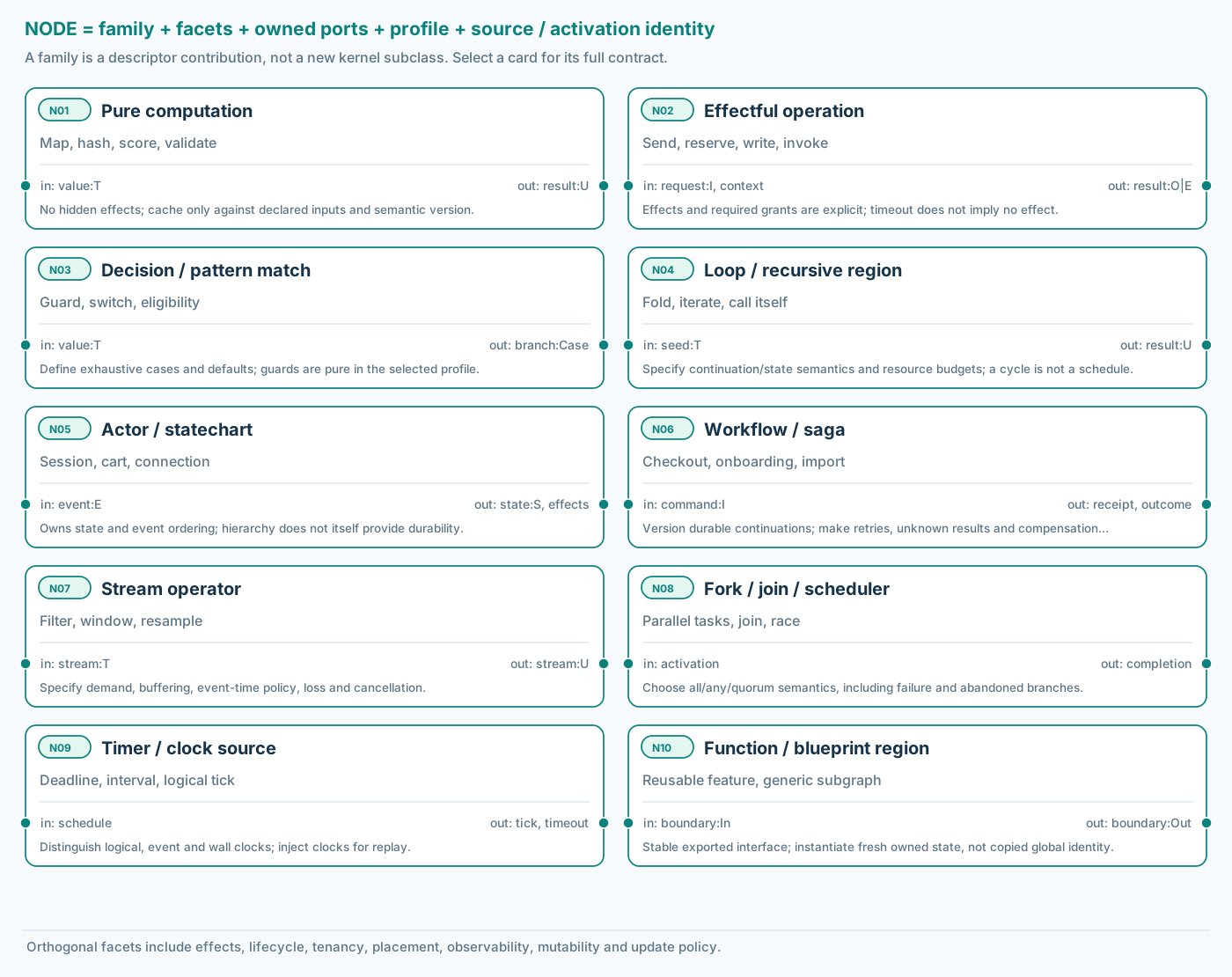
Reaktor design decision
Keep stable entity identity and owned ports in the kernel; register domain families through versioned descriptors. Use typed facets for orthogonal concerns instead of a class hierarchy explosion.
Boundary / caveat
These categories overlap. A native inference service can combine resource, operation and model facets; a property is not automatically a separate node.
Qualification test. Register a new domain family without changing the graph kernel, while unsupported required behavior still blocks activation.
N01 · Pure computation
Example / shape: Map, hash, score, validate
Contract: No hidden effects; cache only against declared inputs and semantic version.
proposed family; module-extensible
N02 · Effectful operation
Example / shape: Send, reserve, write, invoke
Contract: Effects and required grants are explicit; timeout does not imply no effect.
proposed family; module-extensible
N03 · Decision / pattern match
Example / shape: Guard, switch, eligibility
Contract: Define exhaustive cases and defaults; guards are pure in the selected profile.
proposed family; module-extensible
N04 · Loop / recursive region
Example / shape: Fold, iterate, call itself
Contract: Specify continuation/state semantics and resource budgets; a cycle is not a schedule.
proposed family; module-extensible
N05 · Actor / statechart
Example / shape: Session, cart, connection
Contract: Owns state and event ordering; hierarchy does not itself provide durability.
proposed family; module-extensible
N06 · Workflow / saga
Example / shape: Checkout, onboarding, import
Contract: Version durable continuations; make retries, unknown results and compensation explicit.
proposed family; module-extensible
N07 · Stream operator
Example / shape: Filter, window, resample
Contract: Specify demand, buffering, event-time policy, loss and cancellation.
proposed family; module-extensible
N08 · Fork / join / scheduler
Example / shape: Parallel tasks, join, race
Contract: Choose all/any/quorum semantics, including failure and abandoned branches.
proposed family; module-extensible
N09 · Timer / clock source
Example / shape: Deadline, interval, logical tick
Contract: Distinguish logical, event and wall clocks; inject clocks for replay.
proposed family; module-extensible
N10 · Function / blueprint region
Example / shape: Reusable feature, generic subgraph
Contract: Stable exported interface; instantiate fresh owned state, not copied global identity.
proposed family; module-extensible
Official context and precedents: Reaktor Visual Language / Blueprints Reaktor Living Graph
Diagram inspection notes
- N01 · Pure computation: No hidden effects; cache only against declared inputs and semantic version.
- N02 · Effectful operation: Effects and required grants are explicit; timeout does not imply no effect.
- N03 · Decision / pattern match: Define exhaustive cases and defaults; guards are pure in the selected profile.
- N04 · Loop / recursive region: Specify continuation/state semantics and resource budgets; a cycle is not a schedule.
- N05 · Actor / statechart: Owns state and event ordering; hierarchy does not itself provide durability.
- N06 · Workflow / saga: Version durable continuations; make retries, unknown results and compensation explicit.
- N07 · Stream operator: Specify demand, buffering, event-time policy, loss and cancellation.
- N08 · Fork / join / scheduler: Choose all/any/quorum semantics, including failure and abandoned branches.
- N09 · Timer / clock source: Distinguish logical, event and wall clocks; inject clocks for replay.
- N10 · Function / blueprint region: Stable exported interface; instantiate fresh owned state, not copied global identity.
Node families · experience
Ten representative module families: N11–N20. Full contracts are below the diagram.
Vector diagram · click a marked item to inspect
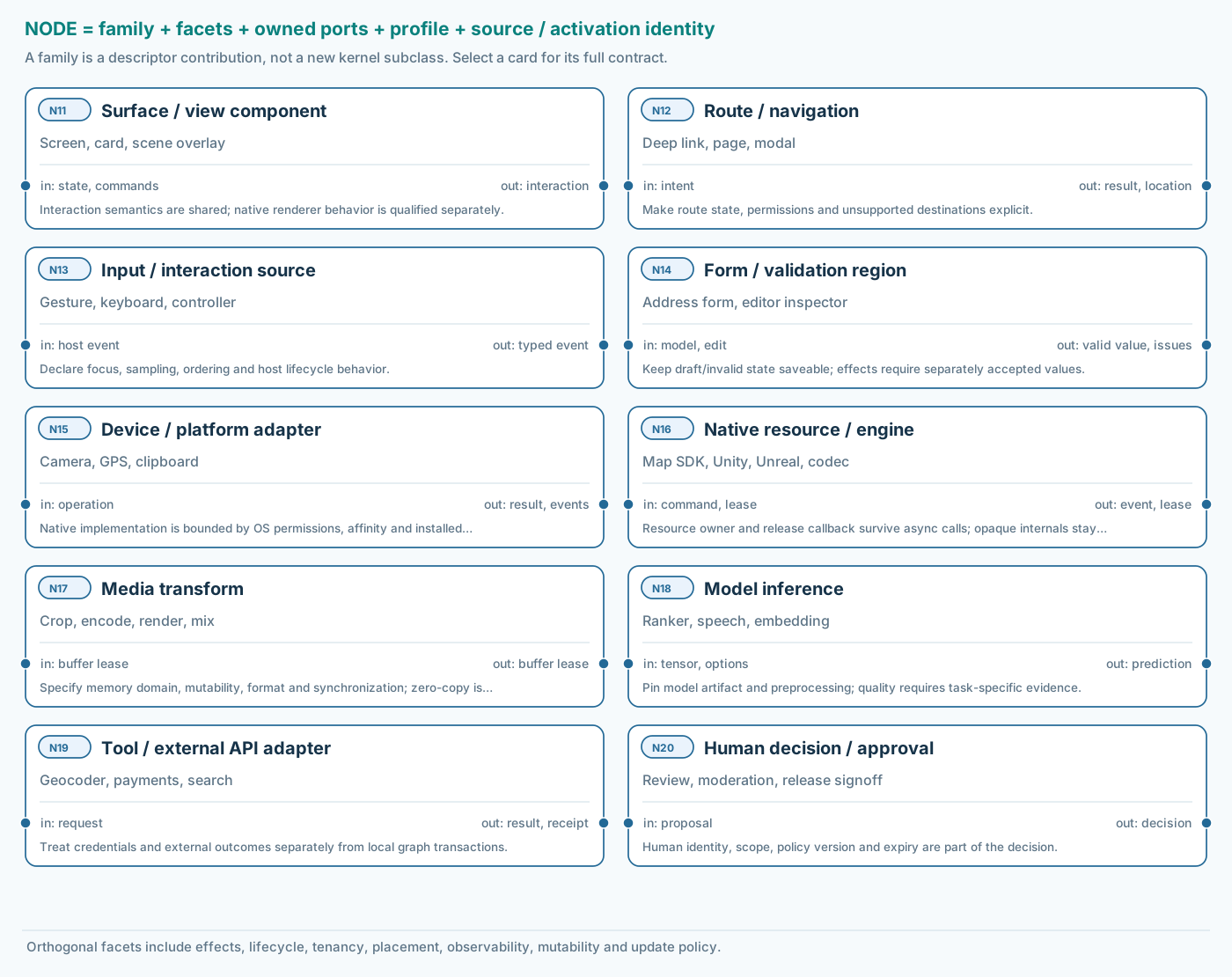
Reaktor design decision
Keep stable entity identity and owned ports in the kernel; register domain families through versioned descriptors. Use typed facets for orthogonal concerns instead of a class hierarchy explosion.
Boundary / caveat
These categories overlap. A native inference service can combine resource, operation and model facets; a property is not automatically a separate node.
Qualification test. Register a new domain family without changing the graph kernel, while unsupported required behavior still blocks activation.
N11 · Surface / view component
Example / shape: Screen, card, scene overlay
Contract: Interaction semantics are shared; native renderer behavior is qualified separately.
proposed family; module-extensible
N12 · Route / navigation
Example / shape: Deep link, page, modal
Contract: Make route state, permissions and unsupported destinations explicit.
proposed family; module-extensible
N13 · Input / interaction source
Example / shape: Gesture, keyboard, controller
Contract: Declare focus, sampling, ordering and host lifecycle behavior.
proposed family; module-extensible
N14 · Form / validation region
Example / shape: Address form, editor inspector
Contract: Keep draft/invalid state saveable; effects require separately accepted values.
proposed family; module-extensible
N15 · Device / platform adapter
Example / shape: Camera, GPS, clipboard
Contract: Native implementation is bounded by OS permissions, affinity and installed capabilities.
proposed family; module-extensible
N16 · Native resource / engine
Example / shape: Map SDK, Unity, Unreal, codec
Contract: Resource owner and release callback survive async calls; opaque internals stay declared.
proposed family; module-extensible
N17 · Media transform
Example / shape: Crop, encode, render, mix
Contract: Specify memory domain, mutability, format and synchronization; zero-copy is conditional.
proposed family; module-extensible
N18 · Model inference
Example / shape: Ranker, speech, embedding
Contract: Pin model artifact and preprocessing; quality requires task-specific evidence.
proposed family; module-extensible
N19 · Tool / external API adapter
Example / shape: Geocoder, payments, search
Contract: Treat credentials and external outcomes separately from local graph transactions.
proposed family; module-extensible
N20 · Human decision / approval
Example / shape: Review, moderation, release signoff
Contract: Human identity, scope, policy version and expiry are part of the decision.
proposed family; module-extensible
Official context and precedents: Reaktor Visual Language / Blueprints Reaktor Living Graph
Diagram inspection notes
- N11 · Surface / view component: Interaction semantics are shared; native renderer behavior is qualified separately.
- N12 · Route / navigation: Make route state, permissions and unsupported destinations explicit.
- N13 · Input / interaction source: Declare focus, sampling, ordering and host lifecycle behavior.
- N14 · Form / validation region: Keep draft/invalid state saveable; effects require separately accepted values.
- N15 · Device / platform adapter: Native implementation is bounded by OS permissions, affinity and installed capabilities.
- N16 · Native resource / engine: Resource owner and release callback survive async calls; opaque internals stay declared.
- N17 · Media transform: Specify memory domain, mutability, format and synchronization; zero-copy is conditional.
- N18 · Model inference: Pin model artifact and preprocessing; quality requires task-specific evidence.
- N19 · Tool / external API adapter: Treat credentials and external outcomes separately from local graph transactions.
- N20 · Human decision / approval: Human identity, scope, policy version and expiry are part of the decision.
Node families · resources
Ten representative module families: N21–N30. Full contracts are below the diagram.
Vector diagram · click a marked item to inspect
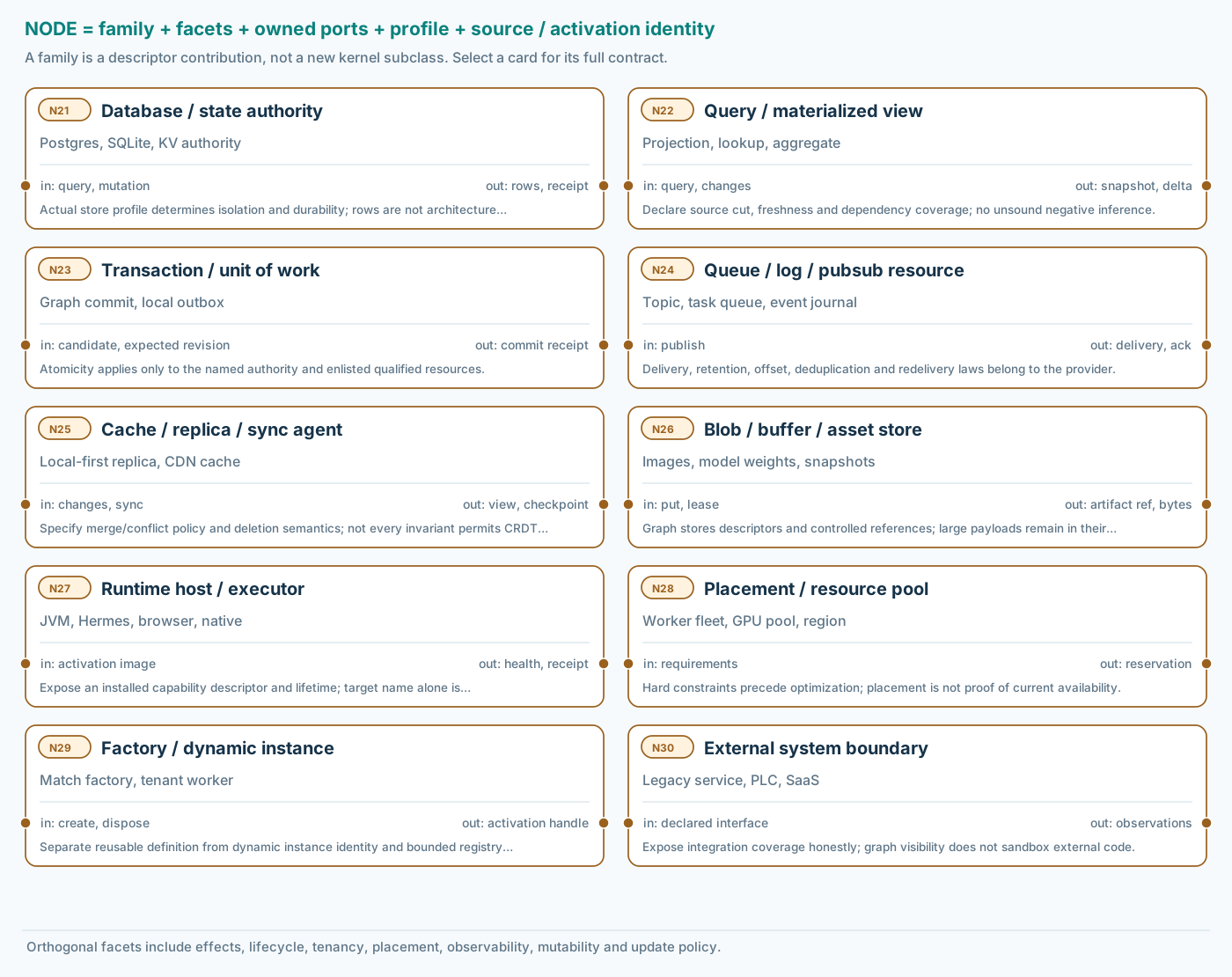
Reaktor design decision
Keep stable entity identity and owned ports in the kernel; register domain families through versioned descriptors. Use typed facets for orthogonal concerns instead of a class hierarchy explosion.
Boundary / caveat
These categories overlap. A native inference service can combine resource, operation and model facets; a property is not automatically a separate node.
Qualification test. Register a new domain family without changing the graph kernel, while unsupported required behavior still blocks activation.
N21 · Database / state authority
Example / shape: Postgres, SQLite, KV authority
Contract: Actual store profile determines isolation and durability; rows are not architecture nodes.
proposed family; module-extensible
N22 · Query / materialized view
Example / shape: Projection, lookup, aggregate
Contract: Declare source cut, freshness and dependency coverage; no unsound negative inference.
proposed family; module-extensible
N23 · Transaction / unit of work
Example / shape: Graph commit, local outbox
Contract: Atomicity applies only to the named authority and enlisted qualified resources.
proposed family; module-extensible
N24 · Queue / log / pubsub resource
Example / shape: Topic, task queue, event journal
Contract: Delivery, retention, offset, deduplication and redelivery laws belong to the provider.
proposed family; module-extensible
N25 · Cache / replica / sync agent
Example / shape: Local-first replica, CDN cache
Contract: Specify merge/conflict policy and deletion semantics; not every invariant permits CRDT merge.
proposed family; module-extensible
N26 · Blob / buffer / asset store
Example / shape: Images, model weights, snapshots
Contract: Graph stores descriptors and controlled references; large payloads remain in their owner.
proposed family; module-extensible
N27 · Runtime host / executor
Example / shape: JVM, Hermes, browser, native
Contract: Expose an installed capability descriptor and lifetime; target name alone is insufficient.
proposed family; module-extensible
N28 · Placement / resource pool
Example / shape: Worker fleet, GPU pool, region
Contract: Hard constraints precede optimization; placement is not proof of current availability.
proposed family; module-extensible
N29 · Factory / dynamic instance
Example / shape: Match factory, tenant worker
Contract: Separate reusable definition from dynamic instance identity and bounded registry visibility.
proposed family; module-extensible
N30 · External system boundary
Example / shape: Legacy service, PLC, SaaS
Contract: Expose integration coverage honestly; graph visibility does not sandbox external code.
proposed family; module-extensible
Official context and precedents: Reaktor Visual Language / Blueprints Reaktor Living Graph
Diagram inspection notes
- N21 · Database / state authority: Actual store profile determines isolation and durability; rows are not architecture nodes.
- N22 · Query / materialized view: Declare source cut, freshness and dependency coverage; no unsound negative inference.
- N23 · Transaction / unit of work: Atomicity applies only to the named authority and enlisted qualified resources.
- N24 · Queue / log / pubsub resource: Delivery, retention, offset, deduplication and redelivery laws belong to the provider.
- N25 · Cache / replica / sync agent: Specify merge/conflict policy and deletion semantics; not every invariant permits CRDT merge.
- N26 · Blob / buffer / asset store: Graph stores descriptors and controlled references; large payloads remain in their owner.
- N27 · Runtime host / executor: Expose an installed capability descriptor and lifetime; target name alone is insufficient.
- N28 · Placement / resource pool: Hard constraints precede optimization; placement is not proof of current availability.
- N29 · Factory / dynamic instance: Separate reusable definition from dynamic instance identity and bounded registry visibility.
- N30 · External system boundary: Expose integration coverage honestly; graph visibility does not sandbox external code.
Node families · governance
Ten representative module families: N31–N40. Full contracts are below the diagram.
Vector diagram · click a marked item to inspect
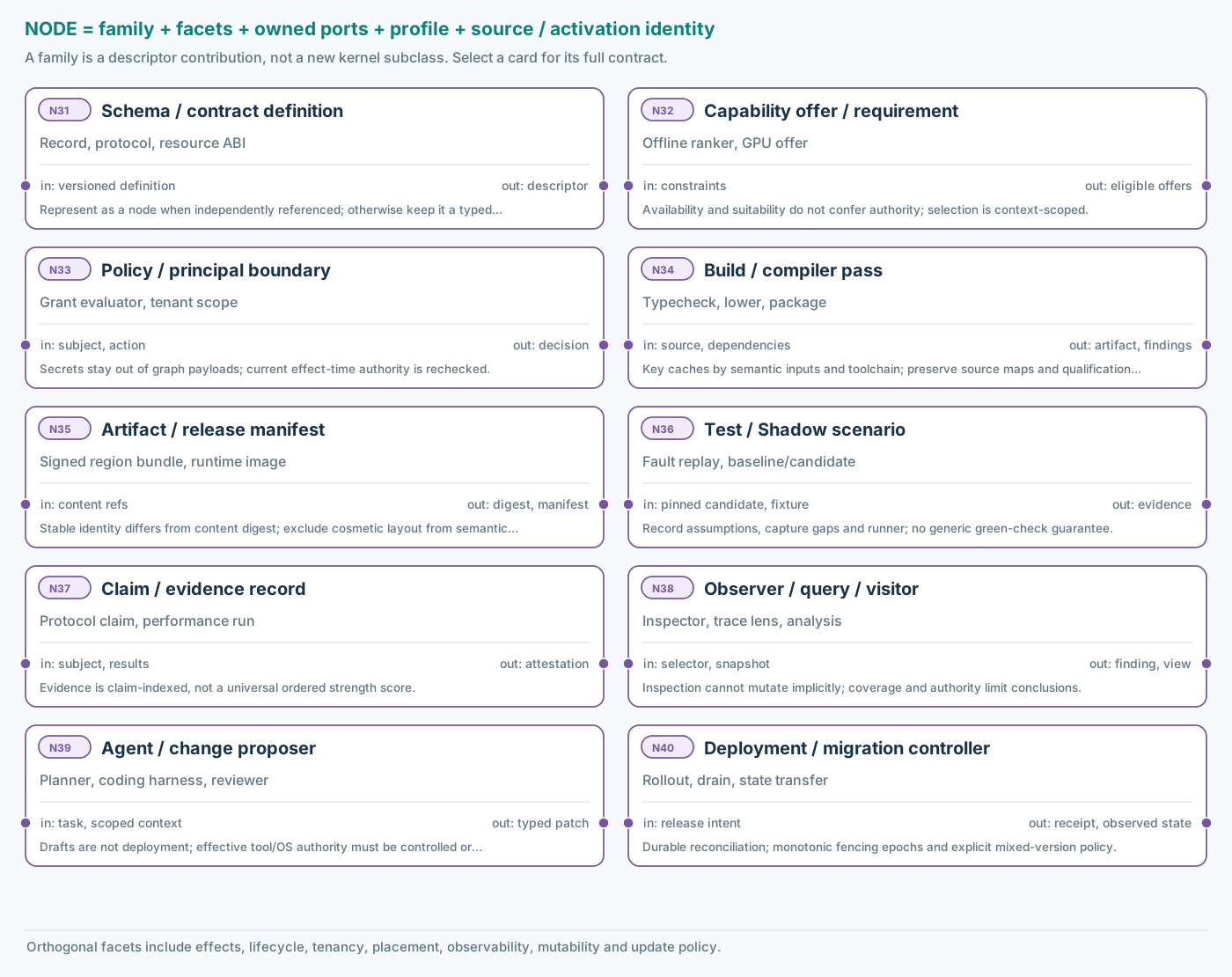
Reaktor design decision
Keep stable entity identity and owned ports in the kernel; register domain families through versioned descriptors. Use typed facets for orthogonal concerns instead of a class hierarchy explosion.
Boundary / caveat
These categories overlap. A native inference service can combine resource, operation and model facets; a property is not automatically a separate node.
Qualification test. Register a new domain family without changing the graph kernel, while unsupported required behavior still blocks activation.
N31 · Schema / contract definition
Example / shape: Record, protocol, resource ABI
Contract: Represent as a node when independently referenced; otherwise keep it a typed value/facet.
proposed family; module-extensible
N32 · Capability offer / requirement
Example / shape: Offline ranker, GPU offer
Contract: Availability and suitability do not confer authority; selection is context-scoped.
proposed family; module-extensible
N33 · Policy / principal boundary
Example / shape: Grant evaluator, tenant scope
Contract: Secrets stay out of graph payloads; current effect-time authority is rechecked.
proposed family; module-extensible
N34 · Build / compiler pass
Example / shape: Typecheck, lower, package
Contract: Key caches by semantic inputs and toolchain; preserve source maps and qualification profile.
proposed family; module-extensible
N35 · Artifact / release manifest
Example / shape: Signed region bundle, runtime image
Contract: Stable identity differs from content digest; exclude cosmetic layout from semantic identity.
proposed family; module-extensible
N36 · Test / Shadow scenario
Example / shape: Fault replay, baseline/candidate
Contract: Record assumptions, capture gaps and runner; no generic green-check guarantee.
proposed family; module-extensible
N37 · Claim / evidence record
Example / shape: Protocol claim, performance run
Contract: Evidence is claim-indexed, not a universal ordered strength score.
proposed family; module-extensible
N38 · Observer / query / visitor
Example / shape: Inspector, trace lens, analysis
Contract: Inspection cannot mutate implicitly; coverage and authority limit conclusions.
proposed family; module-extensible
N39 · Agent / change proposer
Example / shape: Planner, coding harness, reviewer
Contract: Drafts are not deployment; effective tool/OS authority must be controlled or disclosed.
proposed family; module-extensible
N40 · Deployment / migration controller
Example / shape: Rollout, drain, state transfer
Contract: Durable reconciliation; monotonic fencing epochs and explicit mixed-version policy.
proposed family; module-extensible
Official context and precedents: Reaktor Visual Language / Blueprints Reaktor Living Graph
Diagram inspection notes
- N31 · Schema / contract definition: Represent as a node when independently referenced; otherwise keep it a typed value/facet.
- N32 · Capability offer / requirement: Availability and suitability do not confer authority; selection is context-scoped.
- N33 · Policy / principal boundary: Secrets stay out of graph payloads; current effect-time authority is rechecked.
- N34 · Build / compiler pass: Key caches by semantic inputs and toolchain; preserve source maps and qualification profile.
- N35 · Artifact / release manifest: Stable identity differs from content digest; exclude cosmetic layout from semantic identity.
- N36 · Test / Shadow scenario: Record assumptions, capture gaps and runner; no generic green-check guarantee.
- N37 · Claim / evidence record: Evidence is claim-indexed, not a universal ordered strength score.
- N38 · Observer / query / visitor: Inspection cannot mutate implicitly; coverage and authority limit conclusions.
- N39 · Agent / change proposer: Drafts are not deployment; effective tool/OS authority must be controlled or disclosed.
- N40 · Deployment / migration controller: Durable reconciliation; monotonic fencing epochs and explicit mixed-version policy.
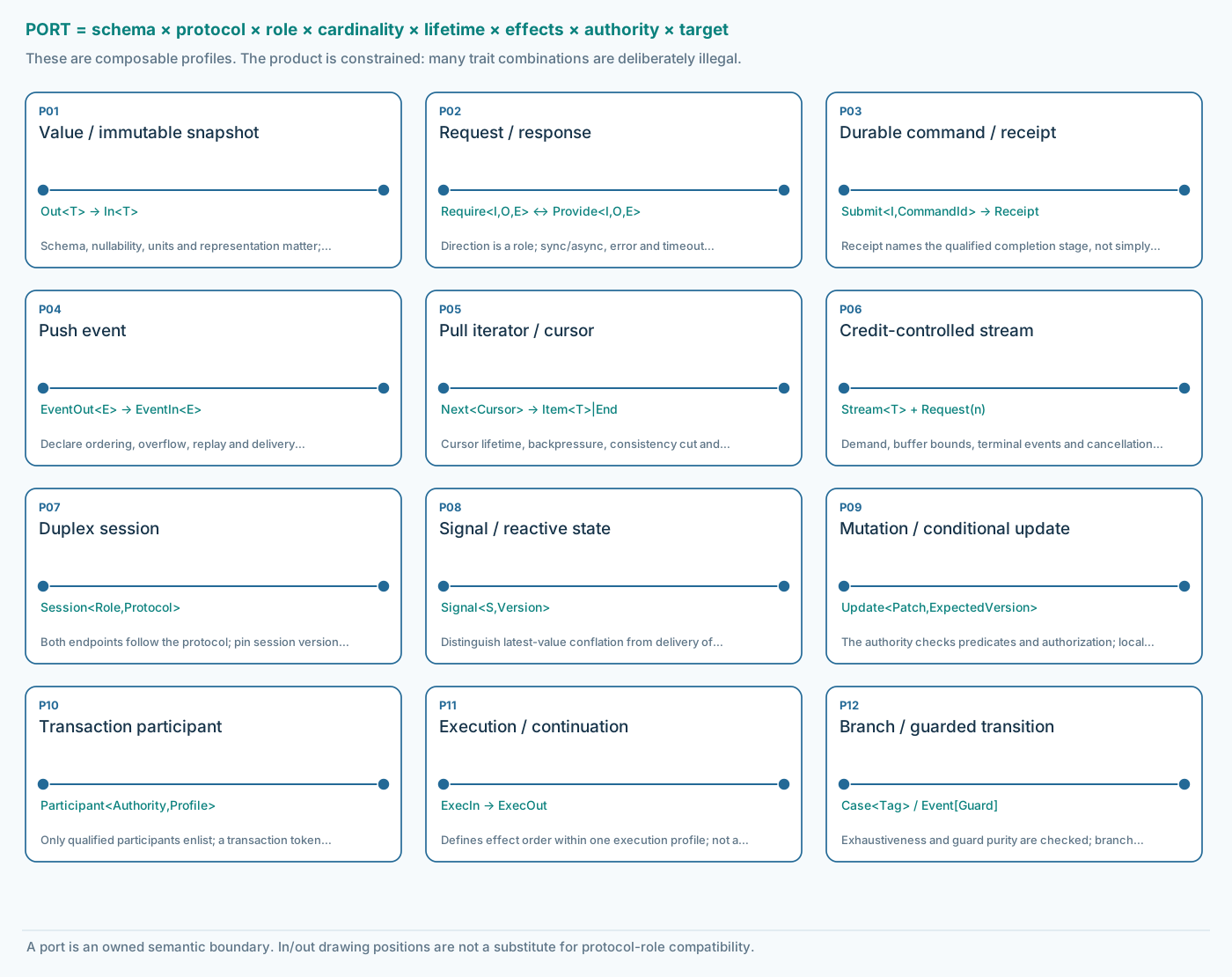
Port profiles · values & interaction
Payload typing is necessary but insufficient: the interaction, ownership and outcome contracts travel with it.
Vector diagram · click a marked item to inspect
Reaktor design decision
Generate codecs, façades, palette constraints and runtime validation from one port descriptor. Keep required capabilities distinct from authorization grants.
Boundary / caveat
Schema-compatible values can still violate lifetime, delivery, affinity, timing or authority. Do not flatten all ports to function signatures or untyped event messages.
Qualification test. Reject a borrowed native buffer sent beyond its lease or address space; offer a qualified copy/transfer adapter rather than silently accepting it.
P01 · Value / immutable snapshot
Example / shape: Out
Contract: Schema, nullability, units and representation matter; value flow alone imposes no effect order.
proposed profile; composable traits
P02 · Request / response
Example / shape: Require<I,O,E> ↔ Provide<I,O,E>
Contract: Direction is a role; sync/async, error and timeout outcomes are part of compatibility.
proposed profile; composable traits
P03 · Durable command / receipt
Example / shape: Submit<I,CommandId> → Receipt
Contract: Receipt names the qualified completion stage, not simply receipt of bytes.
proposed profile; composable traits
P04 · Push event
Example / shape: EventOut
Contract: Declare ordering, overflow, replay and delivery guarantee; not implicitly durable.
proposed profile; composable traits
P05 · Pull iterator / cursor
Example / shape: Next
Contract: Cursor lifetime, backpressure, consistency cut and resume behavior are explicit.
proposed profile; composable traits
P06 · Credit-controlled stream
Example / shape: Stream
Contract: Demand, buffer bounds, terminal events and cancellation must agree across the boundary.
proposed profile; composable traits
P07 · Duplex session
Example / shape: Session<Role,Protocol>
Contract: Both endpoints follow the protocol; pin session version and handoff semantics.
proposed profile; composable traits
P08 · Signal / reactive state
Example / shape: Signal<S,Version>
Contract: Distinguish latest-value conflation from delivery of every historical change.
proposed profile; composable traits
P09 · Mutation / conditional update
Example / shape: Update<Patch,ExpectedVersion>
Contract: The authority checks predicates and authorization; local write locks are not distributed CAS.
proposed profile; composable traits
P10 · Transaction participant
Example / shape: Participant<Authority,Profile>
Contract: Only qualified participants enlist; a transaction token is not universal ACID.
proposed profile; composable traits
P11 · Execution / continuation
Example / shape: ExecIn → ExecOut
Contract: Defines effect order within one execution profile; not a generic network message.
proposed profile; composable traits
P12 · Branch / guarded transition
Example / shape: Case
Contract: Exhaustiveness and guard purity are checked; branch choice is separate from data encoding.
proposed profile; composable traits
Official context and precedents: Reaktor FFI / Switchboard XState actor semantics Expo runtime versions and updates
Diagram inspection notes
- P01 · Value / immutable snapshot: Schema, nullability, units and representation matter; value flow alone imposes no effect order.
- P02 · Request / response: Direction is a role; sync/async, error and timeout outcomes are part of compatibility.
- P03 · Durable command / receipt: Receipt names the qualified completion stage, not simply receipt of bytes.
- P04 · Push event: Declare ordering, overflow, replay and delivery guarantee; not implicitly durable.
- P05 · Pull iterator / cursor: Cursor lifetime, backpressure, consistency cut and resume behavior are explicit.
- P06 · Credit-controlled stream: Demand, buffer bounds, terminal events and cancellation must agree across the boundary.
- P07 · Duplex session: Both endpoints follow the protocol; pin session version and handoff semantics.
- P08 · Signal / reactive state: Distinguish latest-value conflation from delivery of every historical change.
- P09 · Mutation / conditional update: The authority checks predicates and authorization; local write locks are not distributed CAS.
- P10 · Transaction participant: Only qualified participants enlist; a transaction token is not universal ACID.
- P11 · Execution / continuation: Defines effect order within one execution profile; not a generic network message.
- P12 · Branch / guarded transition: Exhaustiveness and guard purity are checked; branch choice is separate from data encoding.
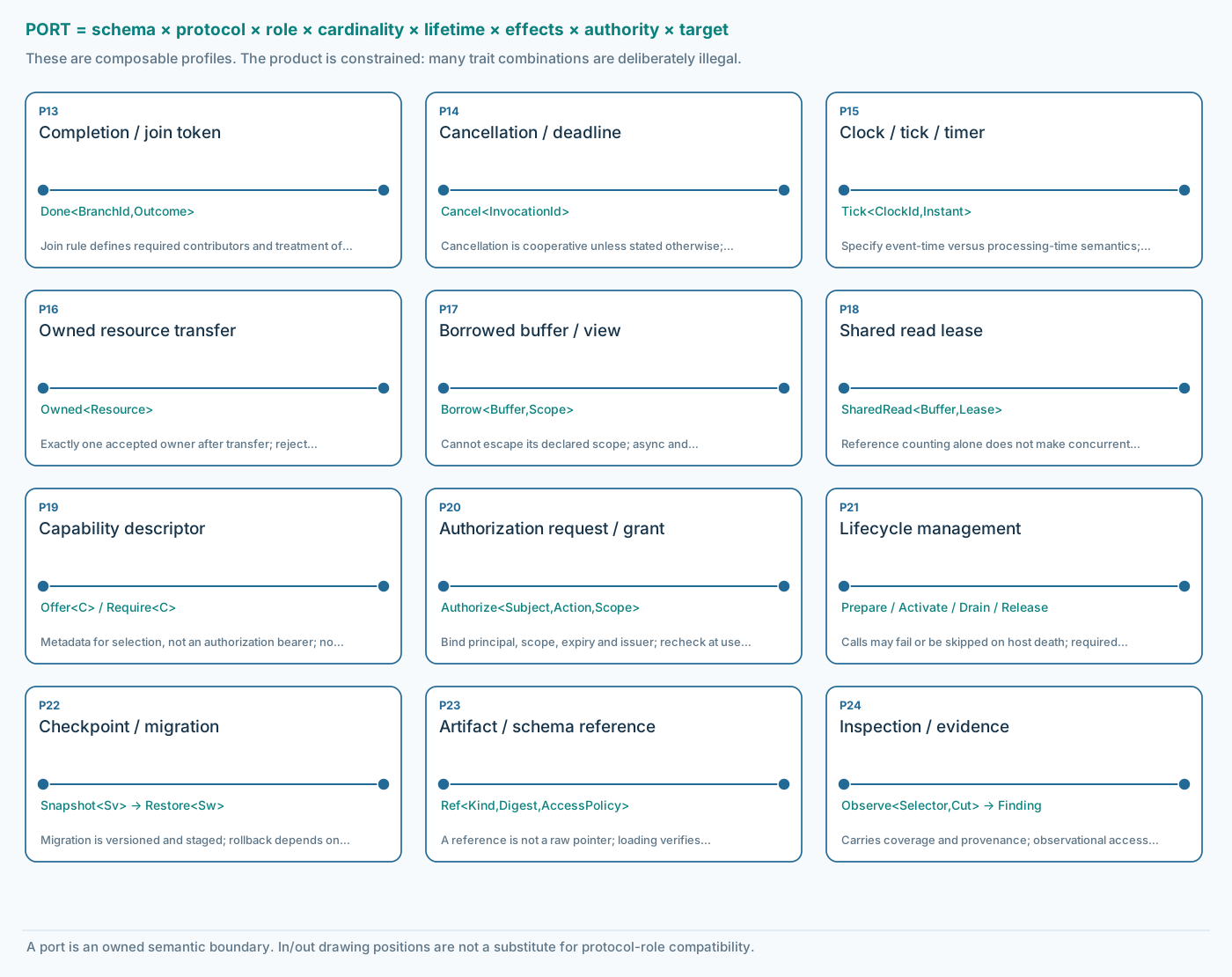
Port profiles · lifetime & control
Payload typing is necessary but insufficient: the interaction, ownership and outcome contracts travel with it.
Vector diagram · click a marked item to inspect
Reaktor design decision
Generate codecs, façades, palette constraints and runtime validation from one port descriptor. Keep required capabilities distinct from authorization grants.
Boundary / caveat
Schema-compatible values can still violate lifetime, delivery, affinity, timing or authority. Do not flatten all ports to function signatures or untyped event messages.
Qualification test. Reject a borrowed native buffer sent beyond its lease or address space; offer a qualified copy/transfer adapter rather than silently accepting it.
P13 · Completion / join token
Example / shape: Done<BranchId,Outcome>
Contract: Join rule defines required contributors and treatment of failure/cancellation.
proposed profile; composable traits
P14 · Cancellation / deadline
Example / shape: Cancel
Contract: Cancellation is cooperative unless stated otherwise; reconcile already-committed effects.
proposed profile; composable traits
P15 · Clock / tick / timer
Example / shape: Tick<ClockId,Instant>
Contract: Specify event-time versus processing-time semantics; clocks are dependencies for replay.
proposed profile; composable traits
P16 · Owned resource transfer
Example / shape: Owned
Contract: Exactly one accepted owner after transfer; reject duplication and invalid module epoch.
proposed profile; composable traits
P17 · Borrowed buffer / view
Example / shape: Borrow<Buffer,Scope>
Contract: Cannot escape its declared scope; async and cross-address-space use require a qualified lease/copy.
proposed profile; composable traits
P18 · Shared read lease
Example / shape: SharedRead<Buffer,Lease>
Contract: Reference counting alone does not make concurrent mutation safe; memory rules stay explicit.
proposed profile; composable traits
P19 · Capability descriptor
Example / shape: Offer
Contract: Metadata for selection, not an authorization bearer; no implied access to the capability.
proposed profile; composable traits
P20 · Authorization request / grant
Example / shape: Authorize<Subject,Action,Scope>
Contract: Bind principal, scope, expiry and issuer; recheck at use and never serialize raw credentials.
proposed profile; composable traits
P21 · Lifecycle management
Example / shape: Prepare / Activate / Drain / Release
Contract: Calls may fail or be skipped on host death; required persistence cannot rely on cleanup.
proposed profile; composable traits
P22 · Checkpoint / migration
Example / shape: Snapshot
Contract: Migration is versioned and staged; rollback depends on state compatibility, not old code availability.
proposed profile; composable traits
P23 · Artifact / schema reference
Example / shape: Ref<Kind,Digest,AccessPolicy>
Contract: A reference is not a raw pointer; loading verifies integrity, provenance and access.
proposed profile; composable traits
P24 · Inspection / evidence
Example / shape: Observe<Selector,Cut> → Finding
Contract: Carries coverage and provenance; observational access does not confer mutation authority.
proposed profile; composable traits
Official context and precedents: Reaktor FFI / Switchboard XState actor semantics Expo runtime versions and updates
Diagram inspection notes
- P13 · Completion / join token: Join rule defines required contributors and treatment of failure/cancellation.
- P14 · Cancellation / deadline: Cancellation is cooperative unless stated otherwise; reconcile already-committed effects.
- P15 · Clock / tick / timer: Specify event-time versus processing-time semantics; clocks are dependencies for replay.
- P16 · Owned resource transfer: Exactly one accepted owner after transfer; reject duplication and invalid module epoch.
- P17 · Borrowed buffer / view: Cannot escape its declared scope; async and cross-address-space use require a qualified lease/copy.
- P18 · Shared read lease: Reference counting alone does not make concurrent mutation safe; memory rules stay explicit.
- P19 · Capability descriptor: Metadata for selection, not an authorization bearer; no implied access to the capability.
- P20 · Authorization request / grant: Bind principal, scope, expiry and issuer; recheck at use and never serialize raw credentials.
- P21 · Lifecycle management: Calls may fail or be skipped on host death; required persistence cannot rely on cleanup.
- P22 · Checkpoint / migration: Migration is versioned and staged; rollback depends on state compatibility, not old code availability.
- P23 · Artifact / schema reference: A reference is not a raw pointer; loading verifies integrity, provenance and access.
- P24 · Inspection / evidence: Carries coverage and provenance; observational access does not confer mutation authority.
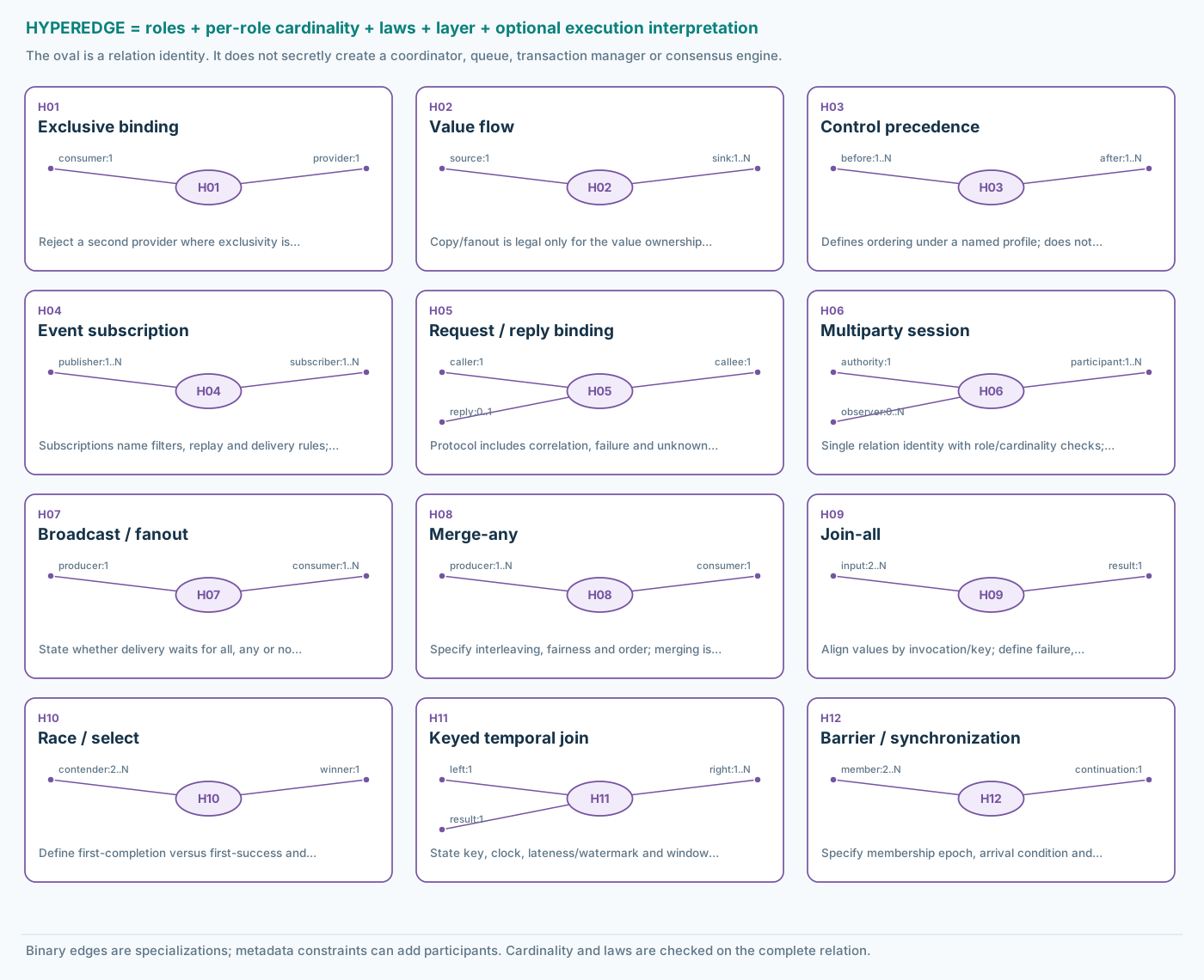
Hyperedge patterns · flow & coordination
Role-labelled relations retain the identity and meaning of n-ary interactions.
Vector diagram · click a marked item to inspect
Reaktor design decision
Store each relationship once with typed incidences. Keep pure structural, constraint, evidence and executable layers distinguishable in queries and views.
Boundary / caveat
A hyperedge records a contract and relation. Atomicity, quorum agreement, stream alignment or access enforcement must come from an actual qualified implementation.
Qualification test. Inspect an n-party relationship without replacing it with an arbitrary clique of unrelated binary links; reject invalid role cardinalities.
H01 · Exclusive binding
Example / shape: consumer:1 • provider:1
Contract: Reject a second provider where exclusivity is required; dispatch can compile to a direct call.
proposed relation schema; not an execution primitive by default
H02 · Value flow
Example / shape: source:1 • sink:1..N
Contract: Copy/fanout is legal only for the value ownership profile; units and schemas must match.
proposed relation schema; not an execution primitive by default
H03 · Control precedence
Example / shape: before:1..N • after:1..N
Contract: Defines ordering under a named profile; does not serialize unrelated graph layers.
proposed relation schema; not an execution primitive by default
H04 · Event subscription
Example / shape: publisher:1..N • subscriber:1..N
Contract: Subscriptions name filters, replay and delivery rules; broker resources remain separate nodes.
proposed relation schema; not an execution primitive by default
H05 · Request / reply binding
Example / shape: caller:1 • callee:1 • reply:0..1
Contract: Protocol includes correlation, failure and unknown outcomes; transport is chosen independently.
proposed relation schema; not an execution primitive by default
H06 · Multiparty session
Example / shape: authority:1 • participant:1..N • observer:0..N
Contract: Single relation identity with role/cardinality checks; delivery comes from an explicit protocol.
proposed relation schema; not an execution primitive by default
H07 · Broadcast / fanout
Example / shape: producer:1 • consumer:1..N
Contract: State whether delivery waits for all, any or no receivers; slow receivers need a policy.
proposed relation schema; not an execution primitive by default
H08 · Merge-any
Example / shape: producer:1..N • consumer:1
Contract: Specify interleaving, fairness and order; merging is not a join of corresponding values.
proposed relation schema; not an execution primitive by default
H09 · Join-all
Example / shape: input:2..N • result:1
Contract: Align values by invocation/key; define failure, timeout and missing-input treatment.
proposed relation schema; not an execution primitive by default
H10 · Race / select
Example / shape: contender:2..N • winner:1
Contract: Define first-completion versus first-success and cleanup/reconciliation of losing effects.
proposed relation schema; not an execution primitive by default
H11 · Keyed temporal join
Example / shape: left:1 • right:1..N • result:1
Contract: State key, clock, lateness/watermark and window policy; topology alone cannot pair records.
proposed relation schema; not an execution primitive by default
H12 · Barrier / synchronization
Example / shape: member:2..N • continuation:1
Contract: Specify membership epoch, arrival condition and failure handling; no hidden global clock.
proposed relation schema; not an execution primitive by default
Official context and precedents: Reaktor Living Graph Reaktor Visual Language / Blueprints
Diagram inspection notes
- H01 · Exclusive binding | consumer:1, provider:1 | Reject a second provider where exclusivity is required; dispatch can compile to a direct call.
- H02 · Value flow | source:1, sink:1..N | Copy/fanout is legal only for the value ownership profile; units and schemas must match.
- H03 · Control precedence | before:1..N, after:1..N | Defines ordering under a named profile; does not serialize unrelated graph layers.
- H04 · Event subscription | publisher:1..N, subscriber:1..N | Subscriptions name filters, replay and delivery rules; broker resources remain separate nodes.
- H05 · Request / reply binding | caller:1, callee:1, reply:0..1 | Protocol includes correlation, failure and unknown outcomes; transport is chosen independently.
- H06 · Multiparty session | authority:1, participant:1..N, observer:0..N | Single relation identity with role/cardinality checks; delivery comes from an explicit protocol.
- H07 · Broadcast / fanout | producer:1, consumer:1..N | State whether delivery waits for all, any or no receivers; slow receivers need a policy.
- H08 · Merge-any | producer:1..N, consumer:1 | Specify interleaving, fairness and order; merging is not a join of corresponding values.
- H09 · Join-all | input:2..N, result:1 | Align values by invocation/key; define failure, timeout and missing-input treatment.
- H10 · Race / select | contender:2..N, winner:1 | Define first-completion versus first-success and cleanup/reconciliation of losing effects.
- H11 · Keyed temporal join | left:1, right:1..N, result:1 | State key, clock, lateness/watermark and window policy; topology alone cannot pair records.
- H12 · Barrier / synchronization | member:2..N, continuation:1 | Specify membership epoch, arrival condition and failure handling; no hidden global clock.
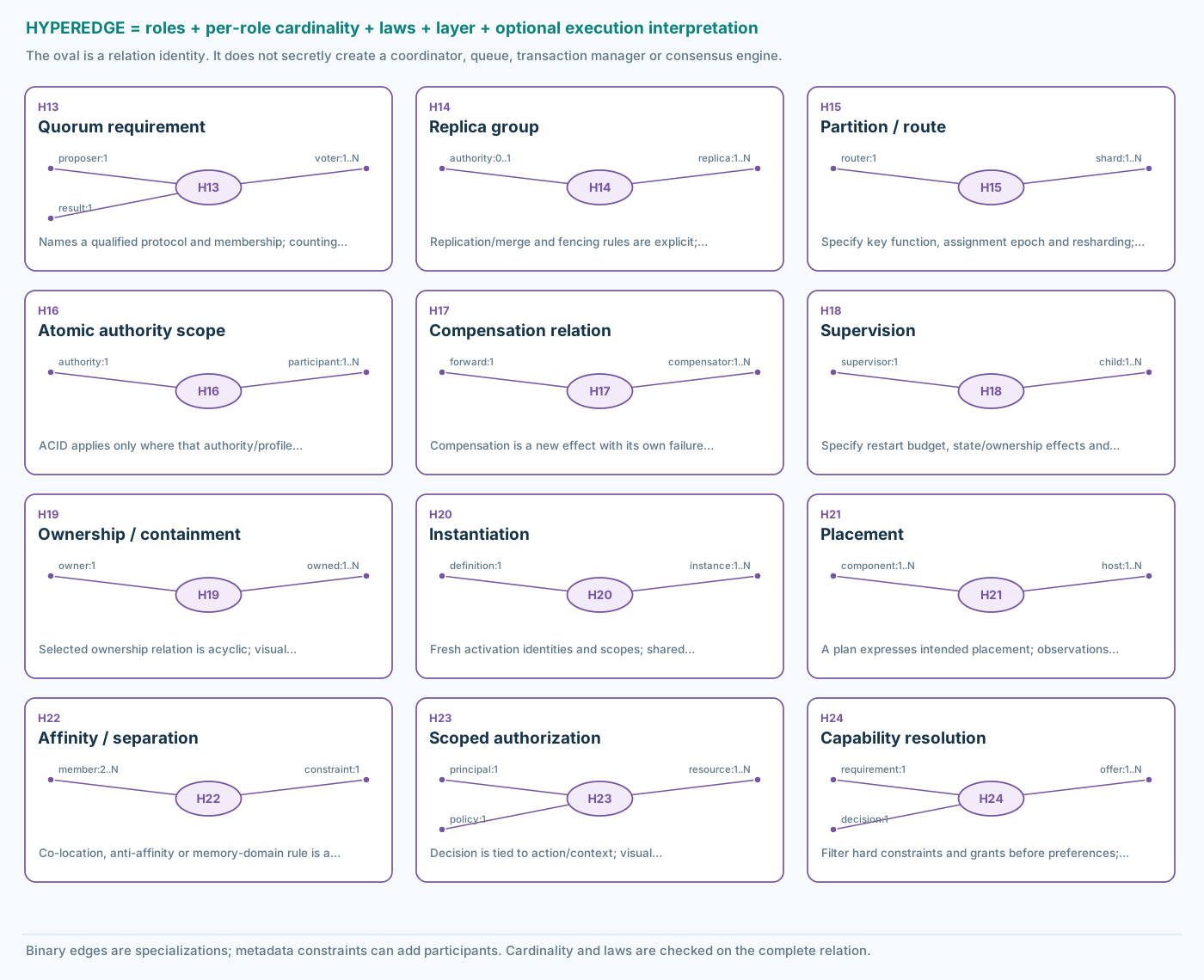
Hyperedge patterns · state & structure
Role-labelled relations retain the identity and meaning of n-ary interactions.
Vector diagram · click a marked item to inspect
Reaktor design decision
Store each relationship once with typed incidences. Keep pure structural, constraint, evidence and executable layers distinguishable in queries and views.
Boundary / caveat
A hyperedge records a contract and relation. Atomicity, quorum agreement, stream alignment or access enforcement must come from an actual qualified implementation.
Qualification test. Inspect an n-party relationship without replacing it with an arbitrary clique of unrelated binary links; reject invalid role cardinalities.
H13 · Quorum requirement
Example / shape: proposer:1 • voter:1..N • result:1
Contract: Names a qualified protocol and membership; counting votes alone does not implement consensus.
proposed relation schema; not an execution primitive by default
H14 · Replica group
Example / shape: authority:0..1 • replica:1..N
Contract: Replication/merge and fencing rules are explicit; schema does not create consistency.
proposed relation schema; not an execution primitive by default
H15 · Partition / route
Example / shape: router:1 • shard:1..N
Contract: Specify key function, assignment epoch and resharding; preserve owner and replay semantics.
proposed relation schema; not an execution primitive by default
H16 · Atomic authority scope
Example / shape: authority:1 • participant:1..N
Contract: ACID applies only where that authority/profile implements it; not across arbitrary stores.
proposed relation schema; not an execution primitive by default
H17 · Compensation relation
Example / shape: forward:1 • compensator:1..N
Contract: Compensation is a new effect with its own failure modes, not automatic historical erasure.
proposed relation schema; not an execution primitive by default
H18 · Supervision
Example / shape: supervisor:1 • child:1..N
Contract: Specify restart budget, state/ownership effects and host-death behavior.
proposed relation schema; not an execution primitive by default
H19 · Ownership / containment
Example / shape: owner:1 • owned:1..N
Contract: Selected ownership relation is acyclic; visual grouping is not ownership.
proposed relation schema; not an execution primitive by default
H20 · Instantiation
Example / shape: definition:1 • instance:1..N
Contract: Fresh activation identities and scopes; shared definitions are not shared mutable instance state.
proposed relation schema; not an execution primitive by default
H21 · Placement
Example / shape: component:1..N • host:1..N
Contract: A plan expresses intended placement; observations separately establish what actually runs.
proposed relation schema; not an execution primitive by default
H22 · Affinity / separation
Example / shape: member:2..N • constraint:1
Contract: Co-location, anti-affinity or memory-domain rule is a constraint, not an executable wire.
proposed relation schema; not an execution primitive by default
H23 · Scoped authorization
Example / shape: principal:1 • resource:1..N • policy:1
Contract: Decision is tied to action/context; visual reachability neither proves nor grants access.
proposed relation schema; not an execution primitive by default
H24 · Capability resolution
Example / shape: requirement:1 • offer:1..N • decision:1
Contract: Filter hard constraints and grants before preferences; pin or safely migrate running sessions.
proposed relation schema; not an execution primitive by default
Official context and precedents: Reaktor Living Graph Reaktor Visual Language / Blueprints
Diagram inspection notes
- H13 · Quorum requirement | proposer:1, voter:1..N, result:1 | Names a qualified protocol and membership; counting votes alone does not implement consensus.
- H14 · Replica group | authority:0..1, replica:1..N | Replication/merge and fencing rules are explicit; schema does not create consistency.
- H15 · Partition / route | router:1, shard:1..N | Specify key function, assignment epoch and resharding; preserve owner and replay semantics.
- H16 · Atomic authority scope | authority:1, participant:1..N | ACID applies only where that authority/profile implements it; not across arbitrary stores.
- H17 · Compensation relation | forward:1, compensator:1..N | Compensation is a new effect with its own failure modes, not automatic historical erasure.
- H18 · Supervision | supervisor:1, child:1..N | Specify restart budget, state/ownership effects and host-death behavior.
- H19 · Ownership / containment | owner:1, owned:1..N | Selected ownership relation is acyclic; visual grouping is not ownership.
- H20 · Instantiation | definition:1, instance:1..N | Fresh activation identities and scopes; shared definitions are not shared mutable instance state.
- H21 · Placement | component:1..N, host:1..N | A plan expresses intended placement; observations separately establish what actually runs.
- H22 · Affinity / separation | member:2..N, constraint:1 | Co-location, anti-affinity or memory-domain rule is a constraint, not an executable wire.
- H23 · Scoped authorization | principal:1, resource:1..N, policy:1 | Decision is tied to action/context; visual reachability neither proves nor grants access.
- H24 · Capability resolution | requirement:1, offer:1..N, decision:1 | Filter hard constraints and grants before preferences; pin or safely migrate running sessions.
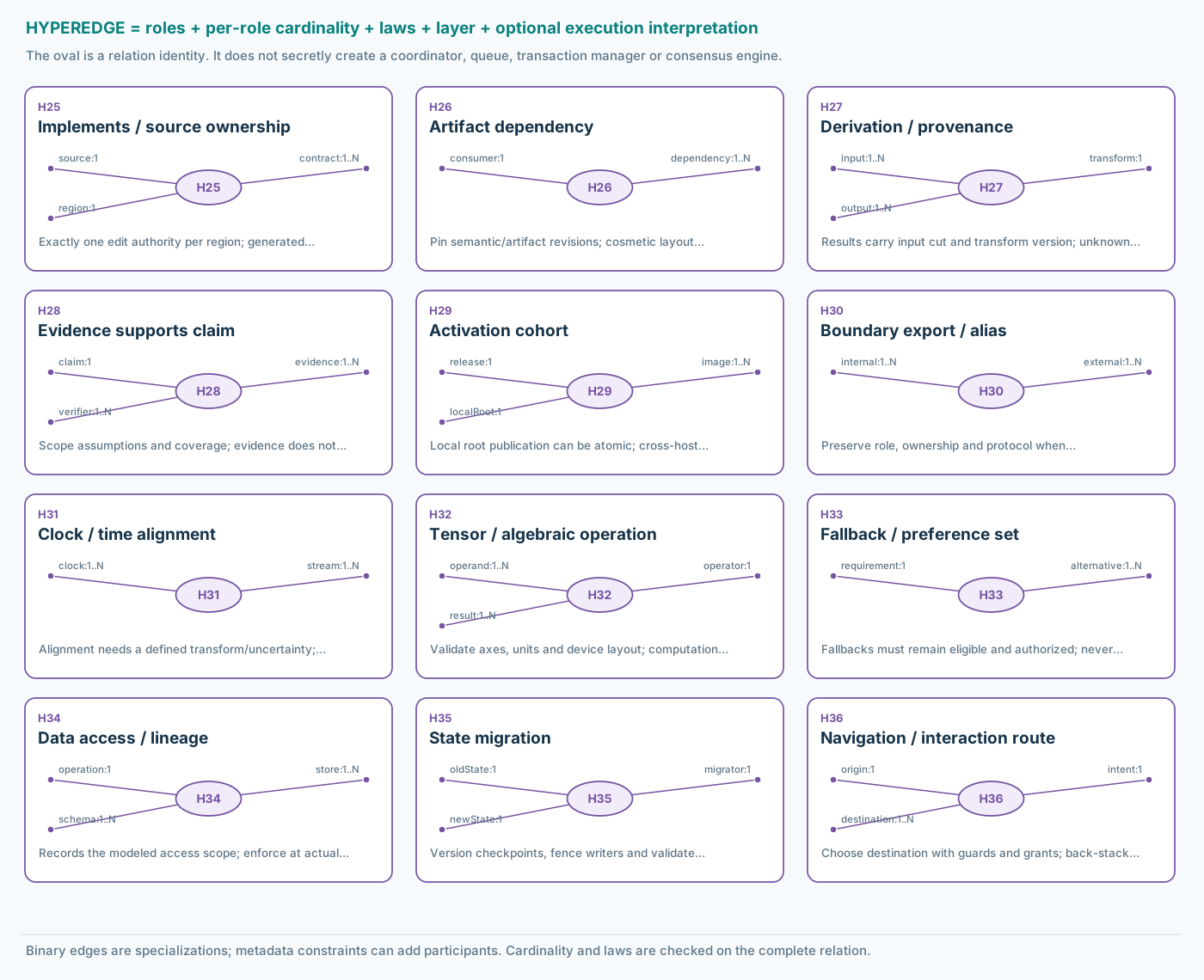
Hyperedge patterns · meaning & change
Role-labelled relations retain the identity and meaning of n-ary interactions.
Vector diagram · click a marked item to inspect
Reaktor design decision
Store each relationship once with typed incidences. Keep pure structural, constraint, evidence and executable layers distinguishable in queries and views.
Boundary / caveat
A hyperedge records a contract and relation. Atomicity, quorum agreement, stream alignment or access enforcement must come from an actual qualified implementation.
Qualification test. Inspect an n-party relationship without replacing it with an arbitrary clique of unrelated binary links; reject invalid role cardinalities.
H25 · Implements / source ownership
Example / shape: source:1 • contract:1..N • region:1
Contract: Exactly one edit authority per region; generated projections are not independently editable truth.
proposed relation schema; not an execution primitive by default
H26 · Artifact dependency
Example / shape: consumer:1 • dependency:1..N
Contract: Pin semantic/artifact revisions; cosmetic layout changes need not invalidate code.
proposed relation schema; not an execution primitive by default
H27 · Derivation / provenance
Example / shape: input:1..N • transform:1 • output:1..N
Contract: Results carry input cut and transform version; unknown dependencies widen invalidation.
proposed relation schema; not an execution primitive by default
H28 · Evidence supports claim
Example / shape: claim:1 • evidence:1..N • verifier:1..N
Contract: Scope assumptions and coverage; evidence does not promote or authorize itself.
proposed relation schema; not an execution primitive by default
H29 · Activation cohort
Example / shape: release:1 • image:1..N • localRoot:1
Contract: Local root publication can be atomic; cross-host realization is recoverable coordination.
proposed relation schema; not an execution primitive by default
H30 · Boundary export / alias
Example / shape: internal:1..N • external:1..N
Contract: Preserve role, ownership and protocol when hiding/expanding a reusable region.
proposed relation schema; not an execution primitive by default
H31 · Clock / time alignment
Example / shape: clock:1..N • stream:1..N
Contract: Alignment needs a defined transform/uncertainty; timestamps do not establish causal order.
proposed relation schema; not an execution primitive by default
H32 · Tensor / algebraic operation
Example / shape: operand:1..N • operator:1 • result:1..N
Contract: Validate axes, units and device layout; computation belongs to the qualified implementation.
proposed relation schema; not an execution primitive by default
H33 · Fallback / preference set
Example / shape: requirement:1 • alternative:1..N
Contract: Fallbacks must remain eligible and authorized; never silently relax mandatory privacy or safety.
proposed relation schema; not an execution primitive by default
H34 · Data access / lineage
Example / shape: operation:1 • store:1..N • schema:1..N
Contract: Records the modeled access scope; enforce at actual storage boundary and disclose opaque access.
proposed relation schema; not an execution primitive by default
H35 · State migration
Example / shape: oldState:1 • migrator:1 • newState:1
Contract: Version checkpoints, fence writers and validate postconditions; inverse may not exist.
proposed relation schema; not an execution primitive by default
H36 · Navigation / interaction route
Example / shape: origin:1 • intent:1 • destination:1..N
Contract: Choose destination with guards and grants; back-stack and cancellation semantics are explicit.
proposed relation schema; not an execution primitive by default
Official context and precedents: Reaktor Living Graph Reaktor Visual Language / Blueprints
Diagram inspection notes
- H25 · Implements / source ownership | source:1, contract:1..N, region:1 | Exactly one edit authority per region; generated projections are not independently editable truth.
- H26 · Artifact dependency | consumer:1, dependency:1..N | Pin semantic/artifact revisions; cosmetic layout changes need not invalidate code.
- H27 · Derivation / provenance | input:1..N, transform:1, output:1..N | Results carry input cut and transform version; unknown dependencies widen invalidation.
- H28 · Evidence supports claim | claim:1, evidence:1..N, verifier:1..N | Scope assumptions and coverage; evidence does not promote or authorize itself.
- H29 · Activation cohort | release:1, image:1..N, localRoot:1 | Local root publication can be atomic; cross-host realization is recoverable coordination.
- H30 · Boundary export / alias | internal:1..N, external:1..N | Preserve role, ownership and protocol when hiding/expanding a reusable region.
- H31 · Clock / time alignment | clock:1..N, stream:1..N | Alignment needs a defined transform/uncertainty; timestamps do not establish causal order.
- H32 · Tensor / algebraic operation | operand:1..N, operator:1, result:1..N | Validate axes, units and device layout; computation belongs to the qualified implementation.
- H33 · Fallback / preference set | requirement:1, alternative:1..N | Fallbacks must remain eligible and authorized; never silently relax mandatory privacy or safety.
- H34 · Data access / lineage | operation:1, store:1..N, schema:1..N | Records the modeled access scope; enforce at actual storage boundary and disclose opaque access.
- H35 · State migration | oldState:1, migrator:1, newState:1 | Version checkpoints, fence writers and validate postconditions; inverse may not exist.
- H36 · Navigation / interaction route | origin:1, intent:1, destination:1..N | Choose destination with guards and grants; back-stack and cancellation semantics are explicit.
Node, port and hyperedge catalog
40 node families, 24 port profiles and 36 hyperedge patterns. This is a starter catalog, not a finite claim to exhaust all possible domain types.
node N01 · Pure computation
Shape: Map, hash, score, validate
Law / obligation: No hidden effects; cache only against declared inputs and semantic version.
proposed family; module-extensible
node N02 · Effectful operation
Shape: Send, reserve, write, invoke
Law / obligation: Effects and required grants are explicit; timeout does not imply no effect.
proposed family; module-extensible
node N03 · Decision / pattern match
Shape: Guard, switch, eligibility
Law / obligation: Define exhaustive cases and defaults; guards are pure in the selected profile.
proposed family; module-extensible
node N04 · Loop / recursive region
Shape: Fold, iterate, call itself
Law / obligation: Specify continuation/state semantics and resource budgets; a cycle is not a schedule.
proposed family; module-extensible
node N05 · Actor / statechart
Shape: Session, cart, connection
Law / obligation: Owns state and event ordering; hierarchy does not itself provide durability.
proposed family; module-extensible
node N06 · Workflow / saga
Shape: Checkout, onboarding, import
Law / obligation: Version durable continuations; make retries, unknown results and compensation explicit.
proposed family; module-extensible
node N07 · Stream operator
Shape: Filter, window, resample
Law / obligation: Specify demand, buffering, event-time policy, loss and cancellation.
proposed family; module-extensible
node N08 · Fork / join / scheduler
Shape: Parallel tasks, join, race
Law / obligation: Choose all/any/quorum semantics, including failure and abandoned branches.
proposed family; module-extensible
node N09 · Timer / clock source
Shape: Deadline, interval, logical tick
Law / obligation: Distinguish logical, event and wall clocks; inject clocks for replay.
proposed family; module-extensible
node N10 · Function / blueprint region
Shape: Reusable feature, generic subgraph
Law / obligation: Stable exported interface; instantiate fresh owned state, not copied global identity.
proposed family; module-extensible
node N11 · Surface / view component
Shape: Screen, card, scene overlay
Law / obligation: Interaction semantics are shared; native renderer behavior is qualified separately.
proposed family; module-extensible
node N12 · Route / navigation
Shape: Deep link, page, modal
Law / obligation: Make route state, permissions and unsupported destinations explicit.
proposed family; module-extensible
node N13 · Input / interaction source
Shape: Gesture, keyboard, controller
Law / obligation: Declare focus, sampling, ordering and host lifecycle behavior.
proposed family; module-extensible
node N14 · Form / validation region
Shape: Address form, editor inspector
Law / obligation: Keep draft/invalid state saveable; effects require separately accepted values.
proposed family; module-extensible
node N15 · Device / platform adapter
Shape: Camera, GPS, clipboard
Law / obligation: Native implementation is bounded by OS permissions, affinity and installed capabilities.
proposed family; module-extensible
node N16 · Native resource / engine
Shape: Map SDK, Unity, Unreal, codec
Law / obligation: Resource owner and release callback survive async calls; opaque internals stay declared.
proposed family; module-extensible
node N17 · Media transform
Shape: Crop, encode, render, mix
Law / obligation: Specify memory domain, mutability, format and synchronization; zero-copy is conditional.
proposed family; module-extensible
node N18 · Model inference
Shape: Ranker, speech, embedding
Law / obligation: Pin model artifact and preprocessing; quality requires task-specific evidence.
proposed family; module-extensible
node N19 · Tool / external API adapter
Shape: Geocoder, payments, search
Law / obligation: Treat credentials and external outcomes separately from local graph transactions.
proposed family; module-extensible
node N20 · Human decision / approval
Shape: Review, moderation, release signoff
Law / obligation: Human identity, scope, policy version and expiry are part of the decision.
proposed family; module-extensible
node N21 · Database / state authority
Shape: Postgres, SQLite, KV authority
Law / obligation: Actual store profile determines isolation and durability; rows are not architecture nodes.
proposed family; module-extensible
node N22 · Query / materialized view
Shape: Projection, lookup, aggregate
Law / obligation: Declare source cut, freshness and dependency coverage; no unsound negative inference.
proposed family; module-extensible
node N23 · Transaction / unit of work
Shape: Graph commit, local outbox
Law / obligation: Atomicity applies only to the named authority and enlisted qualified resources.
proposed family; module-extensible
node N24 · Queue / log / pubsub resource
Shape: Topic, task queue, event journal
Law / obligation: Delivery, retention, offset, deduplication and redelivery laws belong to the provider.
proposed family; module-extensible
node N25 · Cache / replica / sync agent
Shape: Local-first replica, CDN cache
Law / obligation: Specify merge/conflict policy and deletion semantics; not every invariant permits CRDT merge.
proposed family; module-extensible
node N26 · Blob / buffer / asset store
Shape: Images, model weights, snapshots
Law / obligation: Graph stores descriptors and controlled references; large payloads remain in their owner.
proposed family; module-extensible
node N27 · Runtime host / executor
Shape: JVM, Hermes, browser, native
Law / obligation: Expose an installed capability descriptor and lifetime; target name alone is insufficient.
proposed family; module-extensible
node N28 · Placement / resource pool
Shape: Worker fleet, GPU pool, region
Law / obligation: Hard constraints precede optimization; placement is not proof of current availability.
proposed family; module-extensible
node N29 · Factory / dynamic instance
Shape: Match factory, tenant worker
Law / obligation: Separate reusable definition from dynamic instance identity and bounded registry visibility.
proposed family; module-extensible
node N30 · External system boundary
Shape: Legacy service, PLC, SaaS
Law / obligation: Expose integration coverage honestly; graph visibility does not sandbox external code.
proposed family; module-extensible
node N31 · Schema / contract definition
Shape: Record, protocol, resource ABI
Law / obligation: Represent as a node when independently referenced; otherwise keep it a typed value/facet.
proposed family; module-extensible
node N32 · Capability offer / requirement
Shape: Offline ranker, GPU offer
Law / obligation: Availability and suitability do not confer authority; selection is context-scoped.
proposed family; module-extensible
node N33 · Policy / principal boundary
Shape: Grant evaluator, tenant scope
Law / obligation: Secrets stay out of graph payloads; current effect-time authority is rechecked.
proposed family; module-extensible
node N34 · Build / compiler pass
Shape: Typecheck, lower, package
Law / obligation: Key caches by semantic inputs and toolchain; preserve source maps and qualification profile.
proposed family; module-extensible
node N35 · Artifact / release manifest
Shape: Signed region bundle, runtime image
Law / obligation: Stable identity differs from content digest; exclude cosmetic layout from semantic identity.
proposed family; module-extensible
node N36 · Test / Shadow scenario
Shape: Fault replay, baseline/candidate
Law / obligation: Record assumptions, capture gaps and runner; no generic green-check guarantee.
proposed family; module-extensible
node N37 · Claim / evidence record
Shape: Protocol claim, performance run
Law / obligation: Evidence is claim-indexed, not a universal ordered strength score.
proposed family; module-extensible
node N38 · Observer / query / visitor
Shape: Inspector, trace lens, analysis
Law / obligation: Inspection cannot mutate implicitly; coverage and authority limit conclusions.
proposed family; module-extensible
node N39 · Agent / change proposer
Shape: Planner, coding harness, reviewer
Law / obligation: Drafts are not deployment; effective tool/OS authority must be controlled or disclosed.
proposed family; module-extensible
node N40 · Deployment / migration controller
Shape: Rollout, drain, state transfer
Law / obligation: Durable reconciliation; monotonic fencing epochs and explicit mixed-version policy.
proposed family; module-extensible
port P01 · Value / immutable snapshot
Shape: Out
Law / obligation: Schema, nullability, units and representation matter; value flow alone imposes no effect order.
proposed profile; composable traits
port P02 · Request / response
Shape: Require<I,O,E> ↔ Provide<I,O,E>
Law / obligation: Direction is a role; sync/async, error and timeout outcomes are part of compatibility.
proposed profile; composable traits
port P03 · Durable command / receipt
Shape: Submit<I,CommandId> → Receipt
Law / obligation: Receipt names the qualified completion stage, not simply receipt of bytes.
proposed profile; composable traits
port P04 · Push event
Shape: EventOut
Law / obligation: Declare ordering, overflow, replay and delivery guarantee; not implicitly durable.
proposed profile; composable traits
port P05 · Pull iterator / cursor
Shape: Next
Law / obligation: Cursor lifetime, backpressure, consistency cut and resume behavior are explicit.
proposed profile; composable traits
port P06 · Credit-controlled stream
Shape: Stream
Law / obligation: Demand, buffer bounds, terminal events and cancellation must agree across the boundary.
proposed profile; composable traits
port P07 · Duplex session
Shape: Session<Role,Protocol>
Law / obligation: Both endpoints follow the protocol; pin session version and handoff semantics.
proposed profile; composable traits
port P08 · Signal / reactive state
Shape: Signal<S,Version>
Law / obligation: Distinguish latest-value conflation from delivery of every historical change.
proposed profile; composable traits
port P09 · Mutation / conditional update
Shape: Update<Patch,ExpectedVersion>
Law / obligation: The authority checks predicates and authorization; local write locks are not distributed CAS.
proposed profile; composable traits
port P10 · Transaction participant
Shape: Participant<Authority,Profile>
Law / obligation: Only qualified participants enlist; a transaction token is not universal ACID.
proposed profile; composable traits
port P11 · Execution / continuation
Shape: ExecIn → ExecOut
Law / obligation: Defines effect order within one execution profile; not a generic network message.
proposed profile; composable traits
port P12 · Branch / guarded transition
Shape: Case
Law / obligation: Exhaustiveness and guard purity are checked; branch choice is separate from data encoding.
proposed profile; composable traits
port P13 · Completion / join token
Shape: Done<BranchId,Outcome>
Law / obligation: Join rule defines required contributors and treatment of failure/cancellation.
proposed profile; composable traits
port P14 · Cancellation / deadline
Shape: Cancel
Law / obligation: Cancellation is cooperative unless stated otherwise; reconcile already-committed effects.
proposed profile; composable traits
port P15 · Clock / tick / timer
Shape: Tick<ClockId,Instant>
Law / obligation: Specify event-time versus processing-time semantics; clocks are dependencies for replay.
proposed profile; composable traits
port P16 · Owned resource transfer
Shape: Owned
Law / obligation: Exactly one accepted owner after transfer; reject duplication and invalid module epoch.
proposed profile; composable traits
port P17 · Borrowed buffer / view
Shape: Borrow<Buffer,Scope>
Law / obligation: Cannot escape its declared scope; async and cross-address-space use require a qualified lease/copy.
proposed profile; composable traits
port P18 · Shared read lease
Shape: SharedRead<Buffer,Lease>
Law / obligation: Reference counting alone does not make concurrent mutation safe; memory rules stay explicit.
proposed profile; composable traits
port P19 · Capability descriptor
Shape: Offer
Law / obligation: Metadata for selection, not an authorization bearer; no implied access to the capability.
proposed profile; composable traits
port P20 · Authorization request / grant
Shape: Authorize<Subject,Action,Scope>
Law / obligation: Bind principal, scope, expiry and issuer; recheck at use and never serialize raw credentials.
proposed profile; composable traits
port P21 · Lifecycle management
Shape: Prepare / Activate / Drain / Release
Law / obligation: Calls may fail or be skipped on host death; required persistence cannot rely on cleanup.
proposed profile; composable traits
port P22 · Checkpoint / migration
Shape: Snapshot
Law / obligation: Migration is versioned and staged; rollback depends on state compatibility, not old code availability.
proposed profile; composable traits
port P23 · Artifact / schema reference
Shape: Ref<Kind,Digest,AccessPolicy>
Law / obligation: A reference is not a raw pointer; loading verifies integrity, provenance and access.
proposed profile; composable traits
port P24 · Inspection / evidence
Shape: Observe<Selector,Cut> → Finding
Law / obligation: Carries coverage and provenance; observational access does not confer mutation authority.
proposed profile; composable traits
hyperedge H01 · Exclusive binding
Shape: consumer:1, provider:1
Law / obligation: Reject a second provider where exclusivity is required; dispatch can compile to a direct call.
proposed relation schema; not an execution primitive by default
hyperedge H02 · Value flow
Shape: source:1, sink:1..N
Law / obligation: Copy/fanout is legal only for the value ownership profile; units and schemas must match.
proposed relation schema; not an execution primitive by default
hyperedge H03 · Control precedence
Shape: before:1..N, after:1..N
Law / obligation: Defines ordering under a named profile; does not serialize unrelated graph layers.
proposed relation schema; not an execution primitive by default
hyperedge H04 · Event subscription
Shape: publisher:1..N, subscriber:1..N
Law / obligation: Subscriptions name filters, replay and delivery rules; broker resources remain separate nodes.
proposed relation schema; not an execution primitive by default
hyperedge H05 · Request / reply binding
Shape: caller:1, callee:1, reply:0..1
Law / obligation: Protocol includes correlation, failure and unknown outcomes; transport is chosen independently.
proposed relation schema; not an execution primitive by default
hyperedge H06 · Multiparty session
Shape: authority:1, participant:1..N, observer:0..N
Law / obligation: Single relation identity with role/cardinality checks; delivery comes from an explicit protocol.
proposed relation schema; not an execution primitive by default
hyperedge H07 · Broadcast / fanout
Shape: producer:1, consumer:1..N
Law / obligation: State whether delivery waits for all, any or no receivers; slow receivers need a policy.
proposed relation schema; not an execution primitive by default
hyperedge H08 · Merge-any
Shape: producer:1..N, consumer:1
Law / obligation: Specify interleaving, fairness and order; merging is not a join of corresponding values.
proposed relation schema; not an execution primitive by default
hyperedge H09 · Join-all
Shape: input:2..N, result:1
Law / obligation: Align values by invocation/key; define failure, timeout and missing-input treatment.
proposed relation schema; not an execution primitive by default
hyperedge H10 · Race / select
Shape: contender:2..N, winner:1
Law / obligation: Define first-completion versus first-success and cleanup/reconciliation of losing effects.
proposed relation schema; not an execution primitive by default
hyperedge H11 · Keyed temporal join
Shape: left:1, right:1..N, result:1
Law / obligation: State key, clock, lateness/watermark and window policy; topology alone cannot pair records.
proposed relation schema; not an execution primitive by default
hyperedge H12 · Barrier / synchronization
Shape: member:2..N, continuation:1
Law / obligation: Specify membership epoch, arrival condition and failure handling; no hidden global clock.
proposed relation schema; not an execution primitive by default
hyperedge H13 · Quorum requirement
Shape: proposer:1, voter:1..N, result:1
Law / obligation: Names a qualified protocol and membership; counting votes alone does not implement consensus.
proposed relation schema; not an execution primitive by default
hyperedge H14 · Replica group
Shape: authority:0..1, replica:1..N
Law / obligation: Replication/merge and fencing rules are explicit; schema does not create consistency.
proposed relation schema; not an execution primitive by default
hyperedge H15 · Partition / route
Shape: router:1, shard:1..N
Law / obligation: Specify key function, assignment epoch and resharding; preserve owner and replay semantics.
proposed relation schema; not an execution primitive by default
hyperedge H16 · Atomic authority scope
Shape: authority:1, participant:1..N
Law / obligation: ACID applies only where that authority/profile implements it; not across arbitrary stores.
proposed relation schema; not an execution primitive by default
hyperedge H17 · Compensation relation
Shape: forward:1, compensator:1..N
Law / obligation: Compensation is a new effect with its own failure modes, not automatic historical erasure.
proposed relation schema; not an execution primitive by default
hyperedge H18 · Supervision
Shape: supervisor:1, child:1..N
Law / obligation: Specify restart budget, state/ownership effects and host-death behavior.
proposed relation schema; not an execution primitive by default
hyperedge H19 · Ownership / containment
Shape: owner:1, owned:1..N
Law / obligation: Selected ownership relation is acyclic; visual grouping is not ownership.
proposed relation schema; not an execution primitive by default
hyperedge H20 · Instantiation
Shape: definition:1, instance:1..N
Law / obligation: Fresh activation identities and scopes; shared definitions are not shared mutable instance state.
proposed relation schema; not an execution primitive by default
hyperedge H21 · Placement
Shape: component:1..N, host:1..N
Law / obligation: A plan expresses intended placement; observations separately establish what actually runs.
proposed relation schema; not an execution primitive by default
hyperedge H22 · Affinity / separation
Shape: member:2..N, constraint:1
Law / obligation: Co-location, anti-affinity or memory-domain rule is a constraint, not an executable wire.
proposed relation schema; not an execution primitive by default
hyperedge H23 · Scoped authorization
Shape: principal:1, resource:1..N, policy:1
Law / obligation: Decision is tied to action/context; visual reachability neither proves nor grants access.
proposed relation schema; not an execution primitive by default
hyperedge H24 · Capability resolution
Shape: requirement:1, offer:1..N, decision:1
Law / obligation: Filter hard constraints and grants before preferences; pin or safely migrate running sessions.
proposed relation schema; not an execution primitive by default
hyperedge H25 · Implements / source ownership
Shape: source:1, contract:1..N, region:1
Law / obligation: Exactly one edit authority per region; generated projections are not independently editable truth.
proposed relation schema; not an execution primitive by default
hyperedge H26 · Artifact dependency
Shape: consumer:1, dependency:1..N
Law / obligation: Pin semantic/artifact revisions; cosmetic layout changes need not invalidate code.
proposed relation schema; not an execution primitive by default
hyperedge H27 · Derivation / provenance
Shape: input:1..N, transform:1, output:1..N
Law / obligation: Results carry input cut and transform version; unknown dependencies widen invalidation.
proposed relation schema; not an execution primitive by default
hyperedge H28 · Evidence supports claim
Shape: claim:1, evidence:1..N, verifier:1..N
Law / obligation: Scope assumptions and coverage; evidence does not promote or authorize itself.
proposed relation schema; not an execution primitive by default
hyperedge H29 · Activation cohort
Shape: release:1, image:1..N, localRoot:1
Law / obligation: Local root publication can be atomic; cross-host realization is recoverable coordination.
proposed relation schema; not an execution primitive by default
hyperedge H30 · Boundary export / alias
Shape: internal:1..N, external:1..N
Law / obligation: Preserve role, ownership and protocol when hiding/expanding a reusable region.
proposed relation schema; not an execution primitive by default
hyperedge H31 · Clock / time alignment
Shape: clock:1..N, stream:1..N
Law / obligation: Alignment needs a defined transform/uncertainty; timestamps do not establish causal order.
proposed relation schema; not an execution primitive by default
hyperedge H32 · Tensor / algebraic operation
Shape: operand:1..N, operator:1, result:1..N
Law / obligation: Validate axes, units and device layout; computation belongs to the qualified implementation.
proposed relation schema; not an execution primitive by default
hyperedge H33 · Fallback / preference set
Shape: requirement:1, alternative:1..N
Law / obligation: Fallbacks must remain eligible and authorized; never silently relax mandatory privacy or safety.
proposed relation schema; not an execution primitive by default
hyperedge H34 · Data access / lineage
Shape: operation:1, store:1..N, schema:1..N
Law / obligation: Records the modeled access scope; enforce at actual storage boundary and disclose opaque access.
proposed relation schema; not an execution primitive by default
hyperedge H35 · State migration
Shape: oldState:1, migrator:1, newState:1
Law / obligation: Version checkpoints, fence writers and validate postconditions; inverse may not exist.
proposed relation schema; not an execution primitive by default
hyperedge H36 · Navigation / interaction route
Shape: origin:1, intent:1, destination:1..N
Law / obligation: Choose destination with guards and grants; back-stack and cancellation semantics are explicit.
proposed relation schema; not an execution primitive by default